 Hot Stamper Pressings of the Music of Igor Stravinsky Available Now
This is a VERY old and somewhat embarrassing commentary providing the evidence for just how wrong we were about the sound of Solti’s 1974 recording for Decca.
Here is what we had to say about the album in 2008:
This is an amazing recording, DEMO QUALITY SOUND, far better than the Decca heavy vinyl reissue that came out in the 2000s. [That part is no doubt true.]
This record is extremely dynamic; full of ambience; tonally correct; with tons of deep bass. Because it’s a more modern recording, it doesn’t have the Tubey Magic of some Golden Age originals, but it compensates for that shortcoming by being less distorted and “clean.” Some people may consider that more accurate. To be honest with you, I don’t know if that is in fact the case.
However, this record should not disappoint sonically and the performance is every bit as exciting and powerful as any you will find. The Chicago Symphony has the orchestral chops to make a work of this complexity sound effortless.
Skip forward to the present, roughly ten years later. We had three or four copies on hand to audition when we surveyed the work a couple of years ago in preparation for a big shootout.
The Solti did not make the cut. It was not even in the ballpark.
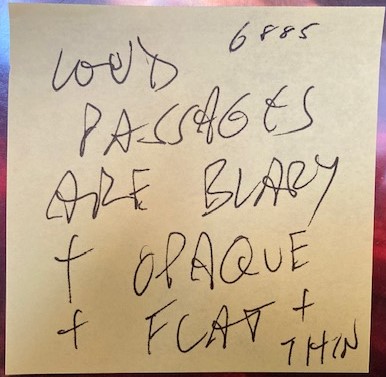
Our reasons are laid out in the post-it note you see to the left. We had three or four copies and even the best one still had the shortcomings you see listed, just to a lesser degree.
(For more on the subject of opacity on record, click here and here.)
So in the eleven or twelve years from the time we played a pile of copies in 2008, to 2020 or thereabouts when we auditioned a new batch, this recording seems to have gotten a lot worse.
But that’s not what happened.
We’re under no illusions now that the album did not always have these sonic shortcomings, shortcomings that existed from the day copies came off the presses in England, some with London labels, others with Decca labels.
We simply did not have the cleaning system or the playback system capable of showing us what was wrong with their sound, and how much better other recordings were than they were.
And Harry Pearson was fooled as well. The Decca (SXL 6691) is on the TAS List to this day. Other records that have no business being on anything called a Super Disc List can be found here.
Our list of Demonstration Quality orchestral recordings can be found here.
You may be aware that Speakers Corner remastered this recording in the 90s. We carried it and recommended it highly back in the day when we offered Heavy Vinyl. At some point, 2007 to be exact, we wised up.
We asked ourselves why we were selling mediocre records instead of Better Records. Since we didn’t have a good answer, we stopped ordering them and proceeded to sell off our remaining stock.
In 2008 I had been seriously involved with audio for more than 30 years. I had been an audiophile record dealer for more than twenty.
I thought I knew what good sound was.
Clearly I still had a lot to learn.
This is, once again, what progress in audio in all about. As your stereo improves, some records should get better, some should get worse. It’s the nature of the game for those of us who constantly strive to improve the quality of our cleaning and playback.
And we’re still at it. With this much money on the line, we had better be able to deliver the goods every time out.
Our customers seem to like the records they’ve been getting. They’ve written us hundreds of letters telling us so.
And we especially like the letters they write to us once they’ve compared our Hot Stamper pressings to the copies they owned that were Half-Speed mastered or pressed on Heavy Vinyl, or both!
Further Reading
Solti is 50/50. There’s a lot of fool’s gold in his discography. Mostly, I think he lacks precision. Anyway, thanks for being honest. There are more narcissists than average among audiophiles.
We call them as we hear them — like many conductors, many of his recordings are amazing, just as many are not to our liking.
As regards his track record, I wouldn’t go 50/50, but we’re fine with it if you do. Mostly the 50s and 60s recordings are the ones we like.
Narcissism should no place in audio — it’s too hard and it’s too easy to be wrong — but we would agree with you that too many audiophiles are convinced they have the answer to questions that they have never bothered to test properly and simply dig in their heals using whatever flimsy evidence they have managed to put forward.
Dunning and Kruger explained 99% of their thinking. Odd they haven’t bothered to read the work of these men.
Best, TP