vin-clas-w

We judged these vintage classical and orchestral records to have unacceptable sound based solely on the specific pressings we played.

We can’t say that other pressings won’t sound better. We just don’t plan on playing any more copies to find out.

Audiophiles Should Avoid These Stampers on LSC 2435

Hot Stamper Pressings Featuring the Violin Available Now

We had two copies with 10s/10s stampers and both of them ended up at the bottom of the rankings with a decnt side one but a terrible side two, earning a grade of NO, meaning just awful.

1.5/NO, 10S, 10S, Shaded Dog
1.5/NO, 10S/10S, Shaded Dog

Note also that our 1s side one did not win the shootout, although the sound was still quite good and better than most of what we played.

There are quite a number of other records that we’ve run into over the years with obvious shortcomings.

Here are some of them, a very small fraction of what we’ve played, broken down into the three major labels that account for most of the best classical and orchestral titles we’ve had the pleasure to play.

  • London/Decca records with weak sound or performances
  • Mercury records with weak sound or performances
  • RCA records with weak sound or performances

We’ve auditioned countless pressings in the 36 years we’ve been in business — buying, cleaning and playing them by the thousands.

This is how we find the best sounding vinyl pressings ever made, through trial and error. It may be expensive and time consuming, but there is simply no other method for finding better records that works. If you know of one, please write me!

We are not the least bit interested in records that are “known” to sound the best.

Known by whom? Which audiophiles — hobbyists or professionals, take your pick — can be trusted to know what they are talking about when it comes to the sound of records?

(more…)

Dvorak’s Symphony No. 9 – An Overview of Decca’s Recordings

More of the music of Antonin Dvorak (1841-1904)

This commentary was written close to a decade ago, when we were first trying to figure out which pressings and performances of the work were worth pursuing.

Please to enjoy.

We got off to a rough start with this piece of music. The early pressings we played were often sonically uninspiring, and that’s being charitable.

The London pressings with Kubelik (CS 6020) that we had thought were competitive with some of the better recordings we had on hand turned out to be disappointing.

The strings were often hard and shrill, the overall sound crude and full of smear.

These Londons cost us a pretty penny owing to the high quality condition we require them to be in for our shootouts. In the end, all that time, effort and money was for naught. A big chunk of dough was headed down the drain.

The Stereo Treasury pressing of this same performance sounded better to us than any of the Bluebacks we played but far from competitive with the recordings we ended up preferring.

The Londons and Deccas from 1967 with Kertesz conducting the LSO also left much to be desired sonically. After hearing the 9th on both London and Decca, we did a quick needle drop on the other symphonies from the complete cycle that Kertesz conducted and concluded that none of them were worth our time.
The trade-in pile was growing ever taller.

Then some good news came our way when we dropped the needle on the Decca/London recording with Mehta and the LA Phil. Our best London sounded shockingly good, much better than the one Decca pressing we had on hand.

His 8th Symphony (CS 6979) is also quite good by the way.

This is surprising because we rarely like anything by Mehta and the LA Phil. from this period — the recording in question is from 1975 — but of course we are happy to be surprised when the recordings sound as good as the ones we played.

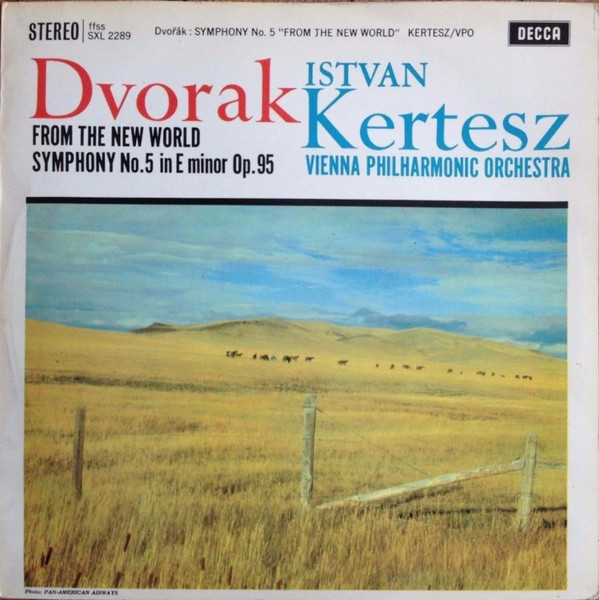
The one that seemed to us to be the best balance of sound and performance was conducted by Istvan Kertesz, but not with the LSO.

His recording with the Vienna Philharmonic in 1961, his debut for Decca as a matter of fact, is the one that ended up winning our shootout of a dozen pressings or so.

We prefer a later mastering of the recording though, not the original.

Here are more reviews of music conducted by Kertesz, a man whose work we very much admire.

(more…)

This Living Stereo from 1958 Didn’t Make the Grade

Hot Stamper Pressings of Living Stereo Records Available Now

Our notes for this copy of LSC 2177 read “blary, bright, not nearly as good as Anserment’s recordings,” which are the ones we compared it to, both the complete ballet and the highlights.

In other words, it just sounded like an old record.

If you are looking for a top quality pressing with a performance to match, we recommend two:

  1. The complete ballet on three discs with Anserment conducting, and/or
  2. The highlights, on a single disc, again with Ansermet conducting.

This Shaded Dog might be passable on an old school audio system, but it was unpleasant when played on the high quality modern equipment we use.

There are quite a number of other vintage classical releases that we’ve run into over the years with similar shortcomings. For fans of vintage Living Stereo pressings, here are some to avoid.

(more…)

Did We Get The Power of the Orchestra Wrong, or Are These Just Bad Stampers?

Hot Stamper Pressings of Living Stereo Recordings Available Now

In 2007, we wrote the following review for The Power of the Orchestra, VCS 2659:

DEMO DISC QUALITY ORCHESTRAL SOUND like you will not believe. We put two top copies together to bring you the ultimate-sounding Pictures At An Exhibition. Folks, it doesn’t get any better than this for huge orchestral dynamics and energy.

I confess I badly misjudged this record over the course of the last few years. I remember liking it in the early ’90s; at that time it was the only Golden Age recording of Pictures whose performance moved me. I never liked the famous Reiner, LSC 2201, and Ansermet’s performance on London also lacks drive and coherency in my opinion.

I then went on to extoll the many virtues of the recording, making special mention of the brass, dynamics and bass, which you can read about here.

More recently we played a copy of VCS 2659 in one of our regular Pictures at an Exhibition shootouts and were not the least bit impressed by it.

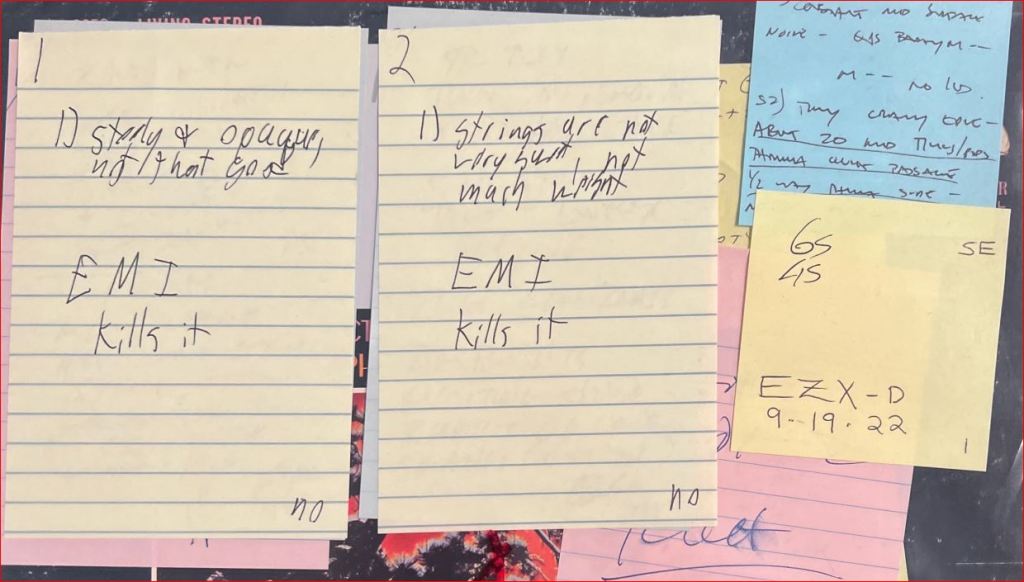
Side One:

Steely and opaque, not that good.

Side Two:

Strings are not very [unintelligible, might be bright], not much weight.

In other words, it just sounded like an old record.

(more…)

And to Think I Used to Like this Strauss Record

Hot Stamper Mercury Pressings Available Now

I used to like this Strauss Family Album back in the old days. Picked them up whenever I saw them, usually for ten bucks or less. They’re fairly common. It’s not exactly HiFi a la Espanola.

Now when we play this Mercury, it doesn’t sound so good. We traded what we had in stock back to stores or gave them away as freebies to our good customers.

A lot of records that I used to like because they were cleaner and brighter — later Red Seal Living Stereos, some OJC jazz, some reissues of rock — sounded much better when my system was darker and less revealing.

Side one of this copy has steely strings, the kiss of death on this kind of music.

Side two is passable, a low grade Hot Stamper. If you see this album for five bucks, pick it up and give it a listen. More than that and you should probably pass.

Many Mercury records simply do not sound good, and this appears to be one of them. The sound is  shrill, and that is just not acceptable on today’s highly-tweaked stereos.

Some of the early Mercs seem better suited to the old school audio systems of the 60s and 70s than the modern systems of today.

Some of these records used to sound good on those older systems, and I should know. I had an Old School stereo and some of the records I used to think sounded good back in the day don’t sound too good to me anymore.

For a more complete list of those records, click here.

How Did We Figure All of This Out?

There are more than 2000 Hot Stamper reviews on this blog. Do you know how we learned so much about so many records?

Simple. We ran thousands and thousands of record experiments under carefully controlled conditions, and we continue to run scores of them week in and week out to this very day.

(more…)

Dorati and Mercury Did Not Produce a Good Sounding Eroica

More of the Music of Ludwig van Beethoven

The sound of this 1959 Mercury recording was unacceptable. SR 90011 was crude and shrill. It seems that many early Mercury recordings suffer from these shortcomings.

Our favorite Beethoven 3rd for sound and performance is the one Solti recorded for Decca in 1959.

1959 just happens to be one of the truly great years for quality analog recordings, as can be seen from this amazing group of albums, all was recorded or released that year.

This Mercury might be passable on an old school system, but it was too unpleasant to be played on the high quality modern equipment we use.

There are quite a number of others that we’ve run into over the years with similar shortcomings. Here they are, broken down by label.

  • London/Decca records with weak sound or performances
  • Mercury records with weak sound or performances
  • RCA records with weak sound or performances

Have You Noticed…

If you’re a fan of Mercury Living Presence records — and what right-thinking audiophile wouldn’t be? — have you noticed that many of them, this one for example, don’t sound very good?

If you’re an audiophile with good equipment, you should have.

But did you? Or did you buy into the hype surrounding these rare pressings and just ignore the problems with the sound?

There is plenty of hype surrounding the hundreds of Heavy Vinyl pressings currently in print. I read a lot about how wonderful their sound is, but when I actually play them, I rarely find them to be any better than mediocre, and most of them are downright awful.

It seems as if the audiophile public has bought completely into the hype for these modern Heavy Vinyl pressings. Audiophiles have too often made the mistake of approaching these records without the slightest trace of skepticism. How could so many be fooled so badly? Surely some of these people have good enough equipment to allow them to hear how bad these records sound.

I would say Mercury’s track record during the ’50s and ’60s is a pretty good one, offering (potentially) excellent sound for roughly one out of every three titles or so.

But that means that odds are there would be a lot of dogs in their catalog. This is definitely one of them.

To see the 50+ Living Presence classical titles we’ve reviewed to date, click here.

(more…)

Don’t Waste Your Money on this Living Stereo with Munch from 1962

More of the Music of Franz Schubert

Some audiophiles buy albums based on their labels. For example, this Shaded Dog pressing of LSC 2522 from the Golden Age of RCA Living Stereo might appeal to a certain kind of audiophile who seeks out clean copies LSCs on the original label.

More than that, he might limit himself to the most sought-after 1S Indianapolis pressings. Hooray! What could be better?

However, many records from this era simply do not sound good, and this is one of them. We have never heard a good sounding copy of LSC 2522, and we’ve played plenty of them over the decades that we’ve been auditioning Golden Age Classical records for sale.

This Shaded Dog might be passable on an old school system, but it was too unpleasant to be played on the high quality modern equipment we use.

There are quite a number of other records that we’ve run into over the years with similar shortcomings. Here are some of them, a very small fraction of what we’ve played, broken down by label.

  • London/Decca records with weak sound or performances
  • Mercury records with weak sound or performances
  • RCA records with weak sound or performances, including many on the coveted Shaded Dog label

(more…)

Are these Strauss Waltzes as Good as Some Say? As Good as We Thought?

The original, favorable review for this album you see further down is from at least ten years ago and probably more like fifteen.

When we revisited the copies we had of this title more recently, we felt the sound was badly lacking in many respects, with no real extension up top nor much weight to the bottom, the very definition of boxy sound.

Many of the vintage classical records we audition have sound that we liked well enough in the past but now no longer meet our standards. Those pressings might sound fine on an old school stereo (or its modern equivalent), but we have something very different to play our records on, courtesy of the many revolutionary changes in audio that have dramatically altered the quality of analog playback over the last twenty five years.

We much prefer Boskovsky’s performances for Decca for waltzes and the like, by Strauss or anyone else.

TAS List Thoughts

We wanted to like the record, it’s on the TAS List for cryin’ out loud, shouldn’t it at least be pretty good?

It very well may be amazingly good, we can’t say it is or it isn’t. In order to be more sure of our opinion, we would need a great deal more data to back it up. We would need to have a large number of copies on hand, clean them all and play them in order to make it possible to find the killer stamper that may be hiding in the pile, assuming one might be.

(more…)

Skip this Ridiculously Compressed London Pines of Rome

Hot Stamper Pressings of The Pines of Rome

The Prevatelli on London you see pictured was way too compressed to be taken seriously by us.

When the music is supposed to get loud at the end of the Pines, it never does!

The Stereo Treasury you see below was equally bad sounding. It did not last more than a few minutes on our turntable.

If more vintage Londons had sound as bad as the three or four copies we had on hand (it’s a fairly common used record, now I know why), we would happily admit that going the Heavy Vinyl route is a good idea.

(more…)

Don’t Waste Your Money on this Mozart Record from 1960

Hot Stamper Pressings of the Music of Mozart Available Now

Neither the sound nor the performance of this 1960 Living Stereo are impressive.

LSC 2287 might be passable on an old school system, but it was too unpleasant to be played on the high quality modern equipment we use.

There are quite a number of other records that we’ve run into over the years with similar shortcomings. Here are some of them, a very small fraction of what we’ve played, broken down by label.

(more…)