sterling-bad

We Don’t Offer Domestic Pressings of Pour Down Like Silver for One Very Simple Reason

Hot Stamper Pressings of the Music of Richard Thompson Available Now

In spite of the fact that the domestic pressings of this Richard and Linda Thompson classic from 1974 were mastered by the likes of Kendun and Sterling — two of the greatest mastering houses of all time, — they have never impressed us with their sound quality.

The biggest problems with this record would be obvious to even the casual listener: gritty, spitty vocals; lack of richness; bright tonality; lack of bass; no real space or transparency, etc.

The domestic Island pressings did not do nearly as well in our shootout as the best Island imports, no surprise there as the early UK records were mastered by one of our favorite engineers.

Avoid the Carthage pressings mastered by Sterling. They came in last in our shootout.
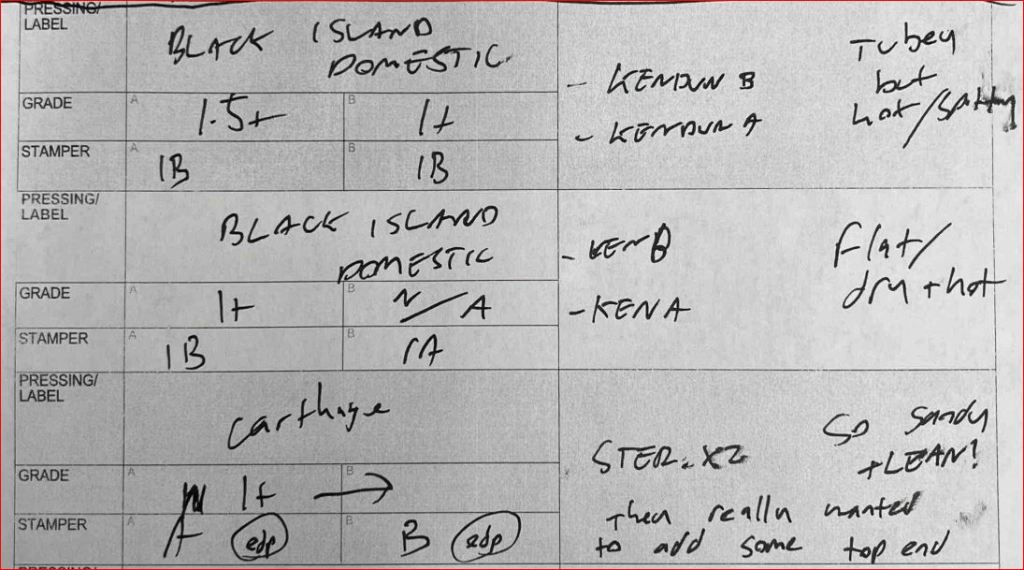
The domestic breakdown follows:

Black Island Domestic #1

  • Tubey but hot and spitty.

Black Island Domestic #2

  • Flat, dry and hot (glary or bright)

Carthage Domestic recut from 1983, Sterling on both sides

  • So sandy and lean! They really wanted to add some top end (!)

Defending the Indefensible

(more…)

Porgy and Bess Gets the Speakers Corner Treatment, from Sterling No Less

Hot Stamper Pressings of Pop and Jazz Vocals Available Now

Here is how we described a recent Shootout Winning copy of Porgy and Bess.

Spacious, full-bodied and Tubey Magical, with Ella and Louis front and center, this is the sound you want to hear on their brilliant collaboration from 1958.

Two vocal giants came together to perform Gershwin’s timeless opera, revered by both music lovers and audiophiles to this day. If you’ve never heard exceptionally well recorded male and female vocals from the 50s, this is a great opportunity to have your mind blown.

Speakers Corner contracted Ryan Smith at Sterling to remaster their Heavy Vinyl pressing in 2013, which might sound like a wise move — Sterling has a good reputation around these parts, even if RKS does not — but the results were disastrous.

Or maybe it wasn’t such a good idea after all. Our notes tell the story of the sound, and it’s not pretty. Painful is actually the word that comes to mind.

Pity our poor listening panel that had to sit through a record that sounds as bad as this one does.

(This is a four sided set but we could not see the point in playing all of them when the first two sucked so badly.)

(Technically they don’t “have to” play these Heavy Vinyl pressings. We don’t force our talented staff to waste their time on modern records. They do it because they choose to, in order to have a better idea of what the competition is up to. Turns out the competition is up to no good.)

Our two sentence review should tell you everything you need to know. Let us hope it saves you from throwing your money away the way we did.

  • Loud, dry and pinched.
  • Hot vocals, no space, very sour and lacking bass.

When the voice is wrong, the sound is wrong. What more do you need to know?

And when the voice is wrong on a legendary recording such as this, you have a worthless piece of vinyl no matter how much you may have paid for it. (Current price on Discogs: about a hundred bucks.)

(more…)

Analogue Productions and Sterling Produce a Disastrous Scheherazade

Hot Stamper Pressings of the Music of Rimsky-Korsakov Available Now

Wikipedia has a nice entry for some of Rimsky-Korsakov’s ideas behind the final movement of the piece:

These [later] works resemble brightly colored mosaics, striking in their own right and often scored with a juxtaposition of pure orchestral groups. The final tutti of Scheherazade is a prime example of this scoring. The theme is assigned to trombones playing in unison, and is accompanied by a combination of string patterns. Meanwhile, another pattern alternates with chromatic scales in the woodwinds and a third pattern of rhythms is played by percussion.

Wikipedia

Could not have said it better myself!

We’ve written at length about the thrills to be had when playing the last movement of Scheherazade — not brilliantly, to be sure, as the writer for Wikipedia has done, but serviceably I hope. Unfortunately, not every pressing of Reiner’s performance is able to communicate the musical values of the work the way the best pressings can.

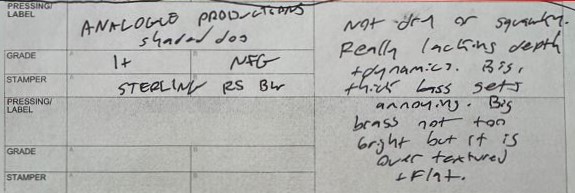
As you can see from our notes for the this Heavy Vinyl Analogue Productions pressing, the thrill was barely there on the first side, and by the second side it was completely gone.

The notes from our 2024 shootout read:

  • Not dry or squawky
  • Really lacking depth and dynamics.
  • Big, thick bass gets annoying.
  • Big brass not too bright but it is over-textured and flat.

Plenty of modern records suffer from these as well as lots of other shortcomings. For some reason, the writers for The Absolute Sound who put this crappy LP on their Super Disc list didn’t seem bothered by them the way we were.

If you own this pressing, here are the kinds of things you might want to listen for in order to recognize its many, and quite serious, failings.

When played head to head against any properly-mastered vintage vinyl LP, this pressing will fall short in a number of important areas. Linked below are titles we’ve found to be good for testing these same qualities in a recording.

(more…)

Tea for the Tillerman – This Is Your Idea of Analog?

Dear Record Loving Audiophiles of Earth,

I’m afraid we have some bad news. [This was written back in 2011 when the record came out so it’s hard to imagine that what I am about to say is news to anyone after all these years.]

Regrettably we must inform you that the 2011 edition of Tea for the Tillerman pressed by Analogue Productions on Heavy Vinyl doesn’t sound very good. We know you were all hoping for the best. We also know that you must be very disappointed to hear this unwelcome news.

But the record is what it is, and what it is is not very good. Its specific shortcomings are many and will be considered at length in our review below.

Yes, we know, the folks over at Acoustic Sounds, in consultation with the late George Marino at Sterling Sound, supposedly with the real master tape in hand, and supposedly with access to the best mastering equipment money can buy, labored mightily, doing their level best to master and press the Definitive Audiophile Tea for the Tillerman on Vinyl of All Time.

It just didn’t come out very good, no matter what the reviewers say. And what do they say? Allow me to quote one.

…superbly dynamic, spacious and detailed…The attack of the pick on the guitar strings is astonishingly clean and detailed.

Depth is pronounced…

…the resolution of low level detail reveals a host of details that are either buried or glossed over on the other versions I’ve heard…

Uh-oh, wait a minute, here’s a blindingly red flag:

If you have the edition, you’ll find this similar in one way: there’s nothing “mellow” about the overall production and when the music gets loud (and Marino lets it get so) it can get a bit hard, but better that than to soften it and lose the clarity, focus and detail of this superb recording, especially in the quieter passages where the resolution of low level detail is astonishing.

More about that later.

(more…)

Is Digital Really the Problem on this Cowboy Junkies Album?

Hot Stamper Pressings of Digital Recordings with Audiophile Sound 

The RCA domestic pressings cut at Sterling are not worth the vinyl they’re pressed on.

Don’t be one of those die-hard analog types who point fingers at the fact that there was digital in the recording chain when their pressing doesn’t sound good.

It’s got nothing to do with digital. It has everything to do with Sterling doing a bad job mastering the domestic vinyl.

(Keep in mind that a very large group of audiophiles, including some well-known reviewers, had no idea there was a digital step used in the process of making some of the records they had raved about. Apparently the only way to hear it is when you already know it’s there.)

Our notes for the domestic pressing below read:

  • Flat and dry vox.
  • Shifted up [tonally]
  • A bit scooped [or “sucked out” in the midrange, meaning the middle of the midrange is missing to some degree]

The midrange suckout effect is easily reproducible in your very own listening room. Pull your speakers farther out into the room and farther apart from each other and you can get that sound on every record you own. I’ve been hearing it in the various audiophile systems I’ve been exposed to for more than 40 years.

Why Defend the Indefensible?

When good mastering houses like Kendun and Sterling and Artisan make bad sounding records, we offer no excuses for their shoddy work. The same would be true for the better-known cutting engineers who’ve done work for them, as well as other cutting operations.

Individuals working for generally good companies sometimes produce substandard work product.

How is this news to anyone outside of the sycophantic thread posters, youtubers, and self-identified record experts who write for the audiophile community?

(more…)

The Germans Won Our Proto-Shootout for The Blue Album Back in 2010

Hot Stamper Pressings of the Music of The Beatles Available Now

UPDATE 2020

We had forgotten how good these pressings were. Apparently we were way ahead of the curve in 2010. The German pressings with the right stampers win the shootouts we’ve been doing recently. A number of old listings from this era don’t hold up, but I’m glad to see that this one does.


This is a WONDERFUL SOUNDING early German Import 2 LP set — pressed on fairly quiet vinyl to boot! We are on record as finding the British pressings of 1967-1970 too bright; certainly most of them are anyway.

This German set has much more natural sound to my ear — it’s RICH, SMOOTH and SWEET, with plenty of tubey magic and little of the grain and grunge of the Brits.

The original domestic pressings, as anyone who has ever played one can attest, mastered at Sterling no less, are absolutely godawful.

Like most compilations, some songs sound better than others, but Don’t Let Me Down and Come Together are two that really stand out here. For some of you out there who have never tried one of our Hot Stamper Beatles records, this may be the best sound you’ve ever heard from them. The CDs — even the new ones — sure don’t sound like this!

(more…)