lacks-life

The audiophile and other pressings listed here are as dead as the proverbial doornail.

The life of the music was sucked out of them by poor mastering, bad tapes, or the use of audibly inferior cutting equipment. In most cases it was some combination of the three.

Any properly-mastered, properly-pressed vintage LP — the kind we offer by the hundreds — will expose what con-jobs these so-called audiophile pressings are when played on a dynamic system at good loud levels.

Live at Leeds – Universal Heavy Vinyl Reviewed

Hot Stamper Pressings of the Music of The Who Available Now

UPDATE 2026

A remastered pressing of Live at Leeds came out on Heavy Vinyl from Universal Records in 2001.

We got a copy of it in, played it, heard the kind of compressed, lifeless sound that is the purest evidence of incompetent mastering — something which was rampant in the world of Heavy Vinyl at the time and still is — and wrote the short review you see below.

We didn’t feel the need to get into much detail about its other faults. When a record is this bad, why bother?


This Universal Records 180 gram LP has flat as a pancake sound. The CD almost has to be better.

It’s yet another record that belongs in the audiophile hall of shame.

(more…)

Love’s Debut and Forever Changes on Heavy Vinyl – Indefensible Dreck from Sundazed

Hot Stamper Pressings of the Music of Love Available Now

Two audiophile hall of shame titles, and another two Sundazed records reviewed and found seriously wanting.

We got hold of a minty original pressing of the first Love album back around 2007, so in preparation for the commentary I pulled one of the Sundazed pressings off the shelf, (Forever Changes, the only one we ever bothered to sell), cracked it open and threw it on the turntable. 

Gag, what a piece of crap. When I had auditioned them all those years ago (2002), it was — I’m not kidding — the best of the bunch.

The sound to me back then was nothing special, but not bad. Knowing how rare the originals were, we gave it a lukewarm review and put it in the catalog, the single Sundazed Love album that (just barely) made the cut.

Now I wish I hadn’t, because no one should have to suffer through sound that bad. Here’s what I wrote for the shootout:

You’d never know it from those dull Sundazed reissues, but the right pressings of Love albums are full of Tubey Magic! With Bruce Botnick at the controls you can expect a meaty bottom end and BIG rock sound, and this recording really delivers on both counts.

With Sundazed mastering engineers running the show, you can expect none of the above.

No Tubey Magic, no meaty bottom end, no big rock sound.

After the shootout, I took the two copies we had in stock right down to my local record store and traded them in.

I didn’t want them in my house, let alone on my site.

(more…)

Double Vision – MoFi Reviewed

Hot Stamper Pressings of Classic Rock Albums Available Now

This title is yet another record that belongs in the audiophile hall of shame.

Like most Mobile Fidelity pressings, it’s better suited to the stone age stereos of decades past.

There is a Mobile Fidelity Half-Speed Mastered version of this album currently in print, and an older one from the days when their records were pressed in Japan (#052).

We haven’t played the latter in years; as I recall it was as lifeless and sucked-out in the midrange as many of the other famous MoFi’s of that period, notably The Doors (#051) and Trick of the Tail (#062), which is perhaps the most lifeless record this ridiculous label ever released.

Is there any doubt that the newer MoFi pressing of the album will be every bit as bad or worse? (more…)

Should You Feel Guilty about Owning the CBS Half-Speed?

Hot Stamper Pressings of Rock and Pop Albums Available Now

UPDATE 2026

The review you see reproduced below was written in 2010 or so. As embarrassing as it may be in the eyes of some audiophiles, I think I actually owned the very pressing we reviewed at the time.

Back in the dark days of the 80s, if an audiophile pressing sounded better than whatever random domestic copy I had managed to find — not knowing anything about pressings variations — I would unhesitatingly give it a home in my collection.

As far as I was concerned, it was the best way to hear the music, and what could possibly be more important than that?

I didn’t see it as a stopgap or benchmark the way I would now. For the purposes of enjoying the music, the Half-Speed was simply the best available pressing I was aware of at the time.

(“I was aware of at the time” is at the heart of every mistaken judgment we audiophiles make. We can’t be blamed for not knowing what we don’t know. What we can be blamed for is not acting on the available information that makes it easy to learn just how much we don’t know and what we may be missing as a result.)

Keeping bad sounding records in my collection is something that I did with many of the records I owned, long after I should have known better, including a favorite of mine, Powerful People. When my stereo finally got good enough to show me how badly MoFi had ruined the sound, I was mortified.

But all through the 80s and 90s I cannot deny that I played that Mobile Fidelity pressing scores of times and loved every minute of it. Thrilled to it even. The Half-Speed of Guilty too, just not as often. (How much of Barbra Streisand’s nasally-singing can one man take? We all have our limits!)

(more…)

This Tsar Saltan Is Diffuse, Washed Out, Veiled, and Vague

Hot Stamper Pressings of the Music of Rimsky-Korsakov Available Now

Sonic Grade: C (at most)

Year ago we cracked open the Speakers Corner pressing of The Tale of Tsar Saltan in order to see how it would fare in a head to head comparison with a pair of wonderful sounding Londons we were in the process of shooting out at the time. Here are the differences we heard.

The soundstage, rarely much of a concern to us at here at Better Records but nevertheless instructive in this case, shrinks roughly 25% with the new pressing. Depth and ambience are reduced by about the same amount.

But what really bothered me was this:

The sound was just so vague.

There was a cloud of musical instruments, some here, some there, but they were very hard to SEE. On the Londons we played they were clear. You could point to each and every one. On this pressing that kind of pinpoint imaging was simply nowhere to be found. (Here are some other records that are good for testing vague imaging.)

Case in point: the snare drum, which on this recording is located toward the back of the stage, roughly halfway between dead center and the far left of the hall. As soon as I heard it on the reissue I recognized how blurry and smeary it was relative to the clarity and immediacy it had on the earlier London pressings we’d played. I’m not sure how else to describe it — diffuse, washed out, veiled — just vague.

(Here are some other records that are good for testing the sound of the snare drum.)

This particular Heavy Vinyl reissue is more or less tonally correct, which is not something you can say about many reissues these days. In that respect it’s tolerable and even enjoyable. I guess for thirty bucks it’s not a bad deal.

But… when I hear this kind of sound only one word comes to mind, a terrible word, a word that makes us recoil in shock and horror. That word is DUB. This reissue is made from copy tapes, not masters.

Copies in analog or copies in digital, who is to say, but it sure ain’t the master tape we’re hearing, of that we can be fairly certain. How else to explain such mediocre sound?

Yes, the cutting systems being used nowadays to master these vintage recordings aren’t very good; that seems safe to say.

Are the tapes too old and worn?

Is the vinyl of today simply not capable of storing the kind of magical sound we find so often in pressings from the 50s, 60s and 70s?

Could the real master tape not be found, and a safety copy used to master the album instead?

To all these questions and more we have but one answer: we don’t know.

We know we don’t like the sound of very many of these modern reissues and I guess that’s probably all that we need to know about them. If someone ever figures out how to make a good sounding modern reissue, we’ll ask them how they did it. Until then it seems the question is moot. (Someone did, which proves it can be done!)

Back in 2011 we stopped carrying Heavy Vinyl and most other audiophile LPs of all kinds. (These we like.)

So many of them don’t even sound this good, and this kind of sound bores us to tears.

(more…)

Remain In Light on Ridiculously Bad Sounding Rhino Vinyl

Hot Stamper Pressings of the Music of Talking Heads Available Now

UPDATE 2026

We reviewed this awful pressing shortly after its release in 2006. More proof, as if more were needed, that Heavy Vinyl collectors have lost their minds.

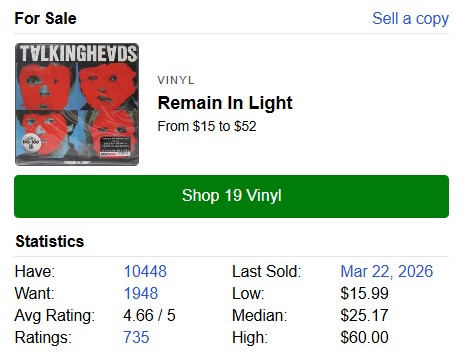
A more accurate formulation might be that such collectors can’t tell a good record from a bad one. If they could, the number owning this pressing would be a fraction of that seen below, as would the number who want it. Let’s take a deeper dive into the actual evidence for its desirability:

More than 10,000 Discogs members have this album, almost two thousand would like to own it, and the consensus is that it is an outstanding reissue, having earned a grade of 4.66 out of 5 from 735 members. (Don’t worry, I won’t show you what they had to say about it, but you are welcome to go to Discogs and read it yourself.)

With an average price of 25 bucks, what is keeping those 1948 potential buyers from pulling the trigger? Seems affordable to me. Inflation has gone up 62+% since 2006, making the album cheaper now than if you had bought it when it came out.


Our 2006 Review

The Rhino Heavy Vinyl reissue of this album was deemed dead on arrival the minute it hit my turntable.

No top, way too much bottom, dramatically less ambience than the average copy — this one is a disaster on every level.

Rhino Records has really made a mockery of the analog medium. Rhino touts their releases as being pressed on “180 gram High Performance Vinyl.” However, if they are using performance to refer to sound quality, we have found the performance of their vinyl to be quite low, lower than the average copy one might stumble upon in the used record bins. 

(more…)

Pet Sounds on DCC Is Yet Another Mediocre Remaster

Hot Stamper Pressings of the Music of The Beach Boys Available Now

Sonic Grade: C-

The no-longer-surprising thing about our Hot Stamper pressings of Pet Sounds is how completely they trounce the DCC LP. Folks, it’s really no contest. Yes, the DCC is tonally balanced and can sound decent enough, but it can’t compete with the best “mystery” pressings [1] that we sell.

It’s missing too much of the presence, intimacy, immediacy and transparency that we’ve discovered on the better Capitol pressings.

As is the case with practically every record pressed on Heavy Vinyl over the last twenty years, there is a suffocating loss of ambience throughout, a pronounced sterility to the sound.

Modern remastered records just do not BREATHE like the real thing.

Good EQ or Bad EQ, they all suffer to one degree or another from a bad case of audio enervation. Where is the life of the music?

You can turn up the volume on these remastered LPs all you want; they simply refuse to come to life.

(more…)

Tell It Like It Is – Another A&M Half-Speed Mastered Disaster

Hot Stamper Pressings of the Music of George Benson Available Now

The Half-Speed is pretty — pretty lifeless if you ask me, in the way that so many Half-Speed mastered records are.

It’s cut very clean, but until you play a good A&M pressing, you don’t know how much meat has been stripped from the bones. The best A&M pressings sound like a Rudy Van Gelder recording, which, of course, they are.

These A&M Half-Speeds suffer from all the same shortcomings that other Half-Speeds suffer from: the kind of pretty but lifeless and oh-so-boring sound that we describe in listing after listing.

(more…)

Audiophiles Should Skip Swingin’ the ’20s on OJC

Hot Stamper Pressings of Contemporary Jazz Records Available Now

This album is fairly common on the OJC pressing from 1988, but more recently we’ve found the sound of the OJC pressings we’ve played seriously wanting. They have the kind of bad reissue sound that plays right into the prejudices of record collectors and audiophiles alike, the kind for whom nothing but an original will do.

They were dramatically smaller, flatter, more recessed and more lifeless than even the worst of the ’70s LPs we played. (We tend to like those, by the way.)

The lesson? Not all reissues are created equal. Some OJC pressings are great — including even some of the new ones — some are awful, and the only way to judge them fairly is to judge them individually, which requires actually playing a large sample.

Since virtually no record collectors or audiophiles like doing that, they make faulty judgments – OJC’s are cheap reissues sourced from digital tapes, run for the hills! – based on their biases and reliance on inadequate sample sizes.

You can find those who subscribe to this approach on every audiophile forum there is. The methods they have adopted do not produce good results, but as long as they stick to them, they will never have to worry about discovering that inconvenient truth.

(more…)

Thick As a Brick on MoFi

Hot Stamper Pressings of the Music of Jethro Tull Available Now

Sonic Grade: D

Here you will find the same problems as the MoFi Meddle, released the previous year, 1984. Here is what we had to say about it back in the day when we were selling this kind of crap.

The MoFi is TRANSPARENT and OPEN, and the top end will be lush and extended. If you prize clarity, this is the one.

But if you prize clarity at the expense of everything else, you are seriously missing the boat on Meddle (and of course Thick As A Brick too).

The MoFi is all mids and highs with almost nothing going on below.

This is a rock record, but without bass and dynamics the MoFi pressing doesn’t rock, so why would anyone want to own it or play it?

The one thing these pressings have going for them is that they tend to be transparent in the midrange.

It sounds like someone messed with the sound, and of course someone did. That’s how they get those audiophile records to sound the way they do.

For some reason, some audiophiles like their records to sound pretty and lifeless with blurry bass.

The whomp factor on this pressing is Zero. Since whomp is critical to the sound of this album, it’s Game Over for us.

That is not our sound here at Better Records. We don’t offer records with shortcomings like these and we don’t think audiophiles should have to put up with records that sound the way this one does.

(more…)