A Hot Stamper pressing of this amazing sounding album, a title we regret to say we have in stock only rarely, might be described this way:
Some of the best sounding live rock and roll sound you will ever hear outside of a concert venue. If you want to understand the unique appeal of the band, there’s no better place to start than right here.
It’s one of our all-time favorite live recordings and their single best release – a true Masterpiece.
I have lately been listening to this album in its entirety at the gym (playing the standard cassette over headphones) and enjoying the hell out of it. As good as their best studio albums are, and I count myself as big a fan of the band as there is, Waiting for Columbus is surely the pinnacle of their recorded output. It is as close to perfect as any live album I know.
(The Last Record Album is my personal favorite of their studio albums, but since nobody seems to want to buy it at the prices we charge, I regret to say we had to stop doing shootouts for it years ago. We were losing too much money that way.)
But Bernie Grundman’s version is just another one in a very long line of disastrous recuts, the kind of crap he has been churning out for the last thirty years. It’s all but unplayable on modern high quality equipment. (If it’s not on your system, you might consideer the idea that you still have plenty of work left to do, audio-wise.)
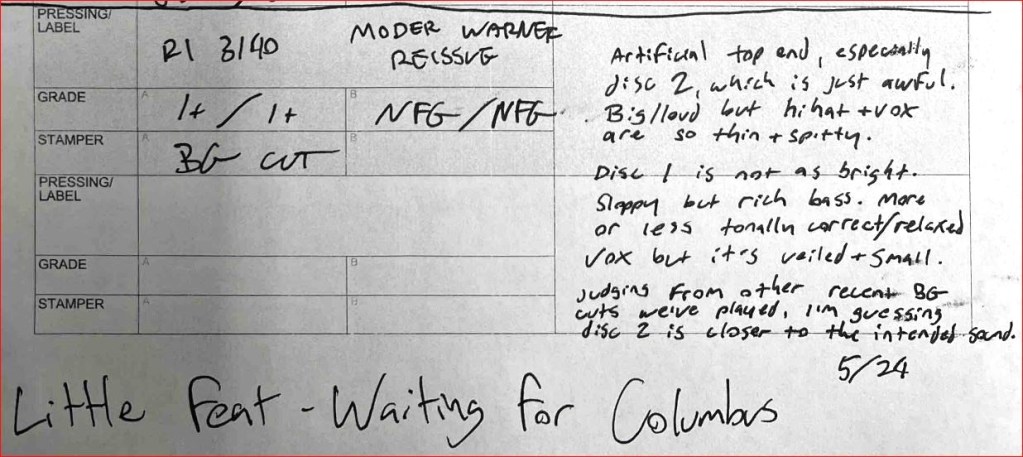
As you can see from the notes below, record one may be passable, but record two is NFG. How is it possible to turn such a wonderful recording into such a ridiculously bad sounding pressing? Even Mobile Fidelity did a better job with the album, and they’re one of the most incompetent remastering outfits that the audiophile world has even known.
We’re frankly at a loss to understand any of it.Bernie Grundman used to make good sounding records. We know that for a fact, having played them by the hundreds. Apparently those days are gone, and, based on this album and plenty of others, there is very little chance of them returning.
This commentary was written about ten years ago has been updated with the latest information from the shootout we did in 2025.
Proof positive that there is nothing wrong with remastering vintage recordings if you know what you’re doing. These sessions from 1956 (left off of an album that Allmusic liked a whole lot less than this one) were remastered in 1985 and the sound — on the better copies mind you — is correct from top to bottom.
The highest compliment I can pay a pressing such as this is that it doesn’t sound like a modern remastered record.
It sounds like a very high quality mono jazz record from the 50s or 60s.
Unlike modern recuts, it doesn’t sound EQ’d in any way.
It doesn’t lack ambience the way modern records do.
It sounds musical and natural the way modern records rarely do.
If not for the fairly quiet vinyl, you would never know it’s not a vintage record. The only originals we had to play against it were too noisy and worn to evaluate critically. They sounded full, but dark and dull and somewhat opaque.
UPDATE 2025
The originals on the Atlantic Plum and Red Label are not the way to go on this album. Our shootout notes below make that clear. Take our friendly and helpful advice and steer clear of them.
We recently found ourselves with an unexpected opportunity — we were given the chance to hear the mono pressing of Saucerful of Secrets, the one that Bernie Grundman mastered for Record Store Day back in 2019.
We had ordered a vintage stereo pressing from a dealer, and instead of sending us what we ordered, we got the RSD mono instead.
Knowing the record well, we figured why not give it a listen. Maybe the mono mix is the way to go! Who can say until they’ve heard it.
Well, we’ve now heard it, and if there is a worse sounding version of the album, whether in stereo or in mono, we would find even the possibility of such a thing very hard to believe. You’re going to have to prove it to us, because this record is as bad as it gets.
I can’t say we hate a lot of records — most of the time we’re just disgusted and disappointed with all the crap Heavy Vinyl being produced these days — but we sure hated this one.
If you had played it, I can only hope you would have hated it too.
It was more thick, it was more opaque, and it was more compressed than most of the originals we played, originals which we noted often had problems in all three areas to start with.
Bernie did the album no favors, that I can tell you.
Head to head in a shootout, our Hot Stampers will be dramatically more lively, solid, punchy, transparent, open, clear and just plain REAL sounding, because these are all the areas in which Heavy Vinyl pressings tend to fall short.
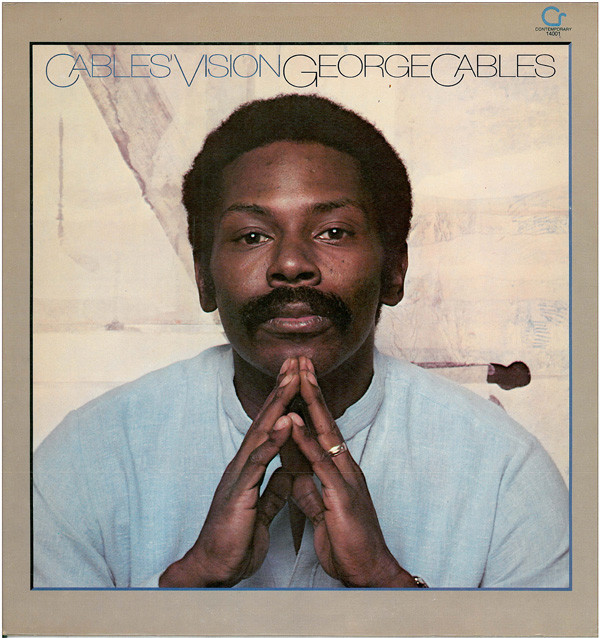
The best Contemporary pressings of George Cables’s 1980 release, Cables’ Vision, have truly wonderful sound. (Our complete review can be found here.)
This should not be too surprising as it was recorded by one of our favorite engineers, Allen Sides, working out of his Oceanway studios. (Supposedly he is a big fan of vintage mics and the like, with many superb and valuable examples.)
In addition, the album was mastered by Bernie Grundman, who was at the time still cutting very good sounding records, this being 1980. Since then he has gone precipitously downhill, as we have noted on the site to the dismay of his many supporters.
Bernie is the man who cut some of the best sounding records I have ever played, including many of the best Contemporary recordings, but his work in recent decades has left much to be desired.
And he sure has fooled a lot of audiophile record reviewers.
Not us, of course. We never jumped on the Classic Records bandwagon, and to this day we cannot understand how any critical listener could be fooled by the countless Heavy Vinyl mediocrities and failures that awful label put out.
You can say the same thing for Doug Sax, a man whose work took a turn for the worse long ago. The sad reality is that the dull, thick, lifeless, recessed, veiled, ambience-free records he cut for Acoustic Sounds and Klavier in the 90s were no worse than the dreck being made today.
We have a special section for bad sounding records that are marketed to audiophiles, and you can find that section here.
It currently has 281 entries, but if someone wanted to audition more of them — that person is definitely not me, although I cannot imagine anyone more qualified — the number could easily hit 500.
And if one were simply to include vintage Japanese pressings, the kind many audiophiles regularly bought in the 80s and 90s for their quieter vinyl and supposedly higher quality mastering, our bad audiophile record section would contain multitudes. Multitudes I tell you!
In the interest of streamlining the process of getting reviews like this up on the blog, we’ll try to stick mostly to the facts and let the description of the strengths and weaknesses of the pressings speak for themselves.
One quick note: the sonic qualities you see described below are the ones we heard with the mono switch on our EAR 324P phono stage activated.
Without the switch set to mono, the sound is even thicker and darker.
Yes, as bad as this pressing sounds, you can make it worse if you don’t switch your preamp or phono stage to mono. Hard to believe but it’s true!
The notes for side one can be seen below. For side one we started with the second track.
It’s been almost one full year since we reviewed our first Steely Dan UHQR, Can’t Buy a Thrill. If you have a few minutes to kill, you can read about it here.
One whole year. Time flies!
Some folks chide us for constantly beating up on one Heavy Vinyl release after another, as if we actually like doing it. We don’t think that’s fair (the “constantly beating up” part, not the “like doing it” part. We actually do like doing it. If we didn’t, we wouldn’t do it. It costs us money and time, and obviously doesn’t put a penny in our pockets, since we would never sell you a record that sounds as wrong as most of them do).
Contrary to what some folks believe, and as we try to make clear in the following paragraphs, we’re actually quitefar behind on our Heavy Vinyl reviews. The reality of our situation is that we simply cannot keep up with all the bad records being made these days.
Let’s take stock. The Electric Record Company’s Heavy Vinyl pressing of Quiet Kenny is still waiting for a review after three years. The Kind of Blue on Mofi at 45 RPM? That one I played at least three years ago. Still no review. I know what I want to say about it, I just haven’t found the time to say it.
Other bad records still waiting to be written up include the Craft pressings of Born Under a Bad Sign and Lush Life; the Britten Young Person’s Guide to the Orchestra on Cisco; Mingus’ Blues and Roots; Dire Straits’ first album, Tapestry and Blue on MoFi; the AP Plow that Broke the Plains; Black Sabbath’s Paranoid; Weaver of Dreams on Classic; LeGrand Jazz on Impex; the 2018 remix of Pink Floyd’s Animals; the Abbey Road Half-Speed mastered pressing of Sticky Fingers (shocker: it could be worse!); Tina Brooks on Music Matters (not that bad, actually); Led Zeppelin’s first album and Houses of the Holy remastered by Jimmy Page; and there are bound to be plenty of others that I’ve simply lost track of.
I have the records here in Georgia with sonic notes attached, and one of these days I will dig them out and make listings for them.
There is an overwhelming, seemingly inexhaustible supply of collectible, out-of-print Heavy Vinyl available to the credulous audiophile with a computer and a credit card.
In addition, there are hundreds of new titles being released every year, far more than a cottage operation such as ours could ever hope to find the time and money it would take to buy, clean, play and review them all.
Keep in mind that we don’t get paid to do any of that. We play and review these records to help audiophiles — customers and non-customers alike — better understand their strengths and weaknesses relative to the amazing sounding vintage pressings we offer as Hot Stampers.
Somehow we managed to have a Classic Records pressing on hand to play in our most recent shootout for the Beethoven Symphony No. 4.
We knew all the way back in 1997 that Classic had done a good job with the record — we recommended it as one of the best Classic Records pressings in our catalogs at the time — but we sure didn’t expect it to do as well as it did, earning 2 pluses on one side and close to that on the other.
Years ago we wrote:
Here is the kind of sound that Classic Records could not ignore, even though the original was only ever made available as part of RCA’s budget reissue series, Victrola.
Don’t let its budget status fool you — this pressing puts to shame most of what came out on the full price Living Stereo label. (And handily beats any Classic Records reissue ever made.)
The top and bottom are wrong to varying degrees on both sides of the Classic, as you can see from our notes, which read:
Steve Westman invited me to appear again on his youtube channel chat with the Audiophile Roundtable.
At about the 39 minute mark, we discuss my picks for what I would rate as the Five Best Sounding Records I know of.
I wanted to go with more variety, so I picked two rock records, two jazz records and one classical album.
A rough transcription with corrections and additions follows:
Before I did my top five, I wanted to say something along the lines of, if you want to know where somebody’s coming from in audio, you don’t ask them what their stereo is, you don’t ask them what their room is like, and how their electricity is done, and what their history with audio is, because they’re not going to tell you, and they just don’t want to go down that road.
But you can ask them about music, and that will tell you a lot about where they’re coming from, so here are my questions for people if I wanted to know more about their understanding of records (and, by implication, audio):
One: what are the five best sounding records you’ve ever heard?
Two: what are your five favorite records of all time?
Three: what five famous recordings never sounded good to you?
Four: name five recordings that are much better than most of your friends or audiophiles in general think?
In my world, you would have to tell me what pressing you’re listening to. If you said “I love the new Rhino Cars album,” I think we would be done, but if you told me that you love the original, then I would say yes, I love that record too. I bought it in 1978 and I’ve played it about 5000 times. Never tired of hearing it.
At about the 48 minute mark I reveal the best stampers for Ry Cooder’s Jazz album.
At about the 50 minute mark someone asks about my system. This would be my answer:
All that information is on the blog., I actually do a thing about my stereo where I take it all the way from 1976 to the present, which I’m sure bores people to death, but you know, there was a lot to talk about there.
There were a lot of changes that I went through and I even talk about how my old stereo from the 90s, which I had put together after having been an audiophile for 25 years, was dark and unrevealing compared to the one I have now, so all my opinions from 25 years ago are suspect, and rightly so.
I feel the same thing is going on in the world of audiophiles when you have systems that aren’t very revealing and aren’t tonally accurate, yet are very musical and enjoyable the way Geoff would like, but they’re not good for really knowing what your records sound like because your system is doing all sorts of things to the record that you’re playing in order to keep the bad stuff from bothering you.
All the bad stuff just jumps out of the speakers, and that’s why these heavy vinyl records don’t appeal to us anymore, because we hear all the bad stuff and we don’t like it.
At 1:03 I’m asked if I like any modern mastering engineers, and the only one I can think of is Chris Bellman, because he masterered one of the few Heavy Vinyl pressing I know of that sounds any good, Brothers in Arms, released in 2021. I played it when Edgers brought it by the studio when he first visited me in preparation for his article.
My best copy was clearly better in some important ways, but Bellman’s mostly sounds right, and that surprised me because most of these modern records sound funny and weird and rarely do they sound right.
(Geoff brought over three records that day: Brothers in Arms, the remastered Zep II, and a ridiculously bad sounding Craft pressing of Lush Life, which was mastered by Bernie Grundman, and one which I have not had time to review yet. It was my introduction to the Craft series (in this case the small batch, limited to 1000), and let’s just say we got off on the wrong foot. I told Geoff it sounded like a bad CD, and that’s pretty much all I remember of it. The average price for that pressing on Discogs is roughly $210 these days. The CD is cheaper and there is very little doubt in my mind that it would be better sounding to boot.)
At 1:04 I mention the biggest snake oil salesman in the history of vinyl, the man behind The Electric Recording Company.
Patrick mentions an ERC Love record which he likes, but we played one that sounded about as bad as a bad record could sound. That Love record will never get any love from us. He says he’ll never buy another ERC pressing, but that doesn’t sound like the kind of thing someone who really likes a record would say, does it? I suppose you can ask him in the comments section why that would be.
At some point I talk about the studio we play records in, not exactly spouse-friendly but good for hearing what’s really in the grooves of the records we play:
The reason the sound room is the way it is is because you’re not there to be reading magazines and looking at your phone. You’re just in there to sit in a single chair in front of two speakers, not talking. Nobody else is in there. They have no business being in there. It’s just you and the music and that’s the way I like it.
This next section has been fleshed out quite a bit. I took the question posed and ran with it: