6-2023

Hot Stampers and Good Sounding Records Are Not the Same Thing

Hot Stamper Pressings of the Music of Stevie Ray Vaughan Available Now

They are barely even related. Here’s why.

A good customer wrote to us recently to say that he was not happy with the Stevie Ray Vaughan White Hot Stamper pressings we had sent him.

Tom,

I also have a couple more returns for you: SRV Couldn’t Stand the Weather and SRV Soul to Soul. While these are good, they’re just not quite up to White Hot Stamper quality like some of the other records clearly are.

I took the opportunity to reply at length.

Dear Sir,

You appear to be conflating two concepts, Hot Stampers and good recordings. They are not the same thing. They are barely even related.

Hot Stampers are especially good sounding pressings of specific albums that we found through shootouts.

The recordings of these albums may be better or worse than others you are familiar with. That has nothing to do with how hot the stampers are of the pressings we sell.

It works this way: if you had a hundred copies of The Dark Side of the Moon, the median pressing– the one that would have ranked number 50 out of 100 — would sound substantially better than either of those two SRV albums.

Pink Floyd: amazing recording. 

SRV: good, not great recording.

We would never sell an average pressing of DSOTM. We only sell the best sounding versions of it.

We would never sell the average version of any SRV album. We only sell the best sounding versions of them.

But no SRV album is ever going to sound like a good Dark Side of the Moon! (more…)

We Learned a Valuable Lesson About Goats Head Soup in 2016

More of the Music of The Rolling Stones

Presenting a classic case of live and learn.

We would agree with very little of what we had to say about Goat’s Head Soup as a recording when we wrote about it back in 2011 — and for the previous 35+ years since I had first played a domestic original. (Turns out the imports are no good either.)

Having done a big shootout for the album in 2016, we now know that there most certainly are great sounding pressings to be found, because we found some. We broke through.

The data are in, and now we know just how wrong we were.

In our defense, let me just ask one question: Did anybody else know this record was well recorded? I can find no evidence to support anyone having ever taken such a contrarian position.

But we’re taking that position now.

All it takes is one great sounding copy to show you the error of your ways, and we had more than one.

Here’s what we had to say back in 2011. After having played dozens of copies and never hearing the record sound more than passable, can you blame us?

(more…)

Letter of the Week – “A great example of a record where proper mastering makes an ENORMOUS difference”

More of the Music of Led Zeppelin

One of our good customers had this to say about a Hot Stamper he purchased recently:

Hey Tom, 

Today I opened up a box of records I just bought from you and your staff at Better Records and in it was a copy of Led Zeppelin 3 with an A++ – A+++ side one.

I’ve read so many of your testimonial letters with customers gushing over records they’ve bought from you and having bought quite a few now myself I can understand their enthusiasm.

But WOW! What a record! My head nearly exploded playing side 1!

And what a great example of a record where proper mastering makes an ENORMOUS difference. Thank you!

Robert

Robert, thanks for your letter.

Let’s face it: the average copy of Zep III is no great shakes. We would never even bother to try and sell the average copy. Who needs it? Audiophiles want something that sounds good and record collectors can find records like these on ebay all day long.

Audiophiles come to us for the best, the copies that beat the Remastered Heavy Vinyl Con Jobs, the originals, the Half-Speeds, the whatever Audiophile BS pressing may be out there. We take them all on and beat them with ease, even with our lowest priced copies.

And sometimes the record we send you is so good that it almost makes your head explode. It happens more often than you might think. Here are just some of the examples our customers have written us about:

The Hot Stamper pressing you now own will give you joy and pleasure far out of proportion to its cost. And it will last forever if you take good care of it.

As always, we look forward to finding you more Better Records of your favorite music.

Best,
TP

(more…)

We Used to Really Like The Forward Look on UHQR

Audiophile Records with Honest-to-Goodness Top Quality Sound

Hot Stamper Pressings of Live Jazz Recordings Available Now

This is a very old review, probably from 2010 or thereabouts.

Hard to say what we would think of this pressing today, what with our unwavering antipathy to Half Speed mastering. In the case of this record, you can add the consistently poor track record of the so-called UHQR to our list of reasons for suspecting that the quality would not in fact by Ultra High.

You are no doubt aware that the UHQR was recently brought back from the dead by Analogue Productions on a pressing whose packaging is quite a bit more impressive than its sound.

Our Old Review

This is a BRAND NEW UNPLAYED Reference 45 RPM Half-Speed Mastered UHQR LP. They only made 1,000 of these, so sealed or unplayed copies are virtually non-existent.

This is actually one of the best sounding Reference Records. It was recorded in the ’50s on location and has very natural sound. Half-Speed Mastered by Jack Hunt even!

I think the exceptionally natural sound found on this record is the result of two factors:

  1. It’s a live recording, meaning not everything can be controlled and the space is real, not engineered. And,
  2. This is early days in the recording history of Keith Johnson. As time went on he thought his engineering skills were improving, but I see little evidence of that in the results of his labors: the records he’s been making since 1957.

His records are as phony and weird as practically every other audiophile label of the day (M&K, Telarc, Chesky), no doubt the result of these audiophile types thinking they knew a lot more about recording music than turned out to be the case.

Play any vintage pressing from the ’50s to see exactly what they failed to accomplish.

We know of at least two releases on Reference Records with “astoundingly” bad sound.

Both figure prominently on our list of the worst kind of audiophile bullshit records.


Further Reading

Original Is Better? Sez Who?

Hot Stamper Pressings that Sound Their Best on the Right Reissue Available Now

Which albums sound better on the right vintage reissue pressing?

These do.

Just to take one example: The original Reprise pressing of Jazz Waltz, whether in mono or stereo, has never sounded very good to us. The mono is quite a bit worse than the stereo – no surprise there – but both must be considered poor reflections of the master tape.

We sold one many years ago, describing it this way: “Beautiful Original with decent sound — rich, smooth and sweet.” Which it was, but from us that’s little more than damning it with faint praise.

The Discovery pressing is so much bigger, clearer and livelier it’s almost hard to imagine it and the 1962 Reprise original were both made from the same tape.

Something sure went wrong the first time around — I think it’s safe to say at least that much.

Does the Original Always Have the Best Sound?

Not for those of us who play records rather than merely collect them.

Leave the originals for the Jazz Guys. The Hot Stamper pressings of the reissues are perfect for us music loving audiophiles.

Don’t be put off by the title; these are not some sleepy old-fashioned waltzes. This is swingin’ West Coast jazz at its best. Of course, the arrangements are done in waltz time, but that doesn’t keep them from swingin’.

And the amazingly good sound? Credit Bones Howe, a man who knows Tubey Magic like practically no one else in the world. The Association, The Mamas and the Papas, The Fifth Dimension, and even Tom Waits — all these brilliant recordings are the result of Bones Howe’s estimable talents as producer and engineer.

(more…)

Listening in Depth to Santana’s First Album

Hot Stamper Pressings of the Music of Santana Available Now

First off, a 360 label doesn’t mean much on this record except the POTENTIAL for good sound. The badly mastered or pressed copies can be recognized easily: they are muddy and smeary. The recording itself has a bit of that too-many-tubes-in-the-signal-path quality to start with, so unless the record is mastered and pressed clearly and cleanly the whole presentation is likely to turn to mud. 

Santana’s first album came out of nowhere and rocked in a way that few had heard before. In that sense it has something in common with Led Zeppelin’s debut. That album took the blues and added heavy guitars. Santana took African and Latin rhythms and added his own heavy guitar sound. Each is a landmark recording in its own right.

Musicianship

Like Abraxas, when you play a Hot Stamper copy Santana’s first album very loud, soon enough you find yourself marvelling at the musicianship of the group — because the best Hot Stamper pressings, communicating every bit of the energy and clarity the recording has to offer, let you hear what a great band they were.

On badly mastered records, such as the run-of-the-mill domestic LP, or the audiophile pressings on MoFi and CBS, the music lacks the power of the real thing. I want to hear Santana ROCK. Most pressings don’t let me do that. Only the best do.

Side One

Waiting

The first 30 seconds of this track will tell you if you have a good side one. The drums and percussion on the good copies are clean and clear, neither grainy nor smeared. Smearing is the most common problem for the originals, and graininess is the most common problem for reissues, which are usually made from sub generation EQ’d tapes.

And the other thing the Hot Stampers have going for them is deep, solid bass, as mentioned above. There is a bass fundamental on this opening track that’s WAY down there. If you have small speakers you can just forget ever hearing this record sound right, because the bass is critical to Santana’s sound.

Evil Ways

The key thing to listen to on this track is the quality of the vocals. On the best pressings they are very silky and sweet. It’s the kind of sound that modern recordings simply fail to capture. Or they’re not interested in that sound. Whatever the reason is, they don’t have it.

(more…)

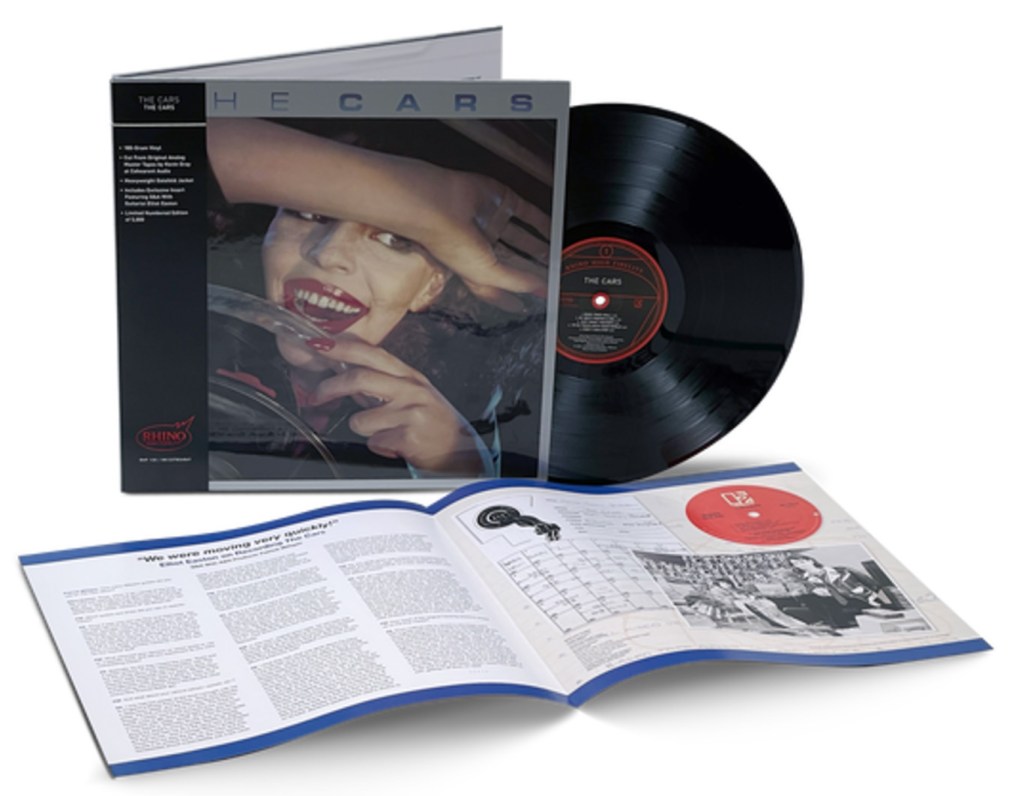
The Cars on Rhino – Man, This Record Is Bad

Hot Stamper Pressings of the Music of The Cars Available Now

I mean, really bad.

Kevin Gray has struck again. He’s a modern one man demolition crew, taking exceptionally well recorded analog albums and turning them into the vinyl equivalent of CDs, and bad CDs at that.

Steve Hoffman did the first Cars album on Gold CD and it sounds quite good. I still own mine. How can Kevin Gray, his former assistant, make such a mess of the album on vinyl?

This question has a rather obvious answer, and much of what we have to say about this record was said in our review of the disastrous Stand Up Gray cut for Analogue Productions.

Allow us to repeat ourselves:

We were finally able to get our hands on the newly remastered Cars first album, a record we know well, having played them by the score. Our notes for the sound can be seen nearby.

If ever a record deserved a “no” grade, as in “not acceptable,” this new pressing mastered by Kevin Gray deserves such a grade, because it’s just awful.
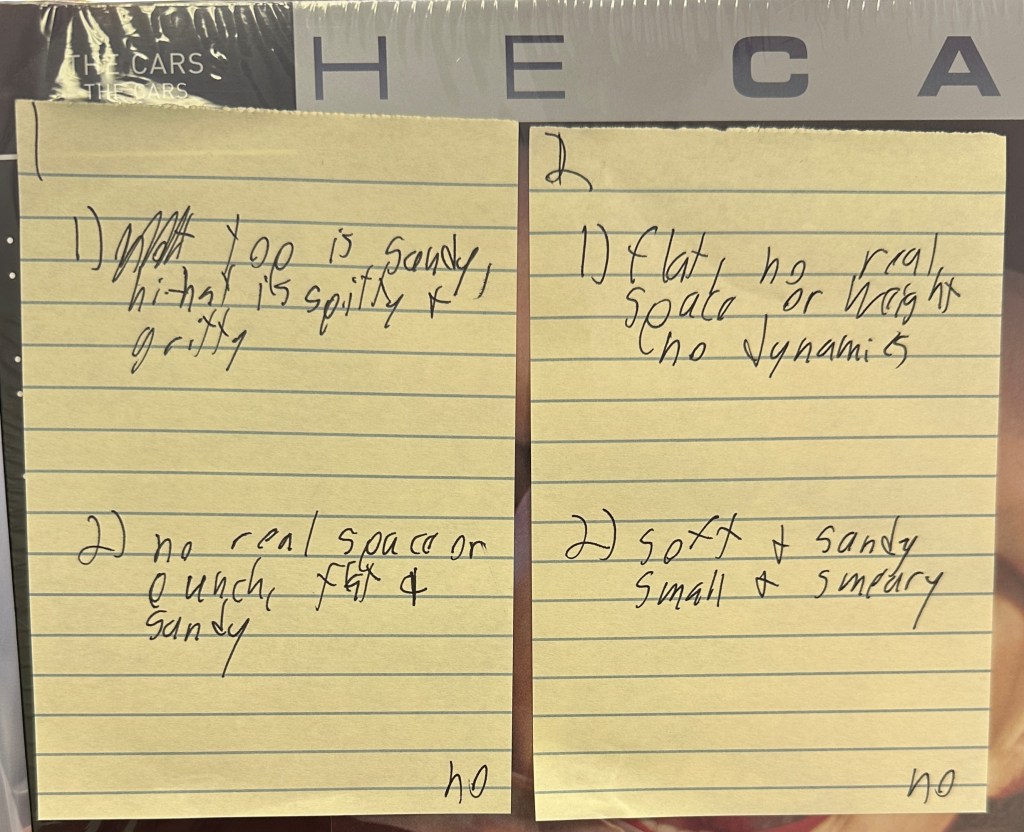
Here is what we heard on side one of the new Cars remaster.

Good Times Roll

  • Top is sandy  [Sandy typically refers to transistory, dry, grainy, or gritty sound.]
  • Hi-hat is spitty and gritty

My Best Friend’s Girl

  • No real space or punch
  • Flat and sandy

You’re All I’ve Got Tonight

  • Flat
  • No real space or weight
  • No dynamics

Bye Bye Love

  • Soft and sandy
  • Small and smeary

Grant Green on Music Matters had many of these same problems. Unsurprisingly, it too was mastered by Kevin Gray.

How this guy is still getting work is beyond me.

I am clearly being facetious here. These guys get work because audiophiles will buy the records they master. The market has decided these records sound just fine, and who am I to say otherwise?

Of course, people can say anything they want about these records, opinions being worth what you pay for them.

We take a different approach. We will sell you the pressing of the album that can mop the floor with this Heavy Vinyl trash. We rarely have the first album in stock, but if you want one, just let us know and we will be glad to put you on the waiting list. Email Fred at fred@better-records.com.

Compared to What?

Is the Rhino pressing the worst version of the album ever made? In our view, it’s only competition would be this disaster, a record that also sold well back in the day. The more things change…
If I were to try to reverse engineer the sound of a system that could play this record and hide its many faults, I would look for a system that was thick, dark and fat, with plenty of tube colorations and no real top end to speak of.

I know that sound. I actually had a system thirty years ago with many of these shortcomings, but of course I didn’t have a clue about any of that. Like every audio enthusiast I met back then, I didn’t know what I didn’t know.

I’m glad to say things are different now, I think.

If you made the mistake of buying this record and can’t stand the phony top end, try covering your tweeter with something absorbent. Foam might work. Also you could try disconnecting your super tweeters if you have any. This is good advice for any record mastered by Stan Ricker as well.

Since that old school vintage tube sound takes the opposite approach to music reproduction that we’ve spent the last few decades working on here at Better Records — our goal being neutrality above all else — we are clearly not playing the record back on equipment that is capable of making it sound anything but godawful, hence our relentlessly negative reaction to the record.

On any properly setup, halfway decent stereo system, any original pressing with RTB in the dead wax should murder this Heavy Vinyl piece of junk. If you don’t have a system like that, we encourage you to get one. You will save a lot of money by not buying crap vinyl like this, only to discover later just how bad it sounds on the higher quality equipment you eventually end up with. (Here is some good news on that subject.)

Although, to be honest, if you are buying these kinds of awful records, it’s hard to see how you will ever get out of the hole you are in. Some audiophiles manage it, but I suspect that most never do.

You can also buy the CD — whether on DCC Gold or just whatever disc Elektra put out — and hear for yourself if it isn’t better sounding. I would be very surprised if it were not.

(more…)

Elvis Costello Arrayed His Armed Forces and Produced His Single Best Sounding Album

Hot Stamper Pressings of Elvis’s Albums Available Now

We consider Armed Forces to be one of the best sounding rock records ever made, and a copy like this White Hot Shootout Winner is proof enough to back up our claim. The best copies are extremely transparent and silky sounding, but with unbelievably punchy, rock-solid bass and drums.

The sound of the rhythm section ranks with the best we’ve ever heard. Beyond that, the musical chops of this band at this time rank with the best in the history of rock. Steve, Bruce and Pete rarely get the credit they deserve for being one of the tightest, liveliest backing bands ever to walk into a studio or on to a stage.

The song Oliver’s Army on the first side is a perfect example of what we’re talking about. Rock music doesn’t get much livelier than that.

Skip on down to Green Shirt for another track that’s as punchy as they come.

(more…)

The Science of Hot Stampers – Incomplete, Imperfect, and (Gulp!) Provisional

Important Lessons We Learned from Record Experiments 

We have a section on the blog you may have seen called live and learn.

It’s devoted to discussing the records we think we we were wrong about.

Oh yes, it’s true. But it’s not really a problem for us here at Better Records. We see no need to cover up our mistakes. The process of learning involves recognizing and correcting previous errors.

Approached scientifically, all knowledge — in any field, not just record collecting or music reproduction — is incomplete, imperfect, and must be considered provisional.

What seems true today might easily be proven false tomorrow. If you haven’t discovered that for yourself yet, one thing’s for certain, you haven’t been in this hobby for very long.

We’re so used to the conventional wisdom being wrong, and having our own previous findings overturned by new ones, that we gladly go out of our way in listing after listing to point out just how wrong we were. (And of course why we think we are correct now.)

A common misperception among those visiting the site is that we think we know it all. Nothing could be further from the truth.

We learn something new about records with practically every shootout.

Each time we go back and play a 180 gram or Half-Speed mastered LP we used to like (or dislike), we gain a better understanding of its true nature. (The bulk of those “audiophile” pressings seem to get worse and worse over time, a subject that has been thoroughly discussed on the blog.)

Record cleaning gets better, front ends get better, electronics get better, tweaks get better, rooms get better — every aspect of your playback system should be improving on a regular basis, allowing you to more correctly identify the strengths and weaknesses of every record you play.

I almost forgot: your ears get better too, whether you like it or not. If that’s not happening, you’re probably not doing some very important things right. (Maybe some of your records are holding you back.)

What follows is a typical excerpt from a recent listing.

(more…)

On Heroes, It Took Us Ages to Break the Sound Barrier

More of the Music of David Bowie

Because the conventional wisdom turned out to be so wrong.

Our intuition that the British originals would sound the best was incorrect.

The experiments we carried out falsified that prediction.

In the audiophile record collecting world, intuitions have a bad track record, but more than a few audiophiles — many of whom are addicted to sharing their “record knowledge” on audiophile forums — seem unaware of this reality.

Taking a page from one of the greatest minds of the 20th century, we’ve opted to use a more scientific approach to discovering the best sounding record pressings, and we encourage you to do likewise. 

We pioneered the evidence-based approach to finding the best sounding pressings, and, like all good scientists, we shared it with everyone. Some in the audiophile community have taken it to heart, but most have chosen to put their faith in reviewers, forum posters, common sense and logic.

None of these produce consistently good results, but those who use these methods are loathe to doubt them and only rarely if ever learn the error of their ways.

Once a decision has been made and a specific pressing acquired — you could call it door number three I suppose — cognitive dissonance and confirmation bias immediately kick in to justify the result, and soon enough the game is over. The prize has been won. It’s the best prize ever. It does everything right, everything you’d hoped for.

But the best sounding copy of the record was not behind door number three.

You don’t have the best sounding pressing (well, you might, but if you did it would be entirely the result of chance, since you have no experimental evidence), but as long as you think you do, and, like most audiophiles, you play records only for yourself, and purely for enjoyment, you have no way of  discovering where on the spectrum of best to worst your record sits.

As long as you think you have the best, you have the best. How could there ever be any evidence offered to the contrary?

(more…)