Top Artists – Bud Shank

Don’t Skip the OJC, Put It in a Shootout

Of the three early OJC pressings of West Coast Sound we played recently, only one met our standards. At 2+/1.5+, the sound was good, not great.

One copy earned grades of 1+/1+, which means the sound was passable. The last copy had an NFG side two, which means it was just awful.

(Many of the Heavy Vinyl disasters we’ve been cataloging lately have earned that notorious grade. The unacceptably lo- to mid-fi sound even the better ones offer doesn’t seem to bother the audiophiles who rave about them, however.)

So does side two of the OJC pressing have fairly good sound, merely passable sound, or is the sound hopelessly bad?

In the case of this Shelly Manne album, all three, and the only way we were able to discover that is by cleaning up three of them and playing them head to head with real Contemporary pressings in a blinded experiment.

Obviously we were hoping for better results from our OJCs — only one of the copies we played will turn out to be saleable.

Why did we bother? That old bugaboo the profit motive was all that was needed to make us give the OJC pressings a try. We thought we could make money on them but it turns out that the opposite will happen. Oh well, nothing ventured, noting gained.

More importantly, we are not the least bit shy about coming clean and sharing the results with our readers and customers, especially the part about three identical looking copies with the same stamper numbers all sounding very diffferent from each other.

An added bonus is that side two was worse than side one most of the time. That happens often enough, but nobody but us ever seems to want to talk about it.

If we had had ten OJC pressings to play, we probably would have be able to find at least one or two with a grade of 2+/2+, meaning that George Horn probably did a creditable job mastering the album back in 1984 when he cut it for Fantasy, to sell for the very affordable price of $5.98. It’s most likely the pressing plant that let listeners down.
Needs Tubes

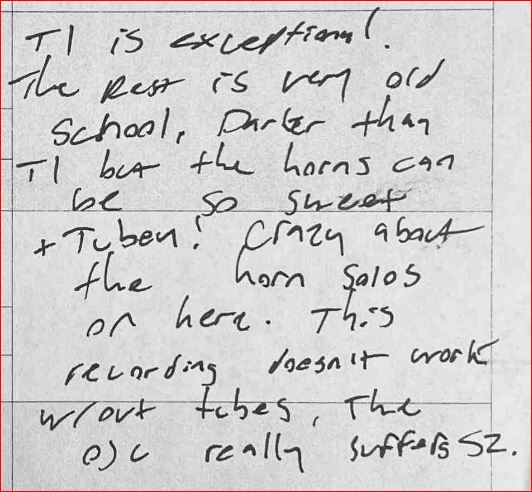
The problem here is that this title needs tubes, or, at the very least, the sound of tubes, and George apparently did not have them, or enough of them, in his mastering chain.

Our specific notes can be seen on the left. We mention that the first track has the best sound (1956 dates), the rest falling short for being darker and more crude (“old school,” some dating from 1953).

The West Coast horn players are the reason to buy this title, with horns that are “sweet and tubey,” but of course to hear that kind of sound you will need a real Contemporary pressing, not an OJC — or anything made in the modern era for that matter.
(more…)

On Barney Kessel’s Easy Like, Stick With the Earlier Contemporary Pressings

Hot Stamper Pressings of Contemporary Jazz Albums Available Now

The Shootout Winning pressing we played in 2024 was yet another killer Barney Kessel recording from the Golden Age of Tube Recording:

Both sides of this vintage Contemporary pressing were giving us the rich, sweet and tubey MONO sound we were looking for, earning INCREDIBLE Shootout Winning Triple Plus (A+++) grades or close to them

Roy DuNann (at the console on select tracks, with Val Valentin handling engineering duties on the others) always seems to get phenomenally good sound out of the sessions he recorded – amazingly realistic drums in a big room; Tubey Magical guitar tone; deep, note-like string bass, and on and on

For some reason, the guitar sound from this era of All Tube Chain Recording seems to have died out with the times – it can only be found on the best of these vintage pressings, and, as you may imagine, the better the guitar sounds, the more likely it is that the record will win our shootout

If you don’t have an electric guitar jazz record with this kind of off-the-charts Tubey Magical sound, maybe it’s time you got one

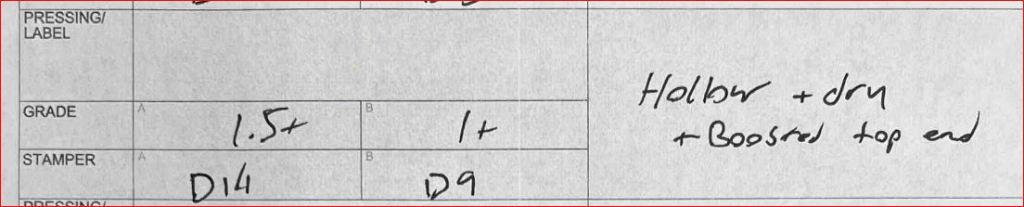
You would never know how good the recording was by playing this D14/D9 pressing on the original label.

The sound was hollow and dry with a boosted top end. The 1+ grade awarded to this side two means it’s simply not that good, early label or no early label.

This Is Why

This is why we do shootouts, and why you must do them too, if owning the highest quality pressings is important to you.

Fortunately for readers of this blog, our methods are explained in detail, free of charge.

We’ve also written quite a few commentaries to help audiophiles improve the way they think about records.

I implore everyone who wants to make progress in this hobby to learn from the mistakes we’ve made. There are 146 “we were wrong” listings on the site as of this writing, and we learned something from every damn one of them.

(more…)

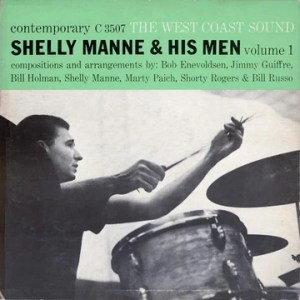
Shelly Manne & His Men – The West Coast Sound, Vol. 1

More Shelly Manne

  • This early MONO pressing was doing practically everything right, with both sides earning INCREDIBLE Shootout Winning Triple Plus (A+++) grades or close to them
  • The first track here is by far the best sounding — it’s amazing and the perfect illustration of just how good 1956 mono sound can be if you know what you are doing
  • The sound may be a bit dated but the horns are enchantingly sweet and Tubey Magical, with solos that show off the jazz chops of “His Men” about as well as any Manne and His Men album ever has
  • Tube mastering is essential for this recording – without vintage tubes in the chain, you end up with the kind of modern sound that the average OJC pressing suffers from (this is especially noticeable on side two of the OJC pressings we played, which were mostly awful)
  • Contemporary in 1956 was making some awfully good jazz records, with room-filling, natural and realistic mono sound, the kind of sound that still holds up today and doesn’t need a lot of “mastering help” to do it
  • Good luck finding quieter early copies of this title — we sure couldn’t do it, not with top quality sound anyway
  • 5 stars: “The music has plenty of variety yet defines the era… Highly recommended and proof (if any is really needed) that West Coast jazz was far from bloodless.”
  • If you’re a fan of West Coast Jazz, this is a Top Title from 1956, and one that certainly belongs in any right-thinking audiophile’s collection.

(more…)

The L.A. 4 / Going Home

  • A vintage East Wind 33 RPM Japanese import pressing with outstanding sound from start to finish
  • A top album in both rarity and demand – you’d be hard pressed to find another copy with this kind of transparency, clarity, presence, and sound (assuming you could find one)
  • This is one of the best sounding copies with all 7 tracks we have ever played
  • This 33 RPM version features all seven of the original tracks – “Greensleeves” and “Django” were omitted from the shorter 45 RPM pressing
  • Lee Herschberg recorded these sessions direct to disc – he’s the guy behind the most amazing piano trio recording I have ever heard, a little album called The Three
  • The star of this record is Shelly Manne, who really plays up a storm

(more…)

Skip the Original OJC of West Coast Sound (C3507)

Hot Stamper Pressings of Contemporary Jazz Albums Available Now

UPDATE 2025

A new shootout for this title gave us a better understanding of the OJC relative to the other pressings we were playing. We came across one fairly good sounding OJC pressing out of the three we played, one that earned grades of 2+/1.5+, so if you have an OJC, play it and see whether it is one of the good ones or, as is most likely the case, one of the bad ones.

Side two is the side to play to hear what we are on about. The grades ranged from decent, 1.5+, to just awful, NFG.


The sound of the early OJC pressings of West Coast Sound that we played recently were not to our liking.

They are brighter and thinner than even the worst of the real Contemporary pressings.

That is decidedly not our sound.

We have to admit that we used to find the sound of many of these OJC pressings much more tolerable in the past.

More than tolerable. Enjoyable. Recommendable. Saleable even.

Nothing to be ashamed of, that was many years ago. As you may already know, live and learn is our motto. Getting it wrong is a feature, not a bug, of collecting if your goal is to find the best sounding pressings of the music you love.

(If you have some other goal, this may not be the right blog for you. Definitely steer clear of this website. The prices there are ridiculous!)

It’s true: Our old system from the 80s and 90s was tubier, tonally darker and dramatically less revealing, which strongly worked to the advantage of leaner, brighter, less Tubey Magical titles such as this one.

That was thirty or more years ago. Pretty much every dynamic speaker system I ran into had that sound. And I was never a fan of screens or horns. Like most audiophiles, I thought my stereo sounded great. It sure sounded right to me at the time.

And the reality is that no matter how hard I worked or how much money I spent, I would never have been able to achieve substantially better sound for one simple reason: most of the critically important revolutions in audio had not yet come to pass. It would take many technological improvements and decades of effort until I would have anything like the system I do now.

Bud Shank And the Sax Section – An Undiscovered Gem

More Bud Shank

More Jazz Recordings Featuring the Saxophone

  • This stellar copy of Bud Shank’s 1966 release boasts Shootout Winning Triple Plus (A+++) sound or close to it on both sides – open, lively and dynamic throughout
  • Full, rich, and spacious with tons of Tubey Magic and, better yet, never dry, hard or transistory — true DEMO DISC QUALITY sound 
  • An absolutely amazing recording engineered by none other than Bruce Botnick – the sound of multiple saxes playing these lively arrangements is music to our ears
  • “… the album works, largely because of Bob Florence’s arrangements and the shrewd doubling of the baritone and bass sax parts, which give the charts heft at the bottom… The overall sound remains wonderfully reedy and flighty.”

Bruce Botnick sure knew what he was doing on this session. He succeeded brilliantly in capturing the unique sound of each of the saxes. The album is really more of a West Coast pop jazz record than it is a “real” jazz record. The arrangements are very tight, the songs are quite short — none exceed three and a half minutes — so there is not a lot of classic jazz saxophone improvisational blowing going on.

Spacious and transparent with plenty of analog Tubey Magic to go around, this is a really wonderful way to hear the music. The sax sound is excellent — rich and full, with none of the hard, edgy quality we heard on the less than stellar pressings. For richness and Tubey Magic — with no sacrifice in clarity or dynamics — these sides just could not be beat.

(more…)

Bob Florence / Here And Now – So Tough to Find in Stereo, We Finally Just Gave Up

More of Our Favorite Recordings By Bones Howe

Recordings Engineered by Bones Howe Available Now


A Five Star Album in the All Music Guide. This lively big band LP has excellent sound. We loved the music too.

Wish we could find some. It apparently sold very poorly, so poorly that there simply aren’t any copies around.

At 32, Florence already largely had his writing style together. He utilized top L.A. studio players for this set including such soloists as altoist Bud Shank, the tenors of Bill Perkins and Bob Hardaway, and trombonist Herbie Harper, but it is the tricky charts on the four originals and four standards (including “The Song Is You” and “Straight No Chaser”) that make this an LP worth searching for.” – AMG


The L.A. 4 – Pavane Pour Une Infante Défunte (33 RPM)

More L.A. 4

More Audiophile Records

  • Boasting two outstanding Double Plus (A++) or BETTER sides, this East Wind 33 RPM Japanese import pressing will be very hard to beat – exceptionally quiet vinyl too
  • Side one was sonically very close to our Shootout Winner – you will be amazed at how big and rich the sound is
  • This is one of the better sounding versions with all 7 tracks we’ve played
  • Lee Herschberg recorded these sessions direct-to-disc – he’s the guy behind the most amazing piano trio recording I have ever heard, a little album called The Three
  • Both of these sides give you the richness, clarity, presence and resolution few copies can touch
  • This 33 RPM version features all seven of the original tracks – “C’est What” and “Corcovado” were omitted from the shorter 45 RPM pressing

(more…)

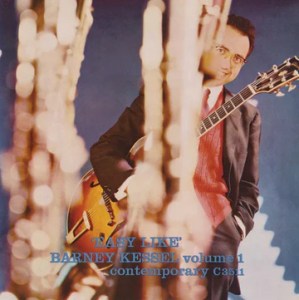
Barney Kessel – Easy Like

More Barney Kessel 

More Contemporary Label Jazz Recordings

  • Both sides of this vintage Contemporary pressing were giving us the rich, sweet and tubey MONO sound we were looking for, earning INCREDIBLE Shootout Winning Triple Plus (A+++) grades or close to them
  • Roy DuNann (at the console on select tracks, with Val Valentin handling engineering duties on the others) always seems to get phenomenally good sound out of the sessions he recorded – amazingly realistic drums in a big room; Tubey Magical guitar tone; deep, note-like string bass, and on and on
  • For some reason, the guitar sound from this era of All Tube Chain Recording seems to have died out with the times – it can only be found on the best of these vintage pressings, and, as you may imagine, the better the guitar sounds, the more likely it is that the record will win our shootout
  • If you don’t have an electric guitar jazz record with this kind of off-the-charts Tubey Magical sound, maybe it’s time you got one
  • 4 1/2 stars: “…features Kessel in boppish form with quintets in 1953 and 1956 featuring, either Bud Shank or Buddy Collette doubling on flute and alto. Kessel shows off the influence of Charlie Christian throughout the performances, with the highlights including ‘Easy Like,’ ‘Lullaby of Birdland,’ ‘North of the Border,’ and the accurately titled ‘Salute to Charlie Christian.'”

(more…)

The L.A. 4 – Pavane Pour Une Infante Défunte (45 RPM)

More L.A. 4

More Audiophile Records

  • This 45 RPM Japanese import copy is one of the BEST we have ever heard, with both sides earning KILLER Shootout Winning Triple Plus (A+++) grades or close to them – exceptionally quiet vinyl too
  • Lee Herschberg recorded these sessions direct to disc – he’s the guy behind the most amazing piano trio recording I have ever heard, a little album called The Three
  • Transparency; absolute freedom from smear and distortion; clarity; presence; frequency extension high and low; correct tonality – everything you want in an audiophile recording is here!
  • This 45 RPM version is shorter than the original album, with five of the original’s seven tracks
  • And it sounded better than any of the Direct to Disc pressings we had on hand, which is exactly what happened when they mastered The Three at 45 RPM from the backup tapes – pretty wild, don’t you think?

(more…)