More Barney Kessel
More Contemporary Label Jazz Recordings
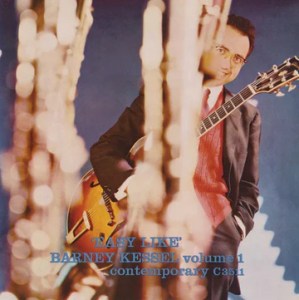
- Both sides of this vintage Contemporary pressing were giving us the rich, sweet and tubey MONO sound we were looking for, earning INCREDIBLE Shootout Winning Triple Plus (A+++) grades or close to them
- Roy DuNann (at the console on select tracks, with Val Valentin handling engineering duties on the others) always seems to get phenomenally good sound out of the sessions he recorded – amazingly realistic drums in a big room; Tubey Magical guitar tone; deep, note-like string bass, and on and on
- For some reason, the guitar sound from this era of All Tube Chain Recording seems to have died out with the times – it can only be found on the best of these vintage pressings, and, as you may imagine, the better the guitar sounds, the more likely it is that the record will win our shootout
- If you don’t have an electric guitar jazz record with this kind of off-the-charts Tubey Magical sound, maybe it’s time you got one
- 4 1/2 stars: “…features Kessel in boppish form with quintets in 1953 and 1956 featuring, either Bud Shank or Buddy Collette doubling on flute and alto. Kessel shows off the influence of Charlie Christian throughout the performances, with the highlights including ‘Easy Like,’ ‘Lullaby of Birdland,’ ‘North of the Border,’ and the accurately titled ‘Salute to Charlie Christian.'”
This vintage Contemporary pressing has the kind of Tubey Magical Midrange that modern records can barely BEGIN to reproduce. Folks, that sound is gone and it sure isn’t showing signs of coming back. If you love hearing INTO a recording, actually being able to “see” the performers, and feeling as if you are sitting in the studio with the band, this is the record for you. It’s what vintage all analog recordings are known for — this sound.
If you exclusively play modern repressings of vintage recordings, I can say without fear of contradiction that you have never heard this kind of sound on vinyl. Old records have it — not often, and certainly not always — but maybe one out of a hundred new records do, and those are some pretty long odds.
What The Best Sides Of Easy Like Have To Offer Is Not Hard To Hear
- The biggest, most immediate staging in the largest acoustic space
- The most Tubey Magic, without which you have almost nothing. CDs give you clean and clear. Only the best vintage vinyl pressings offer the kind of Tubey Magic that was on the tapes in 1956
- Tight, note-like, rich, full-bodied bass, with the correct amount of weight down low
- Natural tonality in the midrange — with all the instruments having the correct timbre
- Transparency and resolution, critical to hearing into the three-dimensional studio space
No doubt there’s more but we hope that should do for now. Playing the record is the only way to hear all of the qualities we discuss above, and playing the best pressings against a pile of other copies under rigorously controlled conditions is the only way to find a pressing that sounds as good as this one does.
Copies with rich lower mids and nice extension up top did the best in our shootout, assuming they weren’t veiled or smeary of course. So many things can go wrong on a record! We know, we’ve heard them all.
Top end extension is critical to the sound of the best copies. Lots of old records (and new ones) have no real top end; consequently, the studio or stage will be missing much of its natural air and space, and instruments will lack their full complement of harmonic information.
Tube smear is common to most vintage pressings. The copies that tend to do the best in a shootout will have the least (or none), yet are full-bodied, tubey and rich.
A Big Group of Musicians Needs This Kind of Space
One of the qualities that we don’t talk about on the site nearly enough is the SIZE of the record’s presentation. Some copies of the album just sound small — they don’t extend all the way to the outside edges of the speakers, and they don’t seem to take up all the space from the floor to the ceiling. In addition, the sound can often be recessed, with a lack of presence and immediacy in the center.
Other copies — my notes for these copies often read “BIG and BOLD” — create a huge soundfield, with the music positively jumping out of the speakers. They’re not brighter, they’re not more aggressive, they’re not hyped-up in any way, they’re just bigger and clearer.
And most of the time those very special pressings are just plain more involving. When you hear a copy that does all that — a copy like this one — it’s an entirely different listening experience.
What We’re Listening For On Easy Like
- Energy for starters. What could be more important than the life of the music?
- The Big Sound comes next — wall to wall, lots of depth, huge space, three-dimensionality, all that sort of thing.
- Then transient information — fast, clear, sharp attacks, not the smear and thickness so common to these LPs.
- Tight, full-bodied bass — which ties in with good transient information, also the issue of frequency extension further down.
- Next: transparency — the quality that allows you to hear deep into the soundfield, showing you the space and air around all the instruments.
- Extend the top and bottom and voila, you have The Real Thing — an honest to goodness Hot Stamper.
The Players and Personnel
- Arnold Ross – Piano (“Tenderly,” “Lullaby Of Birdland,” “What Is There To Say?” “Bernardo,” “Vicky’s Dream,” “Salute To Charlie Christian”)
- Barney Kessel – Guitar
- Bud Shank – Flute, Alto Saxophone (“Tenderly,” “Lullaby Of Birdland,” “What Is There To Say?” “Bernardo,” “Vicky’s Dream,” “Salute To Charlie Christian”)
- Buddy Collette – Flute, Alto Saxophone (“Easy Like,” “That’s All,” “April In Paris,” “North Of The Border”)
- Claude Williamson – Piano (“Easy Like,” “That’s All,” “April In Paris,” “North Of The Border”)
- Harry Babasin – Bass (“Tenderly,” “Lullaby Of Birdland,” “What Is There To Say?” “Bernardo,” “Vicky’s Dream,” “Salute To Charlie Christian”)
- Lester Koenig – Producer
- Red Mitchell – Bass (“Easy Like,” “That’s All,” “April In Paris,” “North Of The Border”)
- Roy DuNann – Engineer (“Easy Like,” “That’s All,” “April In Paris,” “North Of The Border”)
- Shelly Manne – Drums
- Val Valentin – Engineer (“Tenderly,” “Lullaby Of Birdland,” “What Is There To Say?” “Bernardo,” “Vicky’s Dream,” “Salute To Charlie Christian”)
Side One
Easy Like
Tenderly
Lullaby Of Birdland
What Is There To Say?
Bernardo
Vicky’s Dream
Side Two
Salute To Charlie Christian
That’s All
I Let A Song Go Out Of My Heart
Just Squeeze Me
April In Paris
North Of The Border
AMG 4 1/2 Star Review
Easy Like has guitarist Barney Kessel’s first sessions as a leader, performances which launched his longtime association with the Contemporary label. [T]he set features Kessel in boppish form with quintets in 1953 and 1956 featuring, either Bud Shank or Buddy Collette doubling on flute and alto.
Kessel shows off the influence of Charlie Christian throughout the performances, with the highlights including “Easy Like,” “Lullaby of Birdland,” “North of the Border,” and the accurately titled “Salute to Charlie Christian.”