*Thinking About Audio

Problem Solving in Audio

Robert Brook runs a blog called The Broken Record, with a subtitle explaining that his blog is:

A GUIDE FOR THE DEDICATED ANALOG AUDIOPHILE

We know of none better, outside of our own humble attempt to enlighten that portion of the audiophile community who love hearing music reproduced with the highest fidelity — and are willing to go the extra mile and pay the extra dollar to make that happen.

PROBLEM SOLVING in AUDIO

We have a section on the blog under the heading Making Progress that digs into the kinds of issues that audiophiles tend to run into, especially when they are first getting started. They’re the ones Robert Brook writes about in his commentary above, and they’re the ones that tripped me up over and over for decades after I first got started in this hobby sometime in the mid-70s.

It wasn’t until around 2005 that I stumbled upon, mostly through luck and audiophile friends, the elements that make up my current system.

Imagine being so clueless that you actually had to spend thirty years in a hobby before you figured out. That was me!

Of course I thought I had it all figured out right from the start. I was the proud owner of monstrously-large, ridiculously-expensive speakers, tube equipment (also expensive, and the latest and greatest cutting edge technology back in those days), Half-Speed mastered records, records made live directly to disc, fancy cables — you name it, I had everything required to play music at nearly-live levels with near-perfect fidelity.

All the most important boxes I was told about had been checked off right from the get-go in the 70s. I was all in, and for the next thirty years I did everything the audiophiles I knew liked to do: find and evaluate better gear, try new tweaks, and, more than anything else, learn to appreciate music that I had never heard before — some of it new, some of it very old.

These are all stories that have been told here on the blog in hundreds and hundreds of posts.

Everything changed when I started doing audio and records in ways that nobody I knew had ever done them before. (That also is a story that has been frequently told here.)

Taking the approach to audio and software that audiophiles tend to take — the bulk of the story Robert Brook tells in his commentary — can only get you so far. That’s the lesson I learned after spending my first thirty years in the hobby.

It’s why this blog is devoted to one concept above all others — the importance of being skeptical.

Requiring empirical evidence to back up whatever I might choose to believe was the shock that my system — my nervous one, as well as my audio one — needed to jolt it out of its comfort zone and force it to come up with a better way.

At the start I believed what I was told — hey, it seemed to be working, and who was I to argue with the “experts” anyway? I went along with the crowd, and I got the average results crowds tend to get.

This blog, as well as Robert’s, is simply trying to help you circumvent the bad ideas that we run into everywhere in audio these days. We’ve tried lots of them, most of them didn’t work, or didn’t work very well, and the good news for you, dear reader, is that we found others that we know do work.


(more…)

“We want the outcome, but we need the journey.”

Experiments Taught Us Everything We Know about Records

Thought for the Day

We want the outcome, but we need the journey.

Falling in love with outcomes doesn’t move you forward.

Falling in love with the process does.

Shane Parish


It’s amazing how far you can get in this hobby if you’re obsessive enough and driven enough. (See links below for more on these two drivers of success.)

To achieve real success you must be willing to devote huge amounts of time, money and effort to the pursuit of better home audio.

You will really go far if you’re willing to let your ears, not your brain, inform your understanding and appreciation of the sound of the various pressings you play.

If we thought like most audiophiles — that money buys good sound and original pressings are usually the best — we would currently be very unlikely to have a business selling a million dollars or more worth of Hot Stampers every year.

(For those new to the idea, here are the short versions of what they are and how one goes about acquiring them.)

(more…)

What Do Audiophiles Think about Analog?

Robert Brook runs a blog called The Broken Record, with a subtitle explaining that his blog is:

A GUIDE FOR THE DEDICATED ANALOG AUDIOPHILE

We know of none better, outside of our own humble attempt to enlighten that portion of the audiophile community who love hearing music reproduced with the highest fidelity and are willing to go the extra mile to make that happen.

What Do AUDIOPHILES THINK About ANALOG?

Looking at the picture above, I’d say it probably gives a great many of them a headache.

And why shouldn’t it? It sure looks easy, and the fact that everyone who writes about it, reviewers and forum posters alike, seems to think it is easy. They all seem to think that all you have to do to get good sound is to buy the right equipment and play the right records — mastered by the right people, of course — and you are good to go.

But it actually turns out to be hard, so hard that some people — no doubt many of the ones who bought into the idea that it was easy in the first place — want to throw in the towel and move on to something else, preferably something that offers more bang for their hard-earned bucks.

If I had taken the above advice, and bought the remastered records the so-called experts have been recommending to audiophiles liek me for decades, who knows, I might have thrown in the towel too.

But I was obsessed with music, and obsessed people don’t give up on anything easily. (The result, for what it’s worth, is hundreds of great sounding records for sale and thousands of blog postings.)

My Two Cents about Robert’s Post

(the slightly edited version taken from the comments)

Robert,
Thanks for taking on some of the more specious arguments — as well as some very good ones, to be sure — advanced by the music lovers you quote.

Job well done, and one that I could never have taken on as it would have caused my head to explode right at the start.

I wrote a piece recently about what I believe is fundamentally at the heart of the many misunderstandings music lovers of these various persuasions are unable to overcome.

It’s far more esoteric than the many good points you make. I’m assuming that at this stage of the game we can all agree that analog is superior to digital.

What I am trying to do is to get audiophiles to listen critically enough to recognize that no two sides of the same record have the same qualities in the same proportion, that variations in sound quality are almost unavoidable, and that record shootouts are the only way to bring this idea home to the typical analog audiophile enthusiast.

You can find it under the heading of breaking barriers and crossing bridges.

P.S.

Someone mentioned a blindfold test, and I was glad to hear it as blind testing is something I have been recommending for years.

When they tested me for my part in the Washington Post video on audiophiles, I was happy to submit to a blind test.

I did the same with a shootout for the 45 RPM pressings of Rumours in front of a world famous record collector, and it was obvious to me, if not to everyone, that none of the three copies sounded exactly like any of the others, yet they were brand new and pressed on audiophile vinyl in limited numbers.

I have an audio friend who asked me to do the same — be blindfolded — to judge some changes he had made to his stereo, and I agreed.

Afterwards he told me that none of his other audio friends would allow themselves to be blindfolded.

Having spent my life around other audiophiles, this is something I have no trouble believing!

I’m sure Robert would, because Robert knows how easy it is to be fooled, and to fool yourself.

(more…)

Got Nice Equipment? It’s a Good First Step, but Only a First Step

Revolutions in Audio, Anyone?

Nice equipment is only the first step on the long, long, long road to good sound.

The audio magazines that their reviewers write for are purveyors of what we consider to be one of the most pernicious falsehoods in all of audio — that buying more expensive equipment is the key to better sound. (Note that is is a falsehood, not a lie; they probably actually believe it.)

From the audiophile rags’ point of view, this makes perfect sense. They extoll the virtues of one piece of sexy hardware after another on page after page of their glossy magazines. The ten bucks a year you pony up to subscribe doesn’t even cover the cost of all that pretty paper. They make their real money by selling advertising to equipment manufacturers, who in turn advertise equipment they want you to buy. What are all the glossy pages of these magazines devoted to? The fawning and credulous discussion of the sexy equipment being advertised.

stereooldSee how that works? It ain’t rocket science. These magazines have a vested interest in convincing you that the Newer and More Expensive the equipment you own, the better will be the sound in your home.

Wrongheaded Thinking

It’s easily demonstrated how wrongheaded this way of thinking is. If you’ve been in audio for any length of time, you know that one bad interconnect can ruin the sound of a stereo. We’ve all been there. All it takes is one little wire — the wrong wire in the wrong place — to make all that expensive equipment sound like shit.

Or a bad room. Or the speakers on the wrong wall. Or VTA too high. Or too low. Or a mismatch between the arm and cartridge. Or a mismatch between the speaker and amp. Or about 68 million other things, any one of which can turn the sound of all that sexy equipment into musically unpleasant dreck.

(more…)

The Second Best Day of My Life in Audio

Advice on Making Audio Progress

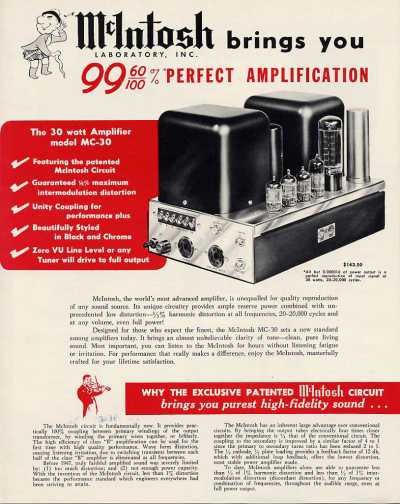
In the late-90s I had tried to power various speakers I owned with Mac 30s. I could never actually get  them to reproduce music faithfully, but they did wonderful things for some recordings.

In 2005, long after I had moved on from the Macs, I found a low-power integrated transistor amp from the 70s that was vastly superior to the custom tube preamp and amp we were using for shootouts at the time. 

It was, simply put, much more musically truthful. It sounded more like live music and less like recorded music.

It is this quality that is hardest to find in all of audio.

It is also the one quality of our system that, more than any other, makes it possible to do the kind of work we do.

Our equipment (along with our room treatments, setup, electricity and such) lets us hear the naked sound of the record being played, uncolored and unadorned.

Back to Mac

They started building them in 1954. Steve Hoffman was a big fan. We spent a fair amount of our time together tube-rolling back in the late-90s. Based on some of the recent interviews I’ve read, he appears to still be enamored with their sound.

Like the fellow who bought his first boat, buying a pair of Mac 30s was the second best day of my life, exceeded only by the day I got rid of them.

Regardless of what they might have said in their ads, they were not 99.60% perfect by any stretch of the imagination. To this day I consider them to be the most colored and inaccurate — albeit perhaps the most Tubey Magical — amp I have ever heard in my life. Having been actively involved in this hobby for more than fifty years, I regret to say that I’ve heard plenty of amps that didn’t do their jobs right.

If this is your idea of good sound, you should consider the very real possibility that you might be wasting your time on this blog.

Euphonic colorations are anathema to us here at The Skeptical Audiophile, regardless of whether their source is records or the equipment used to play them.

The fellow who owns this company makes a very good living producing and selling records with an abundance of that quality. We think he is a crackpot. The success of his company is the surest sign that audiophile record collectors have systems that are fundamentally failing every test of fidelity one could conceive of and clearly in need of a great deal of reform.

Our advice for making the changes needed to overcome the current state of audio despondency comprises five basic steps:

  1. Improve your equipment, room, electricity and setup using the equipment and methods we recommend.
  2. Play better sounding records on your improved system now that you can hear them right.
  3. Learn to listen to records more critically by constantly testing yourself through the shootout process.
  4. Continue to make improvements to your playback using your newly-enhanced listening skills.
  5. Find even better sounding records now that you can easily recognize them on your more accurate and revealing system.

Repeat steps three through five for the rest of your life. Over time you will surely be amazed at the progress you are able to make.

Undoubtedly you will be even more amazed at how much better music sounds in your home than you ever dreamed possible.

Once you have heard for yourself how this blog was able to help you with all of the above, please come back as often as you can. We’re convinced that, using our approach, you will learn even more about bettering your system, as well as obtaining the finest sounding records ever pressed to play on it.

(more…)

Fighting The Dreaded J Curve

More Entries from Tom’s Audiophile Notebook

That guy you see pictured to the left has spent much of the last forty years wandering around used record stores looking for better records (ahem). 

Before that he wandered around stores selling new records because he didn’t know how good old used records could sound.

In these posts he shares some of the things he’s learned since he started buying records at the age of ten roughly sixty years ago. (First purchase: She Loves You on 45. It’s still in his collection, although it cracked a long time ago and hasn’t seen a turntable in forever.)


Perhaps you suspect the electronics of your system are not as neutral as you thought they were.

So let’s say you get rid of your euphonic tube equipment (vintage or modern, makes no difference, colorations are colorations) and switch over to something that’s less colored.

The sound is now cleaner, cleaner, more present, more alive, more “right there” the way live music is “right there,” not veiled or vague or recessed the way so many stereos (at least in my experience) tend to sound. (Hard to believe, but some audiophiles seem to like that sound.)

But perhaps the sound now lacks richness, because you no longer have the richness your tubes were adding.

Perhaps now the sound is not as smooth as you would like, because it’s not being smoothed over by the smooth-sounding tube equipment you were using.

It’s very possible that the change has caused you to be less less happy with the sound.

Welcome to the J Curve.

You started at one point on the J, you made some changes, and now you find yourself with inferior sound compared to the sound you had before.

You may decide to turn back, to restore the sound you had so that you can enjoy your records the way you did when you had euphonic equipment, tube or transistor.

Or you can keep moving in a forward direction (left to right) and eventually — who knows when? — you hopefully (yes, the proper use of the adverb for once!) will start ascending the other side of the curve and end up somewhere better off than where you started.

You solve the richness problem by finding ways to add richness to your overall tonality without the limitations and drawbacks of tubes. You fix other problems that you can now recognize were causing harshness and shrillness in your system because you no longer have any tube equipment  artificially smoothing out the sound.

You’ve ripped off all the Band-Aids, and now it’s time to heal the wounds by other means. Maybe you had some bad interconnects or power cords. It could be anything.

But you can’t see problems that are being actively obscured by the colorations of your equipment.

(more…)

When It Comes to Carts and Horses, Which Comes First, and Who Pulls Who?

Please Consider Taking Some of Our Audio Advice

Robert Brook recently wrote a piece making the case that the cure for audiophile ailments of all kinds — burnout, boredom, etc. — is a high quality stereo system. It is beautifully written and we think well worth your time to read.

Robert walks us through what it has meant to him to have spent so many hours over the years building a high quality stereo system, mostly by describing the musical enjoyment it has brought to him.

What could be better?

We feel the same way. If you build such a system, and play the right records on it, you will experience the music you love in ways more powerful than you could have ever even imagined. Your favorite albums will sound so good that boredom and burnout would be simply inconceivable.

Those of us with top quality systems are confused by the dysfunctional relationship these poor souls have to their stereos and recordings. With a good stereo and good records, it’s hard to see how these psychological states are even possible.

Good Stereos Are Hard to Come By.

The problem audiophiles have is one that sits right at the heart of our hobby.

Good stereos are hard to come by.

So the question always comes down to how one should go about building such a beast. There are two schools of thought.

Is the first priority to have properly-pressed, properly-mastered records of well-recorded music in order to get the ball rolling?

Or is it better to make improvements to the stereo first, so that you can then pursue better sounding records and end up with the best of both worlds, a great stereo playing great records?

My Two Cents

Allow me to weigh in. Please consider the following unusual, even goofy, and possibly logically inconsistent, analogy.

Imagine that the place where you can enjoy music is a town not far from where you live.

Because you love music, you must travel there as that is the only place you can enjoy your favorite music to its fullest.

The Horse and the Cart

The horse that draws the cart that you ride in to this town is not the right record, it is the right stereo in the right room.

Without the right stereo, you lack the ability to recognize the right record.

Similarly, you lack the ability to appreciate what makes it more right than any other record.

Without the right stereo, you may in fact be trying to optimize the playback of records that are wrong. I did this for decades with my Mobile Fidelity records in the 70s and 80s. I played Heavy Vinyl pressings in the 90s and early 2000s that sounded right to me at the time but no longer do, mainly because our current system evolved over a very long time to be ruthless at revealing their deficiencies and my ears became better at recognizing them.

(more…)

The Pareto Effect in Audio – The 80/20 Rule Is Real

Please Consider Taking Some of Our Audio Advice

Even thought this commentary was written close to twenty years ago, we proudly stand behind every word.

Ambrosia’s first album does exactly what a good Test Disc should do. It shows you what your system is doing wrong, or poorly, and once you’ve fixed it, or made it better, it shows you that it actually is better, maybe even right, or at least more right than it was before.

We audiophiles need records like this. They make us better listeners, and they force us to become better audio tweakers. Because the amount of tweaking you do with your setup, components, room, electricity and the like is the only thing that can take you to the highest levels of audio.

The unfortunate reality audiophiles must eventually come to grips with in their journey to higher quality sound is that you cannot simply buy equipment that will get you there.

You can only teach yourself, painstakingly, over the course of many, many years, how to tweak and tune your equipment — regardless of its cost or purported quality — in order to reach the highest levels of audio fidelity.

And learning how to tweak and tune your equipment has other, fundamentally more important benefits in addition to its original purpose.

It helps you become a better listener. To notice aspects of the sound — the nuances and subtleties — you’ve been missing in your favorite recordings.

Breaking It Down

At most 20% of the sound of your stereo is what you bought.

At least 80% is what you’ve done with it.

Based on my experience I would put the number closer to 90%.

This is known as the Pareto Principle

The Pareto Principle, also known as the 80/20 Rule, The Law of the Vital Few and The Principle of Factor Sparsity, illustrates that 80% of effects arise from 20% of the causes – or in laymen’s terms – 20% of your actions/activities will account for 80% of your results/outcomes.

(more…)

Trying to Get at the Truth with Transistors

More Entries from Tom’s Audiophile Notebook

In 2007 we did a shootout for The Four Seasons on RCA and noted the following:

For those of you with better tube gear, the string tone on this record is sublime, with that rosin-on-the-bow quality that tubes seem to bring out in a way virtually nothing else can, at least in my experience.

Our experience since 2007 has changed our view concerning the magical power of tubes to bring out the rosiny texture of bowed stringed instruments.

We have in fact changed our minds completely with respect to that rarely-questioned belief.

It’s a classic case of live and learn, and represents one of the bigger milestones in audio that we marked in 2007, a year that in hindsight turns out to have been the most important in the history of the company.

Everything changed dramatically for the better for us sometime in 2005. That’s when we discovered the transistor equipment we still use to this day.

We found a low-power integrated amp made in the 70s that was vastly superior to our custom-built tube preamp and amp. We had an EAR tube phono stage at that time, which we quite liked.


UPDATE 2025

We recently hooked up our old 834p phono stage in the system and did not like the sound at all.

Things change. Boy do they ever!


In 2007 we auditioned the EAR 324P transistor phono stage and immediately recognized it would take our analog playback to an entirely new level, one we had never simply never experienced before and really had never thought could exist.

We make no claims whatsoever for any other transistor equipment of any kind, almost all of which in my experience is not at all good. The sound of these two units in combination is dramatically faster, more transparent, more free from smear, more dynamic and more resolving than any tube equipment we know of.

It is, simply put, much more musically truthful. It simply sounds more like live music and less like recorded music.

(more…)

When You’re Just Getting Started in Audio, It All Looks So Easy

Presenting another entry in a series of big picture observations about records and audio.

John Salvatier has written a very interesting essay. It’s not short but I think it is well worth the time it will take you to read it.

The parallels to records will be clear to anyone who has spent much time in this hobby, or on this blog for that matter.

Those of us who have run record experiments by the thousands have learned to accept results which regularly defy logic.

All the way back in 2007 we learned an important lesson regarding the vagaries of record pressings: that identical looking LPs can have dramatically different sound quality.

Even two sides of the same record can have quite different sound quality. We know, we’ve played them by the hundreds.

(more…)