*Hey, What’s the Big Idea?

Thoughts on The Big Picture from someone who has been playing records for almost 60 years. I bought a copy of She Loves You on Swan in 1964 and still own it. The disc may be cracked but the picture sleeve is in pretty good shape, just in case you were wondering.

Robert Brook Says: No Azimuth? No Problem!

Robert Brook runs a blog called The Broken Record, with a subtitle explaining that the aim of his blog is to serve as:

A GUIDE FOR THE DEDICATED ANALOG AUDIOPHILE

We know of none better, outside of our own humble attempt to enlighten that portion of the audiophile community who love hearing music reproduced with the highest fidelity and are willing to go the extra mile to make that happen.

Here is Robert’s latest posting.

No Azimuth? No Problem!

After making some adjustments to the arm, getting it in the ballpark, Robert writes:

I changed records to a Jascha Heifetz violin concerto that I like to use for tonearm settings. As I’ve mentioned in an earlier article, I particularly like using concertos for adjusting tonearms because of the challenge of getting both the soloist and the orchestra to sound their best. When the azimuth is just right, the soloist will sound full and present, while the orchestra behind them will be clear and distinct.

A few more tweaks and it was sounding right. Robert continues:

Now it was my friend’s turn to play some of his records, most of which I’d heard before adding the shim. On “Mediocre Bad Guys,” Jack Johnson’s voice now sounded more natural, and the thwack of the drum stick had lost its annoying glare. Zeppelin’s “D’yer Mak’er” was now rocking the way it should with the drum kit sounding appropriately huge and the cymbals showing plenty of top end sparkle and with a long decay. And on Eagles “Take It Easy” I could now better make out the many instruments in the mix, as well as the backing vocals, which I’d been struggling to hear clearly before.

Here’s the first question that comes to mind: Could this tonearm/cartridge tweaking and testing have been done using these other albums instead of the violin concerto recording?

Possibly, but it would have taken all day, because nobody really knows exactly how these records actually sound. Were they good recordings? No doubt, at least in some ways. But were these good pressings of those recordings? Who can say? And we have no business assuming.

Houses of the Holy sounds very different from copy to copy to us. We’ve easily played more than fifty of them, maybe closer to a hundred, and we’ve heard them sound every which way.

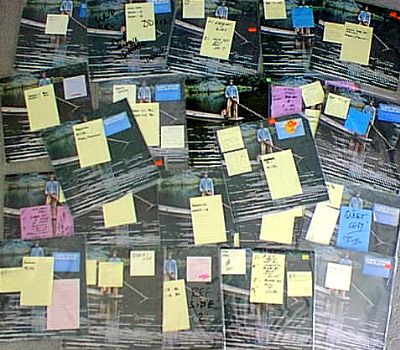
An aside: One of the first shootouts we struggled to do in the early 2000s was Houses of the Holy. We had lots of RL and other good pressings. (There is a picture of 20 of them on the blog). I had them all cleaned. Then, over the course of about three days I listened to a handful of them for a few hours at a time, this being early days and not a regular part of the work we were doing at the time.

The sound was all over the place, and the surfaces were often too noisy to appeal to audiophiles. I had no choice but to give up. I needed better playback equipment, and better cleaning technologies, which came along in 2007, and I needed more rigorous testing methodologies. Houses was too tough a nut to crack, so tought that we didn’t do our first real shootout for it until many years later, 2010.

If Robert adjusts the arm to get the sound he expects to hear on the copy of Houses his friend owns, not knowing if the copy he is playing is dull, bright, thin, fat, compressed, opaque, edgy, dry, thick, dull, recessed, etc. etc., he might end up causing all sorts of mischief with the setup.

The solution to this problem is two-fold.

  1. You must use classical music that has been recorded without the use of amplification. Violin (and other) concertos are indeed wonderful for this purpose. Pop, rock and jazz is rarely meant to recreate the kind of live performance one would hear in a concert hall. Once you have heard a number of classical concerts, you know what a real violin sounds like, and that will serve you as an invaluable guide.
  2. But do you have a good recording to test with? This is the rub. You must buy many such recordings until you find the ones that have the sound of live music. You don’t need to find the best sounding pressings of any given Heifetz record, but if you play enough of them, some of them will be obviously better than others, and those you can probably use until you find others that are even better.

Robert had a good sounding Heifetz record that he had played on his system. The sound quality was not only excellent, it was correct.

The better, the more correct it sounded on his friend’s system, the more he knew he was getting somewhere.

This is much harder to do with other kinds of music because “correct” is rarely what most recordings are going for.

Does Steely Dan’s Aja album sound correct to you? It sure doesn’t to me. It sounds great, don’t get me wrong, but correct? With all the processing they put every instrument through? And that’s assuming you have a good pressing. Not many audiophiles do, or the remastered Heavy Vinyl versions making the rounds would have been laughed out of every room they played in.

And think about this: some of Robert’s friend’s records could have sounded dramatically worse after Robert’s efforts.

(more…)

Teach Yourself Audio Using the Right Records

Advice on How to Make More Progress in Audio

If you believe what you read on the various internet sites where audiophiles gather to dispense advice about everything they think they know regarding music, recordings and equipment, you are asking for trouble and you are surely going to get it.

You will encounter an endless supply of half-truths, untruths and just plain nonsense, more often than not defended tooth and nail by those with typing skills but not much enthusiasm for the tedium of tweaking and critical listening

What kind of equipment are these people using? How deep is their experience in audio?

Truth be told, I was pretty misguided myself during the first twenty (or thirty, gulp) years I spent in audio, reading the magazines (I still have my Stereophiles and Absolute Sounds from the 70s in boxes), traipsing from one stereo showroom to another, trying to figure out what constituted “good sound” so that I could attempt to get my system to produce something closer to the best of what I was hearing.

Most of the time the demonstrations I heard made me want to go in a completely different direction.

Which is often what I ending up doing. The solutions offered by the experts, to these ears, fell far short of the expectations I had for the sound of music in my home.

Unbeknownst to me — I was far too inexperienced in audio to have a real understanding of what it was that I wanted — I was a thrillseeker, and the sound I was hearing rarely gave me anything that could be called a thrill.

So how do you learn about all this stuff?

(more…)

Welcome To the World of Hot Stampers, Where No Two Copies of an Album Sound the Same

New to the Blog? Start Here

The fundamental principle that is at the heart of understanding records is, like evolution, both a theory and a fact:

No two copies of a record sound the same.

That’s the undeniable reality of the analog LP, as well as the driving force that turned a hobby into a full-fledged livelihood for me and my staff of ten. (I have since retired and turned over the running of the business to my highly-trained, exceptionally-competent workers. They seem to like records almost as much as I still do.)

Many people find the ideas (and the prices!) on this website shocking. Frankly, they would be shocking to us too if we weren’t hearing such dramatic differences in the sound quality of the large numbers of copies we play every day.

Our staff devotes its time to finding, cleaning and playing as many pressings of an album as we can get our hands on. We take only the best sounding copies – we call them “Hot Stampers” – and make them available exclusively to those who appreciate (and can afford) the ultimate in analog sound.

What makes us unique in the world of record sellers is that we’re the only ones who base the price of their records on their sound quality. Although we’ve been finding Hot Stamper pressings for close to thirty years, it has only become the main focus of our business since the late-2000s.

(more…)

Let Us Help You Back Up Your Claims

How to Become a Better Listener

UPDATE 2026

We wrote this commentary a couple of years back and now, having played some of the Tone Poets pressings we thought would have bad sound, have updated it with all the latest information on that sorry label.

Credibility is at the heart of our many disagreements with the online audiophile community, so we felt we needed to offer a way for audiophiles to do a better job of giving some context to their opinions.


When we run experiments that include modern remastered Heavy Vinyl records, comparing them to the vintage vinyl pressings we have on hand for our shootouts, the one thing we can say about them is that they are almost certain to be inferior. (Well, almost, but not quite.)

Some are a great deal worse than others, to be sure, but they are all inferior to one degree or another.

On another blog we were taken to task — by those who felt their systems were more than adequate to judge the sound quality of the real Blue Notes compared to the new releases — for predicting that Joe Harley’s Tone Poets releases, once we finally got around to playing them, would be just as awful as all the other records he has had a hand in producing

For the thirty years since these Heavy Vinyl pressings have come along, it has seemed to us that all the evidence pointed in the same direction — namely that audiophile systems are rarely capable of showing their owners the strengths and weaknesses of the records they play.

We discussed that very issue here in some depth. Curiously, the audiophile systems of reviewers has seemed to fail them every bit as badly.

If you, speaking as an audiophile, want to make the case for the superior quality of the records put out on the Tone Poets label, we are happy to entertain the possibility. Having played Heavy Vinyl pressings by the hundreds over the past three decades, the chances of their records having sound we would find acceptable are vanishingly small, but we can’t say the chances are zero.

Repeating the tiresome truism (aren’t they all?) that because reviews are subjective, your review is as credible as any other, simply will not do.

When we wrote the above we had yet to play a Tone Poets reissue in one of our shootouts. (We’d dropped the needle on a couple, but to get deep into the sound we really needed to do a shootout with a good-sized pile of cleaned Blue Note pressings, with special emphasis on those mastered by RVG. They’re the ones that most often win shootouts.)

We actively started to search out real Blue Note pressings, on various labels from various eras, for a couple of titles. After about two years we were able to do the shootouts and report our findings.


UPDATE 2026

We have now played a couple of the Tone Poets releases, for two of the very best sounding Blue Note recordings we’ve had the pleasure to play: Dexter Gordon’s One Flight Up and Lee Morgan’s Cornbread.

To read our reviews, click on the respective links for either or both of them: One Flight Up and Cornbread.

(more…)

The Only Approach to Audio that Works

“Doing” Audio Is the Only Workable Approach to Better Sound

Best-selling author Nassim Taleb (“The Black Swan,” among many others) on why earned knowledge and immersing oneself in the smallest details of any subject lead to success:

“The knowledge we get by tinkering, via trial and error, experience, and the workings of time, in other words, contact with the earth, is vastly superior to that obtained through reasoning…”

This idea ties in to a great many commentaries we’ve written on this blog, more about records than the pursuit of higher quality audio in the home. We are, after all, in the record business, not the audio business.

This commentary describing how big questions rarely have good answers gets to the heart of why predicting which record pressings should be the best is a fool’s errand. An excerpt:

We’re really not that interested in big questions, mostly because there aren’t any big answers for them.

When it comes to records, being able to reveal deep underlying truths about a wide range of vinyl pressings is simply not possible. To be honest, we don’t think it can be done.

It’s not that we don’t have plenty of working knowledge. It’s that we have so much of it that we needed a blog to hold it all so that we could share it with others.

No, our working knowledge is made up of lots of little bits of data that guide us in discovering the best sounding pressings for the individual titles we choose to play.

It would be nice to have general rules to help us in our search for better sound on vinyl, but our experience tells us that general rules are so unreliable that they fail to function as rules at all.

And the same thinking applies to audio equipment, room treatments, turntable setup and everything else having to do with reproducing music in the home. We made the point years ago that tuning and tweaking — in other words, getting your hands dirty — is one of the best ways to improve your listening skills, which can’t help but lead to improvements in your ability to reproduce your favorite recordings. An excerpt:

Since we play all kinds of records all day, practically every day, as part of our regular shootout regimen, tweaking and tuning are much easier for us to do than they would be for most audiophiles. As I have told many in this hobby over the years, if you don’t do the work, the only person who doesn’t get to hear better sound is you. I can come home to my good sounding stereo — I’ve put in the work — but you’re stuck listening to all the problems you haven’t solved, right?

(more…)

To Find the Most Elusive Hot Stamper Records, “Press On!”

Hot Stamper Pressings of the Music of Ambrosia Available Now

“Nothing in this world can take the place of persistence. Talent will not; nothing is more common than unsuccessful people with talent. Genius will not; unrewarded genius is almost a proverb. Education will not; the world is full of educated derelicts. Persistence and determination alone are omnipotent. The slogan “press on” has solved and always will solve the problems of the human race.”

Calvin Coolidge

If you substitute “finding Hot Stamper pressings” for the words “the human race” you will better appreciate the point we are trying to make with this commentary.

ambrosiasomewhereOur story today revolves around the first Hot Stamper listing we had ever done for Ambrosia’s second — and second best — album. It took us a long time to find the right pressing.

Do you, or any of the other audiophiles you know, keep buying the same album over and over again year after year in hopes of finding a better sounding copy?

We do — and have been for more than twenty years as a matter of fact. Here’s why.

Around 2007 I stumbled upon the Hot Stampers for this record — purely by accident of course, there’s almost no other way to do it — and was shocked — shocked — to actually hear INTO the soundfield of the recording for the first time in my life, this after having played copy after frustratingly opaque copy for roughly thirty years.

(more…)

The Reward Comes After

Richard Feynman Is Another Guy with Good Advice on Making [Audio] Progress

But first let’s check in with Shane Parrish, who writes:

You have to train before the race, not after. You have to build the skill before you get the job that requires it. You have to be trustworthy for years before anyone trusts you with something important. The bill comes first. The reward comes later.

The universe does not offer financing.

This is hard to accept because modern life trains us to expect the opposite. We are addicted to “Buy Now, Pay Later.” You live in the house before you pay off the mortgage. You get the degree before you pay off the loan. You eat the meal before you ask for the check.

We are conditioned to enjoy the benefit today and pay the cost tomorrow.

Achievement reverses the transaction. It requires full payment in advance (and regular payments forever). If you want a fit body, a calm mind, a healthy relationship, or financial independence, the cost is non-negotiable. You must do the work before you get the result.

This is why most people quit. They pay a little, see nothing, and stop. They never make it far enough to see the first return arrive.


Some of this comports well with my audio experience over the last fifty years or so, but some of it does not. I feel the need to add some context to Shane’s advice when it comes to the hobby I have devoted most of my life to.

(more…)

Earned Wisdom Versus Borrowed Wisdom

Record Experiments Taught Us Practically Everything We Know

Shane Parrish writes:

Borrowed wisdom breaks under pressure because you haven’t earned it.

You’re trusting someone else’s compression without knowing what created it.

Earned wisdom, on the other hand, holds up because it’s rooted in your actual experience.

You know when it works, why it works, when to ignore it and when to bend it because you created the compression.


It’s amazing how far you can get in this hobby if you’re obsessive enough and driven enough. (See links below for more on these two drivers of success.)

To achieve real success you must be willing to devote huge amounts of time, money and effort to the pursuit of better home audio.

You will really go far if you’re willing to let your ears, not your brain, inform your understanding and appreciation of the sound of the various pressings you play.

If we thought like most audiophiles — that money buys good sound and original pressings are usually the best — we would currently be very unlikely to have a business selling a million dollars or more worth of Hot Stampers every year.

(For those new to the idea, here are the short versions of what they are and how you go about acquiring them.)

(more…)

Problem Solving in Audio

Robert Brook runs a blog called The Broken Record, with a subtitle explaining that his blog is:

A GUIDE FOR THE DEDICATED ANALOG AUDIOPHILE

We know of none better, outside of our own humble attempt to enlighten that portion of the audiophile community who love hearing music reproduced with the highest fidelity — and are willing to go the extra mile and pay the extra dollar to make that happen.

PROBLEM SOLVING in AUDIO

We have a section on the blog under the heading Making Progress that digs into the kinds of issues that audiophiles tend to run into, especially when they are first getting started. They’re the ones Robert Brook writes about in his commentary above, and they’re the ones that tripped me up over and over for decades after I first got started in this hobby sometime in the mid-70s.

It wasn’t until around 2005 that I stumbled upon, mostly through luck and audiophile friends, the elements that make up my current system.

Imagine being so clueless that you actually had to spend thirty years in a hobby before you figured out. That was me!

Of course I thought I had it all figured out right from the start. I was the proud owner of monstrously-large, ridiculously-expensive speakers, tube equipment (also expensive, and the latest and greatest cutting edge technology back in those days), Half-Speed mastered records, records made live directly to disc, fancy cables — you name it, I had everything required to play music at nearly-live levels with near-perfect fidelity.

All the most important boxes I was told about had been checked off right from the get-go in the 70s. I was all in, and for the next thirty years I did everything the audiophiles I knew liked to do: find and evaluate better gear, try new tweaks, and, more than anything else, learn to appreciate music that I had never heard before — some of it new, some of it very old.

These are all stories that have been told here on the blog in hundreds and hundreds of posts.

Everything changed when I started doing audio and records in ways that nobody I knew had ever done them before. (That also is a story that has been frequently told here.)

Taking the approach to audio and software that audiophiles tend to take — the bulk of the story Robert Brook tells in his commentary — can only get you so far. That’s the lesson I learned after spending my first thirty years in the hobby.

It’s why this blog is devoted to one concept above all others — the importance of being skeptical.

Requiring empirical evidence to back up whatever I might choose to believe was the shock that my system — my nervous one, as well as my audio one — needed to jolt it out of its comfort zone and force it to come up with a better way.

At the start I believed what I was told — hey, it seemed to be working, and who was I to argue with the “experts” anyway? I went along with the crowd, and I got the average results crowds tend to get.

This blog, as well as Robert’s, is simply trying to help you circumvent the bad ideas that we run into everywhere in audio these days. We’ve tried lots of them, most of them didn’t work, or didn’t work very well, and the good news for you, dear reader, is that we found others that we know do work.

(more…)

The Law of Large Numbers Can Help You Find Better Records

More Commentaries for Heavy Vinyl LPs

Presenting another entry in our series of big picture observations concerning records and audio.

One of our good customers had this to say about some Hot Stampers he purchased recently:

Hey Tom,   

I’m going out of my frigging mind on this White Hot stamper of Roy Orbison Greatest Hits. What a piece of sh*t is my DCC test pressing.

Naz

Naz,

I actually used to like the DCC vinyl. I suspect you did too back in the day.

Then my stereo got a lot better, which I write about under the heading progress in audio.

Eventually it became obvious to me what was wrong with practically all of the Heavy Vinyl pressings that were put out by that label.

The good ones can be found in this group, along with other Heavy Vinyl pressings we liked or used to like.

The bad ones can be found in this group.

And those in the middle end up in this group.

Audio and record collecting (they go hand in hand) are hard. If you think either one is easy you are most likely not doing it right,, but what makes our twin hobbies compelling enough to keep us involved over the course of a lifetime is one simple fact, which is this: Although we know so little at the start, and we have so much to learn, the journey itself into the world of music and sound turns out to be not only addictive, but a great deal of fun.

Every listing in this section is about knowing now what I didn’t know then, and there is enough of that material to fill its own blog if I would simply take the time to write it all down.

Every album shootout we do is a chance to learn something new about records. When you do them all day, every day, you learn things that no one else could possibly know who hasn’t done the work of comparing thousands of pressings with thousands of other pressings.

The Law of large numbers[1] tells us that in the world of records, more is better. We’ve taken that law and turned it into a business.

It’s the only way to find Better Records.

Not the records that you think are better.

No, truly better records are the records that we proved to be better empirically, by employing rigorous scientific methodologies that we have laid out in detail for anyone to read and follow.

Being willing to make lots of mistakes is part of our secret, and we admit to making a lot of them

(more…)