Mercury (Orchestral) – Reviews, Commentaries, Letters, etc.

Orchestral Music Is the Ultimate Test for Proper Turntable-Arm-Cartridge Setup

Hot Stamper Pressings of the Music of Stravinsky Available Now

Dorati’s performance of The Firebird for Mercury is excellent for adjusting tracking weight, VTA, azimuth and the like.

A huge and powerful recording such as The Firebird quickly separates the men from the boys when it comes to the honest recreation of an orchestra performing live in a concert hall.

Recordings of this quality are the reason $10,000+ front ends exist in the first place. Just ask Robert Brook.

You don’t need to spend that kind of money to play this record, but if you do, this might just be the record that will show you what you got for all your hard-earned dough.

Ideally you would want to work your setup magic at home with this record, then take it to a friend’s house and see if the same results could be achieved on his system.

I actually did this sort of thing for years.

Sadly, not so much anymore; nobody I know can play records such as these the way we can.

Playing and critically evaluating records all day, every day, year after year, you get pretty good at it. And the more you do it, the easier it gets.


UPDATE 2025

The above was written about ten years ago. By then I had learned enough to know that all the systems my audio friends owned were woefully inadequate to the proper reproducton of sonic blockbusters such as The Firebird. They simply hadn’t spent the money on their equipment or done the tweaking and tuning work that it takes to play a magnificent recording such as this.

It was about this time that I stopped visiting them. In my experience, mediocre sound is not simply a matter of being less enjoyable than good sound. In fact, I found it to be the opposite of enjoyable. It was frustrating, irritating and unpleasant, and I wanted no part of it. My friends couldn’t hear what was wrong — they had nothing better to compare the sound to. I knew how much better it could sound because I had the killer pressings and the highly-tweaked system that were able to work magic on orchestral spectaculars like The Firebird. (More on that subject here.)

By the way, Robert Brook can get your front end tuned up and working right.

We highly recommend his new service. It might just put you on the path to achieving the next level in audio. (You will definitely struggle to get there with a table, arm and cartridge that aren’t set up with a high degree of precision by a person who knows what they are doing, and Robert has been doing this work for years now.)


Properly set VTA is especially critical on this record, as it is on most classical recordings. The smallest change will dramatically affect the timbre, texture and harmonic information of the strings, as well as all the other instruments of the symphony orchestra of course.

(more…)

A Scheherazade that Lacks Power in the Brass and Richness in the Lower Strings? No Thanks

Hot Stamper Pressings of the Music of Rimsky-Korsakov Available Now

One of the most dynamic Scheherazade‘s on record. The brass really blasts through in this recording. 

Of course the question is how does this recording stack up to the famous Reiner. Well, I’ll tell you.

The Minneapolis Symphony Orchestra is not in the same league with the CSO, that’s well known. Dorati may be every bit as talented as Reiner, but he doesn’t have the players at his disposal capable of pulling off demanding material such as this.

But the orchestra acquits itself well here. The first violinist is quite good. That’s not the problem.

What lets the side down is the Mercury recording team, who fail to adequately present the weight of the orchestra in the lower midrange and below. One thing I noticed recently when playing an original LSC 2446 was how rich and powerful the sound was in the lower strings and in the brass relative to later pressings of the same title and other recordings of the work.

That opening movement of Scheherazade needs power down there and the Mercury simply doesn’t have enough of that power to qualify it as one of the top sounding Mercs.

(more…)

Is CTFR-1 Dark and Congested, or Flat and Bright?

Hot Stamper Pressings of Mercury Classical Records Available Now

For Mercury classical and orchestral recordings, the original RFR-1 pressings on the plum label are the way to go, right? 

In some cases, yes. The first pressings of Mercury albums often win our shootouts.

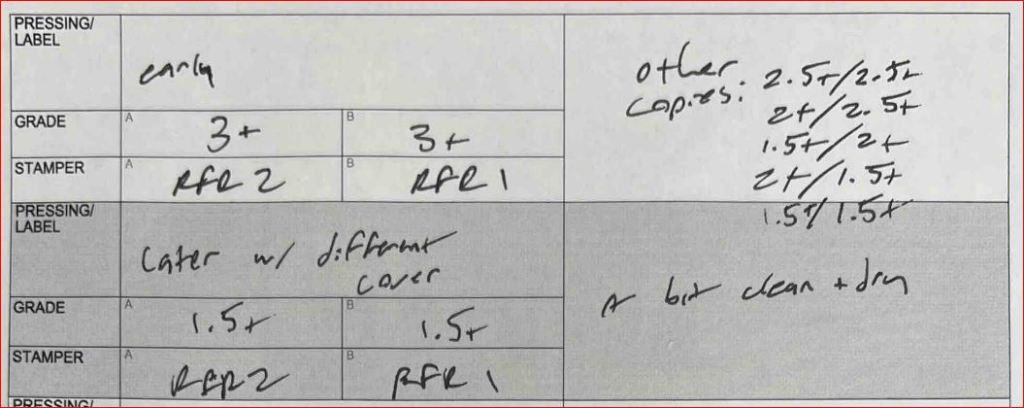
And for both sides of a copy to win a shootout, like our gold promo seen in the stamper sheet below, everything about the pressing must be right. We call records that win their shootout, earning 3+ grades on both sides, Top Shelf pressings. They are rare and special enough to have a section of their own on the site (which, as of this writing, has all of 19 records in it.)

What we find to be interesting about this specific shootout, however, is that we had two later pressings, both with the same stampers, and they sounded markedly different from each other. (Note that the stamper numbers you see below belong to a different album than the one shown above.)

If a collector were to tell you that that the CTFR pressings tend to be dark and congested, and you owned one with the exact same stampers, CTFR-1, you might be inclined to agree with this person.

But if you were the owner of the copy we played that was flat and bright, again, with CTFR-1 in the dead wax of both sides, you would think this person was 1.) Out of his mind, or, 2.) Deaf as a post, or, 3.) The owner of some very inaccurate playback equipment.

He could be all three, but in this case, an unusual one to be sure, his copy of the album doesn’t tell you anything about the sound of your copy of the album. They could match, or they could be completely different. Some records are like that. Not all that many, but definitely some.

Sample Sizes and One Man Bands

Those of us who play a variety of pressings of the same album know how easy it is to draw mistaken conclusions about records. CTFR-1 on this title is the perfect example of a record whose stampers don’t tell you much about its sound. (Even RFR-1 on side one of one copy was no better than “good,” quite a long ways from the best.)

(more…)

Our Shootout Winner Needed to Solve Some Common Problems with Mercury Recordings

Hot Stamper Pressings Featuring the Violin Available Now

We described our shootout winning copy of Szeryng Plays the Music of Fritz Kreisler this way:

With INCREDIBLE Shootout Winning Triple Plus (A+++) sound from first note to last, this Plum Label Mercury stereo pressing (the first copy to ever hit the site) is doing everything right.

The violin is so sweet and present, so rich, natural and real, you will forget you’re listening to a record at all.

This recording is not your typical dry, bright, nasaly, upper-midrangy Merc – the sound is rich and smooth like a good London, with a big stage and lovely transparency.

As is sometimes the nature of the beast with these early pressings, there are marks that play, but if you can tough those out, this copy is going to blow your mind.

Here are the notes that back up what we said above:

Notice that on side one, track four, we mention “not strident,” and the second track we note it’s “not too dry.”

Side has a note to the effect that it’s “kinda rich” and “not too bright.”

This tells you that practically all the other copies had these kinds of problems, something that anyone with a good selection of Mercury violin recordings is sure to know.

Our job is to find the pressings that not strident, not dry, not bright, and richer than others.

When you buy a top copy of an album from us, you don’t hear those problems because they are mostly not there.

What you hear is a side one that is:

  • Much fuller and 3-D, with a
  • Sweet and lively violin, one with
  • The most space

On side two you hear more of the same, and that’s a good thing:

  • 3-D and alive violin
  • Kinda rich
  • More dynamic and jumping out
  • Not too bright

Probably not the best solo violin recording we’ve ever sold, but certainly one of the best.

(more…)

Hungarian Rhapsodies 1, 4, 5 & 6 – Wait a Minute

Hot Stamper Pressings of Orchestral Spectaculars Available Now

1963 was a phenomenal year for audiophile quality recordings, but this is not one of the better records produced that year. Far from it.

The sound of our vintage Mercury here, SR 90371, was awful. The overall sound was crude and the strings were shrill.

It has been our experience that many Mercury recordings suffer from these shortcomings.

But wait a minute.

Dorati recorded Hungarian Rhapsodies 2 and 3 with the London Symphony for Mercury, and those can sound amazing when you get hold of a good one.

How did they get this one so wrong?

We don’t know, and we doubt anyone else does either.

Like so many realities of the world of records, it’s a mystery, one that is very unlikely to be solved.

One of the best reasons mysteries such as this have little chance of being solved is that no one with any real expertise, using methodologies that are reliable and reproducible in any serious way, is taking on this kind of work — besides us.

We actually like testing records, and we refined* a method for doing it that is as reliable and reproducible as any method can be in the world of audio: the record shootout.

(more…)

What’s on Your Turntable and Why?

Robert Brook runs a blog called The Broken Record, with a subtitle explaining that his blog is:

A GUIDE FOR THE DEDICATED ANALOG AUDIOPHILE

Here is Robert’s latest posting.

WHAT’s On Your TURNTABLE? and WHY?

You say your stereo is having trouble playing challenging recordings like The Firebird with Dorati?

You can’t get the strings in the loudest passages to sound the way you think they should? Too screechy are they? Or too smeary? Or too thin? Or too hard? Or even congested and almost distorted in the climaxes?

It’s amazing how many different ways there are for strings on an orchestral recording to sound wrong. If getting The Firebird’s strings to sound right is a goal you wish to achieve, you, my friend, have your work cut out for you.

Because nothing in audio is harder than reproducing the massed strings on the biggest, boldest orchestral recordings.

We have some good test discs for that specific purpose, but it will take a real commitment from you to bring about the success you seek.

Audio Is Hard

This is a drum we have been banging on for as long as I can remember, to the constant irritation of every less-than-serious audiophile who comes in contact with us — which all well and good. We haven’t catered to that crowd since we gave up on Heavy Vinyl in 2007.

We’re trying to reach a much smaller subgroup of more serious enthusiasts with our approach to audio and records. See here, here and here, and there are great many more discussions to be found on our audio advice page.

If you want to achieve any real success in audio, you need to do a lot of work and spend a fair amount of money. Not a fortune, maybe not even six figures, but trying to do audio on the cheap is a fool’s errand. It can’t be done.

Why is it any of our business how your system sounds? If it’s good enough for you, why isn’t it good enough for us?

A true Hi-Fidelity rig is in fact what makes our business possible.

Without top quality sound, our records can’t possibly be worth the admittedly high prices we charge for them.

We want to help you take audio to the next level for two reasons: one, because that’s where our records really come to life, and two, that’s where the shortcomings of the modern Heavy Vinyl reissue are too glaringly obvious to ignore.

I found a way to get there. Like me, Robert Brook found a way.

We believe that the more time you spend following the advice on our two blogs explaining how we got to where we are now, the clearer the path forward will be. We hope you can learn from our experience. It will cost you nothing and might just save you a great deal of money.

(more…)

The Reissues Consistently Beat the Originals on this Mystery Mercury

Hot Stamper Pressings of Mercury Classical Records Available Now

For Mercury classical and orchestral recordings, the original FR pressings on the plum labels are the way to go, right? 

In some cases, yes. We talk about how much better the FR pressings for The Firebird are compared to the much more common, and still quite good, M2 reissue pressings here.

The stamper numbers you see below belong to a different album.

The notes for the FR originals we played read:

  • Tubey but never as open or dynamic as RFR-1 can be.

The better of the three FR pressings we played was not a bad sounding record, earning a grade of 2+. They’re just not as good sounding as the RFR reissues, which, of course, are the ones that win shootouts.

Something to keep in mind: A Super Hot Stamper Mercury orchestral record is guaranteed to be dramatically better than any Heavy Vinyl reissue ever made.

(more…)

Mercury Produced a Truly Awful Collection of Verdi Overtures in 1959

Hot Stamper Classical and Orchestral Pressings Available Now

The sound of this 1959 Mercury release, SR 90156, is terrible. It’s crude and hot like an “old record,” a sound we find on far too many vintage pressings. The world is full of old records that just sound like old records. We’ve suffered through them by the tens of thousands.

Our website, as well as this blog, are devoted to helping audiophiles find pressings that don’t sound anything like the millions of run-of-the-mill LPs that have been stamped out over the last seven decades.

Even a million dollar stereo can’t make the average record sound good, and the more accurate and revealing the system, the more limited and lifeless the average record will show itself to be.

There are quite a number of others that we’ve run into over the years with similar shortcomings. Here they are, broken down by label.

(more…)

The Enigma Variations on Mercury Was Not to Our Liking (Although We Sure Love the Cover)

Neither the sound nor the performance of this 1959 Mercury (SR 90125) impressed us when we did a shootout for the work years ago.

The performance of the Enigma Variations here seems rushed, and the two other recordings of the work that we like, one on Philips, the other on RCA, are better.

The Philips with Haitink is probably the better of the time and our favorite at this time. Of the three recordings that we felt had the best combination of music and sound, the Merc with Barbarolli was our least favorite, so we decided to concentrate on the best two recordings in our shootout and get rid of the Mercury pressings we had on hand.

(more…)

This Mercury Copland Record Had Screechy, Shrill Strings

Hot Stamper Classical and Orchestral Pressings Available Now

Our notes for SR 90246 read:

Lively and clear but screechy strings. Dry and bright sound.

To help you avoid records with these sonic faults, we’ve linked below to others with similar problems.

Here are some titles we’ve found that tend to have dry sound, and here are some that tend to have bright sound.

And of course shrill strings are the kiss of death on any orchestral record. (Classic Records, I’m talking to you!)

None?

None of the copies of SR 90246 we played were any good, but the RFR3 / RFR6 was the worst of the bunch.

Are there good sounding pressings of the recording?

There may well be. We didn’t hear any, but that doesn’t mean they don’t exist.

However, we have no intention of spending more money trying to find them. If you know of some killer stampers for the album, please shoot us an email.

We tend to like Dorati’s work with the London Symphony Orchestra, but in this case the better Dorati/Copland record was recorded in Minneapolis in 1959, SR 90172.

If You’re a Fan

If you’re a fan of Mercury Living Presence records — and what right-thinking audiophile wouldn’t be? — have you noticed that many of them, this one for example, don’t sound very good?

If you’re an audiophile with good equipment, you should have.

But did you? Or did you buy into the hype surrounding these rare pressings and just ignore the problems with the sound?

(more…)