
8-2025

Another Knockout for Indianapolis, and It Was Rarely Even Close

Hot Stamper Pressings of Living Stereo Recordings Available Now

Below you will see the complete stamper sheet for a shootout we did in 2024.

Note that the album you see pictured is not the record we did the shootout for.

For RCA classical and orchestral recordings, many collectors think that the earliest pressings on the Shaded Dog label, in stereo, pressed in Indianapolis, tend to be the best sounding. 

More often than not, a rule of thumb like that one turns out to be right, which is how it got to be a rule of thumb in the first place. In this shootout, it turned out to be as right as rain.

The best pressingss with 1s stampers beat the 2s which beat the3s. Indianapolis was once again the pressing plant that produced the best sounding copies.
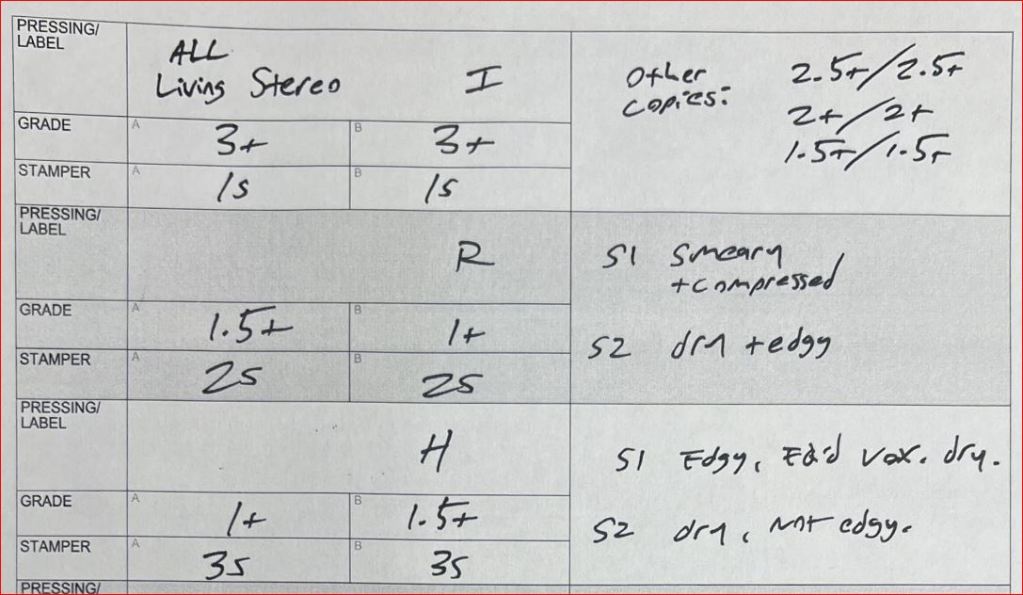
In fact, in this case the differences were even starker than we would have imagined going in. No copy not pressed in Indianapolis was even saleable, since a record that does not earn a grade of at least 1.5+ on both sides can qualify as a Hot Stamper pressing.

Fortunately, even though we were buying them randomly, we managed to luck out to some degree by finding many more 1s pressings than later-numbered ones.

Key Takeaways

  • 1s/1s is by far the best stamper for this mystery title, as collector wisdom would have predicted.
  • Indianapolis produced the best sounding pressings in this shootout, again, as predicted.
  • At some point collector wisdom fails us, as the Shootout Winning stampers (3+) and the good, not great stampers (1.5+) turned out to be the same stampers. This means that:
  • 1s is no guarantee of top quality sound. It follows that:
  • 1s might be the hot ticket, the 3/3 winner, but the odds, four to one, are against it. Again, it follows that:
  • As is almost always the case, the 1s pressing is most likely to be one of a bunch of potentially hot tickets.


(more…)

Orchestral Music Is the Ultimate Test for Proper Turntable-Arm-Cartridge Setup

Hot Stamper Pressings of the Music of Stravinsky Available Now

Dorati’s performance of The Firebird for Mercury is excellent for adjusting tracking weight, VTA, azimuth and the like.

A huge and powerful recording such as The Firebird quickly separates the men from the boys when it comes to the honest recreation of an orchestra performing live in a concert hall.

Recordings of this quality are the reason $10,000+ front ends exist in the first place. Just ask Robert Brook.

You don’t need to spend that kind of money to play this record, but if you do, this might just be the record that will show you what you got for all your hard-earned dough.

Ideally you would want to work your setup magic at home with this record, then take it to a friend’s house and see if the same results could be achieved on his system.

I actually did this sort of thing for years.

Sadly, not so much anymore; nobody I know can play records such as these the way we can.

Playing and critically evaluating records all day, every day, year after year, you get pretty good at it. And the more you do it, the easier it gets.


UPDATE 2025

The above was written about ten years ago. By then I had learned enough to know that all the systems my audio friends owned were woefully inadequate to the proper reproducton of sonic blockbusters such as The Firebird. They simply hadn’t spent the money on their equipment or done the tweaking and tuning work that it takes to play a magnificent recording such as this.

It was about this time that I stopped visiting them. In my experience, mediocre sound is not simply a matter of being less enjoyable than good sound. In fact, I found it to be the opposite of enjoyable. It was frustrating, irritating and unpleasant, and I wanted no part of it. My friends couldn’t hear what was wrong — they had nothing better to compare the sound to. I knew how much better it could sound because I had the killer pressings and the highly-tweaked system that were able to work magic on orchestral spectaculars like The Firebird. (More on that subject here.)

By the way, Robert Brook can get your front end tuned up and working right.

We highly recommend his new service. It might just put you on the path to achieving the next level in audio. (You will definitely struggle to get there with a table, arm and cartridge that aren’t set up with a high degree of precision by a person who knows what they are doing, and Robert has been doing this work for years now.)


Properly set VTA is especially critical on this record, as it is on most classical recordings. The smallest change will dramatically affect the timbre, texture and harmonic information of the strings, as well as all the other instruments of the symphony orchestra of course.

(more…)

In the Real World, You Can Only Choose Two Out of Three

More Heavy Vinyl Commentaries and Reviews

I got this idea while thinking about the old saying:

Fast, cheap and good – pick two.

I’ve modified this saying into a version for audiophiles that takes into account that although some record collectors with top quality equipment may want to pursue the modern Heavy Vinyl pressing, they will run into the unavoidable reality that as their stereo continues to sound better, their new Heavy Vinyl records will start sounding worse.

They may want to get many things out of audio and record collecting, but they can’t have it all.

As will explain in detail further on, they will be forced to limit themselves to two of the following three.

Let’s assume that the audiophiles who collect modern records are those who:

  1. Want to have a revealing, accurate stereo.
  2. Want to be able to enjoy their favorite music.
  3. Want to continue to buy Heavy Vinyl pressings because they enjoy buying and collecting those records.

So let’s look at what happens when they pick one of the only three combinations that are logically available to them:

If they pick one and two, they get to keep their good stereo, and they can continue to enjoy their favorite music on it, but they will not be able to play Heavy Vinyl pressings anymore and will have to stop buying them.

On high-quality equipment those records reveal their manifest shortcomings and are simply no fun to play. They can have one and two but not three.

Damn!

What about one and three then?

If they pick one and three, they can still have excellent stereo reproduction in the home, and they can still buy and collect Heavy Vinyl pressings to their heart’s content, but they will not be able to enjoy the pressings they buy. Those pressings will simply not sound very good on a system that is working properly.

One hopes that before too long these folks will recognize that all they were doing was buying junk vinyl from the grifters exploiting the lo-fi and mid-fi crowd while pretending to appeal to the higher end of the market.

The lo-fi/mid-fi types are those who, lacking high-quality playback, are simply not able to tell the difference. Good systems make it easy to expose the incompetence of the pretentious hacks who make these new records.

Bad systems let them get away with murder.

(more…)