The piano sounds lifelike right from the start, a beautiful instrument in a natural space, tonally correct from top to bottom.
This copy makes it clear that this is an exceptional Demo Disc quality recording for Contemporary, and that’s saying a lot.
It’s all tube, live-to-two-track direct from the Contemporary studio. It’s pretty much everything you want in a recording from this era.
How can you beat a Roy DuNann piano trio recording? We have a good supply of Hot Stamper pressings of great jazz piano recordings, but the ones we offer on Contemporary set a standard that few other labels have ever been able to meet.
Talk About Timbre
Man, when you play a Hot Stamper copy of an amazing recording such as My Fair Lady, the timbre of the instruments is so spot-on it makes all the hard work and money you’ve put into your stereo more than pay off. To paraphrase The Hollies, you get paid back with interest.
If you hear anything funny in the mids and highs of this record, don’t blame the record.
If you are checking for richness, Tubey Magic and freedom from artificiality, I can’t think of a better test disc.
Side One
Get Me To The Church On Time
On The Street Where You Live
I’ve Grown Accustomed To Her Face
Wouldn’t It Be Loverly
Side Two
Ascot Gavotte
Show Me
With A Little Bit Of Luck
I Could Have Danced All Night
The Story of the Album
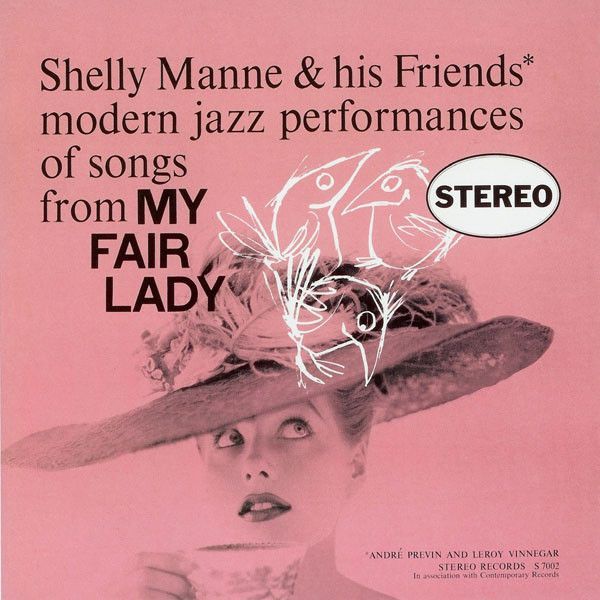
Shelly Manne & his Friends* (*André Previn and Leroy Vinnegar): modern jazz performances of songs from My Fair Lady, as the full name appeared on the 12-inch LP jacket (Contemporary Records C3527), was begun when drummer Shelly Manne, pianist André Previn, and bassist Leroy Vinnegar assembled on August 17, 1956, in the Contemporary studios in Los Angeles to produce an album of jazz versions of miscellaneous show tunes. (The three, having already recorded together as “Shelly Manne and His Friends,” had some experience performing as a trio.)
Previn and Manne were exchanging ideas with producer Lester Koenig, who suggested they do some tunes from the current Broadway musical My Fair Lady. Manne and Previn were so impressed with the Lerner and Loewe songs for the show, that they decided to record more of them. They ended up filling the entire album with My Fair Lady tunes. Koenig brought in the complete score, and that evening Manne and Previn, between them, worked out the arrangements and recorded the entire album in one session, with Vinnegar providing the third “very important musical voice in the trio.”
Lively and appealing, and clearly aimed at popular taste, the music also showed some daring, in the vein of the experimentation that was a factor in much West Coast jazz in the 1950s. Previn, with considerable musical training, and having composed several film scores himself, was able to suggest certain technical modifications to the harmony and other aspects of the music. Manne, as the date’s leader, provided suggestions of his own, for example to treat what was a fast number in the show as a slow ballad instead. The final number, “I Could Have Danced All Night,” was given a Latin touch, with Manne even adding the sound of a tambourine. “There was a total thing going back and forth,” as Manne later put it.
The sound was recorded by Roy DuNann, later recognized as one of the great recording engineers.
-Wikipedia
Further Reading