Half-Speeds – Complete

Chicago Transit Authority on MoFi

Hot Stamper Pressings of the Music of Chicago Available Now

The last time I played a copy of the MoFi Chicago debut was at least twenty years ago. The all tube system I had back then was much darker and dramatically less resolving than the one I have now, having made score upon score of improvements in every area of reproduction in the interim.

I actually had some nice things to say about it. I didn’t find it too bright the way so many MoFi pressings are. Here’s what I wrote all those years ago:

What do we like about this MoFi?

For one thing it doesn’t have the phony boosted top end most of their pressings do. It was mastered by Jack Hunt, not Stan Ricker, and Jack Hunt likes to EQ his projects without all the extra top end that made Mobile Fidelity famous. (Great for dull speakers, don’t you know.)

The other thing this MoFi has going for it is tons of weight down where it needs it, in the all-important lower midrange, and extending well into the mid-bass area.

Chicago is about brass and you want that brass to have weight and power.

So many domestic copies are leaned out, and many are hard sounding. On both counts this MoFi excels over copies with those problems. Our White Hot Stamper was definitely better, but we don’t find those very often, not to mention the fact that we happened to charge a ton of money for it.

I did take issue with the MoFi bass though.

This is where your MoFi falls apart, as good as it may be in other areas.

There IS no lower octave of bass on their pressing.
(more…)

So at 45 RPM – One Side Bad, Another Awful, What’s a Mother to Do?

Hot Stamper Pressings of the Music of Peter Gabriel Available Now

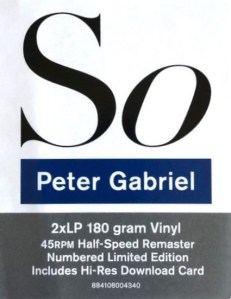
In 2016 a version of So came out using this currently popular vinyl format:

2 180g discs / 45 RPM / Deluxe, Numbered, Limited Edition /Half Speed mastered

As of this writing, there are 15 copies on Discogs, the cheapest of them starting at $139.77.

Sounds like it must be pretty good for that kind of money!

This So release was mastered by a fellow named Matt Colton, who has been doing this kind of work for a very long time, judging by the fact that he has 3,775 technical credits under his name on Discogs.

That did not stop this particular 2 LP set from being one of the worst sounding albums we have played in quite a while.

Let’s take a closer look at the specifics. We played sides one and four of the two-disc, four-sided album. That was more than enough to evaluate the sound quality.

(more…)

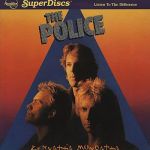
Zenyatta Mondatta on Nautilus SuperDisc

More of the Music of Sting and The Police

This commentary was most likely written in the mid-2000s, shortly after we had started to sell Hot Stamper pressings but had to yet to make it our main business, which we did in 2007.

2007 was a long time ago. It was the year we made many breakthroughs. In fact, we made more breakthroughs in that year than in any other in the history of the company, including this singularly important break with the past.


Our Take Back in the Day

And to think we actually used to like the sound of some of these Nautilus pressings!

They suffer from the same shortcomings other Nautilus and Half Speeds in general suffer from — the kind of transparent but lifeless and oh-so-boring sound that we describe in listing after listing.

Three of the Best?

I just did shootouts with three of what I thought were the best Nautilus Half-Speeds: Dreamboat Annie, Ghost in the Machine, and Time Loves a Her0.

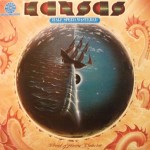
None of them sound like the real thing, and especially disappointing was one of my former favorites, the Little Feat album.

On the title track, the Nautilus is amazingly transparent and sweet sounding. There are no real dynamics or bass on that track, so the “pretty” half-speed does what it does best and shines. But all the other tracks suck in exactly the same way Night and Day does. Cutting the balls off Little Feat is not my idea of hi-fidelity.

We put audiophile beaters up for sale every week. Each and every one of them is a lesson on what makes one record sound better than another. If you want a wall full of good sounding records, we can help you make that happen. In fact it will be our pleasure. Down with audiophile junk and up with Better Records. (more…)

Close to the Edge – A MoFi Winner, Or Was It? We’ll Never Really Know

Hot Stamper Pressings of the Music of Yes Available Now

Sonic Grade: Side One: B to B+ / Side Two: C


Many, many years ago (2005?) we wrote the commentary you see below. We can’t say if we would still agree with the sentiments expressed, so take what you read with a grain of salt, and remember that no two records sound the same. If your copy is better or worse on either side, it will not come as a surprise to us here at Better Records.


This is a great MOFI! (On side one anyway.) I have to admit I was partly wrong about this pressing. I used to think it was mud. Either the copy I have here is much better than the copy I played years ago, or my stereo has changed. I’m going to guess that it’s the stereo that has changed. I used to like the original American copies of this album and now I hear that they are upper midrangy and aggressive. [*] So my stereo must have been too forgiving in that area, which in turn would have made this MOFI sound too dull. [**]

Side one is as good as I’ve ever heard it outside of the best British originals. [We don’t even buy those anymore. Maybe that’s the problem with this comparison.] Since almost none of those have survived in clean enough condition to be played on modern audiophile turntables, there isn’t much of an alternative to this pressing.

And it should be noted that there is distortion on the tape. It’s on every LP copy and it’s on the CD too. There are cacophonous passages that have what sounds like board overload, mike preamp overload, tape saturation or something of the kind.

Eddie Offord, the recording engineer, is famous for complaining that the boys in the band were totally out of control when it came to adding layer upon layer and track upon track to their recordings, running the risk of creating such a dense mix that nothing would be heard above the din. He was always fighting a losing battle trying to rein them in. Although he did his best, it appears his efforts failed in some of the musical passages on this album.

So here’s a MOFI I like, but I only really like side one. Side two, although it’s decent enough, errs a little on the smooth, dull side. I have copies in which the guitars have wonderfully extended harmonics and sweeter tone. Some of them are even domestic pressings! On the MOFI there is a “blunting” of the acoustic guitar transients.

[*] Some pressings are indeed bright and aggressive, but that just shows how little I knew about the album in 2005. The later domestic pressings, and even some of the 4 digit catalog pressings, can indeed sound that way. Eventually I would figure out what the good stampers were and then I would no longer be as ignorant as I so clearly was when I wrote this. As for more stuff we’ve gotten wrong, you can find some of it here, under the heading: live and learn.

[**] My stereo was indeed too dark and forgiving back in those days. The way I know that is that records that are too bright and upper-midrangy to play now played just fine twenty years ago.

(more…)

Can You Believe I Actually Used to Like this CBS Half-Speed?

More of the Music of Boston

Reviews and Commentaries for the Music of Boston

Sonic Grade: D

Lack of weight down low — or as we like to call it, lack of whomp factor [1] — is the main reason Half-Speed mastered records so often come up short when played against their real-time-mastered competition. The highs can be good, the mids can be good, but the bottom end is almost always lacking, which is exactly the problem here.

You can be sure that Boston would not have wanted, nor would they have ever been willing to accept, the kind of anemic sound that the CBS Half-Speed delivers.

The CBS is cut clean from a good tape, so it easily beats the bad domestic pressings, of which there are many.

But it doesn’t rock.

What good is a Boston record that doesn’t rock? It’s a contradiction in terms; they’re a rock band.

The band, as well as their amazingly well recorded debut album, have no other reason to exist.

Transparency is a nice quality, but when it comes at the expense of the energy and power of the music, especially down low, then it comes at too high a price, especially for those of us who have full-range systems and like to play them loud.

We talk about the shortcomings of transparent audiophile records here:

(more…)

Why Is It So Hard for Mobile Fidelity to Get the Midrange Right?

Hot Stamper Pressings of the Music of Joni Mitchell Available Now

We recently auditioned the Mobile Fidelity One-Step pressing of Blue and made the notes regarding the sound you see below.

We focussed on the quality of their pressing’s vocal reproduction, for the simple reason that a Joni Mitchell album that gets the vocals wrong is a Joni Mitchell album that no music lover and certainly no audiophile  would ever want to play.

The fact that some audiophiles do want to play this record speaks poorly of their ability to reproduce it properly. Accurate playback will reveal the problems with Joni’s voice described in detail below. The post-it for side one is on the left, for side two on the right.

We try to be very specific about the shortcomings of these records, which is why we reproduce our notes whenever they are available.

Side One

  • Tonally not far off, a bit too stringy and flat. Not awful. Congested vocals at peaks, harsh. 1+

Side Two

  • Vocal peaks like “traveling, traveling, traveling…” or “California” get squashed and harsh, lacking the real dynamics, presence and space of the vocals. No grade. (Awful in other words.)

(more…)

Music from Big Pink on MoFi – Bad Bass Like This Is Just Annoying

Hot Stamper Pressings of Music by The Band Available Now

In 2012 the “new” MoFi put out another remastered Big Pink. Since their track record at this point is, to be honest, abysmal, we have not felt the need to audition it.

It’s very possible, even likely, that they restored some of the bass that’s missing from so many of the originals.

But bad half-speed mastered bass — poorly defined, never very deep and never punchy — is that the kind of bass that would even be desirable?

To us, it is very much a problem. Bad bass is just plain annoying.

Fortunately for all, it is a problem we have to deal with much less often now that we’ve all but stopped playing Half-Speed mastered records.

Here are some other records with exceptionally sloppy bass. If the bass on these records does not sound sloppy, you have your work cut out for you.

Some of our favorite records for testing bass definition can be found here.

Sucked Out Mids

The Doors first album was yet another obvious example of MoFi’s predilection for sucked-out mids. Scooping out the middle of the midrange has the effect of creating an artificial sense of depth where none belongs.

Play any original Bruce Botnick-engineered album by Love or The Doors and you will notice immediately that the vocals are front and center. 

(more…)

Super Session – A Jack Hunt Mastered MoFi Winner

Hot Stamper Pressings of Music Produced or Performed by Al Kooper Available Now

Sonic Grade: B

Super Session is one of the best-sounding MoFi pressings. The midrange sounds wonderful — silky sweet and transparent. Not having been cut by Stan Ricker, the top end doesn’t have that SR/2 boost. Overall it’s a very nice sounding record, and the music just can’t be beat. 

In fact, it was actually mastered by Jack Hunt, a man we know to be responsible for some of the thickest, dullest, deadest MoFi recuts found in their shameful catalog.

But he did a pretty good job on this one, and for that he deserves some credit.

(more…)

Point of Know Return – CBS Half-Speed Reviewed

Hot Stamper Pressings of Proggy Rock Albums Available Now

Both this album and Leftoverture are way too bright and thin.

What were the engineers thinking — that brighter equals better?

In the case of these two titles it most definitely does not. It’s the sound that most audiophiles are fooled by to this day.

Brighter and more detailed is rarely better. Most of the time it’s just brighter. Not many half-speed mastered audiophile records are dull. They’re bright because the audiophiles who bought them preferred that sound. I did too, a couple of decades ago [make that four decades ago].

Hopefully we’ve all learned our lessons by now, expensive and embarrassing as such lessons usually turn out to be. 

Waking Up a Dull Stereo

If your system is dull, dull, deadly dull, the way older systems tend to be, this record has the hyped-up sound to bring it to life in no time.

There are scores of commentaries on the site about the huge improvements in audio available to the discerning (and well-healed) audiophile. It’s the reason Hot Stampers can and do sound dramatically better than their Heavy Vinyl or Audiophile counterparts: because your stereo is good enough to show you the difference.

With an old school system you will continue to be fooled by bad records, just as I and all my audio buds were fooled thirty and forty years ago. Audio has improved immensely in that time. If you’re still playing Heavy Vinyl and Audiophile pressings, there’s a world of sound you’re missing. We discussed the issue in this commentary:

My advice is to get better equipment and that will allow you to do a better job of recognizing bad records when you play them.

(more…)

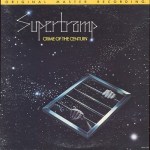
Dreamer Tells You What You Need to Know About this MoFi

Hot Stamper Pressings of the Music of Supertramp Available Now

This commentary was written about 2000, when the Speakers Corner pressing had just come out. We liked it back then, but I doubt we would care much for it now.

Listen to the vocals at the end of Dreamer.

If they are too bright, the bells at the end of the song sound super-extended and harmonically clear and clean.

But at what price? Now the vocals are too bright. Which is more important, good vocals or good bells?

There has to be balance. This is something audiophiles — and audiophile labels, who should obviously know better — seem to have difficulty appreciating.

We used to get these MoFis in on a regular basis, and they usually sound as phony and wrong as can be. They’re the perfect example of a hyped-up audiophile record that appeals to people with lifeless stereos, the kind that need amped-up records to get them to come to life.

I’ve been telling people for years that the MoFi was junk, and that they should get rid of their copy and replace it with a tonally correct version, easily done since there is a very good sounding Speakers Corner 180g reissue currently in print which does not suffer from the ridiculously boosted top end and bloated bass that characterizes the typical MoFi COTC pressing.

Brighter and more detailed is rarely better. Most of the time it’s just brighter. Not many Half-Speed mastered audiophile records are dull. They’re bright because the audiophiles who bought them preferred that sound. I did too, a couple of decades ago [make that four decades ago].

Hopefully we’ve all learned our lesson by now, expensive and embarrassing as such lessons so often turn out to be.

If your system is dull, dull, deadly dull, the way many of our older systems tended to be, this record has the hyped-up sound to bring it to life in a hurry.

There are scores of commentaries on the site about the huge improvements in audio available to the discerning (and well-healed) audiophile. It’s the reason Hot Stampers can and do sound dramatically better than their Heavy Vinyl or audiophile counterparts: because your stereo is good enough to show you the difference.

(more…)