_Performers – Heifetz

The Cisco Pressing of Beethoven’s Kreutzer Sonata

Hot Stamper Pressings of Recordings with Heifetz Performing

An audiophile hall of shame pressing from Cisco / Impex / Boxstar / whatever.

The Cisco pressing of LSC 2577 should not have sound that is acceptable to any person who considers himself an audiophile.

There is no violinist in front of you when you play their pressing.

There is someone back behind your speakers under a thick blanket, and his violin sure doesn’t sound very much like a real violin — no rosiny texture, no extended harmonics, no real body.

In short, the sound of this reissue is much too smearyveiled, and lacking in presence to be taken seriously.

Unfortunately for those of us who love good music with good sound, Cisco’s releases from this era (as well as DCC’s) had to fight their way through Kevin Gray’s transistory, opaque, airless, low-resolution cutting system. We discuss that subject in more depth here.

(more…)

Beethoven, Bach, Schubert / Heifetz, Primrose, Piatigorsky

More of the Music of Beethoven

  • An original Shaded Dog pressing of this wonderful recording of string trios and sinfonias, here with two solid Double Plus (A++) or BETTER sides
  • It’s also fairly quiet at the high end of Mint Minus Minus, a grade that even our most well-cared-for vintage classical titles have trouble playing at
  • Beethoven’s Trio in D, Op 9, No. 2 takes up all of this Nearly Triple Plus (A++ to A+++) side one, and is practically as good as we have ever heard, right up there with our Shootout Winner
  • Remarkably spacious, rich and smooth – only vintage analog seems capable of reproducing all three of these qualities without sacrificing resolution, staging, imaging or presence
  • This copy showed us the balance of clarity and sweetness we were looking for in the violin, viola and cello – not many recordings from this era can do that as well as this one does
  • Heifetz is a fiery player – he is front and center, with every movement of his bow clearly audible without being hyped-up in the least

(more…)

Is the 1s Pressing Always the Best on the Brahms Violin Concerto with Heifetz?

Hot Stamper Pressings that Sound Their Best on the Right Reissue

This early Shaded Dog pressing of the 1958 recording has surprisingly good sound on side two. On the second side the sound opens up and is very sweet, with the violin becoming much more present and clear.

The whole of side two is transparent with an extended top. Usually the earliest Living Stereo titles suffer from a lack of top end extension, but not this one.

Maybe the 1s pressing is also that way. For some reason audiophiles tend to think that the earliest cuttings are the best, but that’s just more mistaken audiophile thinking if our experience can serve as any guide, easily refuted if you’ve played hundreds of these Living Stereo pressings and noted which stampers sound the best and which do not.

The 1s pressings do not consistently win our shootouts.

About half the time, maybe less would be my guess.

Of course, to avoid being biased, the person listening to the record doesn’t know the stamper numbers, and that may help explain why the 1s loses so often.

If you are interested in finding the best sounding pressings, you have to approach the problem scientifically, and that means running record experiments.

Practically everything you read on this blog we learned through experimentation.

When we experimented with the Classic Records pressing of LSC 1903, we were none too pleased with what we heard. Our review is reproduced below.

(more…)

Better Front Ends Actually Reduce Surface Noise

Hot Stamper Pressings of the Music of Tchaikovsky Available Now

This record has no marks that play appreciably, but that RCA vinyl is up to its old tricks again.

Mint Minus Minus with constant light surface noise underneath the music in the quieter sections is the rule. The first half inch of side two is where you will notice it the most.

We are of the opinion that good sound and good music allow you to pretty much ignore surfaces such as these (scratches being another thing entirely of course). 

Better Front Ends

I would make the further point that the better your front end is, the less likely you are to have a problem with vinyl like this, which is the opposite of what many audiophiles perceive to be the case. In other words, some of the cheaper tables and carts seem to make the surface noise more objectionable, not less. (They also tend to collapse completely under the weight of a mighty recordings.)

On the other hand, some pricey cartridges — the Benz line comes to mind — are consistently noisier than those by Dynavector, Lyra and others, in our experience anyway.

Vintage Vinyl

As long as vintage vinyl is the only vinyl with sound worth pursuing, as is surely the case these days and will be the case for the forseeable future — we have ample evidence to support this statement for this who are interested in that lamentable reality — a quiet cartridge and a very high quality arm are essential to your being able to recognize good records and reproduce them properly.

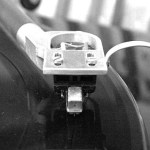
Our Dynavector 17Dx gets down deep into the groove, where vintage used records have the least number of problems created by their previous owners.

And we run it nude for even better sound. I discovered this possibility more than a decade ago — so long ago that I cannot remember where I came by the information — but the sound was immediately so much better that all questions were answered moments after dropping the needle.

Not a lot of things are obvious, but that sure was.

(more…)

Putting Your System to the (Violin and Piano) Test

Hot Stamper Pressings with Jascha Heifetz Performing

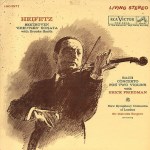
Do you want a recording that is going to put your system to the test? Well this is that record! The violin is REAL. As you compare equipment or tweak your system, you will hear the sound of that violin change and it should be obvious when it gets better and when it gets worse. 

The piano is also very well recorded.

If you lose some body to the piano you’re probably going in the wrong direction.

But since that direction would make the violin almost unbearable sounding, I’m going to guess that would be easily recognized as a mistake.

The balance between those two instruments on this recording is perfection, so if you get this record right, you’re making progress of the most important kind: toward musical naturalness.

Otherwise this violin, at least on the Kreutzer Sonata, is going to tear your head off.

Our previous Hot Stamper review follows.

The Beethoven, which takes up side one, is recorded in a fairly dry acoustic. The sound of the violin is very immediate. It’s quite a showpiece for Heifetz.

I much prefer the Bach on side two, however, which is recorded within a more natural hall acoustic. Sir Malcom Sargent conducts and Eric Freidman plays the second violin in this concerto, which is also his debut for RCA, according to the liner notes.

This piece was recorded in England and to me it has the rich, sweet, glorious sound of Living Stereo at its best.

(more…)

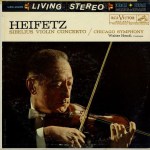
Sibelius – Violin Concerto / Heifetz / Hendl

Hot Stamper Pressings Featuring the Violin

xxx

  • Solid Double Plus (A++) or BETTER Living Stereo sonics from 1960 bring to life this fiery performance from Heifetz in his prime on this early Shaded Dog pressing
  • It’s also fairly quiet at Mint Minus Minus, a grade that even our most well-cared-for vintage classical titles have trouble playing at
  • It’s some of the best sound we have ever heard for the work, right up there with Ricci’s on Decca/London
  • The nothing-less-than-breathtaking performance by Heifetz may raise this one to the rank of ‘first among equals’ for those of you who prize immediacy and energy in your violin recordings
  • If you have one of our killer Hot Stampers of the Beethoven or Tchaikovsky violin concertos, you know exactly the sound I am talking about
  • “In the easier and looser concerto forms invented by Mendelssohn and Schumann I have not met a more original, a more masterly, and a more exhilarating work than the Sibelius violin concerto.”
  • Here is a link to more records like this one containing some of our favorite orchestral performances with top quality sound
  • 1960 was a great years for classical recordings – other Must Own Orchestral releases can be found here.

Early Shaded Dog pressings of Heifetz’s records rarely survived in audiophile playing condition. Top quality early pressings in clean condition come our way at most a few times a year, which means shootouts for them get done infrequently. There are hundreds, even thousands, of clean, vintage classical pressings sitting in our stockroom waiting for a few more copies to come our way so that we can finally do a shootout. These things cannot be rushed.

As for the sound, it’s practically impossible to find the richly textured, natural string tone offered here on anything but the vintage pressings produced in the 50s and 60s. Record making may be a lost art, but as long as we have these wonderful vintage pressings to play, it’s an art that is not being lost on us.

(more…)

The Riddle of the Vastly Different Sides Has Been Solved

Hot Stamper Pressings of Recordings Featuring the Violin

About ten or fifteen years ago we came across a puzzling Shaded Dog pressing of the Bruch / Vieuxtemps recording from 1962 with Heifetz, LSC 2603.

We were surprised at the time how much worse one side sounded than the other. That had rarely if ever happened back in those early Living Stereo shootout days.

We sold the record as a one-sided disc with one complete performance in top quality sound, The Scottish Fantasy. Obviously the Vieuxtemps / Concerto No. 5 wasn’t worth playing; the sound was sub-par, a pale shadow of the sound of the other side of the record. You can read all about it here.

Well, we ran into those stampers again, or at the very least we ran into a copy with the same bad stampers for side one, 5s. Something sure went wrong somewhere, as you can see from our notes below.

At the time we described this curious pressing this way:

The violin is captured beautifully on side two. More importantly there is a lovely lyricism in Heifetz’s playing which suits Bruch’s Romantic work perfectly. I know of no better performance.

The performance of the Vieuxtemps Concerto No. 5 is also wonderful, but the sound is not. Want proof that two sides of the same record can have vastly different sound? Here it is. Note how oversized the violin on side one is, how smeary the orchestra, how little texture there is to anything in the soundfield. This side one is no Hot Stamper.

All true, and now that we know that 5s etched stampers are responsible for the bad sound and not just some pressing anomaly, we can all sleep peacefully once again.

(more…)

This Sibelius Violin Concerto Was Big and Lush but…

Hot Stamper Pressings Featuring the Violin Available Now
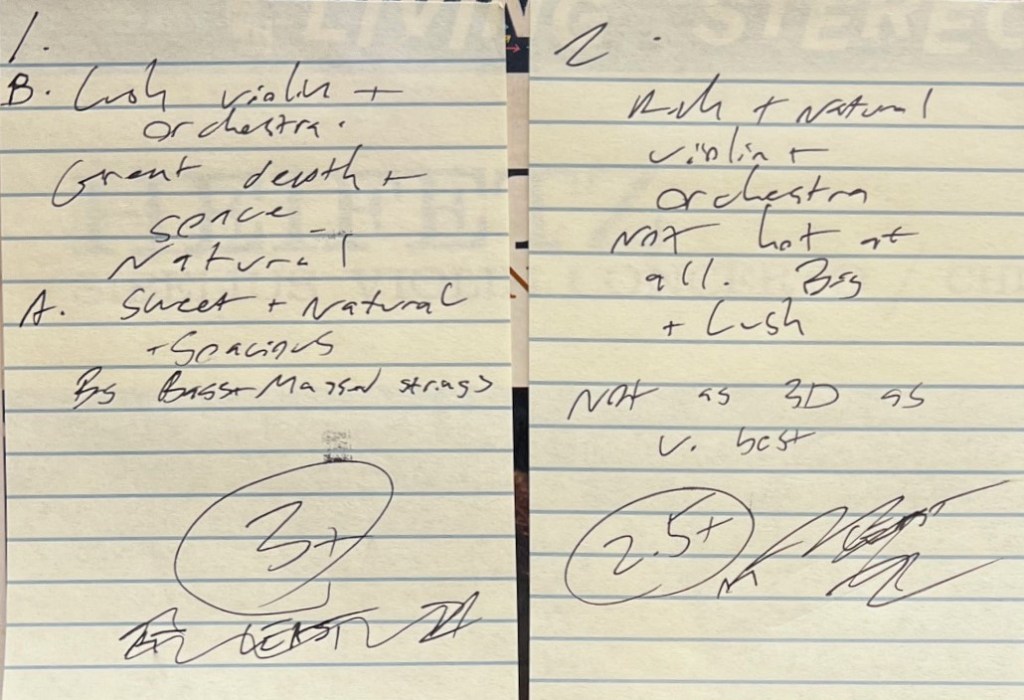
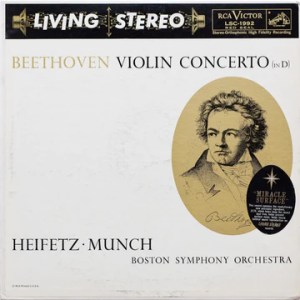
We love the way RCA recorded Heifetz back in the day, the day in this case being 1960. We usually have a good supply of vintage Heifetz titles on the site at all times. They often have our favorite performances, and the best copies, as the notes for the one below make clear, can have absolutely amazing sound.

As you can see from the notes, side one of a recent shootout winning copy was doing everything right.

However, we had a side two that was slightly better than the side two you see here. When we played the two best copies back to back, this side one came out on top, earning a grade of 3+, but the side two of another copy showed us there was even more three-dimensionality to be discovered in the recording than we thought. Consequently this side two was dropped a half grade to 2.5+.

This is exactly why we do shootouts. If you really want to be able to recognize subtle (and not so subtle!) differences between pressings, you must learn to do them too.

(more…)

Beethoven / Violin Concerto / Heifetz / Munch

More of the music of Ludwig van Beethoven (1770-1827)

More Recordings Featuring the Violin

  • Our stunning vintage pressing of this brilliant Living Stereo recording – from 1956! – boasts Nearly Triple Plus (A++ to A+++) sound throughout, just shy of our Shootout Winner
  • Heifetz’s violin is immediate, real and lively here – you are in the presence of greatness with this recording
  • The orchestra is wide, tall, spacious, rich and tubey, yet the dynamics and transparency are first rate
  • White Dogs and Shaded Dogs can both sound good on this title – just avoid the Red Seals and later pressings if you are looking for the best possible sound
  • There are about 150 orchestral recordings we think offer the best performances with the highest quality sound. This record is certainly deserving of a place on that list.
  • If you’re a fan of Beethoven’s music, this superb All Tube Recording from 1956 belongs in your collection.
  • This Classic Records pressing, however, was a piece of garbage, and we made our position clear right from the start

The reproduction of the violin here is superb — harmonically rich, natural, clean, clear, resolving. What sets the truly killer pressings apart is the depth, width and three-dimensional quality of the sound, as well as the fact that they become less congested in the louder passages and don’t get shrill or blary.

The best copies display a Tubey Magical richness — especially evident in the basses and celli — that is to die for.

Big space, a solid bottom, and plenty of dynamic energy are strongly in evidence throughout. Little smear, exceptional resolution, transparency, tremendous dynamics, a violin that is present and solid — the best copies take the sound of the recording right to the limits of what we thought possible.

Heifetz is a fiery player. On the best pressings you will hear all the detail of his bowing without being overpowered by it. As we listened we became completely immersed in the music on the record, transfixed by the remarkable virtuosity he brings to such a difficult and demanding work.

(more…)

The RCA Later Label Pressings from the 70s Fall Short Yet Again

Hot Stamper Pressings Featuring the Violin Available Now

Many of the later RCA pressings we’ve played recently have left a lot to be desired.

We’re on record as telling audiophiles that it’s never a good idea to judge records by their labels, so when it came time to do a shootout for this famous Heifetz recording from 1963, LSC 2652, it was only fitting that we force ourselves to clean and play every pressing we had on the shelf, including the White Dogs and Red Seal reissues.

The White Dog did fine (2+ for the Bruch on side one, 1.5+ for the Mozart on side two).

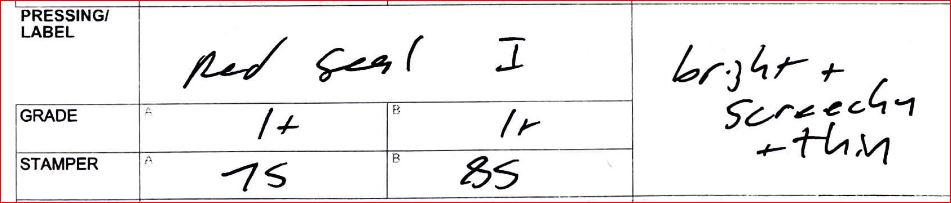
The Red Seal had all the hallmarks of the transistory sound RCA apparently preferred in the 70s.

There are Red Seal pressings with excellent sound — some of them have won shootouts — but this one had too many similarities to the awful Classic Record classical titles produced in the 90s. You know the ones I’m talking about. They have bright, screechy string tone that no self-respecting audiophile with even passable equipment should find tolerable.

(The fact that many of them remain on the TAS list speaks volumes about the self-identified experts’ ability to distinguish a good record from a bad one. More on that subject below.)

More of the Same

Below you will find links to other records we’ve played that had the same problems as this RCA and are best avoided by audiophiles looking for high quality pressings to play.

There is no shortage of other records that we’ve run into over the years with these kinds of obvious shortcomings.

(more…)