_Conductors – Solti

Mahler’s Symphony No. 4 with Solti on Decca/London

Hot Stamper Pressings of Decca Recordings

Deep bass; rich, smooth strings, lots of lovely hall space – this copy was right up there with the best we heard, and clearly won the shootout for side two. You will hear immediately why this side two could not be beat – it’s wonderful.

CS 6217 is potentially every bit as good.

What amazing sides such as these are doing right is not hard to hear:

  • The biggest, most immediate staging in the largest acoustic space
  • The most Tubey Magic, without which you have almost nothing. CDs give you clean and clear. Only the best vintage vinyl pressings offer the kind of Tubey Magic that was on the tapes in 1961
  • Tight, note-like, rich, full-bodied bass, with the correct amount of weight down low
  • Natural tonality in the midrange — with all the instruments of the orchestra having the correct timbre
  • Transparency and resolution, critical to hearing into the three-dimensional space of the concert hall

No doubt there’s more but we hope that should be enough for now.

And of course, playing the record is the only way to hear all of the above.

An Orchestra Needs This Kind of Space

One of the qualities that we don’t talk about on the site nearly enough is the SIZE of the record’s presentation. Some copies of the album just sound small — they don’t extend all the way to the outside edges of the speakers, and they don’t seem to take up all the space from the floor to the ceiling. In addition, the sound can often be recessed, with a lack of presence and immediacy in the center.

Other copies — my notes for these copies often read “BIG and BOLD” — create a huge soundfield, with plenty of room for all of the players. These copies are not brighter, they’re not more aggressive, they’re not hyped-up in any way, they’re just bigger and clearer.

And most of the time those very special pressings are just plain more involving. When you hear a copy that does all that — a copy like this one — it’s an entirely different listening experience.

Side One

Heiter, Bedächtig, Nicht Eilen 
In Gemächlicher Bewegung

Side Two

Ruhevoll 
Sehr Behaglich

About the Symphony

Mahler had begun work on the 4th symphony in 1899 but the ingredients were not all created from scratch. The music of the final movement dates back to 1892 and a particular collection of songs he composed that February. Many were destined to become part of the epic folk-cycle Das Knaben Wunderhorn but the stand-alone Das himmlische Leben (“Heavenly life”) was intended to be an important component of the massive 3rd Symphony. Indeed, melodic material from this song can be found in that earlier work but Mahler soon realized that it deserved more elaborate treatment.

With a technique not uncommon in Mahler’s oeuvre, he used an idea from one symphony to inform another. Much like the trumpet fanfare in the 4th Symphony’s first movement that foreshadows the 5th Symphony, the “Leben” song fragments of the 3rd Symphony’s fifth movement find their apotheosis in the 4th.

There is a decidedly “Classical” feel to the score of the 4th Symphony and the work employs a much more concentrated emotional profile than the prior symphonies. The child’s view of heaven depicted in the 4th Symphony’s closing movement is largely responsible for this overarching simplicity but there is also a sense that Mahler was attempting something novel with this work.

Interestingly, he does not supply explanatory titles to the first three movements (a rarity to this point in his career) but rather allows the music, in all its sunny subtlety, to speak for itself.

Program Notes

Wilkie and the Decca Tree

Decca was an early adopter of the LP album, which put it ahead of its direct competitor EMI. The company was also an early exponent of stereophonic recording. Wilkinson would make the move to stereo recordings for Decca in April 1958, but until then he remained the engineer with the monaural recording team (for a time there were parallel recording teams) because mono was considered the more important release. In the early 1950s, together with Roy Wallace (1927–2007) and Haddy, he developed the Decca tree spaced microphone array used for stereo orchestral recordings. Decca began to use this for recordings in May 1954 [the month and year I was born!] at Victoria Hall in Geneva, a venue Wilkinson did not record in. He preferred recording in London and Paris although he also recorded in Amsterdam, Bayreuth, Chicago, Copenhagen, Rome, and Vienna.

Wilkinson discussed the use of the Decca tree in an interview with Michael H. Gray in 1987.

You set up the Tree just slightly in front of the orchestra. The two outriggers, again, one in front of the first violins, that’s facing the whole orchestra, and one over the cellos. We used to have two mikes on the woodwind section – they were directional mikes, 56’s in the early days. You’d see a mike on the tympani, just to give it that little bit of clarity, and one behind the horns. If we had a harp, we’d have a mike trained on the harp. Basically, we never used too many microphones. I think they’re using too many these days.

Wilkinson’s method of selecting recording venues was recounted in an article on concert hall orchestral sound written by the conductor Denis Vaughan in 1981:

I have recorded in many halls throughout Europe and America and have found that halls built mainly of brick, wood and soft plaster, which are usually older halls, always produce a good natural warm sound. Halls built with concrete and hard plaster seem to produce a thin hard sound and always a lack of warmth and bass. Consequently when looking for halls to record in I always avoid modern concrete structures.

Wilkinson went on to engineer at hundreds of recording sessions. He was said to have worked with more than 150 conductors. He was the engineer most responsible for Richard Itter’s Lyrita recordings (which Decca produced). Itter always requested Wilkinson as engineer, calling him “a wizard with mics.”

Wilkinson’s stereo recordings with the conductor Charles Gerhardt (including a series of Reader’s Digest recordings and the RCA Classic Film Scores series) and the producer John Culshaw made his name and reputation known to record reviewers and audiophiles. His legacy was extended by the fact that he trained every Decca engineer from 1937 onwards.

Wilkinson, always called “Wilkie” in the music business, was known as a straight-talking man, interested only in the quality of the work. The Decca producer Ray Minshull (1934–2007) recalled Wilkinson’s methods in an interview with Jonathan Valin in March 1993:

Everyone loved and respected Wilkie, but during a session he could be exacting when it came to small details. He would prowl the recording stage with a cigarette – half-ash – between his lips, making minute adjustments in the mike set-up and in the orchestral seating. Seating arrangement was really one of the keys to Wilkie’s approach and he would spend a great deal of time making sure that everyone was located just where he wanted them to be, in order for the mikes to reflect the proper balances.

Of course, most musicians had a natural tendency to bend toward the conductor as they played. If such movement became excessive, Wilkie would shoot out onto the stage and chew the erring musician out before reseating him properly. He wanted the musicians to stay exactly where he had put them. He was the steadiest of engineers, the most painstaking and the most imaginative. In all of his sessions, he never did the same thing twice, making small adjustments in mike placement and balances to accord with his sense of the sonic requirements of the piece being played.

His recordings were characterized by the producer Tam Henderson in an appreciation: “The most remarkable sonic aspect of a Wilkinson orchestral recording is its rich balance, which gives full measure to the bottom octaves, and a palpable sense of the superior acoustics of the venues he favored, among them London’s Walthamstow Assembly Hall and The Kingsway Hall of revered memory”.

On retiring, Wilkinson received a special gold disc produced by Decca with extracts of his recordings. He received three Grammys for engineering: 1973, 1975, and 1978. He also received an audio award from Hi-Fi magazine in 1981 and the Walter Legge Award in 2003 “…for extraordinary contribution to the field of recording classical music.”
A Decent Speakers Corner Mahler Reissue from 1996

More of the Music of Gustav Mahler

Sonic Grade: B?

Probably one of the better Speakers Corner Decca reissues.

It was recorded in Kingsway Hall early in 1964, so it already had a lot going for it.

We haven’t played a copy of this reissue in years, but back in the day (1996 or thereabouts) we liked it, so let’s call it a “B” with the caveat that the older the review, the more likely we are to have changed our minds.

Obviously we can’t be sure we would still like it, and it’s very unlikely we would like it as much as we used to, but it’s probably a good reissue at the price, assuming the price is around $30.

(more…)

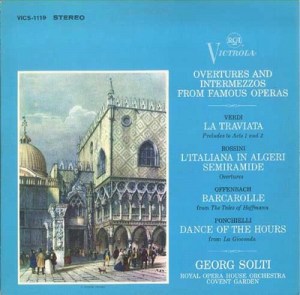
Overtures and Intermezzos – Solti

More Living Stereos

  • Off the charts “Triple Triple” (A+++) sound for this classic Decca engineered “Living Stereo” Victrola from 1965 – both sides of this pressing of VICS 1119 earned our top grade of A+++
  • Listen to how rich the cellos sound — this is Tubey Magical Analog and its most luscious and enchanting.
  • You could easily play one hundred classical albums and not hear this kind of sound!
  • If you have the real Living Stereo pressing (with the cool die-cut cover), let us send you this pressing to compare — who knows, you might like it even better than your Shaded Dog
  • Classic Records did this title back in the 90s, and it was one of the worst of their sorry releases

This 1959 Decca recording is overflowing with the kind of rich, spacious, Tubey Magical sound that can only be found on vintage vinyl.

On this copy you will find As Good As It Gets sound. It’s so BIG and RICH you will have a hard time believing that it’s a budget reissue from 1965, but that’s precisely what it is.

Ah but it’s a reissue from back in the day when they knew how to cut a record properly, regardless of its retail price.

The rich, textured, rosin-on-the-bow lower strings on this record are to die for. Find me a modern record that sounds like this and I will eat it.

And by “modern record” we hasten to include both modern recordings and modern remasterings of older recordings. NO ONE alive today can make a record that sound even remotely as good as this. To call it a lost art is to understand something that few vinyl-loving audiophiles appear to have grasped since the advent of the Modern Reissue, which is simply this: they can’t begin to compete.

After twenty years of trying and literally hundreds of failed examples the engineers of today have yet to make a record that sounds as powerful and life-like as this London from almost fifty years ago.

Fortunately for the both of us we are not trying to make a record that sounds the way this one does. We’re just trying to find one, and folks, we found the hell out of this one. (more…)

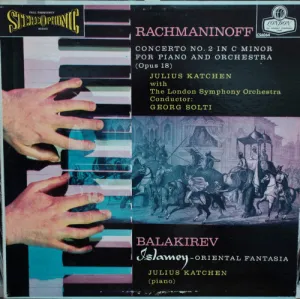
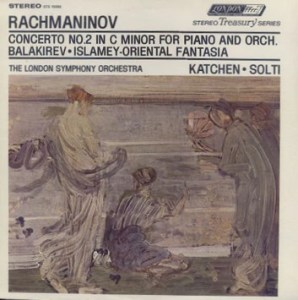
Rachmaninoff / Piano Concerto No. 2 – Katchen / Solti

More of the music of Sergei Rachmaninoff

  • An outstanding UK reissue pressing of this superb recording with solid Double Plus (A++) sound on both sides
  • I’ve known how good this reissue can sound for more than twenty years – it is guaranteed to beat any and every pressing you have of the work or your money back
  • Big, clear, rich, dynamic, transparent and energetic – HERE is the sound that simply does not exist except in the world of the properly cleaned, properly pressed vintage LP
  • On both of these sides you’ll hear rich strings, clear horns, a piano that is full-bodied and natural, with a solid low end (the kind you rarely hear on record but is nonetheless strikingly obvious in the presence of the real instrument)
  • “Is the pulse even, building in steady crescendo, or do those famous opening measures find some subtle phrase within? Most settle for the former; not so, Katchen and Solti – and that pretty much describes the attitude of these artists in this piece altogether: searching for and finding the phrase within the obvious.”

(more…)

Rachmaninoff / Piano Concerto No. 2 – Katchen / Solti

More of the Music of Sergei Rachmaninoff

  • A superb copy of this stunning classical recording with Nearly Triple Plus (A++ to A+++) sound from start to finish – just shy of our Shootout Winner
  • This Demo Disc Quality recording is big, clear, rich, dynamic, transparent and energetic – HERE is the sound that simply does not exist except in the world of the properly cleaned, properly pressed vintage LP
  • On both of these sides you’ll hear rich strings, clear horns, a piano that is full-bodied and natural, with a solid low end (the kind you rarely hear on record but is nonetheless strikingly obvious in the presence of the real instrument)
  • “Is the pulse even, building in steady crescendo, or do those famous opening measures find some subtle phrase within? Most settle for the former; not so, Katchen and Solti – and that pretty much describes the attitude of these artists in this piece altogether: searching for and finding the phrase within the obvious.”
  • Our current favorite recording of the work as of 2025 is the Decca recording with Ashkenazy from 1964

(more…)

Letter of the Week – “What a privilege! A big big thank you.”

More of the Music of Sergei Rachmaninoff (1873-1973)

Reviews and Commentaries for the Music of Rachmaninoff

One of our good customers had this to say about some Hot Stampers he purchased recently:

Hey Tom,

Saturday morning 06.15 waking up, checking messages, news and of course your site. Actually a daily routine.

Finding there Rachmaninov 2. For so many, as for me, an astonishing work.

So once again excited. Then checking reviews on the performance (you just take it for granted what an amazing thing this internet is). Searching, finding and reading about this specific performance is fun, thrilling in a way and in the process you learn more about the composer and piece.

The reviews show the performance as a stand out; for some brusque and maybe too fast leaving out the drama, but for many an exhilarating benchmark.

Afterwards going back to the better-records site to read about the recording. What a great story about Wilkie and the Decca tree.

And then of course being able to actually buy that record. What a privilege! A big big thank you. (more…)

La Boutique Fantasque – Mono Reviewed in 2010

UPDATE 2024

A long time ago I liked a mono pressing of La Boutique Fantasque with Solti.

I doubt I would be impressed by it now, but I can’t rule out the possibility.

Some monos can be amazing. We should know, we’ve played plenty of them.

However, when the stereo pressings are also amazing, as is the case here, wouldn’t you rather hear it in stereo? We didn’t even bother to buy one to put into our recent shootout, which was, shockingly, 14 years in the making.


This London Mono Radio Promotion Copy is a stunner. DEMO QUALITY SOUND.

They even knew it back then — it was given the Hi-Fi Record Of The Month award. The orchestration and the sound of this music are ideal for audiophile listening.

The Sorcerer’s Apprentice that closes out side two has slightly better sound by the way — it’s quite good.

Rachmaninov / Piano Concerto No. 2 – Speakers Corner Reviewed

More of the music of Sergei Rachmaninoff (1873-1943)

Sonic Grade: Unknown

In the late ’90s, we described the sound of this pressing this way:

“Outstanding Rachmaninoff, dark and rich. Highly recommended.”

Since we have not played a copy of the album in over ten years [now 20], we have taken down our previous Sonic Grade of B as we have no idea how the record would fare today on our much-improved system.

For all we know it may have been recut, which is another problem with our older reviews of records we used to like: the new version could have very different sound from the one we played (and that’s not even taking into account the pressing variability, which we all know is sometimes huge).

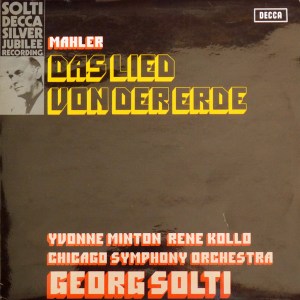
Mahler / Das Lied Von Der Erde / Solti / CSO – Reviewed in 2006

More of the music of Gustav Mahler

More Music Conducted by Georg Solti

This Minty Decca pressing from 1972 sounds WONDERFUL — another Kenneth Wilkinson / Gordon Parry triumph. 

This recording is part of the Solti Decca Silver Jubilee, celebrating the 25th year of Solti’s collaboration with Decca.

(He started in 1947!) The Beethoven 9th on the TAS List, one of the all time great Beethoven recordings, is also part of that series. Judging by those two records, it appears that Decca still had their act together in 1972, long after other labels were producing garbage.

[As of about 2020 we have come to realize that the version of the Ninth Solti recorded for Decca in 1972 is nothing special. It suffers from the kind of opacity we discuss here. We Was Wrong, sorry!]

The Sound You Might Expect from Decca in 1967

More of the Music of Modest Mussorgsky

Released as Romantic Russia by Decca in 1967, this London can also be found with a different cover and a different catalog number, CS 6503.

DEMO QUALITY SOUND on side one — in some ways. Don’t go looking for the Tubey Magic of an earlier era. What you get instead is super-low distortion, full-bandwidth sound with deep powerful bass and more transparency than most later Londons.

Solti is clearly the man for this music! He’s on fire with this fiery material. THIS is the way you want to hear Russian orchestral showpieces — played with verve and dynamically ALIVE. (more…)