Composers

Borodin / Symphonies Nos. 2 & 3 / Ansermet

More of the Music of Alexander Borodin
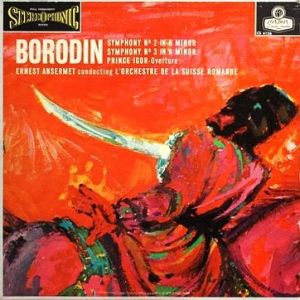
  • An early London Stereo pressing of these two symphonic masterworks with very good Hot Stamper sound on both sides
  • It’s also fairly quiet at Mint Minus Minus, a grade that even our most well-cared-for vintage classical titles have trouble playing at
  • We guarantee there is more richness, fullness, and performance energy on this copy than others you’ve heard, and that’s especially true if you own whatever Heavy Vinyl pressing is currently on the market, made from who-knows-what tapes
  • These originals are selling for hundreds of dollars on ebay these days, so don’t expect many early London pressings to make it to the site

We’ve long considered the album one of the greatest of all the Decca / London recordings.

Big, rich and dynamic, this is the sound of LIVE MUSIC, and it can be yours, to enjoy for years to come — if you’ve got the stereo to play it and the time to listen to it.

The powerful lower strings and brass are gorgeous. Ansermet and the Suisse Romande get that sound better than any performers I know. You will see my raves on record after record of theirs produced during this era. No doubt the world renowned Victoria Hall they recorded in is key. One can assume Decca engineers use similar techniques for their recordings regardless of the artists involved. The only real variable should be the hall.

Ansermet’s recordings with the Suisse Romande exhibit a richness in the lower registers that is unique in my experience. His Pictures At Exhibition has phenomenally powerful brass, the best I’ve ever heard. The same is true for his Night On Bald Mountain. Neither performance does much for me — they’re both too slow — but the sound is out of this world. Like it is here.
(more…)

Venice on Classic Records

Hot Stamper Pressings of Classical and Orchestral Music

Classic Records remastered the tapes for LSC 2313 and even the people who like the sound of Classic’s Heavy Vinyl pressings used to complain about it, so you can imagine what we think of it.

What a piece of garbage. With smeary, shrill, screechy strings, it gives no indication of the beauty that is on the tape. 

The Victrola reissue, VICS 1119, is dramatically better sounding than any other reissue of the album we have played, including of course the Classic, and may even be better sounding that the Shaded Dog original itself.


This Heavy Vinyl reissue is noticeably lacking in a number of areas that are important to the proper presentation of orchestral music. If you own a copy of this title, listen for the qualities we identified above in the sound that came up short.

Below you will find links to other records that have the same shortcomings we heard when playing the Classic Records pressing of LSC 2313.


(more…)

Schubert – The Trout Quintet / Curzon / Vienna Octet

More of the Music of Franz Schubert

  • Boasting two seriously good Double Plus (A++) sides, this vintage Ace of Diamonds pressing is doing just about everything right
  • It’s simply bigger, more transparent, less distorted, more three-dimensional and more REAL than most of what we played – this is music you cannot help but be drawn into
  • The 1958 master tape has been transferred brilliantly using “modern” cutting equipment (from 1968, not the low-rez junk they’re forced to make do with these days), giving you, the listener, sound and surfaces that are hard to fault
  • When you hear how good this record sounds, you may have a hard time believing that it’s a budget reissue from 1968, but that’s precisely what it is.
  • Some budget reissues are so good, they can actually win shootouts

The cello does not have that “fat” sound some audiophiles seem to like – Decca knew more about recording chamber music in 1958 than practically all the audiophile labels that would come along later, the ones that managed to make a mess of the very idea of audiophile quality sound (you know who I mean)

The piano and the strings have that Golden Age Tubey Magical sound we love. It’s been years since I’ve had the opportunity to play this record; most copies are just too beat up to bother with, so I was glad to find a number in minty condition.

Now what I hear in this recording is sound that is absolutely free from any top end boost, much the way live music is. There’s plenty of tape hiss and air; the highs aren’t rolled off, they’re just not boosted the way they often are in a recording.

A few years back I had a chance to see a piano trio perform locally; they even played a piece by Schubert. The one thing I noticed immediately during their live performance was how smooth and natural the top end was. I was no more than ten feet from the performers in a fairly reverberant room, and yet the sound I heard was the opposite of what passes in some circles for Hi-Fidelity.

This is the opposite of those echo-drenched recordings that some audiophiles seem to like, with microphones placed twenty feet away from the performers so that they are awash in “ambience.” If you know anything about us, you know that this is not our sound.

I have never heard live music sound like that and that should settle the question. It does in my mind anyway. The Chesky label (just to choose one awful audiophile label to pick on) is a joke and always will be. How anyone buys into that phony sound is beyond me, but any audio show will prove to you that there is no shortage of audiophiles who love the Chesky “sound,” and probably never will be.

(more…)

It’s Already So Good, How Could It Get Any Better?

Hot Stamper Pressings of the Music of Berlioz Available Now

You may have noticed that most of the time when we give out the stampers for the top copies of an album, we do not identify the title of the record that has those Shootout Winning stampers.

As you can imagine, our huge investments in research and development make up a big part of our costs, costs that accrue over the course of years, decades even, and that must eventually be passed on to our customers.

But this title is an exception, because we are telling you straight out that the 1K pressings of CS 6101, Music of Berlioz, are the way to go.

It turns out that both the early Decca pressings (SXL 2134) and the London Bluebacks were cut by Tony Hawkins.

It’s unfortunate that this record did not sell well when it came out in 1959, which explains why we could find no evidence of copies with any stampers other than 1K.

Not that the work of any other mastering engineers was in any way needed. Mr. Hawkins did a wonderful job on the copies we played than managed to reproduce the glorious, Golden Age All Tube analog sound of the master tape, which may sound  tautological as all get out but I assure you is not.

No, sadly for us, that glorious sound could be found on one and only one pressing, the one we graded 3+/3+.

No other pressing earned a top grade on either side. Whatever caused the amazing pressings to come out differently from the very good ones happened in the plating and pressing stages of manufacturing, an area that did not involve the work of any of the Decca mastering engineers.

(more…)

Rossini-Respighi / La Boutique Fantasque / Solti

More of the Music of Respighi

  • An early London pressing of Solti and the Israel Phil’s performance of this wonderful ballet suite, here with seriously good Double Plus (A++) grades or close to them from first note to last
  • It’s also remarkably quiet at Mint Minus Minus, a grade that even our most well-cared-for vintage classical titles have trouble playing at
  • An abundance of energy, loads of rich detail and texture, superb transparency and excellent clarity (particularly on side one) – the very definition of Demo Disc sound
  • After trying a few years ago, we knew the best copies had the potential to be knockouts in the Decca canon – after that it was only a matter of finding enough clean copies
  • No other performance or recording we played could hold a candle to this one – the Fiedler we used to like years ago was especially disappointing this time around
  • The best sides were always the biggest, clearest and most three-dimensional, assuming they were able to retain the rich, natural, balanced tonality that is inherently key to a good record, or a great one in this case
  • There are about 150 orchestral recordings we think offer the best performances with the highest quality sound. This record is certainly deserving of a place on that list.

(more…)

Another Amazing Mercury Dropped from the TAS Super Disc List?

Hot Stamper Pressings of TAS List Records Available Now

We have a preference for Dorati’s work with the London Symphony Orchestra over those he recorded elesewhere. A record like this will show you exactly why.

The Love of Three Oranges (SR 90006) is a killer recording — the kind of orchestral spectacular that is guaranteed to put your stereo through its paces and then some.

If you’re a fan of 20th century orchestral showpieces such as these, Robert Fine and Wilma Cozart have here produced a very special record containing two of the best.

We hope you like your sound big and bold, because that is the sound they were obviously going for, based on the sound we were hearing from the best early pressings.

I have to admit I was not a fan of this album until recently when I finally got my hands on a clean copy with the right stampers and heard the powerful sound of the London Symphony come blasting out of my speakers – what a thrill!

(more…)

Speakers Corner Has a “Winner” in Espana

Hot Stamper Pressings of the Music of Chabrier Available Now

Sonic Grade: B

One of the better Speakers Corner Deccas.

We haven’t played a copy of this record in years, but back in the day we liked it, so let’s call it a “B” with the caveat that the older the review, the more likely we are to have changed our minds. Not sure if we would still agree with what we wrote back in the 90s when this record came out, but here it is anyway.

This is a Speakers Corner Decca 180 gram LP reissue of the famous Argenta performance, a recording which can sound positively amazing on the right original London, but only about 2 out of 10 copies actually do sound amazing.

And where in the world are you going to find 10 clean copies of a record that’s almost 40 years old?

This pressing gets you most of the way there, on reasonably quiet vinyl, for a lot less money.


UPDATE 2025

This Speakers Corner title may be good, but our Hot Stamper classical and orchestral pressings will be dramatically more transparent, open, clear and just plain REAL sounding, because these are all the areas in which Heavy Vinyl pressings tend to fall short in our experience.  For more on that subject, see here and here.

(more…)

Mozart – Violin Concertos / Milstein

More of the Music of Mozart

  • Milstein’s virtuoso performance of Mozart’s violin concertos, here with an INCREDIBLE Shootout Winning Triple Plus (A+++) side one mated to a solid Double Plus (A++) side two on this vintage Blue Angel Stereo pressing
  • This pressing has all the qualities that make analog so involving and pleasurable – the warmth, the richness, the naturalness, and above all the realism
  • The sound here has the power to transport you completely, with solid imaging and a real sense of space, qualities that allow us to forget we are sitting comfortably in our listening rooms and not in the concert hall
  • Milstein’s violin is immediate, real and lively here – you are in the presence of greatness with this recording

(more…)

Is the 1s Pressing Always the Best on the Brahms Violin Concerto with Heifetz?

Hot Stamper Pressings that Sound Their Best on the Right Reissue

This early Shaded Dog pressing of the 1958 recording has surprisingly good sound on side two. On the second side the sound opens up and is very sweet, with the violin becoming much more present and clear.

The whole of side two is transparent with an extended top. Usually the earliest Living Stereo titles suffer from a lack of top end extension, but not this one.

Maybe the 1s pressing is also that way. For some reason audiophiles tend to think that the earliest cuttings are the best, but that’s just more mistaken audiophile thinking if our experience can serve as any guide, easily refuted if you’ve played hundreds of these Living Stereo pressings and noted which stampers sound the best and which do not.

The 1s pressings do not consistently win our shootouts.

About half the time, maybe less would be my guess.

Of course, to avoid being biased, the person listening to the record doesn’t know the stamper numbers, and that may help explain why the 1s loses so often.

If you are interested in finding the best sounding pressings, you have to approach the problem scientifically, and that means running record experiments.

Practically everything you read on this blog we learned through experimentation.

When we experimented with the Classic Records pressing of LSC 1903, we were none too pleased with what we heard. Our review is reproduced below.

(more…)

Who on Earth Could Possibly Take the Sound of this Ridiculous Remaster Seriously?

Hot Stamper Pressings on Decca and London Available Now

There actually is such a person who does exactly that, can you imagine?

Only an Audiophile True Believer could be fooled by sound so ridiculously unnatural.

But the world is full of such people. They bought into the audiophile BS of Mobile Fidelity in the 80s and apparently haven’t learned much since.

Now they think Heavy Vinyl is the answer to the world’s problems. The more things change…

If your stereo is any good at all, you should have no trouble hearing the sonic qualities of this album we describe below. If you are on this blog, and you have tried some of our Hot Stamper pressings, there is a good chance you’re hearing pretty much what we’re hearing. Why else why would you pay our prices?

One thing I can tell you: we would never charge money for a record that sounds as weird and wrong as this MoFi.

A well-known reviewer has many kind things to say about this pressing, but we think it sounds like a hi-fi-ish version of a 70s London, which means it’s opaque and the strings are badly lacking in Tubey Magical sheen and richness.

The bass is like jello on the MoFi, unlike the real London, which has fairly decent bass.

If an audiophile reviewer cannot hear the obvious faults of this pressing, I would say there’s a good chance one or both of the following is true:

  1. His equipment is not telling him what the record is really doing, and/or,
  2. His listening skills are not sufficiently developed to notice the shortcomings in the sound.

The result is the worst kind of reviewer malpractice.

But is it really the worst kind? It seems to be the only kind!

MoFi had a bad habit of making bright classical records. I suppose you could say they had a bad habit of making bright records in general. A few are dull, some are just right, but most of them are bright in one way or another.

Dull playback equipment? An attempt to confuse detail with resolution? Whatever the reasons, the better and more accurate your equipment becomes, the more obvious this shortcoming will be. My tolerance for their phony EQ is at an all time low. But hey, that’s me.

(more…)