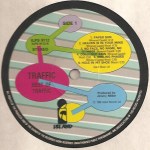
*Arcana – Stamper Info

Some audiophiles complain that our reluctance to give out stamper information is selfish. We think that’s not fair.

We admit that we rarely give out the stamper numbers for the pressings that win shootouts — we paid a high price in time and effort to discover them — but we do give out a great deal of information for records that did not sound especially good to us, a free – and valuable! — service from your friends at Better Records.

The MHS Recording of Chopin’s First Piano Concerto Had the Most Natural Piano of Them All

Hot Stamper Pressings of the Music of Frederic Chopin Available Now

There are some wonderful Musical Heritage Society records sitting in the bins of your local record store or Goodwill, and this one is worth picking up just to hear how well recorded the piano is.

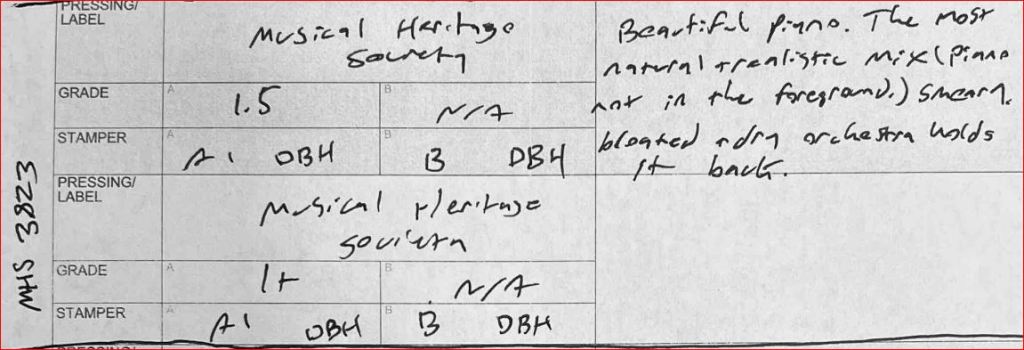
We described it this way:

Beautiful piano. The most natural and realistic mix with the piano not in the foreground.

But there is more to the recording than the sound of the piano.

Smeary, bloated and dry orchestra holds it back.

Well, at least we tried. (Note that side two was deemed not worth grading.)
Our favorite recording for performance and sound is the Living Stereo from 1961, LSC 2575, with Rubinstein at the piano and Skrowaczewski conducting the New Symphony Orchestra of London.

This is what we had to say about the sound of our Shootout Winner:

We love the huge, solid and powerful sound of the piano on this recording. This piano has weight and heft. As a result, it sounds like a real piano.

For some reason, a great many Rubinstein recordings are not capable of reproducing those seemingly all-important qualities in the sound of the piano.

Those are, as I hope everyone understands by now, the ones we don’t sell. If the piano in a piano concerto recording doesn’t sound solid and powerful, what is the point of playing such a record?

Or, to be more accurate, what is the point of an audiophile playing such a record? (Those of you who would like to avoid bad sounding vintage classical and orchestral records have come to the right place. We’ve compiled a very long list of them for precisely that purpose, and we add to it regularly.)

(more…)

Audiophiles Should Avoid These Stampers on West Side Story

Hot Stamper Pressings of Soundtrack Albums Available Now

None of the 360 Label pressings we played recently were competitive with the Six Eye originals. Some sides earned 2+, but no copy on 360 earned grades of 2+ on both sides.

Stick with the early, stereo pressings in order to have any shot at top quality sound.

As you can see from the notes below for this album, one side was passable, earning our 1.5+ grade. It’s a decent sounding record I suppose, but a long, long, long way from the best.

1.5+ is four grades down from the top copy. That’s a steep dropoff as far as we’re concerned. 1.5+ only hints at how good a recording this can be on the best vintage pressings. To see more records that earned the 1.5+ grade, please click here. For those who might be interested, there’s more on our grading scale here.

Here is what a top quality pressing should sound like:

You’ll find INCREDIBLE Shootout Winning Triple Plus (A+++) grades or close to them on both sides of this original Columbia 6-Eye Stereo pressing.

Spacious, rich and smooth – only vintage analog seems capable of reproducing all three of these qualities without sacrificing resolution, staging, imaging or presence.

Tonality is the hardest thing to get right on this album, and here it is right on the money, because if it were not, it would not have won the shootout.

For those of you who like to do your own shootouts, good luck, you will need a lot of originals to find one that sounds as good as this one does.

5 stars: “The soundtrack of the West Side Story film is deservedly one of the most popular soundtrack recordings of all time, and one of the relatively few to have attained long-term popularity beyond a specialized soundtrack/theatrical musical audience.”

This album is at least five times more common in mono than it is in stereo, and finding enough clean early stereo pressings takes us years nowadays.

(more…)

How Would You Ever Know This Was a Good Recording with these Crap Pressings to Play?

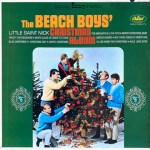
Hot Stamper Pressings of the Music of The Beach Boys Available Now

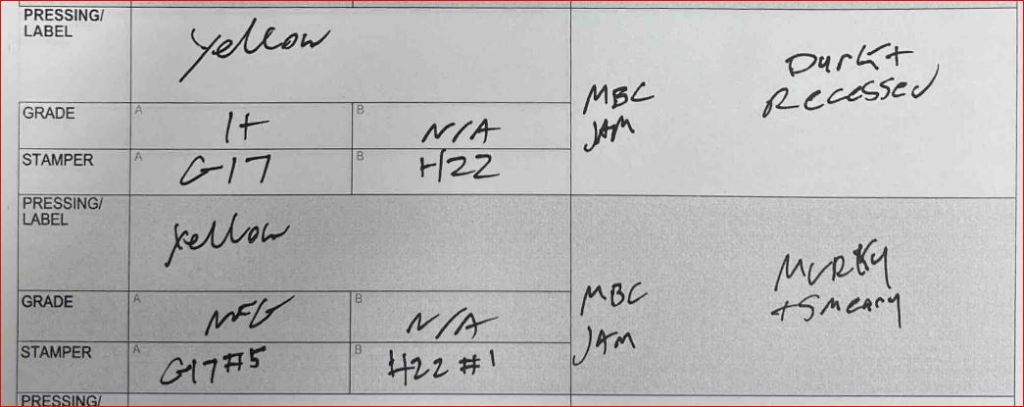
You sure wouldn’t know this was a good recording by playing the crappy reissues Capitol put out on the Yellow Label in 1975.
We found that they tend to suffer from these sonic shortcomings:
They are either dark and recessed, and/or murky and smeary.

There are good Rainbow Label pressings and bad ones. We of course only sell the good ones.

Here is how we described our most recent White Hot shootout winner.
  • With two STUNNING Shootout Winning Triple Plus (A+++) sides or close to them, this early Capitol pressing could not be beat.
  • This copy gets the midrange right, and since that is where The Beach Boys’ voices are, that puts it ahead of everything else we heard.
  • What’s shocking to those of us who have played The Beach Boys records by the bucketful is how rich and open the best pressings of this album are.
  • You will have an awfully hard time finding another Beach Boys album that sounds as good as this one, and you may just find that it simply can’t be done.

(more…)

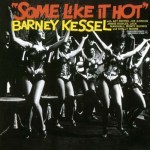
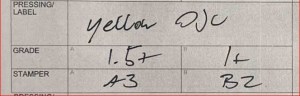
Skip the A3/B2 OJC on Some Like It Hot

Hot Stamper Pressings of the Music of Barney Kessel Available Now

Some Like It Hot badly needed to be made using tubes in the mastering chain, but that didn’t happen.

It’s another case of an OJC with zero Tubey Magic. You might as well be playing the CD. I would bet money it sounds just like this record. Maybe even better.

I suppose if you have a super-tubey phono stage, preamp or amp, you might be able to supply some of the Tubey Magic missing from this pressing, but then all your correctly mastered records wouldn’t sound right, now would they?

We had two copies of the OJC and one of them did better than this one. It earned a Super Hot grade for one side. If you see this OJC pressing in your local record store, avoid these stampers. The sound isn’t awful, but it’s not very good either, especially considering how amazing the tapes must be, based on the sound of our White Hot Stamper shootout winner.

The OJC pressing of this album is much better suited to the old school audio systems of the 60s and 70s than the modern systems of today. These kinds of reissues used to sound good on those older systems, and I should know, I had an old school stereo and some of the records I used to think sounded good back in the day don’t sound too good to me anymore (although this one never did).

The OJC pressings of Some Like It Hot are thinner and brighter than even the worst of the later pressings we’ve auditioned. That is decidedly not our sound. It’s not the sound Roy DuNann was famous for, and we don’t like it either, although we have to admit that we did find the sound of many of these OJC pressings more tolerable — even enjoyable — in the past.

Our old system from the 80s and 90s was tubier, tonally darker and dramatically less revealing, which strongly worked to the advantage of leaner, brighter, less Tubey Magical titles such as this one. Pretty much everybody I knew had a system that suffered from those same afflictions.

Like most audiophiles, I thought my stereo sounded great.

And the reality is that no matter how hard I worked or how much money I spent, I would never have been able to achieve top quality sound for one simple reason: most of the critically important revolutionary advances in audio had not yet come to pass.

It would take many technological improvements and decades of effort until I would have anything like the system I do now.

(more…)

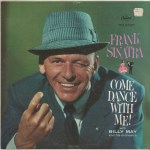
The Mono Pressings of Come Dance With Me Are Just Awful

Hot Stamper Pressings of the Music of Frank Sinatra Available Now

We had two mono pressings, one on the first label, one on the second, and both were unacceptable, especially the reissue.

Side one of the early label pressing was big and tubey but the vocals were gritty. Side two was hot, crude and midrangy.

Which raises the question: what is the general sound of the mono pressing on the early label?

Answer: it has no sound, or more accurately, it has two very different sounds, and if we had ten of them we could probably say it has a lot more sounds than the ones we described. Our advice:Beware of small sample sizes, especially sample sizes of two.

The stereo pressings we listed recently had superb sound. The monos, however, just sounded like old records, and not very good ones at that. The typical record collection is full of them.

Only an old school audio system can hide the faults of a pressing such as this one. The world is full of those too, even though they might comprise all the latest and most expensive components.

The mono pressings are hopeless on today’s modern stereos, and for that reason we say stick with stereo. For other albums that don’t sound good in mono, click here.

If you see this album in mono at a garage sale, pick it up for the music, and then be on the lookout for a nice stereo original to enjoy for the sound.

More on the subject of mono versus stereo.


Want to find your own top quality copy?

Consider taking our moderately helpful advice concerning the pressings that tend to win our shootouts.

As of 2025, shootouts for this album should be carried out:

Nothing else will do for the sound of a Sinatra recording with him fronting Billy May’s orchestra.

(more…)

How Does the Capitol Club Cutting of Master of Reality Sound?

Hot Stamper Pressings of the Music of Black Sabbath Available Now


Somebody at Capitol did not do a very good job when cutting this album for members of the Capitol Record Club. The sound is papery, gritty, and, not to put too fine a point on it, just awful.

Did he try real hard and fail? Was he incompetent? Was he lazy? I doubt we’ll never know!

Discogs gives out the following info for the release:

Mastering at Artisan Sound Recorders and pressing by Columbia Records Pressing Plant, Scranton are uncredited on release. 

    • Matrix / Runout (Side A ): SW-1-93896 W2#1 (IAM Scranton Identifier)
    • Matrix / Runout (Side B): SW2-93896-R4 (IAM Scranton Identifier)

Hard to believe Artisan and IAM would do such a bad job, but if Discogs is to be believed, apparently it’s possible.

Not all record club pressings are bad though; that’s painting with too broad a brush.

Here’s one we are big fans of.

Of course, it helps if your record club pressings are mastered by Bill Kipper at Masterdisk.

He was one of the greats, and there is simply no one like him alive today, at least as far as we know. We had this to say about that subject many years ago:

Think what a different audio world it would be if we still had Bill Kipper with us today, along with the amazingly accurate and resolving cutting system he used at Masterdisk.

As far as we can tell, there are no records being produced today that sound remotely as good as this budget subscription disc.

Furthermore, to my knowledge no record this good has been cut for more than thirty years. The world is awash in mediocre remastered records and we want nothing to do with any of them, not when there are so many good vintage pressings still to be discovered and enjoyed.

The likes of Bill Kipper are no longer with us, but we can be thankful that we still have the records he and so many talented others mastered all those years ago, to enjoy now and for countless years to come.

(more…)

Hot Stamper Sharing Can’t Get Off the Ground, How Come?

Basic Concepts and Record Realities Explained 

The above link takes you to our blog. Normally such a link would take you to our in-stock Hot Stamper pressings on the site for the band in question, but we rarely have any Traffic albums to sell these days, which is the case as of this writing.

Finding just the right Traffic pressings, with audiophile-quality vinyl no less, requires effort and resources that we just haven’t been committing to lately. We hope to do better in 2025.

In 2014 somebody on the Hoffman forum tried to get a Hot Stamper thread going under this heading: cheap Hot Stampers revealed.

The thread:

“If you have a “hot stamper” record – one that smokes and takes no prisoners, I mean a BADASS pressing, show it here with matrix info, label or other identifying features so we can all hunt with a bit of a head-start.

“I know these records are out there, just looking for a place to show off their analog glory.

“Here is a recent find that fits the bill and then some:

“Traffic: Best Of Traffic UK.

“Matrix # ILPS 9112 A-1/B-1”

OK, let’s talk about this Island reissue. We know the record well. If it sounds the way the copies we played over the years have sounded, we would say it can be good, not great, and if it qualified for Hot Stamper status, it might — might — earn a plus and a half at best. (1.5+.)

We don’t even bother to pick them up at any price these days, if that tells you anything.

He got very little support in his endeavor. The thread closed after a while with practically nothing in it.

Could it be that the folks on the Hoffman forum have a poor grasp of the amount of effort, time and money it takes to find Hot Stampers?

And, having committed to neither the effort, the time nor the money, find that they have nothing of any value to contribute to such a list?  

Yes, that could be. That definitely could be. Thank god it doesn’t keep them from criticizing those of us who, working in concert with a staff of ten or so, have devoted ourselves to the task and found them by the thousands.

By the way, we know that Traffic title very well. The Pink Label original is by far the best pressing in our experience. No copy we have ever heard on the label promoted by this poster would qualify as much more than a bargain Hot Stamper in comparison to the Pink Label and Pink Rim label pressings that we sell, although of course, not having heard his copy, we can’t say it’s not fabulous. 

It’s just not very likely to be fabulous. 

(more…)

Talk About Getting the Sound Wrong – What Was Decca Thinking?

Hot Stamper Pressings of the Music of The Rolling Stones Available Now

Even though we know that the UK Decca pressings have not done well in our shootouts for more years than I care to remember, if we see one for cheap locally you know we’re going to buy it and get it another chance at the brass ring no matter how many times it’s failed in the past.

As you can see from our shootout notes, the Decca import has once again let us down.

It’s bright, with no warmth or weight. It’s not musical like the London pressings with the right stampers are.

If a certain kind of audiophile were to play this record, the kind of audiophile who might be given to simplistic conclusions based on insufficiently small sets of data — which, in our experience, pretty much covers the entire audiophile record collector community, including, if not especially, the so-called expert reviewers — the conclusion such a person might reach is that Beggars Banquet is just not very well recorded.

If Decca pressings don’t sound good, what on earth would?

Or, to put it another way, if Decca, the label that the Stones recorded this album for, can’t figure out how to make Beggars sound its best, why would we assume that any other company could?

We would, naturally, assume that Decca did the best they could with the tape and the mediocre quality of the sound you hear — 1+/1.5+ is pretty much our definition of mediocre — is all there is.

The Option that Is Almost Always Wrong

Worse — if a new Heavy Vinyl pressing of the album came out with even halfway-decent sound, then it would prove beyond a doubt that some modern mastering engineer had finally figured out how to get Beggars to sound right.

But of course it would prove no such thing.

If all you have to guide you is conventional collector wisdom, then the one thing you can be sure of is that the Decca pressing from the UK should have better sound than any other, especially any record made in the states.

But it doesn’t. It’s possible I suppose – we haven’t played every pressing ever made – but it sure is unlikely based on the evidence presented to our ears over the course of the last twenty to thirty years or so.

If you would like to hear Beggars Banquet sound right, and have the hundreds of dollars we charge for a copy that is guaranteed to sound right or your money back, click on the link. It’s rare that we have one in stock, but you never know.

(more…)

Labels, Patterns and Reasoning in a Circle

Hot Stamper Pressings of Orchestral Music Available Now

This commentary was written more than ten years ago. It seems to be holding up just fine though, especially considering just how bad some of the Heavy Vinyl pressings we’ve played recently sounded.


RFR1/ 2This pressing has DEMONSTRATION QUALITY SOUND.

Here is the sound that Mercury is famous for: immediate, dynamic and spacious. This record lives up to the Mercury claim: You immediately feel as though you are in the Living Presence of the orchestra.

This is precisely the kind of record that Speakers Corner would not have a clue how to master. I’d stake my reputation on it, for what that’s worth.

As you may know, I am a critic of the new [now long in the tooth] Speakers Corner Mercury series, and I can tell you without ever hearing their version of this recording that there is NO CHANCE IN THE WORLD they will ever cut a record that sounds like this.

It’s alive in a way that none of their pressings would even begin to suggest.

If you don’t believe me, please buy this record and play it for yourself. If you don’t agree, I will refund your money and pay the domestic shipping back.

This record also gives the lie to those who think that Vendor pressings are inferior. This is a Vendor and I would be surprised if there’s a better sounding copy than this one. I’ve certainly never heard one.

People who like to read labels and find some sort of pattern or connection between the label and the sound of the record are living in a world of their own making.

A world that exists solely in their heads.

The stamper numbers are the only thing that can possibly mean anything on a record, and even those are subject to so much variation from pressing to pressing that they become little more than a vague, general guide.

This LP is a good example of a record that a certain kind of record collector might pass up, hoping to find a better sounding non-Vendor pressing.

Of course, the circular reasoning that would result is that such a collector would buy the non-Vendor pressing, possibly with the exact same stamper numbers, hear how good it sounded, and congratulate himself on the fact that the non-Vendor pressings always sound so much better.

All without ever having done a comparison. A good way to never be wrong.

(more…)

On Young Person’s Guide, Stick with the Unboxed Deccas

Hot Stamper Pressings of Classical and Orchestral Music Available Now

This is our favorite recording of the work. Those of you looking for a Young Person’s Guide can stop looking, this is the one.

For those who have never heard it, check out The Young Person’s Guide on YouTube – it is a tour de force of orchestral excitement, especially from the percussion section.

We’ve learned from shootouts past (and were reminded again during our most recent) that the London pressings can also be quite good, but none of them can hold a candle to the early Deccas.

However, the later Boxed Label Deccas leave a lot to be desired and should be avoided by those looking for top quality sound.

Side one of this copy was dry and hot. Side two thin and very small.

This is an amazing recording, but you’d never know it from playing the reissues.

There are about 150 orchestral recordings we think offer the best performances with the highest quality sound. This record is certainly deserving of a place on that list.

(more…)