Focus-Class

Here we offer insights into classical and orchestral recordings we think we know well.

What We Think We Know about Scheherazade

More of the music of Rimsky-Korsakov (1844-1908)

Our Favorite Performance of Scheherazade – Ansermet with the Suisse Romande

This post was written in 2014 or so. It’s the story of the breakthrough pressing we discovered that year.

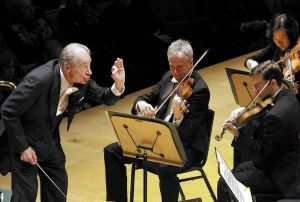
I attended the Dec. 2013 performance of the work at the Disney Hall. Pictured is Mr de Burgos conducting. It was a thrill like no other. (Well, maybe The Planets.)

“Guest conductor Rafael Frühbeck de Burgos’s attention to detail delivers the razzle dazzle and also discovers renewed radiance in ‘Scheherazade.'”

We did a monster shootout for this music in 2014, one we had been planning for more than two years. On hand were quite a few copies of the Reiner on RCA; the Ansermet on London (CS 6212, his second stereo recording, from 1961, not the earlier and noticeably poorer sounding recording from in 1959); the Ormandy on Columbia, and a few others we felt had shown potential.

The only recordings that held up all the way through — the fourth movement being THE Ball Breaker of all time, for both the engineers and musicians — were those by Reiner and Ansermet. This was disappointing considering how much time and money we spent finding, cleaning and playing those ten or so other pressings.

Here it is a year later and we’re capitalizing on what we learned from the first big go around, which is simply this: the Ansermet recording on Decca/London can not only hold its own with the Reiner on RCA, but beat it in virtually any area. The presentation and the sound itself are both more relaxed and natural, even when compared to the best RCA pressings.

The emotional content of the first three movements (all of side one) under Ansermet’s direction are clearly superior. The roller coaster excitement Reiner and the CSO bring to the fourth movement cannot be faulted, or equaled. In every other way Ansermet’s performance is the one for me.

Both Sides

Superb! Big brass, so full-bodied and dynamic, yet clear and not thick or overly tubey. Lots of space as is usually the case with Ansermet’s recordings from this era.

Both sides here are BIG, with the space and depth of the wonderful Victoria Hall that the L’Orchestre De La Suisse Romande perform in. As a rule, the classic ’50s and ’60s recordings of Ansermet and the Suisse Romande are as big and rich as any you’ve heard. On the finest pressings (known around these parts as Hot Stampers) they seem to be the ideal blend of clarity and richness, with depth and spaciousness that will put to shame 98% of the classical recordings ever made.

The solo violin is present and so real you will have a hard time believing it.

This copy is huge in every dimension, just as all the best ones always are, with maximum amounts of height, width, and depth. The transparency is also superb — you really hear into this one in the way that only the best Golden Age recordings allow.

(more…)

The Said and the Unsaid – The Firebird on Mercury

Hot Stamper Pressings of the Music of Igor Stravinsky Available Now

For our shootout years ago of The Firebird we had three minty, potentially hot copies of the Mercury with Dorati, as well as our noisy ref. (We have a noisy reference copy for just about every major title now. We have been doing these shootouts for a very long time. After thirty years in the record business we have accumulated a World Class collection of great sounding records that are just too noisy to sell.)


UPDATE 2024 

This is no longer true. Our customers seem to be able to put up with surface noise on the records we offer if the price is low enough. Not actually low, just low enough. We have a section for records with condition issues, and there are 175 entries in it as of today, which turns out to be more than a quarter of all the Hot Stamper pressings on the site as a matter of fact.


We had one FR pressing and two of the later pressings with the lighter label, the ones that most often come with Philips M2 stampers. This is how we described the winner:

So clear and ALIVE. Transparent, with huge hall space extending wall to wall and floor to ceiling. Zero compression.

Lifelike, immediate, front row center sound like few records you have ever heard.

Rich, sweet strings, especially for a Mercury. This side really gets quiet in places, a sure sign that all the dynamics of the master tape were protected in the mastering of this copy.

What we didn’t say — and what we never say in the listings — is what the second tier copies didn’t do as well as the shootout winner.

We used to. When you read the older entries, most of the time they mention the shortcomings that caused one side or another to be downgraded by some amount, usually something like a half to a full plus.

Not all the top end, not all the bass, not as present, slightly smeary, slightly congested — the list of potential faults for any given pressing is long indeed. These are all the problems we listen for and it’s the rare copy that doesn’t suffer from one or more of them.

We decided years ago that it was better just to let you hear the two sides of the record for yourself and make your own judgments about the sound, rather than make clear to you what areas we felt needed improvement.

Consider this example. If on our system the bass was lacking compared to the very best, perhaps on your system the bass was fine, not an issue, good enough. Without the top copy to compare yours to, how would you know how much better the bass could possibly be?

A classic case of “compared to what?

Shootouts are the only way to answer that question, which, as we never tire of saying, is THE most important question in all of audio. This is why we do shootouts, and why you must do them too, if owning the highest quality pressings is important to you.

Click on the following link to see more records for which we’ve detailed the strengths and weaknesses of a specific copy.

What We Heard on The Firebird

With all that in mind, only the Triple Plus (A+++) copy, as described above, did everything right.

There were two Double Plus (A++) copies, and each of them fell short in different ways.

(more…)

Behind the Scenes of One of My Favorite Recordings – Citizen Kane

More of the Music of Bernard Herrmann in Stock

An orchestral dreadnought such as this requires mastering and pressing of the highest quality. The music by its very nature taxes the limits of LP playback itself, with deep bass notes; incredible dynamics from every area of the stage; masses of strings playing at the top of their registers with abandon; huge drums; powerful brass effects — every sound an orchestra can produce is found on this record, and then some.

Kenneth Wilkinson was the engineer for these sessions in glorious Kingsway Hall.

It’s yet another remarkable disc from the Golden Age of Recording, in this case extending all the way into the ’70s.

You will hear plenty of sounds that defy description, that’s for sure. Some of the time I could not even imagine what exotic instrument could possibly be making the sound I was hearing. The remarkable document pictured below will show you some of them.

(more…)

The Bloated Cello Sound Some Audiophiles Find Appealing

Hot Stamper Pressings of the Music of Claude Debussy Available Now

On this pressing we were a bit surprised at how natural the cello sounded — more like the real instrument and less like the typical recording of it. 

Normally when recording the cello, the microphones are placed fairly close to the instrument. This often results in what’s known as the “proximity effect,” which simply describes a boost in the lower frequencies relative to the more linear response of the microphone when placed at a distance.

The famous Starker cello recordings on Mercury — you know the ones, the originals and even the reissues sell for hundreds and hundreds of dollars — suffer from this effect, which audiophiles seem to prefer. (The Mercury heavy vinyl reissues, at least the ones I’ve played, were ridiculously fat and bloated in the bottom.)

Audiophiles did not seem to mind much, judging by the apparently strong sales and the rave reviews I read. Bass shy systems, and that means most of the systems owned by audiophiles, probably benefited from the bass boost.

Systems with lots of large woofers — at least in our case — would of course make the sound of these pressings positively unbearable. That indeed was our experience.

Getting back to the record at hand, it presents a more natural cello if only because the instrument has been miked from a greater distance.

Side two is a bit fuller sounding than side one, and one of them is going to sound more correct on your system than the other. I would not even want to say for sure which one actually is more correct, as the slight difference between them might be subtle enough to play into room and system non-linearities that plague all stereos and rooms.

Both sides here will sound the way these real instruments sound when played in the kinds of rooms that one might hear them in, practice rooms perhaps. That makes this recording unusual in the world of “audiophile recordings,” if I can call this one, and no less refreshing and enjoyable for it.

(more…)

Chabrier / Ansermet – The Best Espana on Record?

Hot Stamper Pressings of the Music of Chabrier Available Now

In 2021 we wrote:

Ansermet’s performance of Espana is still our favorite — nothing in our experience can touch it, musically or sonically.


UPDATE 2022

As of 2022 we slightly prefer the famous Argenta recording for Decca that’s on the TAS List, CS 6006.

Both are wonderful and both belong in any serious audiophile collection of orchestral music.


We created a special section for recordings of this quality. Classical and orchestral records that we’ve auditioned and found to have the best performances with the highest quality sound can be found here.

This has been a favorite recording of ours here at Better Records for a very long time, since at least the mid-’90s or thereabouts. We’ve mentioned how much we like the sound of Londons with catalog numbers ranging from about 6400 to 6500 or so (which are simply Decca recordings from the mid-’60s), and this one (CS 6438) is one of the best reasons to hold that view.

You get some of the Tubey Magic and golden age sound from Decca’s earlier days, coupled with the clarity and freedom from compression and tube smear of their later period. In other words, this record strikes the perfect sonic balance, retaining qualities from different periods that are normally at odds with each other. Here they work together wonderfully.


Further Reading

The Brahms Violin Concerto – Unplug or Suffer the Consequences!

Hot Stamper Pressings Featuring the Violin Available Now

The massed strings here, such as those found at the opening, are close-miked and immediate as befits the Mercury recording style.

Your electricity had better be good when you play this record, because it presents a test many of you will have trouble passing at even moderate levels. 

We’ve often encouraged our readers and customers to go about unplugging things in their homes in order to test the effect of clean electricity on their playback systems.

The opening of this record is a perfect example of the kind of material everyone should be testing with in order to hear these changes.

I’d be very surprised if the strings on this record don’t sound noticeably better after you’ve unplugged a few things in your house, and the more the better.

The effect should not be the least bit subtle. It’s certainly not subtle in our listening room.

The same would be true for any of the tweaks we recommend. The Townshend Seismic Platform or Hallographs would be a godsend for proper playback of this record. Hard to imagine what it would sound like without them. (To tell you the truth, we don’t really want to know.)

(more…)

The Music of Leonard Bernstein – Our Four Plus Mind Blowing Shootout Winner

More music written or performed by Leonard Bernstein

This London Phase 4 British import has some of the most SPECTACULAR sound I have ever heard reproduced from disc. The sound is so BIG and BOLD that it handily puts to shame 95% or more of all the Golden Age Shaded Dogs, London Bluebacks, Mercury Living Presence’s, EMI’s and Decca’s we’ve ever played. If we had a Classical Top 100 list, this record would belong in a Top Ten taken from it, right near the top judging by what I heard when I played it.

Side two here is BEYOND White Hot, earning a sonic grade of A++++! I don’t know that any other copy has earned such a high grade for side two but this one sure did. It blew our minds.

If you have a system with the speed, power and size to play this record properly (yes, you will need all three and a whole lot more), it’s hard to imagine it would not qualify as the best sounding classical recording you’ve ever heard. Demo Disc barely begins to do it justice. What sound. What music. What a record! Side two is where the real action is on this album, and it is presented here with SPECTACULAR AUDIO FIDELITY the likes of which you may have never experienced.

(more…)

An Amazing 45 RPM Discovery from 2015

More of the music of Sergei Prokofiev (1891-1953)

PLEASE NOTE:

We no longer give Four Pluses out as a matter of policy, but that doesn’t mean we don’t come across records that deserve them from time to time.


We award this copy our very special Four Plus A++++ grade, which is strictly limited to pressings (really, individual sides of pressings) that take a given recording to a level we’ve never experienced before and had no idea could even exist. We estimate that about one per cent of the Hot Stamper pressings we come across in our shootouts earn this grade. You can’t get much more rare than that.

This Japanese 45 RPM remastering of our favorite recording of Prokofiev’s wonderful Lt. Kije Suite has DEMONSTRATION QUALITY SOUND. For starters, there are very few records with dynamics comparable to these. Since this is my favorite performance of all time, I can’t recommend the record any more highly.   

Most of what’s “bad” about a DG recording from 1978 is ameliorated with this pressing. The bass drum (drums?) here must be heard to be believed. We know of no Golden Age recording with as believable a presentation of the instrument as this.

When a particular pressing we’re auditioning takes the recording to a level significantly higher than our expectations, it gets our attention, big time. This can only happen with a record we know well. We thought we knew how good Lt. Kije on Japanese 45 could sound but we were wrong — this pressing is clearly better than the copy we would be proud to call White Hot, which means this one deserves an impossible sonic rating of eleven on a scale of one to ten.

Forget the logic. It’s not about that, it’s about the sound and the music, and we make no apologies for calling this copy Beyond White Hot. It blew our minds.

(more…)

Mussorgsky / The Power of the Orchestra – Awesome In Stereo?

More of the Music of Modest Mussorgsky

UPDATE 2022

This review dates from 2007. We recently played a copy of the album and did not care for the sound much, which you can read about here.


DEMO DISC QUALITY ORCHESTRAL SOUND like you will not believe. We put two top copies together to bring you the ultimate-sounding Pictures At An Exhibition. Folks, it doesn’t get any better than this for huge orchestral dynamics and energy.

One side of each copy rates A Triple Plus — our highest sonic grade. The sound is out of this world. 

We had to do it that way, for one simple reason: Pictures stretches over both sides of this record, and no copy we played had two good sides, which means that if you were to own only one LP of this set, some part of the work would not sound nearly as good as the rest. This is always a problem with classical recordings: one good sounding side is not enough.

On top of that there are always condition issues with old Living Stereo records. So few are quiet. We love the sound but the vinyl leaves much to be desired. Here are some comments from a previous comparison package (with minor changes of course). (more…)

Sibelius / Symphony No. 2 – An Overview

More of the Music of Jean Sibelius

A truly extraordinary recording mastered beautifully but pressed on vinyl that has never been known for its quiescence (if I can get by with that ten cent word).

The strings are clear and textured, yet rich and full-bodied. The bottom is big and weighty. The horns are tubey and full-bodied and never screech through even the most difficult passages.

My notes mention that it’s

  • rich and tubey but clear and lively;
  • big, with great energy;
  • superbly spacious and
  • never harsh or shrill.

(It can be a bit dark in places; as you know this is much preferable to the alternative.)

About as close to live music as I think this piece can sound in my listening room.

This shootout has been many years in the making. Some time around 2014 we surveyed the recordings of the work we had on hand, close to a dozen I would think, and found them all wanting, save two: this one and the 1964 reading by Ansermet for Decca (CS 6391).

So many recordings failed to capture the size, weight and power of the orchestra. Too much multi-miking was ruinous to some; screechy strings and horns to others.

Most recordings we played were profoundly unnatural, lacking transparency and the relaxed sense of involvement that eases one’s ability to be tricked into thinking “you (really) are there.”

(more…)