Advice-WTLF, Jazz

Jazz records with advice on what to listen for, in order to help you separate the best pressings from the also-rans and improve the quality of your collection.

Which Side of this Pressing Lacked Space, and How on Earth Did You Spot It?

Hot Stamper Pressings of the Music of Thelonious Monk Available Now

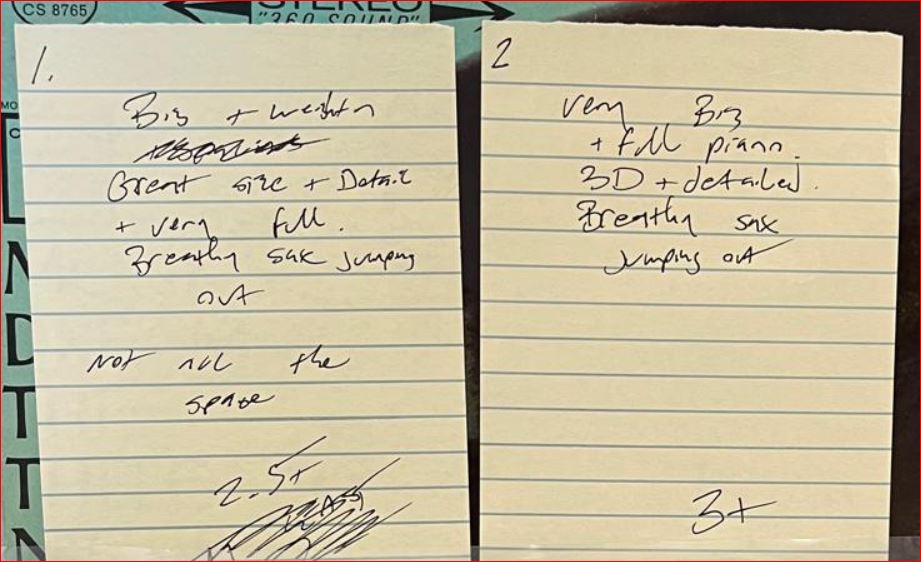
Our notes for a recent shootout winning copy read:

Monk’s Dream returns to the site for only the second time in over two years, here with INCREDIBLE Shootout Winning Triple Plus (A+++) grades or close to them throughout this black print Stereo 360 pressing.

These are just a few of the things we had to say about this killer copy in our notes: “big and weighty”…”great size and detail and very full”…”breathy sax jumping out of the speakers”…”very big and full piano”

In our notes you can see that side one fell short in one area, space, but how would anyone know that who hadn’t played a copy with even more space than this one? That’s why we do shootouts and you must do them too.

Both of these sides are rich, spacious, big and Tubey Magical, with less smear on the piano, a problem that holds many copies back. The sound found on these early Columbia 360 Label Stereo pressings is absolutely the right one for Monk’s music.

As you can see from the notes we took for this copy, we are not making any of this up!

This is why we do shootouts. If you really want to be able to recognize subtle (and sometimes not so subtle!) differences between pressings, you must learn to do them too.

And make sure to take notes about what you are hearing, good and bad.

One side falling short of the full Three Pluses happens all the time.

One out of five records that has one shootout winning side will have a matching shootout-winning other side.

(more…)

On Waka/Jawaka Transparency Is Key

Hot Stamper Pressings of the Music of Frank Zappa Available Now

Not long ago we discovered the secret to separating the men from the boys on side one: TRANSPARENCY.

On the lively, punchy, dynamic copies — which are of course the best ones — you can follow the drumming at the beginning of ‘Big Swifty’ note for note: every beat, every kick of the kick drum, every fill, every roll.

It’s all there to be heard and appreciated. If that track on this copy doesn’t make you a huge fan of Aynsley Dunbar, I can’t imagine what would. The guy had a real gift.

Big Swifty!

The 17-plus-minute-long Big Swifty is a suite in which each section slowly, almost imperceptibly blends into the next, so that you find yourself in a completely new and different section without knowing how you got there — that is, until you go back and play the album and listen for just those transistions, which is what makes it worth playing hundreds and hundreds and hundreds of times.

Big Swifty is a jazz suite with amazingly innovative work by Sal Marquez on trumpet. He single-handedly turns this music into a work of brilliance. I can’t imagine a more talented player.

Zappa on guitar is excellent as well. Aynsley Dunbar plays his ass off, only falling short when it comes time to do his drum solo on Waka/Jawaka.

The interplay of each of these rock musicians is in the tradition of the greatest jazz artists stretching all the way back to the 50s.

And since the drumming throughout this record is so crucial to the music itself, a copy that really gets that right is one that probably gets everything right.

(more…)

On Discovered Again, Does It Sound Like the Snare Is Wrapped in a Towel on Your Copy?

Hot Stamper Pressings of Direct-to-Disc Recordings Available Now

The bulk of this commentary was written in 2008 and is based on the shootout we had just done, our first for the album. It has been amended a number of times since.

I bought my first copy of Discovered Again in 1976 upon its release. I was a big fan of the label at the time. The Missing Linc had been a revelation to me years before in terms of how good music could sound in the home (or apartment as the case may be). I wrote a bit about it here.

I credit that amazing record as well as Discovered Again as fundamentally important in helping me advance in this devilishly difficult hobby of ours. Back in those dark days of the 70s, although I was completely clueless at the time about pretty much everything having to do with vinyl and equipment, I can take some solace in the fact that everybody else was every bit as clueless as I was too.

This blog is dedicated to sharing some of what I’ve learned — with the unflagging help of my staff of course — about records and audio over the last fifty years.


The sound quality of the typical pressing of Discovered Again leaves much to be desired.

Two areas are especially lacking as a rule: the top end tends to be rolled off, and there is a noticeable lack of presence, which can easily be heard in the drum sound.

The snare sounds like it’s covered with a towel on most copies of this album.

How does that even happen?

Who knows? Even though the mastering is fixed at the live event, there are many other variables which no doubt affect the sound. The album is cut on two different lathes — M (Master) and S (Slave), and pressed in two different countries: Japan and Germany. Many mothers were pulled from the acetates and many, many stampers made from those mothers. (I saw one stamper marked number 15!)

Bottom line? You got to play ’em to know how they sound, just like any other pressing. If no two records sound the same, it follows that no two audiophile records sound the same, a fact that became clear early on in the listening.

Of course not many audiophiles are in a position to shootout six copies of Discovered Again, and I’m not sure most people would have the patience to do it. Here at Better Records we have a whole system set up to do that, so we waited until we had a pile of them, got them all cleaned up, and off to the races we went.

What Else to Listen For

Listen to the harmonics around the cymbals and bells on Git Along Little Dogies — on the best copies you can really hear the transients of the cymbals and percussion, so important to the actual sound of those instruments. (More records that are good for testing percussion can be found here.)

The stand-up acoustic bass is amazingly well recorded on this album; it’s so rich and full-bodied. You will have a hard time finding a string bass that sounds better.

Track after track, the sound is surprisingly open and airy. Dave’s keyboards throughout have wonderful presence; on the best copies they really jump out of the speakers. (A good test for midrange presence.)

(more…)

The Amazingly Spacious Sound of Ellington Indigos

Hot Stamper Pressings of the Music of Duke Ellington Available Now

This original 6-Eye Stereo pressing blew us away with its superbly well-recorded romantic big band jazz, of which Ellington was a true master.

A near-perfect demonstration of just how good 1958 All Tube Analog sound can be – no modern record can hold a candle to a pressing as good as this one.

If you like the sound of relaxed, tube-mastered jazz, you can’t do much better than Ellington Indigos. Many of the other Six Eye copies we played suffered from blubbery bass and transient smearing, but the clarity and bass definition here are surprisingly good. The warmth and immediacy of this sound may just blow your mind.

We played a handful of later pressings that didn’t really do it for us. They offer improved clarity, but can’t deliver the tubey goodness that you’ll hear on the best early pressings. We won’t be bothering with them anymore. It’s tubes or nothing on this album, and that means the best 6 Eye Stereo original pressings will always win our shootouts.

The key for vintage super-tubey recordings is balancing clarity with richness. The easiest way to test for those two qualities on this album is to find a track with clear, lively, loud trumpets that also includes rich trombones and other low brass.

On side one that track is Where or When. If your copy has clear, lively trumpets and rich, full-bodied, Tubey Magical low brass, it is definitely doing an awful lot of what it needs to do right.

Some of you may recognize that this is precisely why Bob and Ray Throw a Stereo Spectacular is our all time favorite test disc. (Was might be more accurate. It was for me, but I retired. The younger generation now running the show has their own favorite test discs, as is only fitting. They didn’t spend ten or fifteen years working on the stereo and room with the record the way I did.)

(more…)

In the Market for New Speakers? See How Well They Handle the Energy of Far More Drums

Hot Stamper Pressings of the Music of Dave Brubeck Available Now

The drum solo Joe Morello lets loose on Far More Drums is one of the best on record. I was playing that song recently and it occurred to me that it is practically impossible for a screen or panel speaker of any design to reproduce the sound of those drums properly, regardless of how many subs you have.

Most of the music is not in the deeper bass anyway. It’s the whack of instruments whose energy is in the lower midrange and mid-bass that a screen speaker will struggle with.

A good large-driver dynamic speaker fed by fast electronics can handle the energy in that range with ease.

This is the album you need to take with you next time you head to your local stereo store to audition speakers.

It will help clarify the issues. Screen speakers do many things well, but drums are not one of them, at least in my experience they aren’t. If drums are important to you, do yourself a favor and buy a dynamic speaker, the bigger the better.

brubeck in the studio733

Time Further Out, like most of the classic Brubeck albums, is a big speaker record. It requires a pair of speakers that can move air with authority below 250 cycles and play at fairly loud levels. If you don’t own speakers that can do that, this record will never really sound the way it should.

(more…)

Alan Sides Sure Likes a Dead Studio

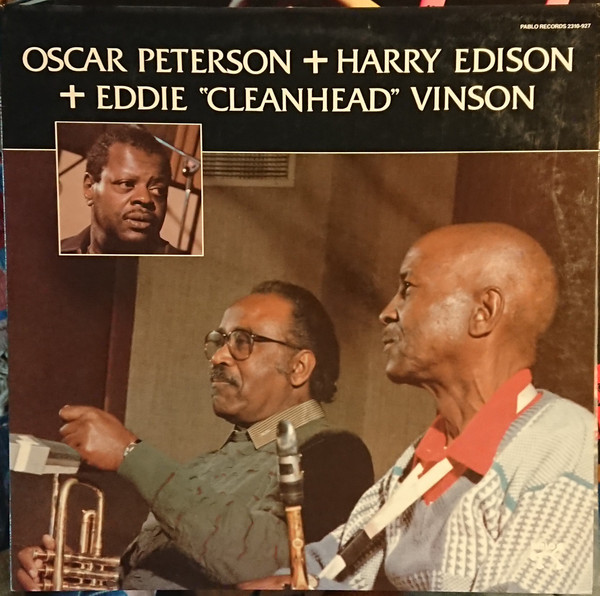
Hot Stamper Pressings of Pablo Recordings Available Now

Many of Allen Sides‘ recordings suffer from a lack of ambience. The musicians do not seem to have much room around them. In audiophile parlance, his recordings often lack “air.”  I can’t say all his recordings are made in a dead studio, but some of them sure are.

Many audiophile recordings, especially direct-to-disc recordings from the ’70s, are insufferable in this respect, with too much multi-miking and not enough studio space.

This Bach recording on Crystal Clear is a good example of the sound some audiophile labels were going for. Back in the 70s, audiophile producers and engineers were using state-of-the-art high-tech recording equipment, but they seemed to lack experience as well as knowledge of the recordings of the past. They regularly ended up producing records that are not remotely the equal of those that were commonly made only twenty years before.

For Duke is the poster boy for that sound. The instruments are dynamic as all get out, but no one ever imagined that the ideal approach to recording Ellington’s music would be to cram a big group of players into the equivalent of a heavily carpeted and draped livingroom.

Miller and Kreisel created a completely new, strange and inappropriate sound for Duke’s music, and it has been rubbing me the wrong way since I first heard it demoed in the audio showrooms I frequented back in the 70s.

(more…)

Prelude Is a Phenomenally Good Van Gelder Recording from 1973

Hot Stamper Pressings of Recordings by Rudy Van Gelder

On Deodato’s magnificent Prelude, listen to the trumpet on the second track on side one — it’s so immediate, it’s practically JUMPING out of the soundfield, just bursting with energy. Rudy can really pull off these big productions on occasion, and this session was clearly one of them.

If you have the kind of stereo that’s right for this music (the bigger the better) you could easily find yourself using this record as a demonstration disc. It’s very unlikely that many of your audiophile friends have ever heard anything like it.

The congas are present in the mix and very full-bodied — this allows them to really drive the rhythmic energy of the music. We know this because the copies with congas that were veiled or thin never seemed to want to get up and go. 

The top is most often the problem with these CTI pressings. The best sides seem to give you all the top end that was on the tape.

There is wonderful transparency and openness to the soundstage, as well as less congestion in the loudest parts. Also Sprach (2001) is on side one of the album and it is KILLER on the best pressings.

The best sides are also surprisingly sweet and Tubey Magical, nice qualities for a CTI record to have since so many of them are aggressive and edgy.

Full, lively horns; rich, punchy, smear-free congas; fuzzy fuzzed-out guitars; as well as correct tonality and Tubey Magic in every area of the spectrum, what’s not to love?

The best are so much bigger than most copies too. There is no doubt that you will hear the difference immediately. If you do a shootout with your best copy and ours plan on it being over practically before it starts.

(more…)

What to Listen For on Birds of Fire

Hot Stamper Pressings of Jazz-Rock Fusion Albums Available Now

Birds of Fire as a recording is not about depth or soundstage or ambience.

It’s about immediacy, plain and simple.

All the lead instruments positively jump out of the speakers — if you are lucky enough to be playing the right pressing.

This is precisely what we want our best Hot Stampers to do. In most cases, the better they do it, the higher their grade will be.

The main problem with this record is a lack of midrange presence. If the keyboards, drums and guitars are not front and center, your copy does not have the presence it should. On the best copies the musicians are right in the room with you. We know this for a fact because we heard the copies that could present them that way, and we heard it more than once.

Which of course gets to the reason shootouts are the only real way to learn about records.

The best copies will show you qualities in the sound you had no way of knowing were there. Without the freakishly good pressings you run into by chance in a shootout you have no way to know how high is up. On this record up is very high indeed.

A True Demo Disc

Birds of Fire is one of the top two or three Jazz/Rock Fusion Albums of All Time. In my experience, few recordings within this genre can begin to compete with the Dynamics and Energy of the best pressings of the album — if you have the Big Dynamic system for it.

(more…)

Sonny Rollins Helped Us See the Light Many Years Ago

The following commentary was taken from our mid-90s catalogs, the ones that came out back in the days when it was still possible to find great jazz records like Alternate Takes for cheap, often still sealed.

The Analogue Productions Heavy Vinyl recuts done by Doug Sax had come out a few years earlier, starting in 1992. Those remastered records were in print at the time I wrote this, and I was pretty pissed off at the way they sounded.

Here is our listing with some minor changes from long ago:

Acoustic Sounds had just remastered and ruined a big batch of famous jazz records, and shortly thereafter a certain writer in The Absolute Sound had said nice things about them.

Said writer and I got into a war of words over these records, long, long ago. You’ll notice that no one ever mentions these awful records anymore, and for good reason: they suck. If you own any of them, do yourself a favor and get either the CD or a good LP for comparison purposes. I expect you will hear what I’m talking about.

In my essay on reviewers I attack him for giving a big “Thumbs Up” in TAS to the botched remastering of Sonny’s Way Out West. The OJC reissue, though superior, is still only a pale shadow of the original.

The Real Deal

Now we have the real thing! This LP has three alternate takes from that session, all mastered by George Horn, and surprise, surprise, surprise, they sound just like my original, much better than (but not so different from) the OJC, and worlds away from the muted flab of the Analogue Productions LP!

(more…)

Finding the Rare Pressing of Heavy Weather with An Extended Top End

Hot Stamper Pressings of Jazz Rock Fusion Albums Available Now

It has been our experience that the copies with high frequency extension and the clarity, space and percussive energy that results from it are consistently the best sounding. You may have read elsewhere on the site that what separates many of the best Columbia LPs from their competition is an open, extended top end.

For some reason, Columbia, more than most labels, had a habit of making slightly dull records. Dull does not work for this album. 

When the highs on the record are right, it all comes together. Unfortunately, most copies don’t have those highs. There’s more to it than that of course: some copies lack bass, some are a bit grainy and gritty sounding — the normal problems associated with vinyl records are all here to one degree or another.

But when you have good highs you are about 80 to 85% of the way toward a Hot Stamper. Complete the picture with bass, dynamics, etc. (and a big speaker system) and there’s a good chance the sound will blow your mind.


Heavy Weather is a classic case of yet another in the long list of recordings that really comes alive when you turn up your volume.

This is music that doesn’t make any sense unless you play it LOUD. This is a BIG SPEAKER recording. I know this because I was playing it too quietly, which is to say at normal listening volumes, and it just wasn’t thrilling me. As soon as I turned it up, it really started to work, both as a piece of music and as a recording. So much gets lost in a mix as dense as this one at moderate levels. Everything comes out into the open when you give it the volume it needs. Trust me on this one; without a big dynamic speaker this music is never going to do what it wants to do — which is to ROCK YOUR WORLD. (more…)