Month: March 2025

Close to You on Mobile Fidelity Vinyl – Is This the Sound Audiophiles Were Clamoring For in ’83?

Hot Stamper Pressings of the Music of Frank Sinatra Available Now

In 2024 we did a shootout for the first of Frank’s many releases from 1957, Close to You. We were fortunate to have the Mobile Fidelity pressing from the ’80s box set to play against the mostly original pressings we had accumulated since our last shootout in 2020.

It takes a long time to find enough clean copies to get a shootout going. Four years is fairly typical these days I would imagine.

As you can see from our notes, side one of this MoFi was just awful. Can you blame us if we didn’t bother to play side two?

P.S. I Love You

  • Over-textured violin
  • Spitty, gritty vocals
  • Hollow and dry

Close To You

  • Very clean
  • Bass and vocals really lacking body and warmth

Our grade, had we given it one, would have had to have been a big fat F.

Is it the worst version of the album ever made?

(more…)

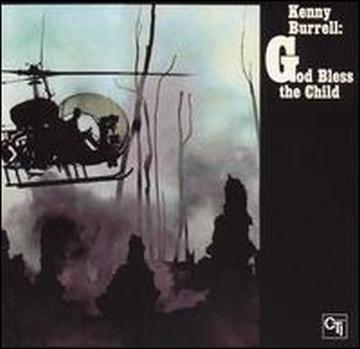
Kenny Burrell – God Bless The Child

More Kenny Burrell

  • Incredible sound throughout this original copy (only the second to hit the site in years), with both sides earning Shootout Winning Triple Plus (A+++) grades or close to them
  • Here are just a few of the things we had to say about this stunning copy in our notes: “spacious and rich guitar and strings”…”big and open and clear”…”jumping out of the speakers”
  • One of our favorite CTI albums, and surely one of the best sounding, especially on this pressing
  • If you’re looking for the best sounding jazz from the 70s and 80s, you might want to check out these titles
  • Credit goes to Rudy Van Gelder once again for the huge space that the superbly well-recorded orchestra occupies
  • 4 stars: “This is Burrell at his level best as a player to be sure, but also as a composer and as a bandleader. Magnificent.”

God Bless The Child is one of our favorite orchestra-backed jazz records here at Better Records. A few others at the top of my list would be Wes Montgomery’s California Dreaming (1966, and also Sebesky-arranged), Grover Washington’s All the King’s Horses (1973) and Deodato’s Prelude (also 1973, with brilliant arrangements by the man himself).

What’s especially notable is how well-recorded the strings are. They have just the right amount of texture and immediacy without being forced or shrill. They’re also very well integrated into the mix. I wouldn’t have expected RVG to pull it off so well — I’ve heard other CTI records where the orchestration was abominable — but here it works as well as on any album I know of.

The bass is deep and defined; the tonality of the guitar and its overall harmonic richness are beautifully rendered. The piano has the weight and heft of the real thing.

This kind of warm, rich, Tubey Magical analog sound is gone forever. You have to go back to 1971 to find it.

The Music

The high point for side one is clearly the first track. It’s got a Midnight Blue relaxed groove going on, the kind that Kenny Burrell seems to be able to bring to any session he plays on. Or maybe it’s the rhythms Ray Barretto works out in the songs that make them so relaxed and swinging at the same time.

Side two is magical from start to finish. The two extended songs, both more than eight minutes in length, leave plenty of room for the band and the orchestra to stretch out.

(more…)

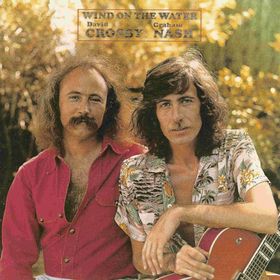
Crosby / Nash – Wind on the Water

More of the Music of David Crosby and Graham Nash

  • With a STUNNING Shootout Winning Triple Plus (A+++) side two mated to a solid Double Plus (A++) side one, we guarantee you’ve never heard Wind on the Water sound this good
  • These are just a few of the things we had to say about this incredible copy in our notes: “lots of space”…”huge and present and tubey”…”very detailed vox”…”tons of weight…”present and lively”
  • Here you will find noticeably richer sonics than practically all other pressings (hence the high grades) – many tended to be leaner and drier than we would have liked, and we take a lot of points off when they sound that way
  • It’s possible to get the clear, breathy vocals that bring out the wonderful harmonies these two are so rightly famous for – it’s just not easy
  • Marks in the vinyl are sometimes the nature of the beast with these vintage LPs – those on “Carry Me” are especially bad – but if you can tough those out, this copy is going to blow your mind
  • 4 stars: “Wind on the Water has an instant classic, lived-in sound and is a definite must-have.”

Solo and In Combination

Of course it’s easy to argue that finding good sound on an album with two or more members of Crosby, Stills, Nash and Young, in any configuration, has never been easy. It’s the rare copy of either of the first two albums that’s even listenable, and the CSN album from 1977 doesn’t sound nearly as good as any of the first three Crosby/Nash albums (of which this is the second). Which simply means that the “good” sound of our Hot Stamper copies is far better than what most audiophiles own of any of these guys in combination.

Their solo albums are a different story altogether. The first solo albums by David Crosby (1971), Stephen Stills (1970) and Graham Nash (1971) are three of my favorite records of all time; each is a brilliant recording, each is powerfully compelling music (the Nash album especially). Two made our Top 100. It’s puzzling to contemplate just how well-recorded each of their first solo albums are considering their less-than-stellar group recording efforts. Too many cooks spoiling the broth might make a good guess, but at this point it’s no more than speculation and mostly a waste of time. With so many records to play, we find we do better when we confine ourselves to the realities of the vinyl in front of us.

(more…)

Pet Sounds: Analogue Productions Takes on the Hot Stamper

Robert Brook has a blog which he calls

A GUIDE FOR THE DEDICATED ANALOG AUDIOPHILE

Below is a link to a comparison Robert Brook carried out between two pressings of Pet Sounds – the Analogue Productions pressing and one of our Hot Stampers.

We’ve written quite a bit about the album, and you can find plenty of our reviews and commentaries for Pet Sounds on this very blog.

PET SOUNDS: Analogue Productions Takes on the Hot Stamper

I have never heard the AP pressing, and have no plans at this time to get one, mostly because not a single one that I have heard on my system was better than mediocre. If your experience has been different, we have some questions for you.

(more…)

Letter of the Week – “This is the best sounding LP I have ever heard…”

Hot Stamper Pressings of the Music of Steely Dan Available Now

One of our newest Hot Stamper converts, John R., a customer only since February [of who knows what year, 2010 perhaps?], has already managed to acquire about a dozen of our best Hot Stamper LPs to the tune of many thousands of dollars.

As we like to say, the best copies may not be cheap, but here at Better Records you most certainly get what you pay for. Just ask John. If I read him right what he got for his 650 clams was something that exceeded any expectation he might have had for it.

Who knew? How would anyone know this album could sound so this good? The average copy barely hints at the sound the engineers recorded.

Anyway, that’s our story. Now here’s John’s.

Tom,

This is the best sounding LP I have ever heard including all the ones I have bought from you or ever heard in my life at a show etc. Holy Shit! This is a GREAT LP – sound and music. I must confess, I never heard this LP before – even once. I did recognize the lead song though having heard it on the radio several times. MY GOD! I listened to it twice over both sides. This is fantastic. The music slayed me.

I took Tom’s advice and played it real loud. Once I turned it up hard – well it got even better and better and better. Wow! You can’t have this one back. Every single song on both sides is a winner. I especially got a kick out of the last song on side one – which is an old fashioned instrumental that got me jumping all over the place.

One of the great things about doing business with you guys is that you know and love your music. This means I get good advice and direction about what LPs are great music and about the performers. This means I can get great stuff that not only I know I love but stuff I don’t know yet that I will love. Wow – there just is no way to be able to buy that. No way at all. Thanks so very much. Please tell Tom that I am really happy with this LP. Katy Lied now has to be on my short list to get soon.

I think I jumped on another good one tonight. I also am not familiar with this LP or this group Return to Forever. But the description had me salivating to listen to it. (more…)

Uptown Girl Is Often Hard and Harsh in the Midrange

Hot Stamper Pressings of the Music of Billy Joel Available Now

Dynamic and open, with driving rhythmic energy – the best early pressings really bring this great batch of songs to life.

Jam packed with hits: An Innocent Man, The Longest Time, Tell Her About It, Uptown Girl, Leave a Tender Moment Alone, and more – seven singles in all.

The best sides have the huge soundstage and startling clarity and immediacy that characterizes this album, but they also add an ingredient missing from most of the copies we played — a full, rich, musical midrange!

On many pressings, the vocals can get hard and harsh on the more uptempo tracks.

Uptown Girl” is a notable offender in this regard, and never sounds quite as good as the other tracks.

A prime example of an album in which the hit sounds worse than the rest of the album.
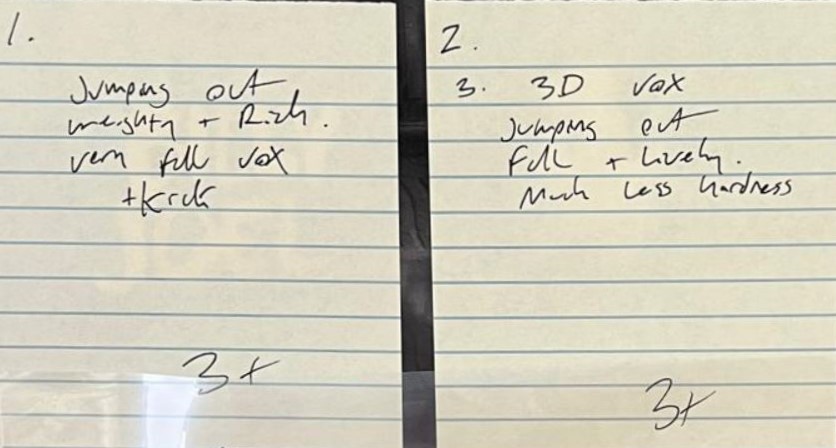
As you can see from the notes for our our most recent White Hot shootout winning copy, side one was doing everything right, and side two, where Uptown Girl can be found, was doing the best it could, all things considered.

Side One

Jumping out / weighty and rich / very full vocals and kick drum

Side Two

Three-dimensional vocals / jumping out / full and lively / much less hardness

The notes for side two point out that it less hard sounding than the typical pressing, and that, coupled with its many other desirable qualities, put it over the top and made it the winner for side two.

Other records that are good for testing midrange hardness can be found here.

Hey, want to find your own top quality copy?

Consider taking our moderately helpful advice concerning the pressings that consistently win our shootouts.

This record has been sounding its best for many years, in shootout after shootout, this way:

(more…)
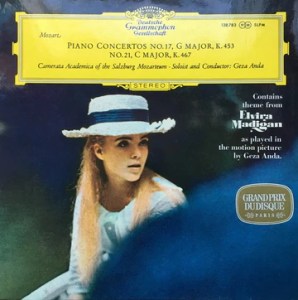
Mozart / Piano Concerto No. 17 and No. 21 – Anda

More of the Music of Wofgang Amadeus Mozart (1756-1791)

  • This vintage Large Tulip label copy of these classical masterpieces boasts solid Double Plus (A++) sound from first note to last
  • Spacious, three-dimensional and real beyond practically any DG recording you’ve heard – you hear into the soundstage on this record like you will not believe
  • Marks in the vinyl are sometimes the nature of the beast with these early pressings – there simply is no way around them if the superior sound of vintage analog is important to you
  • “Mozart’s piano concertos are filled with assured transition passages, modulations, dissonances, Neapolitan relationships and suspensions. Today, at least three of these works (nos 20, 21 and 23) are among the most recorded and popular classical works in the repertoire…”

The string tone here is especially rich and sweet, yet full of texture and that lovely rosiny quality that vintage pressings capture so well. (Sometimes capture so well. We’ve played plenty of copies with a smeary quality that robs the strings of their lovely sheen.)

The piano is beautifully recorded as well. Geza Anda’s performance is hard to fault here. You will have a very hard time finding better recordings of these Mozart piano concertos, of that we have no doubt. (more…)

Bob Seger – Against The Wind

More Bob Seger

  • Both sides of this original Capitol pressing have killer sound for Bob Seger’s brand of Heartland Rock, earning Shootout Winning Triple Plus (A+++) grades or close to them
  • About half of the tracks feature the Muscle Shoals Rhythm Section, and if you have never seen the brilliant documentary done about them, we highly recommend you take the time to do so forthwith
  • “It is Seger’s only number-one album to date, spending six weeks at the top of the Billboard Top LPs chart, knocking Pink Floyd’s The Wall from the top spot.”
  • A very famous mastering engineer cut this record right, and it doesn’t take a pair of golden ears to hear just how right it is
  • 4 stars: “Against the Wind finds Bob Seger turning toward craft. Perhaps he had to, since Against the Wind arrived after three blockbuster albums and never-ending tours… compared with its peers, it’s a strong, varied heartland rock album that finds Seger at a near peak.”
  • If you’re a Bob Seger fan, this title from 1980 is surely a Must Own

(more…)

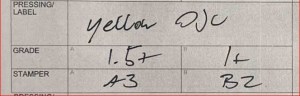
Skip the A3/B2 OJC on Some Like It Hot

Hot Stamper Pressings of the Music of Barney Kessel Available Now

Some Like It Hot badly needed to be made using tubes in the mastering chain, but that didn’t happen.

It’s another case of an OJC with zero Tubey Magic. You might as well be playing the CD. I would bet money it sounds just like this record. Maybe even better.

I suppose if you have a super-tubey phono stage, preamp or amp, you might be able to supply some of the Tubey Magic missing from this pressing, but then all your correctly mastered records wouldn’t sound right, now would they?

We had two copies of the OJC and one of them did better than this one. It earned a Super Hot grade for one side. If you see this OJC pressing in your local record store, avoid these stampers. The sound isn’t awful, but it’s not very good either, especially considering how amazing the tapes must be, based on the sound of our White Hot Stamper shootout winner.

The OJC pressing of this album is much better suited to the old school audio systems of the 60s and 70s than the modern systems of today. These kinds of reissues used to sound good on those older systems, and I should know, I had an old school stereo and some of the records I used to think sounded good back in the day don’t sound too good to me anymore (although this one never did).

The OJC pressings of Some Like It Hot are thinner and brighter than even the worst of the later pressings we’ve auditioned. That is decidedly not our sound. It’s not the sound Roy DuNann was famous for, and we don’t like it either, although we have to admit that we did find the sound of many of these OJC pressings more tolerable — even enjoyable — in the past.

Our old system from the 80s and 90s was tubier, tonally darker and dramatically less revealing, which strongly worked to the advantage of leaner, brighter, less Tubey Magical titles such as this one. Pretty much everybody I knew had a system that suffered from those same afflictions.

Like most audiophiles, I thought my stereo sounded great.

And the reality is that no matter how hard I worked or how much money I spent, I would never have been able to achieve top quality sound for one simple reason: most of the critically important revolutionary advances in audio had not yet come to pass.

It would take many technological improvements and decades of effort until I would have anything like the system I do now.

(more…)

Fighting The Dreaded J Curve

More Entries from Tom’s Audiophile Notebook

That guy you see pictured to the left has spent much of the last forty years wandering around used record stores looking for better records (ahem). 

Before that he wandered around stores selling new records because he didn’t know how good old used records could sound.

In these posts he shares some of the things he’s learned since he started buying records at the age of ten roughly sixty years ago. (First purchase: She Loves You on 45. It’s still in his collection, although it cracked a long time ago and hasn’t seen a turntable in forever.)


Perhaps you suspect the electronics of your system are not as neutral as you thought they were.

So let’s say you get rid of your euphonic tube equipment (vintage or modern, makes no difference, colorations are colorations) and switch over to something that’s less colored.

The sound is now cleaner, cleaner, more present, more alive, more “right there” the way live music is “right there,” not veiled or vague or recessed the way so many stereos (at least in my experience) tend to sound. (Hard to believe, but some audiophiles seem to like that sound.)

But perhaps the sound now lacks richness, because you no longer have the richness your tubes were adding.

Perhaps now the sound is not as smooth as you would like, because it’s not being smoothed over by the smooth-sounding tube equipment you were using.

It’s very possible that the change has caused you to be less less happy with the sound.

Welcome to the J Curve.

You started at one point on the J, you made some changes, and now you find yourself with inferior sound compared to the sound you had before.

You may decide to turn back, to restore the sound you had so that you can enjoy your records the way you did when you had euphonic equipment, tube or transistor.

(more…)