 More of the Music of Jethro Tull
With a nod to our old friend, John Barleycorn.
We were finally able to get our hands on Analogue Productions’ newly remastered Stand Up, an album we know well, having played the British copies from every era by the score. Our notes for the sound can be seen below.
If ever a record deserved a “no” grade, as in “not acceptable,” this new 45 RPM pressing mastered by Kevin Gray deserves such a grade, because it’s just awful.
But let’s put that grade in context. The last time a good sounding version of Stand Up was released, as far as we can tell, was 1989, and that version was the Mobile Fidelity Gold CD. I bought mine soon after it came out. I wasn’t even planning on buying a CD player when the Compact Disc was first invented, but then Mobile Fidelity played a dirty trick on me. Instead of releasing Loggins and Messina’s first album on vinyl, they put it out exclusively on CD as part of their Silver MFCD series.
 As a die-hard MoFi fan, that sealed the deal: now I had to buy a CD player. I picked up a cheap Magnavox player, the 1040. I think it ran me less than $100, and played my new Sittin’ In CD, which, as I recall, sounded pretty good. (One of my other early CD purchases was Tumbleweed Connection, the regular label release, and it was dreadful.)
I still own Stand Up on Gold CD, and I still find it superb in every way. (Many of the MFSL Gold CDs from this era are excellent and worth seeking out.)
It sounds nothing like this new vinyl release, and that’s a good thing.
On vinyl, Stand Up has rarely been given the care it deserved. The last version of Stand Up to have sound we would want to listen to was pressed in the UK in the early ’70s. That was close to fifty years ago.
We sold some domestic pressings of the album back in the early 2000s, describing them at the time as made from dub tapes with all the shortcomings that entails, but mastered very well from dub tapes. The best domestic pressings are rich, smooth, tonally correct and natural sounding. They’re too dubby to sell as Hot Stampers, but they are not bad records. Some later Chrysalis pressings are big and open, but often they are too thin and bass-shy for the music to work. We’ve never taken them seriously.
It wasn’t long before we’d eliminated everything but the early UK pressings for our shootouts, and we quickly discovered that the earliest of the UK pressings on the older Island label were not good at all. We wrote about the problem with some originals more than ten years ago.
What was surprising about the shootouts we had done in past years was how disappointing most of the early British pressings we played were. They were flat, lacked energy and just didn’t rock the way they should have.
We learned the hard way that most British Pink label pressings aren’t especially rich, that some are small and recessed, and some are just so smeary, thick and opaque that they frustrate the hell out of you as you’re trying to hear what any of the musicians other than Ian Anderson is doing.
So when a reviewer comes along and says something positive about the new pressing compared to some unidentified original, we appreciate the problem that is at the root of his mistaken judgments:
Here’s the deal: if the goal was to duplicate the original pink label Island sound, this reissue misses that, which is good because this new double 45 reissue is far superior to the original in every possible way.
The tape was in great shape, that’s for sure. Clarity, transparency, high frequency extension and especially transient precision are all far superior to the original. Bass is honest, not hyped up and the mastering delivers full dynamics that are somewhat (but only slightly), compressed on the original. Ian Anderson’s vocals are naturally present as if you are on the other side of the microphone. Most importantly, the overall timbral balance sounds honest and correct. But especially great is the transient clarity on top and bottom.
If you’re fortunate to have an original pink label Island, at first you might think the sound is somewhat “laid back”, but that’s only because the mids and upper mids are not hyped up as they are on the original. That adds some excitement, but it clouds the picture and greatly obscures detail.
If you scroll down to our notes, you will see what we thought of the “laid back” sound this reviewer talks about. (Keep in mind that we first read the above review mere moments ago.)
We think “smaller, thick and stuck in the speakers” may be someone’s idea of “laid back,” but, just so there is no misunderstanding, it’s our idea of “awful.”
None of these are good things. Our Hot Stamper pressings are never small, thick or stuck in the speakers. They’re the records with the opposite of that sound. Our records are big, transparent and open. That’s why we can charge so much money for them and have people lining up to buy them.
They deliver the big, bold sound that the brilliant engineer for the album, Andy Johns, was known for. Laid back was not in his vocabulary.
Here is more of what we heard on side one.
Jeffrey Goes to Leicester Square
“Transients are sharp but body is dull. Kinda phony.”
Phony sound is the key here. Messing with the EQ in the mastering benefits some aspects of the sound at the expense of others.
Nothing new there. Audiophile pressings with wacky EQ are the norm. I would be surprised if any common Reprise pressing from back in the day wouldn’t sound more “right,” more tonally correct, more seamless. I’ve played quite a few and I don’t recall ever hearing one sound “phony.”
On side two we played the first two tracks.
 Nothing Is Easy
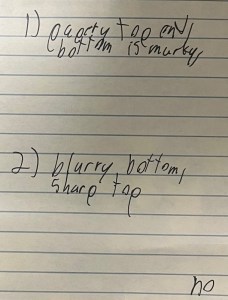
“Papery top end. Bottom is murky.” A papery top is thin and brittle. Lots of OJC pressings have that sound, so it’s easy for us to recognize it because we’ve heard scores of records with the very same tonality issue.
This Grant Green title on Music Matters had the same problem. Unsurprisingly it was mastered by the same guy who mastered Stand Up. Hey, maybe that’s his signature sound! When it comes to audiophile remastering, nothing surprises me anymore.
Fat Man
“Blurry bottom, sharp top.”
Is that the sound you’re looking for on vinyl?
The balalaika Ian Anderson plays on this track is a tough instrument to reproduce. It can indeed be characterized as having a “sharp” sonic signature. The crude, transistory cutting equipment Kevin Gray uses was a poor fit for this song and for this album in general. Why he cannot cut better bass we have no idea. The bass on the Grant Green title linked above was “sloppy and fat” too. More of his signature sound?
How this guy keeps getting work is a mystery to me.
But in this case it’s really not a mystery at all. Here’s how we think it might have gone down.
On whatever crappy audiophile system they are using to play these records, the new pressing beat the original Pink Label Island. Drinks all around.
Not knowing that the original pressings do not sound very good — really, not knowing all that much about records period — made their job seem a lot easier than it actually was.
They didn’t produce a good sounding record. They produced a record that was (perhaps) better than a bad sounding record. They unknowingly set the bar very low. But unknowingly is how this label has been operating from the very beginning. I’ve written extensively about many of their bad sounding records, starting all the way back in 1995 with Way Out West.
Not much has changed. You may remember from the Washington Post video last year that Geoff Edgers blind-tested me with two copies of Quiet Kenny, one from The Electric Recording Company (“this guy makes mud pies!”) and the other from Analogue Productions (‘it’s the best record they ever made, because it’s not terrible”), or words to that effect.
Had I had a good copy of Quiet Kenny on hand, a record I think I know well, I could have elucidated all the shortcomings of the AP pressing in great detail. Instead I was stuck comparing a very bad pressing of the album to a copy that was not as bad.
What purpose does such a comparison serve?
For that matter, what purpose does the new pressing of Stand Up serve, other than to put more money in Chad’s pockets? He’s about to ruin the Steely Dan catalog. Is that what you want?
What are some of the more important take-aways from this review of Stand Up?
Let’s start with these six.
- Stand Up is yet another imperfectly mastered original [1] that can easily be beaten by the right vintage reissue. (Those are the pressings we sell, obviously. No original we’ve ever played would qualify as a Hot Stamper.)
- The original is never the de facto standard for judging any other pressing. Provisionally, yes, but when the original is not that good sounding, as is the case here, why try to beat it? Try to beat a good sounding record, for chrissakes!
- If you are an audiophile looking for the best sound, avoid any vinyl pressing of Stand Up made in the last four decades or so.
- The Gold CD is your best bet, unless you want to buy one of our rare and expensive Hot Stamper pressings.
- Analogue Productions produces records that rarely sound better than awful. They should be avoided by anyone with good equipment [2] and well-developed critical listening skills [3]. No one with both could possibly be fooled by the atrocious reissues this man has been producing for the last twenty five years.
- Kevin Gray is also responsible for remastered records that are rarely better than mediocre and often just plain awful. If you are looking for audiophile sound on vinyl, take our advice and avoid his stuff, too.
[1] We’re nothing if not consistent
[2] Our stereo
Thank you very much for this analyzation of “Stand Up”. Reading your reviews gives me more security to choose a pressing than listening to the 45 guy on YouTube.
If you’re high enough, practically any record you play sounds good, right?
Once you sober up or come down, whichever the case may be, only then do you realize how much money you flushed down the toilet on these dreadful audiophile reissues.
Cognitive dissonance explains him pretty well. His identity is tied up completely with these records. He can never find fault with them. Faulting them would be the same as faulting himself.
He was a MoFi fan and now he is an Analogue Productions fan. If he’s a fan of the two worst audiophile labels of all time, how on earth can he have any credibility with anyone who is not a True Believer?
Thanks for your comment.
TP
I invited M45 to give one of your records a try. He declined because he does not want to frequent a business that criticizes Chad’s unimpeachable work. That means that his 41,000 followers can’t view him as a reliable, unbiased guide to the best sounding records.
Dear ab_ba,
There was never any hope for this guy. Like you say, he thinks Chad can do no wrong.
And that means he has made very little progress in this hobby and is unlikely to make more any time soon.
He is stuck in his Heavy Vinyl rut and he and his followers are just fine with that, so it’s probably best to just leave them alone.
Playing them a better sounding pressing of Stand Up would just confuse and upset them.
They’re no different than the CD-only and digital-download guys. They have their thing and they see no reason to think there is anything better.
Thanks for your letter,
TP