tizzy-cymbals

The Original Jazz Classics Series Got Off to a Bad Start with Concorde

Here Are Some Potentially Good Sounding OJC Pressings

OJC-002! Fantasy’s second release in the series, but not a very good one.

The copy (or copies; who can remember?) we’ve auditioned in the past did not impress us sonically, so don’t expect to see Hot Stampers of this title on OJC coming to the Better Records website any time soon.

The music might be wonderful — we unreservedly follow the maxim de gustibus non est disputandum — but the sound of this pressing is not likely to be of audiophile quality.

There may be great sounding pressings of the album – how could we possibly know there aren’t without playing every version ever pressed — but we’re pretty sure the OJC pictured here will always fall short of the mark.

(more…)

Soultrane Sucks on the Early OJC

Hot Stamper Pressings of the Music of John Coltrane Available Now

The early OJC reissues from 1982 of this title are awful.

And whatever Heavy Vinyl they’re churning out these days is probably every bit as bad, but — I’m guessing, never played one so don’t hold me to it — in the opposite way.

The OJC is thin and bright, and the modern reissue (I’m assuming, based on playing scores of them) is probably thick, veiled, overly smooth, lacking in space and boosted in the bass — because that’s the sound that audiophiles record buyers seem to like these days.

Without the excellent sounding 60s and 70s reissues that we are still able to find in audiophile playing condition, all that we would have available to buy for our shootouts would be the originals. 

At the big bucks those records go for nowadays, shootouts would be impossibly expensive.

So our thanks go to Rudy for doing a good job on these later pressings!


UPDATE 2025

We were surprised to find that the right stampers on the new OJC pressings can have very good sound. Click on the link below to that Soultrane has joined the group of good sounding modern OJC pressings.

(more…)

Waiting For Columbus Gets the Bernie Treatment Care of Rhino Records

Hot Stamper Pressings of the Music of Little Feat Available Now

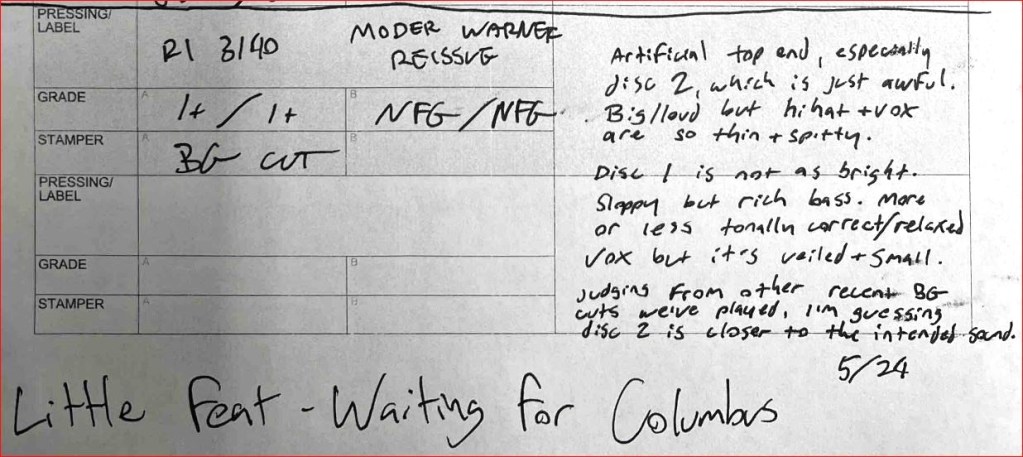
A Hot Stamper pressing of this amazing sounding album, a title we regret to say we have in stock only rarely, might be described this way:

Some of the best sounding live rock and roll sound you will ever hear outside of a concert venue. If you want to understand the unique appeal of the band, there’s no better place to start than right here.

It’s one of our all-time favorite live recordings and their single best release – a true Masterpiece.

I have lately been listening to this album in its entirety at the gym (playing the standard cassette over headphones) and enjoying the hell out of it. As good as their best studio albums are, and I count myself as big a fan of the band as there is, Waiting for Columbus is surely the pinnacle of their recorded output. It is as close to perfect as any live album I know.

(The Last Record Album is my personal favorite of their studio albums, but since nobody seems to want to buy it at the prices we charge, I regret to say we had to stop doing shootouts for it years ago. We were losing too much money that way.)

But Bernie Grundman’s version is just another one in a very long line of disastrous recuts, the kind of crap he has been churning out for the last thirty years. It’s all but unplayable on modern high quality equipment. (If it’s not on your system, you might consideer the idea that you still have plenty of work left to do, audio-wise.)

As you can see from the notes below, record one may be passable, but record two is NFG. How is it possible to turn such a wonderful recording into such a ridiculously bad sounding pressing? Even Mobile Fidelity did a better job with the album, and they’re one of the most incompetent remastering outfits that the audiophile world has even known.

We’re frankly at a loss to understand any of it.Bernie Grundman used to make good sounding records. We know that for a fact, having played them by the hundreds. Apparently those days are gone, and, based on this album and plenty of others, there is very little chance of them returning.

Notes on the Sound

(more…)

Music Matters – Tizzy Cymbals and a Bright Snare Drum, That’s Your Idea of Audiophile Sound?

Hot Stamper Pressings of Blue Note Albums Available Now

UPDATE 2026

This review was written in 2021.

An audiophile hall of shame pressing and a Heavy Vinyl disaster if there ever was one (and oh yes, the audiophile world is practically drowning in them).

After discovering Hot Stampers and the mind-blowing sound they deliver, a new customer generously sent me a few of his favorite Heavy Vinyl pressings to audition, records that he considered the best of the modern reissues that he owns.

He admitted that most of what he has on Heavy Vinyl is not very good, and now that he can clearly hear what he has been missing, having heard some of our best Hot Stamper jazz pressings, he is going to be putting them up on Ebay and selling them to anyone foolish enough to throw their money away on this kind of junk.

We say more power to him.  That money can be used to buy records that actually are good sounding, not just supposedly good sounding because they were custom manufactured with the utmost care and marketed at high prices to soi-disant audiophiles.

Audiophile records are a scam. They always have been and they always will be.

I haven’t listened to a copy of this album in a very long time, but I know a good sounding jazz record when I hear one, having critically auditioned more than a thousand over the course of the 33 38 years I have been in business. (To be clear, we only sold verified good sounding records starting in 2004.)

I knew pretty early on in the session that this was not a good sounding jazz record.  Five minutes was all it took, but I probably wasted another ten making sure the sound was as hopeless as it initially seemed.

For those of you who might have trouble reading my handwriting, my notes say:

  • Bass is sloppy and fat.

The bass is boosted and badly lacks definition. It constantly calls attention to itself. It is the kind of sloppy bass that cannot be found on any RVG recording, none that I have ever heard anyway, and I’ve heard them by the hundreds.

You no doubt know about the boosted bass on the remastered Beatles albums. It’s that sound. Irritating in the extreme, and just plain wrong.

  • Reserved. Playing through a curtain.

Very few Heavy Vinyl records these days do not sound veiled and reserved in the midrange.

To get a better sense of the effect, throw a medium weight blanket over your speakers. Voila! Your thin vinyl now weighs 180 grams!

  • No space.

Typical of Heavy Vinyl. The studio space and ambience found on the better vintage pressings, the kind we play all day long, is GONE.

RTI pressings are serial offenders in this regard.  We find them uniformly insufferable.

  • No transients.

Not the sound of the instruments that RVG is famous for.  No leading edges to any instrument anywhere.

Somebody screwed them up in the mastering. Bad cutting equipment? Bad EQ? Both? What else could it be?

  • Boring.

Of course it is. Nothing sounds right and it’s all just so dead.

I would be very surprised if the CD was not dramatically better sounding in practically every way, and far more fun to listen to.

  • Snare is hot when played loud like a bad OJC

We’ve auditioned close to a hundred OJC titles over the years. We sell quite a few of them, but of course we only sell the ones that sound good. We are in the good sounding records business. And some of them are hard to beat.

But lots of them have a phony, boosted top end, easily heard as tizzy, sizzly, gritty, phony cymbals and too-hot snare drums.

This record has that phony sound.

We would never sell any record that sounds this phony and wrong. It is an utter disgrace and an affront to vinyl loving audiophiles around the world.

If this record sounds right to you, one thing I can say without fear of contradiction: no matter how much money and time you may have spent on it, you still have a great deal of work to do on your stereo system if you want it to sound right.

(more…)

Sounds Unheard Of! – Another Analogue Productions Disaster

Hot Stamper Pressings Featuring Shelly Manne Available Now

Remember the 90s Acoustic Sounds Analog Revival series mastered by Stan Ricker? This was one of the titles they did, and completely ruined of course, as was the case with all the titles from that series that we played.

Ricker boosted the hell out of the top end, as is his wont, so all the percussion had the phony MoFi exaggerated sizzle and tizziness that we dislike so much around here at Better Records.

Yes, it’s the very same phony top that many audiophiles do not seem bothered by to this day. 

The whole series was an audio disaster, but oddly enough, I cannot remember reading a single word of criticism in the audiophile press discussing the shortcomings of that series of (badly) Half-Speed mastered LPs — outside of my own reviews of course. Has anything in audio really changed?

If I were to try to “reverse engineer” the sound of a system that could play this record and hide its many faults, I would look for a system that was thick, dark and overly smooth, with no real extension on the top end to speak of. Stan’s 10k boost — along with other the colorations he favors — is just what the doctor ordered for such a system.

I know that sound. I had a system in the 90s with many of the same shortcomings, but of course I didn’t know any of that.

I didn’t know what I didn’t know back then.

(more…)

Waiting for the Sun – Don’t the DCC Pressings All Sound Different Too?

More of the Music of The Doors

I recently had a chance to listen again to this DCC pressing for the first time in many years. I was putting it up on ebay to sell and dropped the needle to check the sound. I can’t say I liked what I heard. Knowing the record as well as I do, I could her that the DCC was clearly to be brighter in the midrange.

When I went back to read what I had said about the DCC years ago, I saw that I had described that copy the same way. You can read it for yourself.

Our old review follows.

We rate the DCC LP a B Minus

We used to like the DCC pressing of this Doors album. Now… not so much. It’s a classic case of Live and Learn.

Keep in mind that the only way you can never be wrong about your records is simply to avoid playing them. If you have better equipment than you did, say, five or ten years ago, try playing some of your MoFi’s, 180 gram LPs, Japanese pressings, 45 RPM remasters and the like. You might be in for quite a shock.

Of course the question on everyone’s mind is, “How does this Hot Stamper copy stack up to the famous DCC pressing?” After all, the DCC was the one we were touting all through the ’90s as The One To Beat.

Well, to be honest, the DCC is a nice record, but a really special original copy throws a pretty strong light on its faults, which are numerous and frankly fairly bothersome.

The top end on the copy I played was a touch boosted, causing a number of problems.

For one, the cymbals sounded slightly tizzy compared to the real thing, which had a fairly natural, though not especially extended, top end.

But the real problem was in the midrange. Morrison sounded thinner and brighter, more like a tenor and less like a baritone, with a somewhat hi-fi-ish quality added to the top of his voice. Folks, I hate to say it, but if someone had told me that the record playing was half-speed mastered, I probably would have believed it. I detest that sound, and the DCC pressing bugged the hell out of me in that respect.

Morrison has one of the richest and most distinctive voices in the history of rock. When it doesn’t sound like the guy I’ve been listening to for close to forty years, something ain’t right.

The mid-bass was also a tad boosted — not in the deep bass, but more in that area around 100-200 cycles, causing the sound to be overly rich. None of the originals we played had anything like it, so I’m pretty sure that’s a bit of added EQ Hoffman introduced for reasons best known to him. (Did he like it that way, or was he pandering to some of the audiophile community’s preference for overly rich sound, the kind they confuse with “analog”? Nobody knows.)

Not So Fast There, O Hot Stamper Guru

But wait a minute — don’t all records sound different? Is it really fair to paint his version with such a broad brush on the basis of having played only one copy?

Of course not. Perhaps other copies sound better. It wouldn’t be the first time. (Maybe they sound worse. Think about that.)

So here’s our offer to you, dear customer: We absolutely guarantee our Hot Stamper copies will handily beat the DCC pressing or your money back. We’ll even pay the return domestic shipping if for some reason you are not 100% satisfied with the sound of our Hot Stamper. Now there’s an offer you can’t refuse, for any one of you who love the album and have a wad of money burning a hole in your pocket.

(more…)

Byrd at the Gate – Another Hyped-Up MoFi

An Audiophile Hall of Shame pressing and another MoFi LP reviewed [decades ago] and found seriously wanting.

This is a title Mobile Fidelity ruined (what else is new?), and having just played an early Riverside LP I can see how their mastering approach was — as is so often the case — misguided to say the least.

First off, the guitar and the drums on the original are tonally right on the money. They sound like bass and drums should. They sound, in a word, correct.

Mobile Fidelity felt it necessary to brighten up both and the results are a phony sounding guitar and phony sounding drums, with tizzy cymbals thrown in for good measure.

(The Wes Montgomery MoFi title has many of the same faults, but it’s not quite as bad as this one. We’ve had Hot Stamper copies of the originals so we know they can sound superb, some of RVG’s best work.)

The old Mobile Fidelity — the pre-Heavy Vinyl Mobile Fidelity — rarely met a master tape they didn’t think needed a healthy dose of top end boost. They also never understood what an acoustic guitar sounds like. They blew it on every last one of the Cat Stevens albums, brightening up the guitars, which, as we all know from playing with the treble controls on our receivers way back when, emphasizes the “picking” of the strings at the expense of the resonating guitar body as well as the vibrating string harmonics.

What makes Byrd At The Gate a good record is the natural acoustic guitar tone. Once you screw that up, what’s left?

An audiophile record, for audiophiles who like phony sounding guitars. (Chesky anyone?)

Another reason the Mobile Fidelity is such a joke is that this recording inherently has a lot of ill-defined bass. Since Half-Speed mastering causes a loss of bass definition, their pressing is even WORSE in this respect. Bad guitars, bad drums and bad bass — that pretty much covers everybody in the trio. Resulting score: 0 for 3. (more…)

Jazz Giant – Is the OJC Really 100x Worse?

Hot Stamper Pressings of Contemporary Jazz Albums Available Now

The OJC versions of Contemporary Records are typically thin and somewhat opaque, as well as tizzy up top, the kind of sound one often hears on CDs (and that CD lovers for some reason never seem to notice).

Some OJC pressings, however, can be excellent — when you are lucky enough to chance upon the right copy.

The pressings that were mastered and put out by Contemporary in the mid-70s (until they were bought by Fantasy) are almost always superior to the OJCs, but these rules of thumb break down so badly and so often that the only workable approach is just to play as many different copies of the album as you can get your hands on and simply let them sort themselves out sonically.

This of course is exactly how we conduct our shootouts. We make a lot of mistakes, but when all is said and done, we rarely fail to come up with the goods, the goods being phenomenal sounding pressings of important music, pressings that are dramatically superior to any others.

Although we’ve liked the OJC of Jazz Giant in the past, last time around the OJC versions were quite a bit thinner, smaller and less energetic than our “real” Contemporary stereo pressings. They were a big step down from our killer shootout winner.

The notes read “100x better” if that tells you anything (!)

A clear case of live and learn.

(more…)

Skip the OJC on You Get More Bounce with Curtis Counce

Hot Stamper Pressings of Contemporary Jazz Albums Available Now

This album is findable on the OJC pressing from the ’80s, but we found the sound of the OJC pressings we played seriously wanting.

They were thinner and brighter than even the worst of the ’70s LPs we had auditioned. They did not make the cut for our shootout. That is not our sound. It’s not the sound Roy DuNann was famous for, so why should we like it either?

Some OJC pressings are great — including even some of the new ones — some are awful, and the only way to judge them fairly is to judge them individually, which requires actually playing a large enough sample.

Since virtually no record collectors or audiophiles like doing that, they make faulty judgments – OJC’s are cheap reissues sourced from digital tapes, run for the hills! – based on their biases and inadequate sample sizes.

You can find those who subscribe to this approach on every audiophile forum there is. The methods they have adopted do not produce good results, but as long as they stick to them they will never have to worry about discovering that inconvenient truth.


Further Reading

If you’re searching for the perfect sound, you came to the right place.