rock-pop-overview

An Overview of the Reissues of Teaser & The Firecat

Hot Stamper Pressings of the Music of Cat Stevens Available Now

It is my contention that there is no audiophile pressing on the face of the Earth that can compete with the best sounding originals of Teaser and the Firecat. 

Of ANY music. From ANY era.

The best copies of Teaser have a sound I have never experienced with any modern remastered record. There is a magic in its grooves that may simply be impossible to capture with the cutting equipment currently in use. Perhaps one day I’ll be proven wrong, but that day is clearly not yet upon us.

Island 25th Anniversary LP

I remember fifteen years ago when Acoustic Sounds was selling the then in-print 25th Anniversary Island pressing (10U, as I recall) for $15, claiming that it was a TAS list record. If you’ve ever heard that pressing, you know it has no business going anywhere near a Super Disc List. It’s mediocre at best and has virtually none of the magic of the good original pressings. I refused to sell it back in those days, for no other reason than it’s far from a Better Record. I don’t like misrepresenting records and I don’t like ripping off my customers. That pressing was a fraud and I was having none of it.

The Anadisq

In case you don’t already know, one of the worst sounding, if not the worst sounding version of all time, is the Mobile Fidelity Anadisq pressing that came out in the ’90s. If you own that record, you really owe it to yourself to pull it out and play it. It’s just a mess and it should sound like a mess, whether you have anything else to compare it to or not.

It’s also on the TAS Super Disc list, which is sad. Really, really sad. (more…)

How Good Are the UK Original Unboxed Deccas of Satanic Majesties?

Hot Stamper Pressings of the Music of The Rolling Stones Available Now

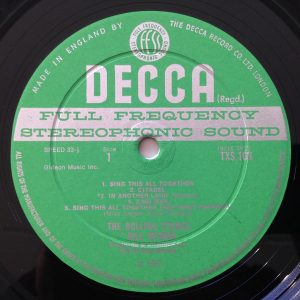
How good are the original Unboxed Deccas on Satanic Majesties?

They can be very good.

But they are never as good as the right later pressings with the Decca in a box label, the ones produced from about 1970 on.

The Unboxed Decca pressing earned a Super Hot Stamper grade (A++). The later pressing, with the right stamper, showed us just how good the album can sound.

Since the originals are pricey and hard to find, and, as a rule, noisier than the later pressings, we don’t pick them up unless we find them for cheap, which rarely happens. They have not won any shootouts, and that is very unlikely to change.

There is one set of stampers for this album that always wins, and those stampers are not found on the early label.

(more…)

In the Court of the Crimson King – An Overview

Hot Stamper Pressings of Progressive Rock Albums Available Now

If you have the Atlantic pressing, from any era, you have not yet begun to hear this record at its best.

The domestic original was cleary mastered from copy tapes, which results in its dubby sound. It’s such a well recorded album that even its second-generation sound quality is still better than much of what came out in 1969.

UK Polydor reissue? Passable, not really worth the labor to put them in a shootout just to have them earn mediocre-at-best grades.

The same can be said for some of the earliest UK Pink Label Island pressings.

None of them has ever won a shootout and probably none of them ever will.

(A number of Pink Label Island pressings that never win shootouts can be found here.)

As a rule, we don’t buy them, for two reasons:

  1. They are expensive to buy in clean condition, and
  2. Their sound quality does not justify paying the premium price sellers typically ask.

We leave them to the record collectors who like to collect originals.

The Mobile Fidelity pressing is surprisingly good, one of their best.

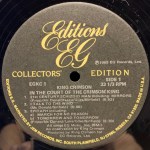
Rumor has it that they stopped making their version when Editions EG came out with a Half-Speed mastered pressing of their own, which, like most Editions EG records in our experience, sounds about as awful as any copy of the album can.

We and our customers are audiophiles. We like to collect records with good sound. If we have our heads on straight, we don’t care what pressing we buy as long as it’s the one with the best sound.

Of course, not everybody agrees with us about that, but enough of you out there do, such that our business is sure to continue to prosper in the years to come.


In the Court of the Crimson King is an album we think we know well, one that checks off a number of important boxes for us here at Better Records:

(more…)

An Overview of The Soft Parade

Our vintage Doors pressings — either on the Elektra Gold or Big Red E Label, nothing else will do — have the kind of Tubey Magical midrange that modern records are almost never able to reproduce.

Folks, that sound is gone and it sure isn’t showing any sign of coming back.

One of The Records That Did It For Me

Perhaps hearing Dark Side was what made you realize how good a record could sound. Looking back over the last forty years, it’s clear to me now that this album, along with scores of others, is one of the surest reasons I became an audiophile in the first place, and stuck with it for so long. What could be better than hearing music you love sound so good?

It’s clearly an album we are obsessed with. We have written extensively about quite a number of them to date. It is our contention that to be any good at this hobby, you have to become obsessed with well-recorded albums and work out the consequences of those obsessions for yourself.

The Soft Parade was one of those albums that blew my fifteen-year-old mind. Songs for Beginners was another one.

We also wrote about the subject of being obsessed with music here. An excerpt:

(more…)

After You’ve Played 100 Copies of the Album, What’s Left to Learn?

bloodchildHot Stamper Pressings of the Music of Blood, Sweat and Tears Available Now

This commentary is at least ten years old. We can’t say that a red label reissue like the one discussed below would do as well under the improved shootout conditions in our new studio, but the possibility exists, which is the point of the story we are telling here.

A common misconception of many of those visiting the site for the first time is that we think we know it all.

Nothing could be further from the truth. We definitely do not know it all. We learn something new about records with practically every shootout.

Not This Title

Case in point: the record you do NOT see pictured above. (The record we recently learned something new about — this, after having played scores and scores of copies over the years — will remain a secret for the time being. At least until we find another one.)

In 2013 we played a red label Columbia reissue of a famous 60s rock record (again, not shown) that had the best side two we had ever heard. Up to that point no copy other than the 360 original had ever won a shootout, and we’ve done plenty. Lo and behold, here was a reissue that put them all to shame.

I’m still in shock from the experience to tell you the truth, but what a blast it was to hear it!

The recording, which I first played more than 40 years ago at the tender age of 16, was now bigger, less murky and more energetic than ever before. Had you asked me, I would have confidently told you not to waste your time with the second pressing, to stick to the 360s on that title, and I would have been wrong wrong wrong.

How Wrong?

But wait a minute. The 360 original will probably beat 49 out of 50 red label reissue copies on side two, and the best 360 original could not be beaten on side one by any other pressing. When you stop to think about it, we weren’t very wrong at all.

Let’s just say our understanding was incomplete.

This is why we prefer to offer actual physical records rather than just advice, although it’s clear for all to see that we happily do both, and, moreover, we certainly feel qualified — as qualified as anyone can be — to offer up our opinions, since our opinions are based on a great deal of experimental data.

Having big piles of cleaned records at one’s disposal is fundamentally important to this kind of operation. In our experience, shootouts using only a small number of pressings have relatively little value. They are best seen as a guide for the next, more comprehensive attempt to find out what might be the truly killer pressings of any given album.

(more…)

Wish You Were Here – An Overview

Hot Stamper Pressings of the Music of Pink Floyd Available Now

We have added some moderately helpful title specific advice at the bottom of the listing for those of you want to find your own Hot Stamper pressing.

This is the perfect example of everything we look for in a recording here at Better Records: it’s dynamic, present, transparent, rich, full-bodied, super low-distortion, sweet — good copies of this record have exactly what we need to make us audiophiles forget what our stereos are doing and focus instead on what the musicians are doing.

For those of you who aren’t familiar with the album, Pink Floyd managed to record one of the most amazing sounding records in the history of rock music. The song Wish You Were Here starts out with radio noise and other sound effects, then suddenly an acoustic guitar appears, floating in the middle of your living room between the speakers, clear as a bell and as real as you have ever heard. It’s obviously an “effect,” but for us audiophiles it’s pure ear candy.   

Shine on You Crazy Diamond, Pts. 1-5

Right from the dynamic intro you can tell this is going to be a wild ride. David Gilmour’s haunting guitar line that comes cutting from out of the abyss should be warm with tons of room for his phasers to do their phasing.

After the band comes in and the vocals begin (listen for the man chuckling in the left channel) you should pay attention to the balance of the mix. Most copies tend to be very midrangy which can make the guitars aggressive and harsh, often times taking emphasis away from the vocals. The good copies have lots of transparency and allow everything to sit in their respectively places. This is probably most noticeable during the saxophone solo.

The tenor that starts off this section needs to be breathy, full-bodied, and sitting delicately in the center of your speakers. It does NOT need be be honky and hard sounding without any top extension. As the solo slowly crescendos, notice the guitar line spread across the soundstage that actually bookends the saxophone. The more dynamic copies really let you hear the intricacy and delicacy of his picking that foreshadows the time signature shift about to come.

When the time does change to 6/4, the saxophone player changes to alto, totally changing the sound of the solo! You can clearly hear on the better copies that he is further away from the mic than during the previous section, but if you listen closely, it sounds as though he is moving on and off axis. Whether this is part of his mic technique or him just dancin’ and groovin’ to the music, we may never know. I certainly hope for the latter.

Other Pressings

Most copies of the CBS Half-Speed lack deep bass, and for that matter bass in general.

They’re also consistently brighter. The upper mids and highs call attention to themselves at every turn. When you switch back to a good domestic copy or import, you might not notice as much detail, but everything will sound correct and balanced: less like a recording and more like music.

Phony highs cause listener fatigue for the same reason that bright CDs get tiresome.

Just listen to the sax break on side one. If your pressing is too bright that sax will tear your head off.

The Seventies – What a Decade!

Tubey Magical acoustic guitar reproduction is superb on the better copies of this recording. Simply phenomenal amounts of Tubey Magic can be heard on every strum, along with richness, body and harmonic coherency that have all but disappeared from modern recordings (and especially from modern remasterings).

Big Production Tubey Magical British Prog Rock just doesn’t get much better than Wish You Were Here.

A Big Speaker Record

Let’s face it, this is a big speaker recording. It requires a pair of speakers that can move air with authority below 250 cycles and play at loud levels. If you don’t own speakers that can do that, this record will never really sound the way it should.

It demands to be played loud. It simply cannot come to life the way the producers, engineers and artists involved intended if you play it at moderate levels.

Obsessed? You Better Believe It

Wish You Were Here is yet another record we admit to being obsessed with.

Currently we have identified about 150 that fit that description, so if you have some spare time, check them out.

(more…)

The Dark Side of the Moon – An Overview

Hot Stamper Pressings of the Music of Pink Floyd Available Now

I admit to some bias when it comes to DSOTM. I must have played more than a hundred copies over the last forty-odd years. Whenever I was sure I understood exactly which copies had the best sound, again and again I would be proved wrong.

We only found out what the best sounding versions were about five ten years ago. We did that by doing shootout after shootout with every version we could lay our hands on, starting around 2005. We even did a shootout for two different Mobile Fidelity pressings many years ago, which we think still makes for some good reading twenty years later.

It’s especially good reading for those who don’t appreciate how dramatic pressing variations can be for even quality-controlled limited editions. The comparison of the two MoFi’s centers around the idea that midrange tonality is by far the most important quality on Dark Side, and that, surprisingly to some audiophiles, but obviously not to us, there are MoFi pressings with a correct midrange and there are those without.

Our Take on DSOTM Pressings

The domestic pressings we have auditioned over the years have never made it into a real shootout. They have always sounded far too flat and veiled to be taken seriously. There are some very good sounding Pink Floyd pressings on domestic vinyl — Wish You Were Here and The Wall can both sound amazing on domestic vinyl — but Dark Side is not one of them in our experience.

The Doug Sax-mastered Heavy Vinyl version from 2003 we played when it came out was way too bright and phony to these ears. We hated it and made that clear to our readers at the time.

We came across a very early British pressing about fifteen years ago, the one with the solid blue triangle label, but it was not as good as other pressings we were playing back then and we never bought another one.

We’ve liked a lot of later UK pressings over the years, but we don’t go out of our way to buy those anymore now that we have heard the really amazing pressings we like now.

As I said, we discovered the killer stampers about five ten years ago, and that showed us an out of this world Dark Side we had no idea could even exist.

We have a name for records like those. We call them breakthrough pressings, and we used to award them a sonic grade of more than Three Pluses in some cases.

(more…)

Hejira Overview and Joni Mitchell Discography

Hot Stamper Pressings of the Music of Joni Mitchell Available Now

Most copies we played were too compressed or veiled to involve us in the music, but the best ones have the big, rich, clear sound of analog that Joni’s spacey “beatnik jazz” needs to work its magic

We played a ton of copies and heard a lot to dislike. Many copies have a tendency to sound phony, a case of heavy-handed EQ in the mastering perhaps.

Our old friend Bernie Grundman handled the mastering for the album.

When a copy sounds glossy, it loses its natural warmth and starts to sound like any old audiophile LP. We’re ideally looking for something akin to Blue here, and not the sound you find on Patricia Barber LPs. (Gratuitous maybe, but it feels like it’s been too long since we took a swipe at that third-rate audiophile-oriented music. But I digress…)

Plenty of copies had natural sound but no real life or presence to speak of. It’s a sound you could live with until you heard a good one, but there’s no going back once you’ve heard what the album’s really capable of. A copy like this one gives you lots of richness and warmth without sacrificing the texture to the instruments or the breath to Joni’s voice. The percussion really comes through, the bass has more weight and the immediacy of the vocals put Joni front and center, just where she should be.

If you aren’t familiar with this album, it’s a few more steps down the path she started taking on Court and Spark. The musicians include Larry Carlton and Jaco Pastorius, so that should give you an idea about the jazz-fusion direction of the arrangements. It was a fun album to get to know and on a copy like this one, it really rewards multiple listens.

(more…)

Bass, Choruses and Energy Are Key to the Best Pressings of War’s Albums

More Jazz / Rock Fusion Records with Hot Stampers

[This review was originally published about 2012 or so. Note that we rarely have any War records in stock. If you see one, grab it, the recordings on the best pressings are positively amazing on big speakers at loud levels.]

We just finished our first big shootout for this fun album — the All Music Guide calls it “a magical ride with plenty of surprises to keep the listener on his or her toes” and we couldn’t agree more.

This copy gives you punchy bass, airy flutes, hard-hitting percussion and loads of Tubey Magic. Many copies we played had too much hardness, edge, and midrange honk, but this one is smooth, sweet and rich.

Engineered by the brilliant Chris Huston, this recording displays all his trademark gifts.

His mixes feature:

The links above will take you to other albums that are good for testing all of these qualities.

As for the choruses, allow me to paraphrase our listing from Commoner’s Crown.

This is one of the rare pop/rock albums that actually has actual, measurable, serious dynamic contrasts in its levels as it moves from the verses to the choruses of many songs. The first track on side two, Four Cornered Room, is a perfect example. Not only are the choruses noticeably louder than the verses, but later on in the song the choruses get REALLY LOUD, louder than the choruses of 99 out of 100 rock/pop records we audition. It sometimes takes a record like this to open your ears to how compressed practically everything else you own is.

The Top Is Important Too

Richness and weight are key to the sound, but oddly enough an extended top end was almost as crucial to the success of the best copies. When the top end extends, the sound is open and relaxed. When the various songs build to their climaxes, the copies with lots of clean top end had a sense of “ease” that simply was not to be found on the smoother (read: duller) brethren.

(more…)

Who’s Next – An Overview

More of the Music of The Who

The following was written in the early 2000s. Some of the commentary has been added or modified.


Who’s Next has been remastered for audiophiles many, many times, more often than not quite badly in our opinion.

To be fair, we should point out that our opinion has changed quite a few times over the course of the last twenty years.

This then is our story.

MCA MASTERPHILE

Back in the days when I was foolishly in the thrall of half-speed mastered audiophile pressings, I thought that the MCA Masterphile was king. That was probably the mid to late ’80s.

BRITISH TRACK LABEL ORIGINALS

By the early 90s I had discovered how good the Black Label Original British Track pressings could be and started preferring those. A bit murky but Tubey Magical, full and rich, precisely the way a good British Rock recording (Faces, Jethro Tull) should be.

JAPANESE AND GERMAN

Of course by then I had played numerous Japanese and German pressings, none of which sounded right to my ears, then or now. The Japanese did what they like to do to most of the records they master, from whatever dub tapes are sent to them: they brighten up the sound.

When I had much darker, less-revealing system, the Japanese pressing did better than most of the other pressings I played.

But it was wrong, and the better my stereo got the more wrong it sounded. This process comes under the general heading of audio progress 

MCA HEAVY VINYL

In 1995 the MCA Heavy Vinyl version came out, mastered by Kevin Gray. I quite liked it at the time but no longer do; it’s brightened up, opaque, airless and much of the fine detail of the recording is missing, all due to the crude cutting system Kevin employed at the time. It’s also notoriously badly pressed, resulting in stitches in the vinyl that are audible on practically every copy. (more…)