lacks-body

The Cisco Pressing of Beethoven’s Kreutzer Sonata

Hot Stamper Pressings of Recordings with Heifetz Performing

An audiophile hall of shame pressing from Cisco / Impex / Boxstar / whatever.

The Cisco pressing of LSC 2577 should not have sound that is acceptable to any person who considers himself an audiophile.

There is no violinist in front of you when you play their pressing.

There is someone back behind your speakers under a thick blanket, and his violin sure doesn’t sound very much like a real violin — no rosiny texture, no extended harmonics, no real body.

In short, the sound of this reissue is much too smearyveiled, and lacking in presence to be taken seriously.

Unfortunately for those of us who love good music with good sound, Cisco’s releases from this era (as well as DCC’s) had to fight their way through Kevin Gray’s transistory, opaque, airless, low-resolution cutting system. We discuss that subject in more depth here.

(more…)

Our Guide to Legrand Jazz on Impex

Hot Stamper Pressings of 30th St. Recordings Available Now

Years ago I wrote about how important the Legrand Jazz album was in my growth as a critical listener.

It’s yet another example of an album that helped make me a better audiophile by showing me the error of my tweaking and tuning ways.

Now there is a new pressing of it. Well, new to us anyway. (We readily admit to being behind the times and make no apologies for it. With records like these, we often find ourselves wondering why we bother.)

Two new pressings in fact. One on a single disc at 33 RPM as of 2017, and one mastered at 45 RPM on 2 LPs as of 2019, still in print and available for $59.99.

Production details can be found at the end of this review, along with some favorable comments, some from none other than Steve Hoffman himself.

But first let’s hear from the personification of the well-meaning audiophile reviewer, Michael Fremer. He gives the Impex pressings an 11 for sound. He writes (emphasis added):

This IMPEX reissue is sourced from an “analog mix-down transfer of the original 1958 work tape by Mark Wilder at Battery Studios” and cut by Chris Bellman and Bob Donnelly at Bernie Grundman Mastering on Grundman’s all-tube mastering system. I have a clean, original 6-Eye pressing that this superbly pressed reissue betters in every way. This will make both your stereo and your heart sing. Some of the greatest jazz musicians of that or any era wailing and clearly having a Legrand time. Limited to 3000 copies. Don’t miss it!

Who are you going to believe, the Self-Appointed Vinyl Experts of the World or some guy like me who thinks he knows a thing or two about the sound of records, especially, as in this case, a record I have been playing since 1990 or thereabouts.

(Back in those early days I also had the standard CD, which is excellent and highly recommended. Since I couldn’t clean or play my original vinyl pressing at a very high level, my guess would be that the CD had the better sound at the time.)

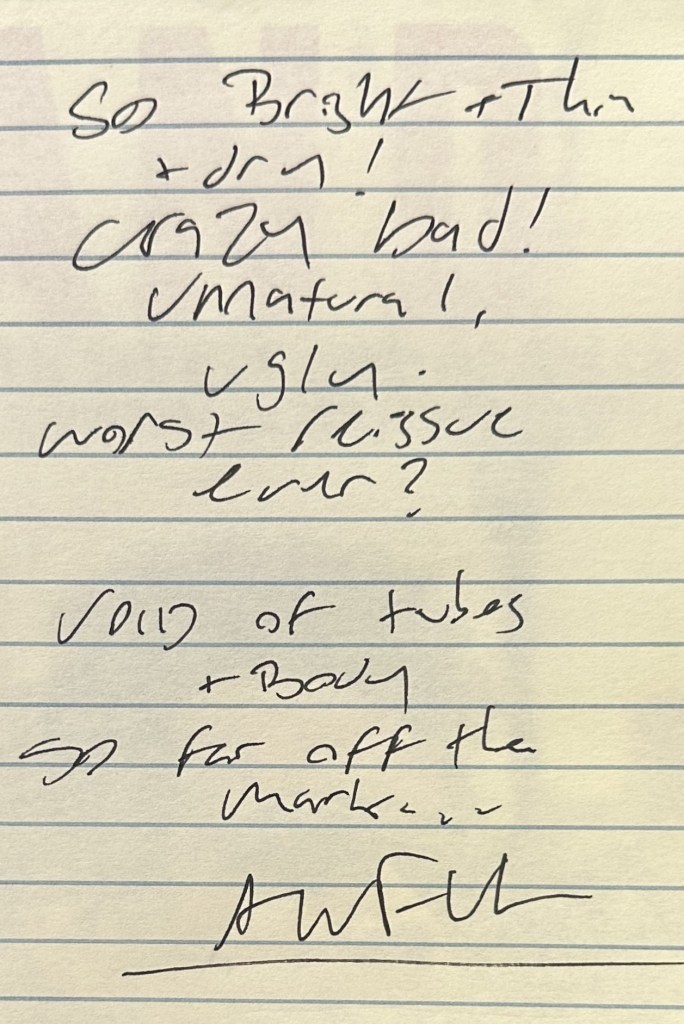
Our notes (for those who have trouble reading our scratch)

So bright and thin and dry.

Crazy bad!

Unnatural, ugly.

Worst reissue ever?

Void of tubes and body.

So far off the mark.

Awful.

A second opinion

Robert Brook reviewed this pressing a while back. He does his best to remain positive when choosing the words that he thinks will help the reader bette understand the experience of playing the Impex release of Legrand Jazz that we had loaned him. In the end he goes with the spoken word over the written one.

Legrand Jazz (featuring Miles Davis) – the 2019 IMPEX Double 45 rpm

I think it’s safe to say Robert has learned a great deal regarding the state of modern remastering. Impex’s recent release may have shown him just how low it can go.

And this is a man who’s played records from The Electric Recording Company!

When you play those, it’s hard to imagine worse sound, but one doesn’t need to imagine it, one only needs to be one of the 3000 unlucky souls who took Michael Fremer’s and Steve Hoffman’s advice and actually paid good money for this Impex pressing.

I might give it an 11 rating if the scale was 1 to 100.

Even that might be too generous. Let’s be honest, it’s a zero on any scale worth a damn, a complete failure and proof, as if more were needed, that Michael Fremer has been as deaf as a post since at least 2017, when he favorably reviewed the first Impex iteration of Legrand Jazz.

No one with two working ears should have anything good to say about this record. If you own these ridiculously bad pressings, buy the CD and find out for yourself if it isn’t better sounding.

(more…)

MoFi Sure Added Plenty of Sparkle to These Acoustic Guitars

Hot Stamper Pressing of the Music of Ry Cooder Available Now

This review is from many years ago. Hard to imagine I would not still agree with it though.

As you probably know, the MoFi of Jazz goes for big bucks nowadays — $500 and up. Is it worth it? 

You’ve got to be kidding. It’s a nice record as far as it goes, but it suffers from the same shortcomings as just about every Mobile Fidelity pressing we bother to play these days (with some obvious exceptions of course).

We have a test pressing, and knowing that the MoFi is the standard against which many audiophiles prefer to judge our Hot Stampers, we listened to it first before going about our comparison test.

Our MoFi copy is actually tonally correct, which was a bit of a surprise. (Yours of course could very well be otherwise.)

Right away we could hear exactly what people like about it, the same thing that has always impressed audiophiles about half-speed mastered records: their often outstanding transparency.

Jazz on MoFi has zero-distortion, utterly clear, spacious, see-through sound.

But listen past that and what do you hear?

Don’t those guitars seem to have that MoFi Tea-for-the-Tillerman “sparkly” quality you hate: all pluck and no body, all detail and no substance?

Nothing has any weight.

Nothing has any solidity.

Nothing has any real life.

It’s pretty, maybe, but it sure ain’t right.

It’s the kind of sound that shouts out to the world “Hey, look at me, I’m an audiophile record! See how I sound? So clear! So clean!”

Which isn’t bad for about two minutes, and then it’s positively insufferable.

(more…)

Can’t Buy Much of a Thrill – Now with Notes!

Hot Stamper Pressings of the Music of Steely Dan Available Now

At least some of the thrills are here, and for any record on Chad’s label, that is really saying something.

Sonic Grade: B+ to A-

A few comments for the UHQR have been added since this went up on 4-4-23, now that I’ve had a chance to see the notes in full. I’ve noted the additions in brackets and sectioned some off as well.

Word from the listening panel is in, and they say the new Bernie Grundman mastered UHQR is actually not bad! [Not good, but not bad.]

The tonality is much closer to correct than a lot of the Heavy Vinyl LPs we’ve played recently. Oddly enough, instead of the EQ being overly smooth, in the way that appears to be all the rage these days, the tonality instead errs on the side of somewhat thinner and brighter than ideal. (One could also use the term “correct.”)

This should not be especially surprising. Bernie Grundman has been remastering Heavy Vinyl records since the mid-’90s. Overly smooth titles that he cut are hard to find, on the hundreds of titles he did for Classic Records or anywhere else. The more of his recent work I play, the more I have come to see his disastrously dull Giant Steps as an outlier.

The instruments where these tonality issues are most easily recognized are two that we have written a great deal about on this blog: pianos and snare drums.

The snare sound on the Brothers in Arms that Chris Bellman cut at Bernie Grundman Mastering has the same problem as this new Can’t Buy a Thrill. (Review with specifics coming, sorry for the delay, it has only been two years and I’ve been busy with other things.)

The thin sounding piano on the Cisco pressing of Aja is likewise a common shortcoming we notice on many of the modern recuts we play.

With links to 29 titles to test for a correct piano sound, and 13 for the snare test, the critical listener should be able to find some records in his own collection that will shed light on the problems we heard on Chad’s UHQR.

If your system errs on the side of fat and dark, Chad’s repress has what you need to “fix” the sound of the album. Instead of a murky piano, now you have a clear one. Instead of a too-fat snare getting lost in the mix, now you have a clear snare that you can more easily separate out from the other instruments.


Added 4/5

Note that we did not play all four sides. We felt sides one and three were enough to get an idea of how thrilling this pressing was going to be. We don’t get paid to play Heavy Vinyl pressings. We play them to help audiophiles understand their strengths and weaknesses. We hope that some audiophiles will hear what we have described and perhaps consider that there is a better way. That other way can be found in the bins of their local record store or, for those with deeper pockets, on our site. Either way, settling for the kind of sound found on these modern reissues is the one choice no one should be making.

We played the following four songs, and heard the sonic qualities described below:

(more…)

Today’s Heavy Vinyl Mediocrity Is… Fragile

Hot Stamper Pressings of the Music of Yes Available Now

The Analogue Productions 180g reissue shown here is mastered by Steve Hoffman and Kevin Gray, two guys with reputations for doing good work, but the results of their collaboration [can you believe this record came out in 2006!?] leave much to be desired.

The overall sound is too lean.

This is especially noticeable on the too-thin-sounding guitars and vocals.

Believe me, it’s no fun to play a Yes album with thin guitars and vocals.

Also, there’s a noticeable lack of ambience throughout the record. What comes to mind when I hear a record that sounds like this is the dreaded D word: dubby.

I find it hard to believe they had the actual two-track original master tape to work with. The sound is just too anemic to have come from the real tape. If they did have the real tape, then they really botched the job.
(more…)

Sergio Mendes & Brasil ’66 – Another Spitty and Thin MoFi

Sonic Grade: D

An Audiophile Hall of Shame pressing and another MoFi LP reviewed and found wanting.

So spitty and thin! Why, in God’s name, why would you want to ruin such a wonderful recording?

When you have a recording that is already plenty bright, adding top end and taking out more lower midrange is the last thing in the world you should be doing. Since that was the standard operating procedure for MoFi and other Half-Speed mastering outfits around this time, that’s exactly the approach they ended up taking.

Those of you who have had the opportunity to play the Mobile Fidelity pressing of this record should know what a disaster it is.

Is brighter better? Apparently Mobile Fidelity thinks so. It sounds like a bad CD.

But it’s not a bad CD. It’s an expensive audiophile record!

If you’ve spent any time on this site, you should know by now that many audiophile records sound WORSE than the typical CD.

The typical CD does not have an equalization curve resembling a smile. The classic smile curve starts up high on the left, gets low in the middle, and rises again at the end, resulting in boosted bass, boosted top end, and a sucked out midrange — the Mobile Fidelity formula in a nutshell.

But they forgot to boost the bass on this album, so it’s closer to a half-smile I suppose.

More letters, reviews and commentaries for the debut album by Sergio Mendes and Brasil ’66