fall-short

This group of White Hot Stamper pressings had a side that fell short of the best in one or more areas of their sound.

The shootout notes you see may help you appreciate the extremely high standards by which we judge the pressings we play.

On your own copies of the album, consider listening for whatever shortcoming we took pains to point out on ours.

Which Side Lacked Space, and How Did You Figure That Out?

Hot Stamper Pressings of the Music of Linda Ronstadt Available Now

Big, rich, smooth, and sweet, how did George Massenburg pull off this kind of analog sound in 1987?

We don’t know, but we do know good sound when we hear it, and we heard remarkably good sound on this copy.

The first track on side one was big and rich, with vocals that were breathy and present, just the way we like ’em.

The third track was every bit as good, with sound that was rich and weighty. The vocals wer so present and open, sweet and silky. This is exactly what you want on this album.

And the way we know that is we played a bunch of copies and nothing could beat it. This side one took top honors for having sound we described above.

Side two is another matter. We came across a side two that was slightly better than the side one you see here.

How did that kind of thing happen, you ask?

Well, when we played the two best copies back to back, side one of this copy came out on top, earning a grade of 3+, but the side two of another pressing showed us there was even more space in the recording than we noticed the first time around.

We knew side two was “at least 2+,” the crossed-out text you see in the notes.

With another copy earning a better grade, 3 pluses, we felt the right grade for this side two was 2.5+.

(more…)

An Amazing Pressing of Latin Rendezvous – Complete with Notes!

Hot Stamper Pressings of Records from 1963 Available Now

We offered a White Hot stamper copy of this album many years ago, but our customers were not the least bit interested in it at the time, and we suspect that not much has changed since then.

It’s been tagged a never again record, meaning that although we like the music and the sound, we can’t devote the resources — in this case, mostly studio time — to finding top quality copies if there are not going to be any buyers for them.

We think it’s well worth seeking out, and one thing you can be sure of, you won’t have to pay too much for it. If you see one locally on the early label, in stereo, pick it up.

There’s a high probability it will sound at least very good, and you might even luck into one that is downright amazing the way we did, assuming you can clean it right.

More amazing finds like it can be found here.

NOTE: On side two, track three, the initialism ROTM stands for Right On The Money. See if you agree with me that the second track on side one is “kind of dry and thin.”


Our Review

A wonderful Latin jazz collection, with the unbeatable combination of the quintet’s “celebrated piano-vibes, liltingly embellished by Latin percussion and occasional flute.”

“In this collection, you’ll find Latin at its most alluring, as a musical language interpreted by Shearing.”

Clean, clear and dynamic, this copy has huge amounts of bass and tremendous space around the keyboards and percussion.

If you’re a fan of the kind of music Cal Tjader was making in the 60s, this album should be right up your alley. Plenty of Latin Percussion, with vibes and flutes to add color to the proceedings, all anchored by Shearing on the piano.

It’s lounge music but it’s fun lounge music — and it sounds like a very well recorded album from Capitol in 1963 should sound: big and rich.

1963 was a phenomenal year for audiophile quality recordings. We’ve auditioned and reviewed more than a hundred  titles to date, and there are undoubtedly a great many more that we’ve yet to discover.

Some of the best titles released in 1963 can be found here.

This link will take you to the 25+ titles recorded or released in 1963 that we think belong in any music-loving audiophile’s record collection.

(more…)

Barney Kessel Plays Carmen on the Original Stereo Pressing

Hot Stamper Pressings of Contemporary Jazz Albums Available Now

A recent shootout produced this shootout winning pressing with amazing sound.

STUNNING Shootout Winning grades or close to them bring Kessel’s inspired jazz album to life on this original Contemporary stereo LP (the first copy to hit the site in years).

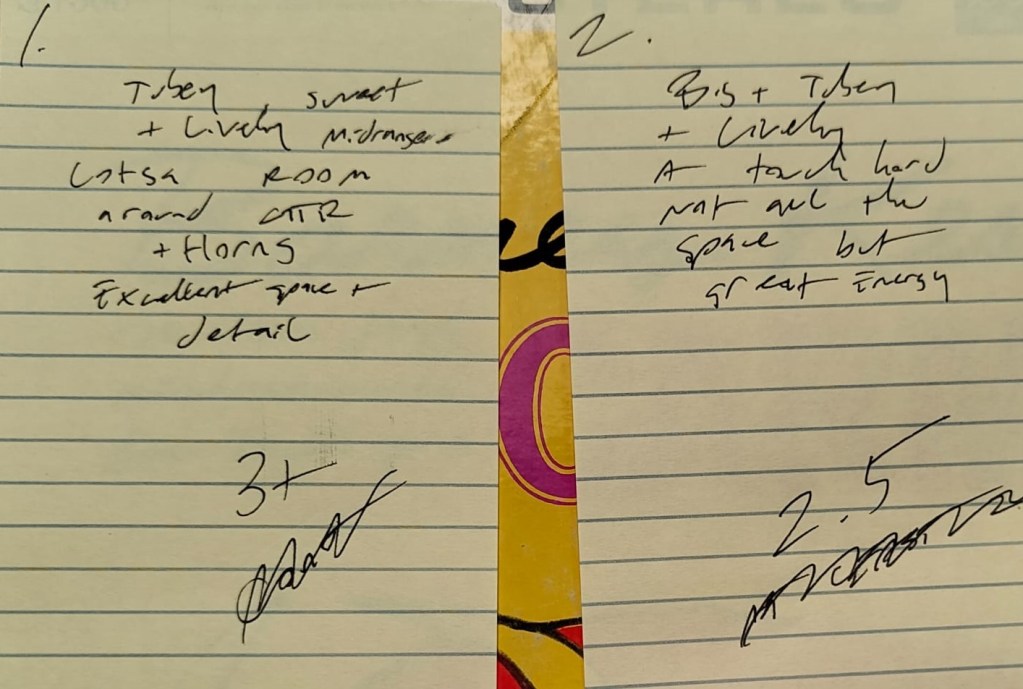
Here are just a few of the things we had to say about this killer copy in our notes: “tubey, sweet, and lively midrange”…”lots of room around the guitar and horns”…”excellent space and detail”…”great energy”

Tubey Magic, richness, sweetness, dead-on timbres from top to bottom – this is a textbook example of Contemporary sound at its best. The sonics are gorgeous – all tube, live-to-two-track, direct from the Contemporary studio to you, on glorious un-remastered analog vinyl.

For those of you who appreciate the sound that Roy DuNann (and Howard Holzer on other sessions) were able to achieve in the 50s at Contemporary Records, this LP is a Must Own (unless you already have it, which is doubtful considering how hard it is to find a copy in clean condition). Their stuff just doesn’t get any better than this.

From an audiophile point of view, how can you beat a Roy DuNann recording of so many instruments? It’s audiophile heaven.

Talk About Timbre

Man, when you play a Hot Stamper copy of an amazing recording such as this, the timbre of the instruments is so spot-on it makes all the hard work and money you’ve put into your stereo more than pay off. To paraphrase The Hollies, you get paid back with interest. If you hear anything funny in the mids and highs of this record, don’t blame the record. (This is the kind of record that shows up audiophile BS equipment for what it is: audiophile BS. If you are checking for richness, tubey-magic and freedom from artificiality, I can’t think of a better test disc. It has loads of the first two and none of the last.)

(more…)

An Amazingly Good Nashville Skyline, But Side Two Fell Short in One Area

Hot Stamper Pressings of the Music of Bob Dylan Available Now

You just can’t beat a well-produced, well-engineered Columbia from this era. There’s a richness and a naturalness to the sound that’s almost completely disappeared from the modern world of music, and by “modern world” we mean both modern recordings and modern remasterings of vintage recordings.

Practically none of them ever have the qualities of this wonderful record from 1969.

You really do have to go back to these old originals to find it. And then you have to find just the right old originals for it to be there. Here are the notes for one we played not long ago.

As you can see from the notes, side one of our most recent White Hot stamper shootout winning copy was doing everything right. We marvelled at these specific qualities in the sound:

Track three

  • Big and spacious and lively
  • The vocals and guitars are big and weighty and jumping

Track one

  • Spacious and great size and detail
  • Vocals jump out
  • Realistic acoustics

However, we had a side two that was slightly better than the side two you see here.

When we played the two best copies back to back, side one of this copy came out on top, earning a grade of 3+, but the side two of another copy showed us there was potentially even more presence to Dylan’s vocals in the recording than we had assumed. As a consequence, we felt it best to drop side two’s grade a half plus to 2.5+.

Track one

  • Tubey bass
  • Weighty
  • Very full vocals
  • A bit veiled but better than most

Track one on side two was doing practically everything right, but it slightly lacked presence, and for that we dropped the grade one half plus to 2.5+.

Midrange presence is one of the most important qualities of any rock or pop recording we might evaluate, and for a Bob Dylan album it is absolutely essential.

You want Dylan to be front and center, neither recessed nor behind a veil.

To aid you in doing your own evaluations, here is a list of records that we’ve found to be good for testing midrange presence.

(more…)

This Sibelius Violin Concerto Was Big and Lush but…

Hot Stamper Pressings Featuring the Violin Available Now
We love the way RCA recorded Heifetz back in the day, the day in this case being 1960. We usually have a good supply of vintage Heifetz titles on the site at all times. They often have our favorite performances, and the best copies, as the notes for the one below make clear, can have absolutely amazing sound.

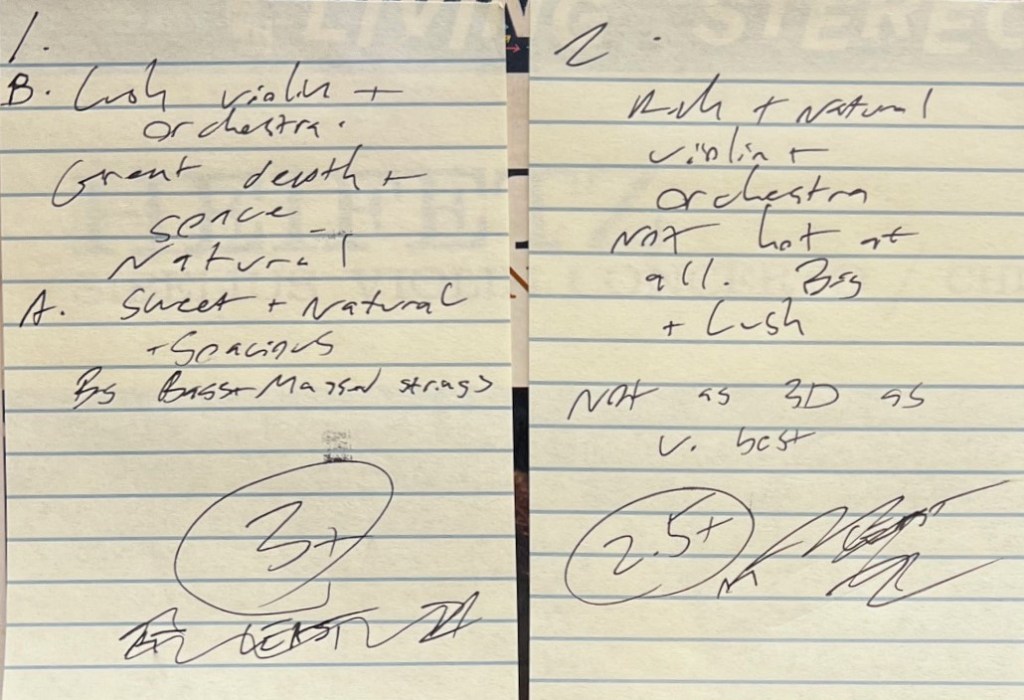
As you can see from the notes, side one of a recent shootout winning copy was doing everything right.

However, we had a side two that was slightly better than the side two you see here. When we played the two best copies back to back, this side one came out on top, earning a grade of 3+, but the side two of another copy showed us there was even more three-dimensionality to be discovered in the recording than we thought. Consequently this side two was dropped a half grade to 2.5+.

This is exactly why we do shootouts. If you really want to be able to recognize subtle (and not so subtle!) differences between pressings, you must learn to do them too.

(more…)

Can Houses of the Holy Get Any Better? Apparently It Can

Hot Stamper Pressings of the Music of Led Zeppelin Available Now

Wall-to-wall, floor-to-ceiling Led Zeppelin power – our most recent Shootout Winning copies of Houses of the Holy knocked us out with their Demo Disc sound.

The Tubey Magical acoustic guitars here should be a wake up call to everyone that any attempt to remaster this album — to outdo Robert Ludwig and his awesome tube compressors and hi-rez transistor cutting equipment — is bound to fail.

This kind of sound is gone and it is never coming back.

Here are our notes for the top two copies from our recent shootout, each of which had one Shootout Winning side and one that came close but did not quite earn the top grade.

Side One

Track Three (Over the Hills and Far Away)

  • Upfront and detailed and breathy
  • Spacious
  • Big and wide when it kicks in

Track One (The Song Remains the Same)

  • Huge and rich and weighty
  • Vocals are less veiled
  • Richest, with the most extension high and low

Note that we played both a rocker as well as a quieter, more acoustic track. This is standard operating procedure. Both of these very different sounding songs have to sound their best.

Side two had a few problems which kept it from doing as well as side one.

(more…)

Casino Royale Is Truly a Demo Disc, Assuming You Have a Copy that Sounds Like This One

Hot Stamper Pressings of the Music of Burt Bacharach Available Now

This is one of those rare and delightful instances where the RCA mastering engineer (the stampers are, famously, 1s, 2s, 3s, etc.) was exceptionally skilled, because both sides of this record are Demo Discs of the highest order.

Just look at our notes for one of the top two copies from our recent shootout.

I can honestly say that until we discovered the Hot Stampers for this album, I never thought this record deserved the praise The Absolute Sound’s Harry Pearson heaped upon it.

One of only thirteen entries in the Best of the Bunch: Popular section?

Not that hard to believe if, like me, you think a number of the titles there don’t really deserve to be called Super Discs in the first place, For Duke and The Sheffield Track Record being two that spring immediately to mind.

And by the way, does his copy sound as good as this one? I would bet money right now that this monster is clearly the better pressing. 

The highest-numbered stampers I have seen were 5s. That means there are five choices of stampers for each of the sides. Where are you going to find five clean copies of this album with the five different stampers in order to see which one seems to hold the most promise? We do this for a living, but most audiophiles and the reviewers who write for them simply lack the resources to do this kind of work at the level it needs to be done in order to find the amazing pressing we found. T

Let’s face it: Harry’s not the kind of guy to sit down with ten copies and shoot them out. That would be far beneath the great and powerful Oz himself. We put the question this way: Was it even possible for Harry Pearson to create a meaningful Super Disc list?

Note that side one fell a little short of the full 3+ sound found on side two, something that happens more often than not. One out of five records that has a shootout winning side will have a matching shootout winning other side.

The math works like this. 3+/3+ records go in this section, which currently holds 23 titles as of 7/2024. Records with at least one 3+ side go in this section, and there are 125 of those as of the same date — five times as many.

Side One

Track Three

    • Tubey and spacious and relaxed

Track Two (The Look of Love)

    • Immediate and silky vocals
    • Very tubey and spacious
    • Not as fat as the best

Side Two

Track Three

    • Huge and rich and transparent
    • Excellent space

Track One

    • Big and silky
    • Tubey and dynamic

(more…)

This Is Why We Love Pablo in the 70s

Hot Stamper Pressings of Pablo Recordings Available Now

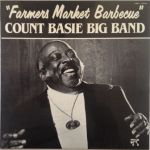
For years we have been including the followinig commentary in our Hot Stamper listings for Farmers Market Barbecue:

Musically FMB is a top Basie big band title in every way. This should not be surprising: many of his recordings for Pablo in the 70s and early 80s display the talents of The Count and his band at their best.

Sonically there’s more to the story. Based on our recent shootout for this title, in comparison to the other Basie titles we’ve done lately, we would have to say that FMB is the best Basie big band title we’ve ever played.

Since so many Basie big band recordings are so good, we don’t want to get ahead of ourselves; after all, we haven’t done shootouts for all of Basie’s Pablo large group recordings. To be safe we’ll just call this one first among equals.

Having recently done another shootout, our first in two and a half years, we would have to say that the album still sounds every bit as amazing as we thought it did when we wrote the above comments more than fifteen years ago.

Our notes for a shootout winning copy get right to the heart of what makes the recording so special.

For those who might have trouble reading our scratch, allow me to transcribe what Riley, our main listening guy, heard and noted as he played the two sides of this copy.

(more…)

Ravel, Saint-Saens et al. / Tzigane, Havanaise / Kyung-Wha Chung

Hot Stamper Orchestral Imports on Decca & London

This 1979 London original English pressing of violin showpieces (reviewed in 2012) has Super Hot Stamper sound on side two, which came as a bit of a shock to us after playing side one, which is as congested and opaque as one would expect from such a late London recording.

A great many Decca recordings from the Seventies are not to our liking, for reasons we lay out here.

Side two is fabulous — full-bodied, rich and sweet. Even though it may have been recorded in 1977, the engineer is Kenneth Wilkinson, and the hall is Kingsway — not many bad recordings can be attributed to either.    

But bad mastering or bad pressing quality are surely not the fault of either. When the record doesn’t come out of the oven right, the sound is going to suffer, and the sound on this side one is insufferable all right.

But side two is GLORIOUS, with wonderful music played with skill and feeling. (more…)

How Novel Patterns Emerge During Shootouts

Hot Stamper Pressings of the Music of Ambrosia Available Now

When you sit down to play ten or twelve copies of an album, one right after the other, patterns in the sound are going to emerge from that experience, patterns which would be very likely to pass unnoticed when playing one copy against another or two over the course of the twenty or thirty minutes it would take to do it.

In the case of this album, the pattern we perceived was simply this: About one or two out of that dozen or so will have punchy, solid, rich, deep bass. (There is a huge amount of bass on the recording, so recognizing those special copies is not the least bit difficult if you have a full-range speaker and a properly treated room.)

About one or two copies really get the top end right, which is easily heard when the cymbals splash dynamically, with their harmonics intact, and they extend high about the rest of the soundfield (precisely the way they do in live music).

(Fewer copies have an extended top end compared to those with tight punchy bass by the way.)

Like so many Mastering Lab tube-mastered records from the era, most copies tend to be somewhat smooth.

Only one copy had both the best bass and the best highs.

All the other copies fell short in one or both of these areas.

Think about it: if you do your home shootouts with three or four or even five copies of an album, what are the chances that:

1. You will detect this pattern? Or,
2. That you will run into the one copy that does it all?

This is precisely the reason we have taken the concept of doing comparisons between pressings to an entirely new level.

It’s the only way to find the outliers in the group, the “thin tails” as the statisticians like to call them. (More on outliers here.)

(more…)