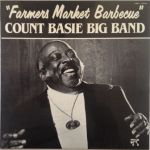
Hot Stamper Pressings of Pablo Recordings Available Now
For years we have been including the followinig commentary in our Hot Stamper listings for Farmers Market Barbecue:
Musically FMB is a top Basie big band title in every way. This should not be surprising: many of his recordings for Pablo in the 70s and early 80s display the talents of The Count and his band at their best.
Sonically there’s more to the story. Based on our recent shootout for this title, in comparison to the other Basie titles we’ve done lately, we would have to say that FMB is the best Basie big band title we’ve ever played.
Since so many Basie big band recordings are so good, we don’t want to get ahead of ourselves; after all, we haven’t done shootouts for all of Basie’s Pablo large group recordings. To be safe we’ll just call this one first among equals.
Having recently done another shootout, our first in two and a half years, we would have to say that the album still sounds every bit as amazing as we thought it did when we wrote the above comments more than fifteen years ago.
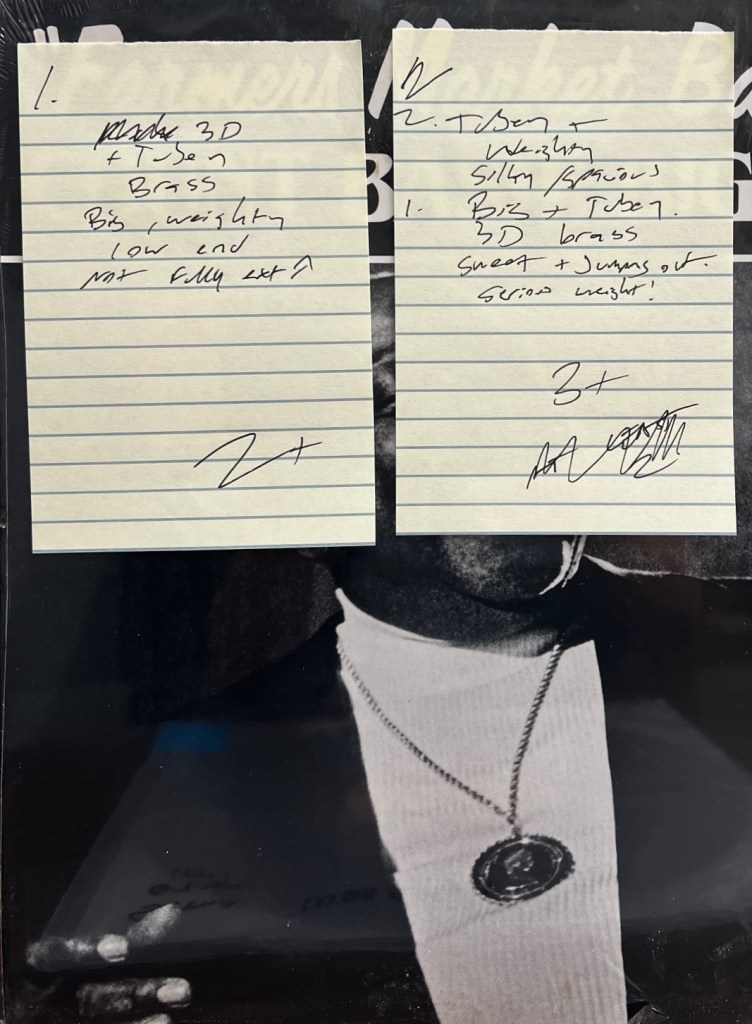
Our notes for a shootout winning copy get right to the heart of what makes the recording so special.

For those who might have trouble reading our scratch, allow me to transcribe what Riley, our main listening guy, heard and noted as he played the two sides of this copy.
Side One (A++)
- 3-D and tubey brass
- Big, weighty low end
- Not fully extending
Side Two (A+++)
- Tubey and weighty
- Silky/spacious
- Big and tubey
- 3-D brass
- Sweet and jumping out
- Serious weight!
What do these notes have to tell us, other than this is a great sounding record?
The first thing we should pay attention to is the lower grade given to side one. What made Riley give side one two pluses when side two earned three?
The last line in the notes tell us it simply was not extending on the top the way it could have.
There was no need to elaborate futher as to what that means or the effect it has. All of us shootout vets know exactly what that sounds like. With a rolled-off top end, the space and air of the studio are compromised. The highest harmonics of the instruments seem restricted, deficient. (Modern remastered records appear to purposely lack top end in this way, probably as a way of making them stand apart from the sound of CDs, and they come in for plenty of criticism for that shortcoming, at least they do on this blog. What’s sauce for the goose…)
Both sides had weighty, powerful brass, reproducing the sounds of more than a dozen horns and saxes with plenty of Tubey Magic, and in three dimensions no less.
Side One Vs Side Two
But only one side was silky — reproducing the highest of the high frequencies where the most extended harmonics can be found — and only one side was noted as being “spacious.”
Side two of this very copy shows us exactly what is missing from side one, and what effect that has on the sound of the recording.
(Some inside baseball: The fact that side one was given that grade right off the bat rather than a “probably 2” or “contender” of something equally non-committal means that by the time he got to this copy, he had already played a 3+ copy that was doing everything right on side one the way this copy was doing everything right on side two.)
That’s why he didn’t hedge his bets and call side one 2.5+. Not having all the top end took a lot of the joy out of the sound. Don’t get me wrong: Side one is still very good. There’s nothing actually “wrong” with it, and on some systems in some rooms its faults may not be nearly as obvious to others as they were to us.
We have a big, high-ceilinged room, with massive speakers pulled well out from the back wall, and the combination of all that and a great deal more allows us to hear just how real and immersive a recording like Farmers Market Barbecue can be when you get hold of a good one.
 What About the Rest of Us?
Of course, it should go without saying that not everybody has a setup like ours. Big rooms are hard to come by. Big speakers are expensive and the powerful sound they put out is hard to control.
So what will a Basie big band record sound like on the typical home system? We have no idea. We hope it will sound good on the kind of system that many audiophiles have. The customers who buy our Hot Stamper pressings of the Basie big band albums have never returned one to my knowledge. But what they actually sound like we cannot say.
Speaking of other systems, we recently came in for some criticism on that front. We had disparaged the speakers of a fellow audiophile who was commenting about the sound of a couple of Rudy Van Gelder jazz recordings he had played. You can read the whole thing here.
I took the position that playing RVG’s recordings through this fellow’s speakers — a tiny two-way box speaker with a 5.25 inch woofer — was not going to allow him to hear more than a fraction of the “live music” qualities Mr. Van Gelder had worked so hard to capture on tape.
So Here’s the Deal
Let’s return to Riley’s notes. 99 times out of a hundred these notes will not be seen by anyone other than me and other members of the staff. The notes he wrote, the qualities of the sound he described, give away the game entirely.
Side one, among other things, has a “big, weighty low end.”
Side two is “big and tubey,” with “serious weight!” The instruments “jump out.”
Both sides are three-dimensional. Side two is “silky” and “spacious.”
Now which of these qualities can be reproduced by a speaker as small as the KEF LS50?
Can it play any of them? Not in my view. To be more charitable, a few, maybe, but none of them very well.
Seriously, I ask you: is anyone foolish enough to think that hearing the record through small speakers would allow them to feel the music of the Count Basie Big Band the way the musicians felt it, or the way Riley felt it as it was playing at good loud levels in our dedicated studio?
Would anyone playing Farmers Market Barbecue through small speakers be inclined to write anything like the rave review he wrote for the album? The very idea is risible.
Trombones and SPLs
The trombone produces the highest sound pressure levels (SPL) of any instrument in the orchestra.
Can a box speaker standing less than a foot high reproduce the powerful blast of a trombone?
Basie has four of them in his big band, along with four trumpets, five saxophones, drums, bass, guitar and, of course, a piano.
What happens to all those instruments when they try to squeeze though a five inch hole in a box? Any one of them would have a hard time sounding lifelike, but all of them at the same time? Simply not possible.
I can’t imagine what his system would do to Basie’s music, but I can tell you one thing: the owner of these speakers is unlikely to have very many big band records. If he has some, they are surely not in danger of being overplayed.
His system is simply not capable of playing certain kinds of music well. I would be very surprised if he listens much to the kinds of music his system struggles — and fails — to play.
Music Lovers and Sound Lovers
Is that the kind of system a music-loving audiophile should own? One that prevents him from enjoying whole genres of music? Or even individual works.
What about The Pines of Rome or The Firebird — how do you think they would sound on the LS50s?
What about Dark Side of the Moon or The Wall — how about them?
Time Out? Sketches of Spain? Thriller? Way Out West?
I’m trying to think of a record I could stand to hear coming out of small speakers. I’ve come up dry so far.
At the end of A Day in the Life four pianos — four! — bang out the same crashing note. What on earth would that sound like on little speakers? And why would anyone want to find out? Or have to listen to them that way.
Final Thoughts
The more music you have in your life, assuming it is good music, the better off you are. Music is full of joy, and, in my experience, the bigger, louder, more lively and more realistic it is, the more joyful it will be and the more joy it will bring into your life.
Listen to your records playing through any speakers you like.
Just do us all a favor and stop pretending that you can hear a record properly on a system that is incapable of recreating the size, weight and power of the instruments that were recorded in the studio, whether it’s Pablo’s or Rudy’s.