>6

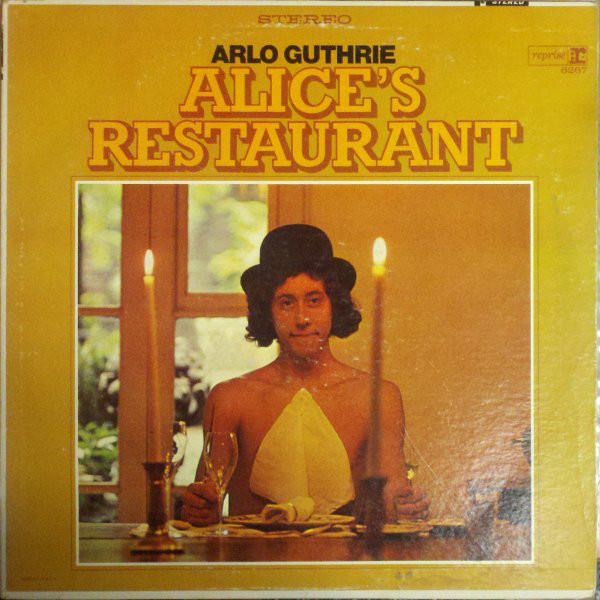
Watch Out for Vocals that Are Too Forward on Alice’s Restaurant

More Records with Specific Advice on What to Listen For

It’s not easy to find a copy of this album that sounds right.

Many of the copies we played suffer from a “too-forward” quality to the vocals, which make them positively unpleasant to listen to.

Others lacked presence, which left them easy on the ears but ultimately boring.

Then there were the copies that got the vocals right but just didn’t have all the Tubey Magic you want for this kind of simple, folky music.

I’m not going to go out on a limb and say this is an album everyone needs in their collection, but it’s certainly enjoyable. For those of you who get a kick out of this slice of 60s life, you’re going to have a very hard time finding a copy that sounds as good as this one.

It’s nice when the copy in hand has all the transparency, space, layered depth and three-dimensionality that makes listening to records such a fundamentally different experience than listening to digitally-sourced material, but it’s not nearly as important as having that rich, relaxed tonal balance.

A little smear and a subtle lack of resolution is not the end of the world on most of the records we sell, including this one.

Brightness and leanness, along with grit and grain on the vocals, can be.

If the average record sounded even close to right, nobody would need us to find good sounding copies for them. They’d be sitting in every record bin in town and we would have to find some other kinds of records to sell.

The records may indeed be in every bin in town — that’s where we found the copies that went into this shootout — but the sound sure isn’t.

Hint: for the best sound, stick to the Tri-Tone original Reprise pressings. They win every shootout.


(more…)

Holst and Previn – A Planets for the Ages

Hot Stamper Pressings of the Music of Holst Available Now

Fortunately for audiophiles who love The Planets but are disappointed by most performances, a group that includes us to be sure, the amazing sound found on this copy is coupled with a superb performance.

As you might imagine, on a big system this would make for a powerful listening experience, which is exactly the experience we ourselves had during our recent shootout. This copy actually deserves its place on the TAS List.

The brass is so BIG and POWERFUL on EMI’s recording that other orchestras and recordings frankly pale in comparison. Until I heard one of our top EMI pressings show me brass with this kind of weight and energy, I simply had no idea it was even possible to play the work this powerfully. The lower brass comes in, builds, gaining volume and weight, then calms down, but soon returns and builds relentlessly, ever and ever louder. Eventually the trumpets break out, blasting their way forward and above the melee the heavier brass has created below.

Quite honestly I have never heard anything like it, and I heard this work in concert in late 2012! In live performance, the members of the brass section, being at the back of the stage, were at least 100 feet away from me, perhaps more. When playing the best EMI pressings, the brass were right there in front of me, eight to ten feet away. In a way this is of course unnatural, but that fact takes nothing away from the subjective power of the experience.

Only the conductor can stand at the podium, but the EMI producers and engineers (the two Christophers in this case) have managed to put the listener, at least in this movement, right there with him.

(more…)

A Better Way to Get Rid of Grit and Grain on Jumpin’ Jive

More Records that Are Good for Testing Grit and Grain

Jumpin’ Jive is one of the clearest examples of an album where it is critically important to make sure your stereo is running on good electricity before you make any attempt to play it. This is the kind of recording — bright, full of energy — that will bring most stereo systems to their knees. Of course, when you play a good copy and it really sounds good, it’s a record that rewards all the time and effort you’ve put into your system.

So much of the aggressiveness, grit and grain that we hear in immediate, high-energy recordings such as this are really the fault of the electricity feeding the stereo, not the fault primarily of the record or even the equipment used to play it.

Now it should be noted that this recording has a ton of high frequency information that will be difficult to reproduce on most systems. If you leave a lot of appliances and electronic devices plugged in around the house when you listen to your stereo, you can forget ever hearing this record right. The grit and grunge caused by polluted electricity will make this record practically unlistenable, at the levels we listen at anyway. (At lower levels most of the garbage is masked, one reason no doubt that audiophiles rarely turn their stereos up to anything approaching live levels.) 

So do as we do: unplug everything you can get your hands on before you sit down to listen. Make sure your tubes (if you have tube equipment) are nice and warm too.

(more…)

Diamonds and Rust – Another TAS Listed Anadisq Disaster

Hot Stamper Pressings of the Music of Joan Baez Available Now

Mobile Fidelity released their version of Diamonds and Rust on Anadisq in 1995, and if you want to hear a pressing that’s not murky, compressed and opaque, you would be wise to avoid their Heavy Vinyl Half-Speed.

Somehow it ended up on the TAS Super Disc List, but we could find nothing “super” about it. We felt it more properly belonged on our list of records that have no business being called Super Discs.

It was a real muckfest, as was to be expected from a record mastered by this awful label during the Anadisq era, the darkest chapter in the disgraceful history of Mobile Fidelity, which, considering the consistently dismal quality of their output, is really saying something.

Ken Lee Strikes Again

Many of the worst of them were mastered by a Mr. Ken Lee. If you happen to come across a record in a store with his name in the credits, or his initials in the deadwax, you are best advised to drop it back in the bin and keep moving. Anything else is just asking for trouble.

To be fair, MoFi made some reasonably good sounding records too. For those of you whose budget is on the limited side, if you find an affordable copy of any of these MoFis, you are probably not wasting your money.

Although I had a long way to go in this hobby in the early days of my audiophile record business, even then I could tell how bad the Anadisq series that Mobile Fidelity released in the 90s was. They produced one awful sounding record after another, with not a single winner that I knew of. I sold them — my bad, an ethical lapse for which I must apologize — but I sure never recommended them or had anything good to say about them.

(more…)

Bashin’ Is a Good Test for Setup, Tweaks, Room Treatments, etc.

Hot Stamper Pressings of Large Group Jazz Recordings Available Now

On side one of Smith’s (and Oliver Nelson’s) Masterpiece, Bashin’, the bell tree in the right channel on track one is a great test for top end extension, resolution of harmonic complexity, overall clarity and freedom from smear.

Get all the top end you can from whatever turntable adjustment, tweak or room treatment you’re messing around with, then check to make sure that all the brass instruments still sound right. If they do, you are probably good to go.

Blary, smeary, leading-edge-challenged horns are the kiss of death on this album, as are grainy, gritty, transistory ones.

When the horns have clarity, correct tonality, plenty of space around them and a solid, full-bodied sound, probably every other instrument in the soundscape will too. Other records with brass instruments that are good for testing can be found here.

(more…)

Could This Be More of the Sound Audiophiles Complain About with RVG’s Mastering?

Hot Stamper Pressings of the Music of John Coltrane Available Now

Some of the Rudy Van Gelder cuttings of this album were decent, but had you bought a copy with these stampers, you could be forgiven for using the man’s name in vain.

VAN GELDER in the dead wax is no guarantee of high quality sound, on any record. Records don’t work like that.

The 1+ grade found on side one of both discs means the sound for those two sides may be passable, but the NFG sound on side two of record one means you have at best only half an album with decent sound, and what good is that?

As you can see from our notes, the sound is way too hot and messy and thin.

Note that side two of the second record wasn’t played at all. Why waste more time on a record that clearly did not come off the press properly, whether from bad mastering or bad vinyl? Or bad something else, who can say?

We do not sell records with 1+ grades. You should have no trouble finding those on your own. The world is full of them.

Poor Rudy

Rudy Van Gelder comes in for a lot of criticism from the audiophile community, especially from audiophiles who tend to prefer the remastered Heavy Vinyl pressings made from his recordings.

Unsurprisingly, much of the criticism comes from some of the very same engineers responsible for the remastering those records.

Those who produce reissues of his recordings are notable critics as well.

(more…)

The Middle of the Midrange Is Key on Prisoner in Disguise

Hot Stamper Pressings of the Music of Linda Ronstadt Available Now

Here’s what we learned when doing a shootout years ago: many copies sounded like they were Half-Speed mastered.

For those of you who don’t know what that means, or sounds like, the blog is full of commentaries about the sonic shortcomings of this mastering technique.

In this case, these Half-Speed sounding ones had a little something phony added to the top of Linda’s voice; they had a little bit of suckout right in the middle of the midrange, the middle of her voice; and they had an overall diffuse, vague quality, with sound that lacked the solidity we heard on the best of the non-audiophile pressings we played. 

These hi-fi-ish qualities that we heard reminded us of the kind of sound we decry at every turn. We’ve played literally hundreds and hundreds of MoFi’s and other Half-Speed mastered records over the course of the last twenty thirty-plus years, and one thing we know well is that sound.

But stop and think about it for a moment.

What if you only had one copy of the album — why would someone have more than one anyway? — and it had that Half-Speed sound?

You’d simply assume the recording had those qualities, assuming you recognized them in the first place.

(Let’s face it, most audiophiles can’t, or all these companies that use this approach to mastering would have gone out of business and stayed out of business, and their out of print records would sell for peanuts, not the collector prices they bring on ebay and discogs. More on that subject here.)

(more…)

Taking Tiger Mountain – Peak Art Rock

Hot Stamper Pressings of the Music of Brian Eno Available Now

This is Brian Eno’s Masterpiece as well as a personal favorite of yours truly.

On the right pressing, Taking Tiger Mountain is a twisted pop Big Speaker Demo Disc like nothing you have ever heard.

If you have a big speaker and the kind of high quality playback that is capable of unraveling the most complicated studio creations, with all the weight and power of live music at practically live levels, this is the record that will make all your audio effort and expense worthwhile.

That’s the kind of stereo I’ve been working on for forty fifty years and this album just plain KILLS over here.

Art Rock

That being said, it may not be the kind of thing most music loving audiophiles will be able to make sense of if they have no history with this kind of arty rock from the 70s. I grew up on Roxy Music, 10cc, Eno, The Talking Heads, Peter Gabriel, Ambrosia, Supertramp, Yes and the like, bands that wanted to play rock music but felt shackled by the chains of the conventional pop song.

This was and still is my favorite kind of music. Experts who study these things say that the music you discover between the ages of 17 and 23 stays with you for your entire life. For me that’s the music I fell in love from 1971 to 1977. I was 20 when this album came out.

When it comes to the genre, I put this album right at the top of the heap, along with several other landmark albums from the period: More Songs About Buildings and Food, Siren, The Original Soundtrack, Crisis? What Crisis?, Ambrosia’s first two releases, The Yes Album, 801 Live, A New World Order and plenty of others, many more than I have room to describe here.

It should be noted that most of these album don’t sell all that well. We do shootouts for them anyway, partly in the hopes that at least some of our more adventurous customers will get turned on to this music and have their lives changed in the same way mine was.

One difference I could be forgiven for pointing to in this regard is that I had available to me random copies of unknown quality, unlike our customers who get offered nothing but great sounding pressings.

(more…)

Listening in Depth to Country Life

Hot Stamper Pressings of the Music of Roxy Music Available Now

The domestic, German, Japanese and Dutch pressings are not remotely competitive with the Brits on this album (which is not true for all Roxy’s albums but clearly true for this one, Siren being the obvious exception to the rule).

Now for those of you who are not big Roxy Music fans and don’t know this music, this album may take a bit of getting used to. We assure you it will be well worth your while. We think it’s brilliant.

And if you do consider yourself a fan of Art Rock, every Roxy album should be on your shelf, right up there with your Bowie, Pink Floyd, Supertramp, Eno, Peter Gabriel, 10cc and too many others to list. (Most are personal favorites of mine, albums I have played hundreds of times over the last 40 years and plan to keep playing until my ears give out.)

Side One

The Thrill of It All
Three and Nine

On the best copies this track is the very definition of Tubey Magical richness and smoothness.

All I Want Is You

A little thinner and brighter than the other tracks on this side as a rule.

Out of the Blue

The best guitar solo ever played on the violin. Go Eddie!

If It Takes All Night

Side Two

Bitter Sweet

The best copies have monstrous bass on this track, along with huge amounts of space. Again, the Tubey Magic can be off the charts here.

Triptych
Casanova

The vocals on this track will always spit to some degree. The cleanest, most tonally correct sibilance is what you are looking for on this track. That, and amazing rock energy!

A Really Good Time
Prairie Rose


Want to find your own top quality copy?

Consider taking our moderately helpful advice concerning the pressings that tend to win our shootouts.

(more…)

The MHS Recording of Chopin’s First Piano Concerto Had the Most Natural Piano of Them All

Hot Stamper Pressings of the Music of Frederic Chopin Available Now

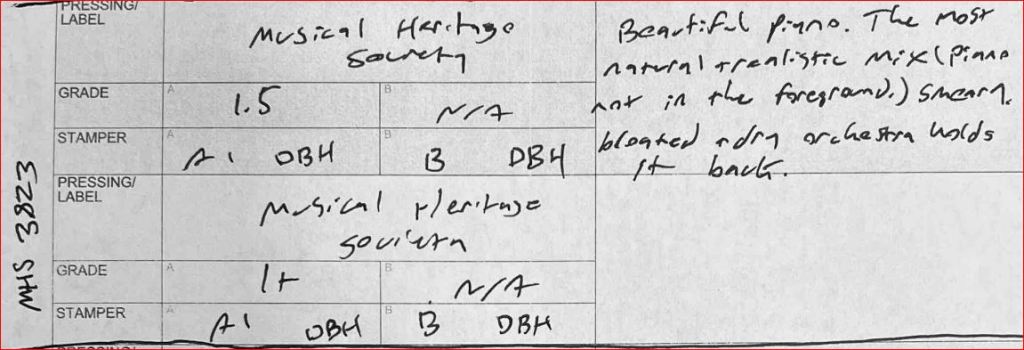
There are some wonderful Musical Heritage Society records sitting in the bins of your local record store or Goodwill, and this one is worth picking up just to hear how well recorded the piano is.

We described it this way:

Beautiful piano. The most natural and realistic mix with the piano not in the foreground.

But there is more to the recording than the sound of the piano.

Smeary, bloated and dry orchestra holds it back.

Well, at least we tried. (Note that side two was deemed not worth grading.)

Our favorite recording for performance and sound is the Living Stereo from 1961, LSC 2575, with Rubinstein at the piano and Skrowaczewski conducting the New Symphony Orchestra of London.

This is what we had to say about the sound of our Shootout Winner:

We love the huge, solid and powerful sound of the piano on this recording. This piano has weight and heft. As a result, it sounds like a real piano.

For some reason, a great many Rubinstein recordings are not capable of reproducing those seemingly all-important qualities in the sound of the piano.

Those are, as I hope everyone understands by now, the ones we don’t sell. If the piano in a piano concerto recording doesn’t sound solid and powerful, what is the point of playing such a record?

Or, to be more accurate, what is the point of an audiophile playing such a record? (Those of you who would like to avoid bad sounding vintage classical and orchestral records have come to the right place. We’ve compiled a very long list of them for precisely that purpose, and we add to it regularly.)

(more…)