Top Producers – Teo Macero

Miles Davis – Kind of Blue on a Killer 70s Red Label Pressing

More Miles Davis

  • With two solid Double Plus (A++) sides, this Red Label pressing has Demo Disc sound – sound that’s guaranteed to make you want to take all of your remastered pressings and dump them off at the Goodwill
  • After auditioning a Hot Stamper Kind of Blue like this one – a pressing that captures the sound of this amazing group like nothing you have ever heard – you may be motivated to add a hearty, “Good riddance to bad audiophile rubbish!”
  • KOB is the embodiment of the big-as-life, spacious and timbrally accurate 30th Street Studio Sound Fred Plaut was justly famous for
  • Space, clarity, transparency, and in-the-room immediacy are some of the qualities to be found on this pressing (particularly on side one)
  • It’s guaranteed to beat any copy you’ve ever played, and if you have the new MoFi pressing, please, please, please order this copy so that you can hear just how screwy the sound of their ridiculous remaster is
  • 5 stars: “KOB isn’t merely an artistic highlight for Miles Davis, it’s an album that towers above its peers, a record generally considered as the definitive jazz album, a universally acknowledged standard of excellence.”
  • If you’re a fan of the music Davis, Adderley and Coltrane were playing circa 1959, this album clearly belongs in your collection

The Labels of Kind of Blue

The 6 Eye label domestic stereo pressings win our shootouts, in the case of Kind of Blue without exception.

The 360 label pressings, black print (1962-63) or white print (1963-70), as well as the rare 70s red label (1970-?), can sound very good, but they never win shootouts.

We’ve identified a select group of reissues with the potential to do well in shootouts, typically earning a grade of Super Hot (A++) when up against the best originals, which earn our top grade, White Hot (A+++). Kind of Blue is one of those recordings.

Scores of differently mastered versions have been cut over the years, but to find one that’s lively and dynamic yet still communicates the relaxed nature of this music is a trick that few of them can pull off. These sides did just that.

When the band really starts cutting loose on “So What,” you’re going to lose your mind! The sound is open and spacious with a wonderful three-dimensional quality that gives each musician a defined space. You can easily tune in to one player or another and follow their contribution as the band stretches out.

Quick Listening Tests

This is an easy one. Just listen to the trumpet at the start of Freddie Freeloader. Most copies do not properly reproduce the transient information of Miles’ horn, causing it to have an easily recognizable quality we talk about all the time on the site: smear. No two pressings will have precisely the same amount of smear on his trumpet, so look for the least smeary copy that does everything else right too. (Meaning simply that smear is important, but not all-important.)

On All Blues (track one, side two), the drums in the right channel are key to evaluating the sound of the better copies. The snare should sound solid and fat — like a real snare — and if there is space in the recording on your copy you will have no trouble hearing the room around the kit.

[The drums are precisely where one of the major faults of the disastrous MoFi 2 LP 45 RPM pressing can be heard. A fuller review is coming, soon I hope!}

Next check the cymbals. No two copies will get the cymbals to sound the same, so play a few and see which ones sound the most natural to you. The most natural will be the one with the best top end.

When Adderley comes in hard left, his alto should not be thin, squawky or stuck in the speaker. The best of the best copies have the instrument sounding full-bodied (for an alto) and reedy. The reedy quality tells you that your pressing is highly resolving and not smeared.

(more…)

Our Guide to Legrand Jazz on Impex

Hot Stamper Pressings of 30th St. Recordings Available Now

Years ago I wrote about how important the Legrand Jazz album was in my growth as a critical listener.

It’s yet another example of an album that helped make me a better audiophile by showing me the error of my tweaking and tuning ways.

Now there is a new pressing of it. Well, new to us anyway. (We readily admit to being behind the times and make no apologies for it. With records like these, we often find ourselves wondering why we bother.)

Two new pressings in fact. One on a single disc at 33 RPM as of 2017, and one mastered at 45 RPM on 2 LPs as of 2019, still in print and available for $59.99.

Production details can be found at the end of this review, along with some favorable comments, some from none other than Steve Hoffman himself.

But first let’s hear from the personification of the well-meaning audiophile reviewer, Michael Fremer. He gives the Impex pressings an 11 for sound. He writes (emphasis added):

This IMPEX reissue is sourced from an “analog mix-down transfer of the original 1958 work tape by Mark Wilder at Battery Studios” and cut by Chris Bellman and Bob Donnelly at Bernie Grundman Mastering on Grundman’s all-tube mastering system. I have a clean, original 6-Eye pressing that this superbly pressed reissue betters in every way. This will make both your stereo and your heart sing. Some of the greatest jazz musicians of that or any era wailing and clearly having a Legrand time. Limited to 3000 copies. Don’t miss it!

Who are you going to believe, the Self-Appointed Vinyl Experts of the World or some guy like me who thinks he knows a thing or two about the sound of records, especially, as in this case, a record I have been playing since 1990 or thereabouts.

(Back in those early days I also had the standard CD, which is excellent and highly recommended. Since I couldn’t clean or play my original vinyl pressing properly, my guess would be that the CD had the better sound at the time.)

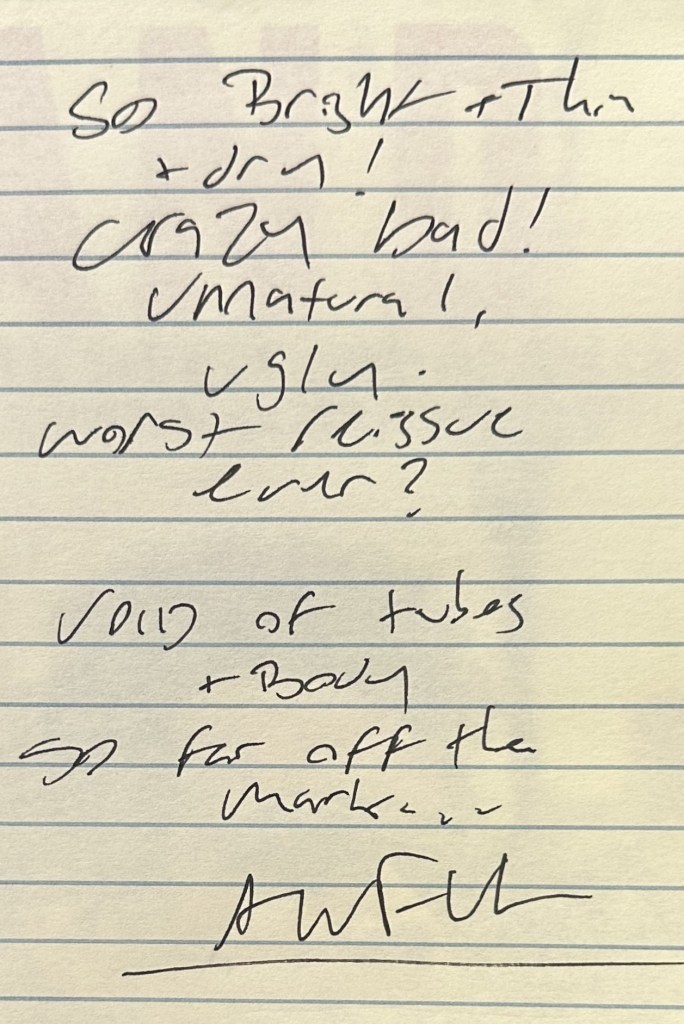
Our notes (for those who have trouble reading our scratch)

So bright and thin and dry.

Crazy bad!

Unnatural, ugly.

Worst reissue ever?

Void of tubes and body.

So far off the mark.

Awful.

A second opinion

Robert Brook reviewed this pressing a while back. He does his best to remain positive when choosing the words that he thinks will help the reader bette understand the experience of playing the Impex release of Legrand Jazz that we had loaned him. In the end he goes with the spoken word over the written one.

(more…)

Thelonious Monk / Monk’s Blues

More Thelonious Monk

  • Seriously good Double Plus (A++) sound or BETTER brings Monk’s 1969 release to life on this vintage Stereo 360 pressing – exceptionally quiet vinyl too
  • Both of these sides are rich, full and open throughout, with excellent transparency and real weight to the piano
  • This is not your typical Monk album – here he joins a big band, conducted by the great Oliver Nelson
  • It’s an interesting collaboration that may not succeed in every way, but it’s certainly a fun listen and even more so when you have an outstanding copy like this one
  • Marks in the vinyl are sometimes the nature of the beast with these vintage LPs – there simply is no way around them if the superior sound of vintage analog is important to you

I wish more Blue Note records had this kind of sound — natural, full-bodied, and sweet up top. The bass here is well-defined with real weight and lots of punch. Monk’s piano sounds correct from the highest notes all the way down to the lower register, and Charlie Rouse‘s sax sounds just right — totally free of the “RVG squawk” we often hear on some Blue Notes. The clarity and transparency are superb throughout.

(more…)

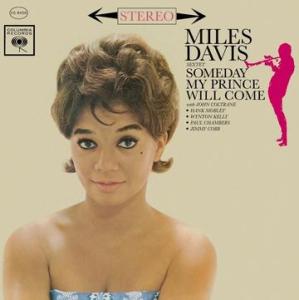
Miles Davis – Someday My Prince Will Come (360 Label)

More of the Music of Miles Davis

  • Seriously good sound throughout this Miles Davis classic, with both sides earning Double Plus (A++) grades – fairly quiet vinyl too
  • This early Stereo 360 LP is full-bodied, high-rez and spacious, with Miles’s horn uncannily present, a sound you just cannot find on Heavy Vinyl no matter who makes it
  • If you have the big system and dedicated room a record of this quality demands, you can put Miles right in the room with you with a Hot Stamper pressing as good as this
  • Vintage pressings that play this reasonably quiet and are free of scratches and groove damage are few and far between, but here’s one, perfect for even the most demanding audiophile
  • Another engineering triumph for Fred Plaut at Columbia’s legendary 30th Street Studios – the man is a genius
  • Musically this is one of our very favorite Miles albums, and the sound is Demo Disc quality on the better copies

(more…)

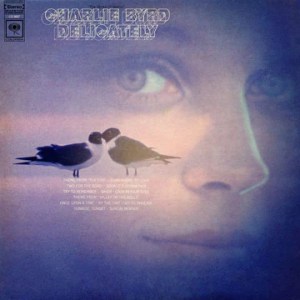
Charlie Byrd – Delicately

  • Superb sound for Byrd’s 1968 release, with solid Double Plus (A++) grades on both sides of this original 360 Stereo pressing
  • Teo Macero‘s production here is rich, sweet, and highly resolving, with all the space and three-dimensionality that Frank Laico‘s brilliant engineering is known for
  • The music on this enchanting jazz / pop guitar album is every bit as good as the sound quality (and that is rarely the case with these kinds of records – we should know, we’ve played scores of them)

Hearing is definitely believing, especially in our unique corner of the record business — we don’t give a fig about who, why or when a record was made; we just play it and judge it based on what we hear in its grooves. Needless to say. this pressing of the album was judged to be a knockout.

Apparently the album has garnered attention from other audiophiles – HDTracks offers a high-rez digital download of it! (more…)

Miles Davis – Sketches of Spain on 360

More Miles Davis

  • Seriously good sound throughout this Miles Davis classic, with both sides earning Double Plus (A++) grades – fairly quiet vinyl too
  • This early Stereo 360 LP is full-bodied, high-rez and spacious, with Miles’s horn uncannily present, a sound you just cannot find on Heavy Vinyl no matter who makes it
  • If you have the big system and dedicated room a record of this quality demands, you can put Miles right in the room with you with a Hot Stamper pressing as good as this
  • Vintage pressings that play this reasonably quiet and are free of scratches and groove damage are few and far between, but here’s one, perfect for even the most demanding audiophile
  • Another engineering triumph for Fred Plaut at Columbia’s legendary 30th Street Studios – the man is a genius
  • Musically this is one of our very favorite Miles albums, and the sound is Demo Disc quality on the better copies
  • 5 stars: “Sketches of Spain is the most luxuriant and stridently romantic recording Davis ever made. To listen to it in the 21st century is still a spine-tingling experience…”
  • This pressing is clearly a Demo Disc for orchestral size and space
  • Although the right 6-Eye originals will always win our shootouts, the 360 stereo reissues still sound quite good to us, just not as good

On the better pressings of this masterpiece, the sound is truly magical. (AMG has that dead right in their review.) It is lively but never strained. Davis’s horn has breath and bite, just like the real thing. What more can you ask for?

(more…)

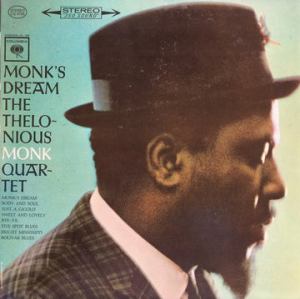
Thelonious Monk – Monk’s Dream

More of the Music of Thelonious Monk

  • Monk’s Dream returns to the site for only the second time in over two years, here with INCREDIBLE Shootout Winning Triple Plus (A+++) grades or close to them throughout this black print Stereo 360 pressing
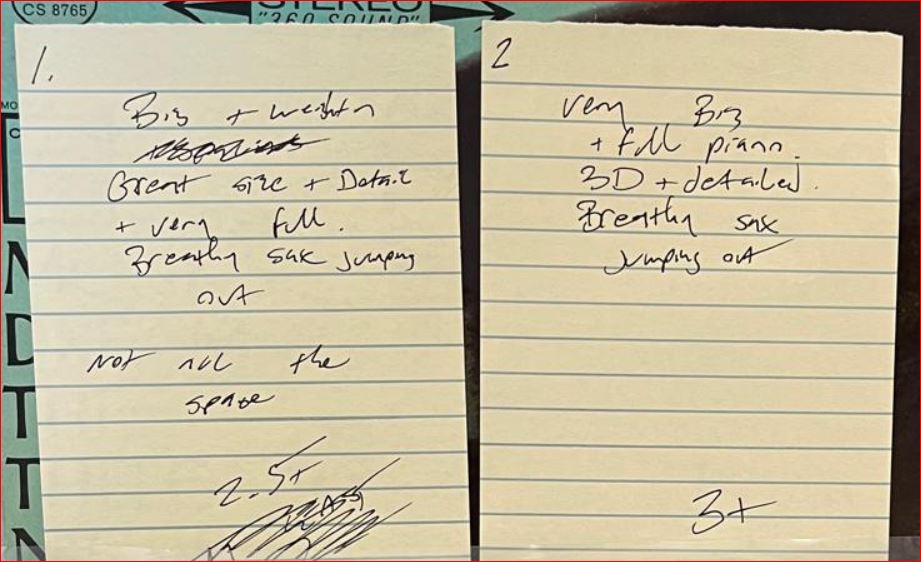
  • These are just a few of the things we had to say about this killer copy in our notes: “big and weighty”…”great size and detail and very full”…”breathy sax jumping out of the speakers”…”very big and full piano”
  • Both of these sides are rich, spacious, big and Tubey Magical, with less smear on the piano, a problem that holds many copies back
  • The sound found on these early Columbia 360 Label Stereo pressings is absolutely the right one for Monk’s music
  • This is a lot of money for a somewhat noisy copy – “Body and Soul” is pretty much ruined here, alas – but the sound is so awesome and quiet pressings of the album so hard to come by that we hope someone will take a chance on it and get the thrill we did from hearing it sound so good
  • 5 stars: “Although he would perform and record supported by various other musicians, the tight – almost telepathic – dimensions that these four shared has rarely been equalled in any genre… Monk’s Dream is recommended, with something for every degree of Monk enthusiast.”

A truly outstanding Monk album from 1963. Thanks to Columbia’s state of the art engineering, the recording really comes to life, or at least it does on a copy that sounds as good as this one does!

Charlie Rouse is particularly wonderful on sax on this album, and this copy features him on many of its tracks. The sax sound is full-bodied and natural with lots of breath and just the right amount of bite. Monk’s piano comes through with powerful dynamics and real weight to the keys.

So many copies just sound like an old jazz record, but this one lets you feel like you are right there in the studio, watching as the music is spontaneously created. What more could you ask for?

(more…)

Miles Davis – Sorcerer

More Miles Davis

More of Our Best Jazz Trumpet Recordings

  • Outstanding sonics throughout this vintage Stereo 360 pressing, with both sides earning solid Double Plus (A++) grades
  • Sorcerer demonstrates the big-as-life, spacious and unerringly accurate 30th Street Studio sound Fred Plaut was justly famous for
  • 4 1/2 stars: “The emphasis is as much on complex, interweaving chords and a coolly relaxed sound as it is on sheer improvisation, though each member tears off thoroughly compelling solos. Still, the individual flights aren’t placed at the forefront the way they were on the two predecessors — it all merges together, pointing toward the dense soundscapes of Miles’ later 60s work.”

Drop the needle anywhere and listen to how open, transparent and spacious this early pressing is. The soundfield is HUGE — big, wide and deep.

Everything sounds natural, balanced and correct. The bass has good tone, the piano has weight, the brass has the right amount of bite, and so on.

We had a big stack of copies for this shootout, including a bunch of 360 originals and some later Red Label pressings. You can find great sound on either label but it will probably take you quite a few copies to get there, and you’d need a serious stack to have any hope of finding two sides this good on vinyl that plays well.

And by the way, copies of classic Miles Davis albums from the ’60s are neither easy to find nor are they cheap. Hit the jazz bins at your local store and I’m sure you’ll have the same experience we’ve been having — tons of pricey modern reissues but not too many clean vintage pressings. (more…)

Kind of Blue – Our Shootout Winner from 2013 on the 70s Label

Hot Stamper Pressings of the Music of Miles Davis Available Now

UPDATE 2024: As good as the best 70s Red Label pressings may be, it’s unlikely that any copy other than the Six-Eye original will win a shootout these days.

In other words, in 2013 we still had a lot to learn about Kind of Blue even after we had been doing shootouts for the album for the eight years starting in 2005.

Doing shootouts for the album about twice a year, over the next eleven years and roughly 22 shootouts with every Columbia label represented, the data are in, and the right originals win every time, with no exceptions to that rule in a very long time. As you may have read elsewhere on the blog:


We don’t know it all and we’ve never pretended we did. All knowledge is provisional. We may not be the smartest guys in the room, but we’re sure as hell smart enough to know that much.

We regularly learn from our mistakes and we hope you do too.

But we learn things from the records we play not by reading about them, but by playing them. Our experiments, conducted using the shootout process we’ve painstakingly developed and refined over the course of the last twenty years, produces all the data we need: the winners, the losers, and the ranking for all the records in-between.

We’ve learned to ignore everything but the sound of the records we’ve actually played on our reference system.

This approach allows us to have a unique, and, to our way of thinking, uniquely valuable service to offer the discriminating audiophile. When you’re tired of wasting your time and money on the ubiquitous mediocrities that populate the major audiophile dealers’ sites and take up far too much space in your local record store, let us show you just how much more real handpicked-for-quality recordings can do for your enjoyment of music.

Our Commentary from 2013

This is one of the very best copies we’ve ever heard, and we have literally played more than a HUNDRED copies of this album over just the last five years.

(more…)

Miles Davis – Porgy and Bess on the Six Eye Label

More Miles Davis

More Gil Evans

  • Here is an original 6-Eye Stereo pressing with outstanding Double Plus (A++) grades or BETTER from start to finish
  • Side one was sonically very close to our Shootout Winner – you will be amazed at how big and rich and tubey the sound is
  • Both sides are full of that vintage Columbia jazz Tubey Magic – the brass is full-bodied with lots of air, the bass is surprisingly well-defined, the top end is extended and sweet, and the soundfield is HUGE and three-dimensional
  • 5 stars: “It was Evans’ intimate knowledge of the composition as well as the performer that allowed him to so definitively capture the essence of both… No observation or collection of American jazz can be deemed complete without this recording.”
  • Teo Macero was the producer and Ray Moore the engineer — it’s yet another remarkable disc from the Golden Age of Vacuum Tube Recording.
  • If you’re a fan of the marvelous collaborations of Miles Davis and Gil Evans circa 1959, and what audiophile wouldn’t be?, this album belongs in your collection
  • The complete list of titles from 1959 that we’ve reviewed to date can be found here.

(more…)