Roy Wallace, Engineer

Beethoven / Symphony No. 6 (Pastoral) – Ansermet

More of the music of Ludwig van Beethoven (1770-1827)

More Classical Recordings

  • A vintage London pressing of Beethoven’s Sixth with superb grades from top to bottom
  • These sides are doing practically everything right – they’re rich, clear, undistorted, open, spacious, and have depth and transparency to rival the best recordings you may have heard
  • The texture on the strings is captured perfectly – this is an area in which modern pressings fail almost completely
  • Recorded in Geneva’s exquisite Victoria Hall in 1959, this is a top performance from Ansermet and the Suisse Romande, the best we know of
  • There are about 150 orchestral recordings we think offer the best performances with the highest quality sound. This record is certainly deserving of a place on that list.
  • If you love the symphonic music of Beethoven — and what audiophile doesn’t? — this London from 1959 is surely a Must Own as well as our pick for the best recording of any of the nine Beethoven symphonies

In our opinion, this is the best sounding Beethoven 6th Symphony ever recorded. It is the most beautiful of them all, and has long been my personal favorite of the nine Beethoven composed.

Ansermet’s performance is clearly definitive to my ear as well. The gorgeous hall the Suisse Romande recorded in was possibly the best recording venue of its day, possibly of all time; more amazing sounding recordings were made there than any other hall we know of. There is a richness to the sound that exceeds all others, yet clarity and transparency are not sacrificed in the least. It’s as wide, deep and three-dimensional as any, which is of course all to the good, but what makes the sound of these recordings so special is the weight and power of the brass and the timbral accuracy of the instruments in every section.

Everything sounds so right on this record, so much like live music, there is practically nothing to say about the sound other than You Are There.

This is the kind of record that will make you want to take all your heavy vinyl classical pressings and put them in storage. None of them, I repeat none of them, will ever begin to sound the way this record sounds. Quality record production is a lost art, and it’s been lost for a very long time.

The texture on the strings is captured perfectly; this is, by the way, an area in which modern pressings fail almost completely. We have discussed this subject extensively on the site. The “rosin on the horsehair” is a sound that is apparently impossible to encode on modern vinyl.

(more…)

Ravel / Dukas et al. – Works by Ravel, Honegger and Dukas / Ansermet

More Classical and Orchestral Recordings

  • An incredible London pressingof this superb release with Nearly Triple Plus (A++ to A+++) grades on both sides – just shy of our Shootout Winner
  • It’s also fairly quiet at Mint Minus Minus, a grade that even our most well-cared-for vintage classical titles have trouble playing at
  • This spectacular Demo Disc recording is big, clear, rich, dynamic, transparent and energetic – here you will find some of the best orchestral Hot Stamper sound we offer
  • The sound of the orchestra is dramatically richer and sweeter than you will hear on practically all other pressings – what else would you expect from Decca’s engineers and the Suisse Romande?
  • 1963 was a great year for classical recordings – other Must Own Orchestral releases can be found here.

The sound is clear, with wonderful depth to the stage. As a rule, the classic ’50s and ’60s recordings of Ansermet and the Suisse Romande in Victoria Hall are as big and rich as any you may have ever heard. These recordings may just be the ideal blend of clarity and richness, with depth and spaciousness that will put to shame 98% of the classical recordings ever made.

Side One

Bolero (Ravel)

Tubey and clear, with both the snare and the flute coming from so far back in the hall. OUTSTANDING energy and dynamic power.

Turn it up and it really comes to life like LIVE MUSIC. It’s big, wide and believable. We loved it.

Side Two

The Sorcerer’s Apprentice (Dukas)

ZERO compression. ZERO distortion when loud. Which means it has ZERO compressor distortion, something not five out of a hundred Golden Age recordings can claim. Nice extended top too.

There is depth and richness to beat the band, as well as clarity and tonal correctness that let you forget the recording and just enjoy the music. This piece is not quite as transparent as the Ravel, but still has earned every one of its Three Pluses.

The timbre of the brass is right on the money. As we have noted before, the brass of the Suisse Romande is some of the best to have ever been committed to analog tape.

Again, this side had OUTSTANDING energy and dynamic power the likes of which we think you may never have heard.

La Valse (Ravel)

Again, with that wondrously huge hall adding a sense of space that will allow your speakers to disappear. The performers are not too close, which is very much in keeping with live music.

In his tribute to Ravel after the composer’s death in 1937, Paul Landormy described the work as follows:

“….the most unexpected of the compositions of Ravel, revealing to us heretofore unexpected depths of Romanticism, power, vigor, and rapture in this musician whose expression is usually limited to the manifestations of an essentially classical genius.”

(more…)

Falla – El Amor Brujo / El Retablo De Maese Pedro / Ansermet / Argenta

More of the music of Manuel De Falla (1876-1946)

More Classical and Orchestral Recordings

  • This vintage London Stereo Treasury Import LP of Falla’s wonderful classical works boasts superb Double Plus (A++) grades or close to them from first note to last
  • Side two is big, rich, open, and natural sounding with wonderfully full vocals and a more three-dimensional sound than most other copies we played, and side one is not far behind in all those areas
  • The Argenta recording of El Retablo de Maese Pedro (Master Peter’s Puppet Show) is High Fidelity Audiophile Demo Disc Quality Gold, with bells, drums, voices, trumpets, strings, woodwinds and more, all sounding so real it will take your breath away.
  • Our favorite performance with top quality sound is found on a 1967 Decca with Fruhbeck De Burgos at the helm, but the Ansermet we are presenting here is still a very good record if you know what to look for

This Golden Age tape has been mastered brilliantly with “modern” mastering equipment from 1967, not the low-rez junk they’re forced to make do with these days, giving you, the listener, sound that only the best of both worlds can offer.

You can be pretty sure of two things when you hear a record of this quality: one, the original won’t sound as good, having been cut on much cruder equipment.

And two, no modern recutting of the tapes by the likes of Speakers Corner for example could begin to capture this kind of naturalistic sound. I have never heard a Heavy Vinyl pressing begin to do what this record is doing. This STS may be a London budget reissue pressing, but it was mastered by Decca, pressed in England on high quality vinyl, using fairly fresh tapes, and mastered about as well as a record can be mastered. The sound is REAL and BELIEVABLE.

When have you ever heard a modern remastering with this kind of depth and width to the soundstage? I have yet to have the pleasure and I’ve played scores of them, close to a hundred I would guess. We used to carry all that Heavy Vinyl back in the day and I played them and reviewed them as they came out, rejecting a good 80% right from the get go. None, not one, ever sounded like this.

This price for a reissue might seem to be a stretch, but we know an amazing record when we hear one, and we know that the next copy that comes along is very unlikely to sound as good as this one does. That’s simply “regression toward the mean,” a reality we have learned to respect. We don’t sell our records based on their reputations. We sell them based on the sound inscribed in their grooves, and these are some mighty fine grooves on both of these sides.

(more…)

Tchaikovsky – Sleeping Beauty Highlights / Ansermet

More of the music of Peter Ilyich Tchaikovsky (1840 – 1893)

More Classical and Orchestral Recordings

  • With STUNNING Shootout Winning Triple Plus (A+++) Demo Disc sound from first note to last, this Decca pressing from 1974 could not be beat
  • These sides are doing everything right – they’re rich, clear, undistorted, open, spacious, and have depth and transparency to rival the best recordings you may have heard
  • Ansermet is of course a master of the ballet – the complete performance of Tchaikovsky’s Sleeping Beauty by the Suisse Romande is outstanding, perhaps even definitive
  • 1959 was a great year for classical recordings – other Must Own Orchestral releases can be found here.
  • Here are more of the orchestral “sleeper” recordings we’ve discovered with demo disc sound

Big Decca sound! Powerful deep bass. Beautiful string tone and sharply articulated brass. This is a simply wonderful record.

Ansermet is surely the man for this music, and the famously huge hall he recorded in just as surely contributes much to the wonderful sound here.

Production and Engineering

James Walker was the producer, Roy Wallace the engineer for these sessions from 1958 in Geneva’s glorious Victoria Hall. It’s yet another remarkable disc from the Golden Age of Vacuum Tube Recording.

The gorgeous hall the Suisse Romande recorded in was possibly the best recording venue of its day, perhaps of all time. More amazing sounding recordings were made there than in any other hall we know of. There is a solidity and richness to the sound that goes beyond all the other recordings we have played, yet clarity and transparency are not sacrificed in the least.

It’s as wide, deep and three-dimensional as any, which is of course all to the good, but what makes the sound of these recordings so special is the weight and power of the brass, combined with timbral accuracy of the instruments in every section.

(more…)

Tchaikovsky / The Nutcracker Ballet in Two Acts (Complete) / Ansermet

More of the music of Peter Ilyich Tchaikovsky (1840-1893)

More Orchestral Music Conducted by Ernest Ansermet

  • Tchaikovsky’s complete classical masterpiece returns to the site for the first time in nearly two-years with INSANELY GOOD Shootout Winning Triple Plus (A+++) sound on all FOUR sides of these original London pressings
  • It’s also fairly quiet at Mint Minus Minus, a grade that even our most well-cared-for vintage classical titles have trouble playing at
  • If you have never experienced a vintage top quality pressing of a Wilkinson-engineered Decca Tree recording from Victoria Hall, this is your chance to hear sound that puts practically anything else to shame
  • A record like this lets you get lost in the world of its music, and what could be more important in a recording than that?
  • This is our favorite performance of The Nutcracker, perhaps the most famous ballet ever written, and one that belongs in every right-thinking audiophile’s collection
  • Enchanting music and sound combine on this copy to make one seriously good Demo Disc, if what you are trying to demonstrate is how relaxed and involved vintage analog can make you feel
  • If you’re a fan of brilliant orchestral showpieces, this London Box Set from 1959 belongs in your collection.

There is certainly no shortage of Audio Spectaculars available on the site. A record such as this, so rich, natural and effortless, has distinctly different qualities that we feel are every bit as vital to the critical audiophile’s enjoyment of Tchaikovsky’s music.

Ansermet breathes life into this ballet as only he can and the Decca engineering team led by Kenneth Wilkinson do him proud. (more…)

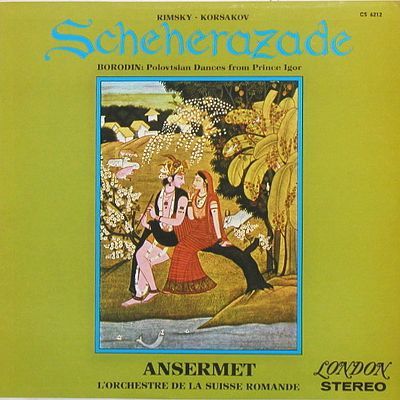
Rimsky-Korsakov / Scheherazade – As Good As It Gets

More of the Music of Rimsky-Korsakov

rimskscheh_6212_1610_1389793105

  • Outstanding Double Plus (A++) sound throughout this vintage London pressing of Ansermet and the Suisse Romande’s superb performance of this dazzlingly symphonic suite
  • It’s also fairly quiet at Mint Minus Minus, a grade that even our most well-cared-for vintage classical titles have trouble playing at
  • This copy will go head to head with the hottest Reiner pressing and is guaranteed to blow the doors off of it
  • The top end is natural and sweet – this is the way the solo violin in the left channel is supposed to sound
  • Extraordinary Demo Disc sound – the brass displays weight and power throughout the powerful first movement like nothing you’ve ever heard in your life, outside of a live performance of course
  • Finding the best sounding pressings of this exceptional recording was a breakthrough for us – here was sound we had never experienced for the work, and let me tell you, that was a thrill we will not soon forget
  • These are the stampers that always win our shootouts, and when you play this copy, you will know why – the sound is big, rich and clear like no other Scheherazade you’ve heard
  • We’ve come up with a simple listening test to help our audiophile brethren judge pressings of Scheherazade, especially those woeful iterations of the music on Heavy Vinyl. We hope you will find time to avail yourself of the lessons we’ve learned
  • There are about 80 orchestral recordings that are personal favorites, and this one deserves a place right at the top of that list

We did a monster shootout for this music in 2014, one we had been planning for more than two years. On hand were quite a few copies of the Reiner on RCA; the Ansermet on London (CS 6212, his second stereo recording, from 1961, not the earlier and noticeably poorer sounding recording from in 1959); the Ormandy on Columbia, and a few others we felt had potential.

The only recordings that held up all the way through — the fourth movement being THE Ball Breaker of all time, for both the engineers and musicians — were those by Reiner and Ansermet. This was disappointing considering how much time and money we spent finding, cleaning and playing those ten or so other pressings.

Here it is many years later and we’re capitalizing on what we learned from the first big go around, which is simply this: the Ansermet recording on Decca/London can not only hold its own with the Reiner on RCA, but beat it in virtually every area. The presentation and the sound itself are both more relaxed and natural, even when compared to the best RCA pressings.

The emotional content of the first three movements (all of side one) under Ansermet’s direction are clearly superior. The roller-coaster excitement Reiner and the CSO bring to the fourth movement cannot be faulted, or equaled. In every other way, Ansermet’s performance is the one for me. We did a monster shootout for this music in 2014, one we had been planning for more than two years. On hand were quite a few copies of the Reiner on RCA; the Ansermet on London (CS 6212, his second stereo recording, from 1961, not the earlier and noticeably poorer sounding recording from in 1959); the Ormandy on Columbia, and a few others we felt had potential. (more…)

Rimsky-Korsakov – Christmas Eve Suite / Ansermet

More of the Music of Rimsky-Korsakov

  • An early pressing of Rimsky-Korsakov’s exotic orchestrations that was giving us the rich and Tubey Magical London / Decca sound we were looking for, with an INCREDIBLE Shootout Winning Triple Plus (A+++) side one mated to an excellent Double Plus (A++) side two
  • It’s also fairly quiet at Mint Minus Minus, a grade that even our most well-cared-for vintage classical titles have trouble playing at
  • These sides are clear, full-bodied and present, with plenty of space around the players, the unmistakable sonic hallmark of the properly mastered, properly pressed vintage analog LP
  • The texture on the strings and the breathy quality of the woodwinds are superb, making this a very special copy indeed

James Walker was the producer, Roy Wallace the engineer for these sessions from May 1957 in Geneva’s glorious Victoria Hall. It’s yet another remarkable disc from the Golden Age of Vacuum Tube Recording.

The gorgeous hall the Orchestre de la Suisse Romande recorded in was possibly the best recording venue of its day; possibly of all time. More amazing sounding recordings were made there than in any other hall we know of. There is a solidity and richness to the sound beyond all others, yet clarity and transparency are not sacrificed in the least.

It’s as wide, deep and three-dimensional as any, which is of course all to the good, but what makes the sound of these recordings so special is the weight and power of the brass, combined with timbral accuracy of the instruments in every section.

This is the kind of record that will make you want to take all your heavy vinyl classical pressings and put them in storage. None of them, I repeat not a single one, can begin to sound the way this record sounds. (Before you put them in storage or on Ebay please play them against this pressing so that you can be confident in your decision to rid yourself of their insufferable mediocrity.)

The Christmas Eve suite takes up the entire first side, with three shorter pieces comprising the second. Rimsky-Korsakov’s exotic orchestrations, much like those found on his wonderful Scheherazade and The Tale of the Tsar Saltan, are pure audiophile ear candy from first note to last.

(more…)

Ravel and Ansermet Produce The Best Bolero on Vinyl

Hot Stamper Pressings of the Music of Maurice Ravel Available Now

Here are some comments from a Hot Stamper listing we did years ago.

The sound is clear, with wonderful depth to the stage.

As a rule, the classic ’50s and ’60s recordings of Ansermet and the Suisse Romande in Victoria Hall are as big and rich as any you may have ever heard.

These recordings may just be the ideal blend of clarity and richness, with depth and spaciousness that will put to shame 98% of the classical recordings ever made.

Side One

Bolero (Ravel)

Tubey and clear, with both the snare and the flute coming from so far back in the hall. OUTSTANDING energy and dynamic power.

Turn it up and it really comes to life like LIVE MUSIC. It’s big, wide and believable. We loved it.

Side Two

The Sorcerer’s Apprentice (Dukas)

ZERO compression. ZERO distortion when loud. Which means it has ZERO compressor distortion, something not five out of a hundred Golden Age recordings can claim. Nice extended top too.

There is depth and richness to beat the band, as well as clarity and tonal correctness that let you forget the recording and just enjoy the music. This piece is not quite as transparent as the Ravel, but still has earned every one of its Three Pluses.

The timbre of the brass is right on the money. As we have noted before, the brass of the Suisse Romande is some of the best to have ever been committed to analog tape.

Again, this side had OUTSTANDING energy and dynamic power the likes of which we think you may never have heard.

La Valse (Ravel)

Boasting some of the best sound of the three works we played on this copy. Again, with that wondrously huge hall adding a sense of space that will allow your speakers to disappear. The performers are not too close, which is very much in keeping with live music.

In his tribute to Ravel after the composer’s death in 1937, Paul Landormy described the work as follows:

“….the most unexpected of the compositions of Ravel, revealing to us heretofore unexpected depths of Romanticism, power, vigor, and rapture in this musician whose expression is usually limited to the manifestations of an essentially classical genius.”

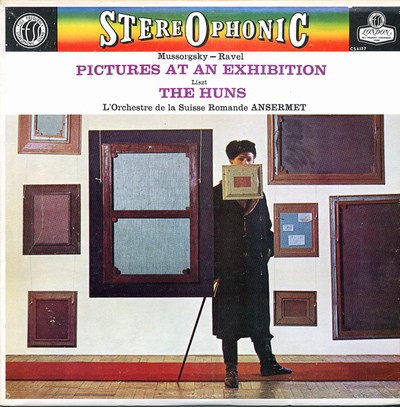
Mussorgsky / Pictures at an Exhibition / Ansermet

Hot Stamper LPs that Need to Be Played on Big Speakers at Loud Levels

Recordings that Sound Their Best on Big Speakers at Loud Levels 

I used to think Ansermet’s reading was ponderous, but this copy from 2013 is making me want to change my mind.

Is it more lively than others? Is the stereo that much improved since I last heard one of these Londons?

We have no way of knowing. All we do know is that we were enjoying Ansermet’s performance more than we ever had before.

The darker brass instruments like tubas, trombones and french horns are superb here. Other Golden Age recordings of the work, as enjoyable as they may be in other respects, do not fully reproduce the weighty quality of the brass, probably because of compression, limiting, tube smear, or some combination of the three.

The brass on this record has a power like practically no other recording of the work we know.

It’s also tonally correct. It’s not aggressive. It’s not irritating. It’s just immediate and powerful the way the real thing is when you hear it live. That’s what really caught my ear when I first played the recording.

There is a blast of brass at the end of Catacombs that is so big and real, it makes you forget you’re listening to a recording. You hear every brass instrument, full size, full weight. I still remember the night I was playing the album, good and loud of course, when that part of the work played through. It was truly startling in its power.

Some of Ansermet’s recordings with the Suisse Romande are absolutely the best I’ve ever heard. It was a magical combination of the right hall, the right engineers, the right orchestra and the right technology — the pure tube ANALOG technology of the ’50s and ’60s!

(more…)

Gounod / Borodin / The World of Ballet, Vol. 2

More Orchestral Music Conducted by Ernest Ansermet

Reviews and Commentaries for Guonod / Faust Ballet Music

Side one contains one of the most famous and sought-after pieces of music in the entire Living Stereo catalog, the wonderful Faust Ballet Music that takes up side one of LSC 2449. (The Carmen that makes up side two of the original Shaded Dog has never impressed us sonically. There are so many better recordings of the piece, the Ansermet recording on London being one of the best.) 

The hall is HUGE — so spacious and three-dimensional it’s almost shocking, especially if you’ve been playing the kind of dry, multi-miked modern recordings that the ’70s ushered in for the major labels such as London and RCA. (EMI is super spacious but much of that space is weird, coming from out of phase back channels folded in to the stereo mix. And often so mid-hall and distant. Sorry, just not our sound.)

Or maybe you own a batch of dense Londons from the ’70s. How many Solti records are not ridiculously thick and opaque? One out of ten? If that. We’re very wary of records recorded in the ’70s; we’ve been burned too many times.

And to tell you the truth we are not all that thrilled with most of what passes for good sound on Mehta’s London output either. If you have a high-resolution system these recordings, like those on Classic Heavy Vinyl we discuss below, leave a lot to be desired. (The Planets is a favorite whipping boy around here as you may know.)

Opacity is a real dealbreaker for us. Most of the classical records we play from later eras simply do not have the transparency that’s essential to us suspending our disbelief. (more…)