Roy Wallace, Engineer – Reviews and Commentaries

Tchaikovsky / Swan Lake – Notes for All Four Sides

More of the Music of Tchaikovsky

This review was written for our first shootout of the complete ballet in 2012.

This London Small Red Label “Whiteback” (it’s white inside the box, not on the back, but you get what I mean) UK Import 2 LP Set put every other recording we had of Swan Lake to shame. This is the one folks, assuming you want a nearly complete performance of the work. (We will have some single LP highlight pressings coming to the site down the road. The Fistoulari on London can be especially good on the right pressing.) 

The performance here by Ansermet and the Suisse Romande I rank second to none.

Ansermet is surely the man for this music, and the famously huge hall he recorded in just as surely contributes much to the wonderful sound here. (The Royal Gala Ballet is a good example. If you have the two grand to spend we highly recommend you find yourself a good one. And don’t waste your money on the Classic no matter what you may have read elsewhere.)

Speaking of bad sounding Heavy Vinyl, Speakers Corner reissued this very recording on 180g fifteen years ago or so and ruined it. Imagine that. (I happily admit their Nutcracker was quite good for a Heavy Vinyl reissue. It cannot hold a candle to a good vintage pressing but it will beat most of what’s out there on audiophile vinyl, which, truth be told, isn’t saying much.)

This Masterpiece of Ballet Music should have a place in any audiophile’s classical collection.

Others that belong in that category can be found here.

(more…)

Letter of the Week – “There is an airiness to the recording where the instruments seem to float in a 3-D space in the soundstage.”

Hot Stamper Pressings of the Music of Tchaikovsky Available Now

One of our good customers had this to say about some Hot Stampers he purchased recently. 

Hey Tom, 

I wanted to give you my impressions of the hot stamper (vs. the Speakers Corner Decca reissue) before going out of town for a bit.

Crank it up. Sounds really good turned up loud so I knew I was going to be in for a treat. There is an airiness to the recording where the instruments seem to float in a 3D space in the soundstage. I also noticed an improved clarity of the instruments themselves; in particular, the triangles, flute, and strings.

Yes, these differences are obvious to us, because we already have the best pressings, so the heavy vinyl stuff is always wrong or worse in some way that is not hard to hear. Back to back it does not take a pair of golden ears to hear these kinds of differences.

Funny, we discussed this yesterday and as you said, until you compare multiple pressings you might think you already have a great recording. Another big difference I noticed was the tightness and solidity of the bottom end. The Decca [Heavy Vinyl reissue] seemed to smear the low frequency content compared to the London.

This happens a lot. The smear is everywhere on these newly remastered records but sometimes you can hear it most clearly in one area or another. In this case you heard it most clearly in the bass, but it’s everywhere.

The ONLY thing I miss is the flow of the full ballet. The ballet seems to tell a nice complete story where the suite just gives me the reader’s digest version — sort of a greatest hits if you will, and does not allow one to immerse themselves in the whole experience. Ideally, a hot stamper of the full ballet would be pretty amazing I am guessing.

We can definitely get you the complete ballet at some point, but these shootouts take years to get going.

I would say your best bet is to return the record since it doesn’t seem to be the way you want to hear the music and we can put you on the want list for the next complete version we find.

(more…)

Ravel and Ansermet Produce The Best Bolero on Vinyl

Hot Stamper Pressings of the Music of Maurice Ravel Available Now

Here are some comments from a Hot Stamper listing we did years ago.

The sound is clear, with wonderful depth to the stage.

As a rule, the classic ’50s and ’60s recordings of Ansermet and the Suisse Romande in Victoria Hall are as big and rich as any you may have ever heard.

These recordings may just be the ideal blend of clarity and richness, with depth and spaciousness that will put to shame 98% of the classical recordings ever made.

Side One

Bolero (Ravel)

Tubey and clear, with both the snare and the flute coming from so far back in the hall. OUTSTANDING energy and dynamic power.

Turn it up and it really comes to life like LIVE MUSIC. It’s big, wide and believable. We loved it.

Side Two

The Sorcerer’s Apprentice (Dukas)

ZERO compression. ZERO distortion when loud. Which means it has ZERO compressor distortion, something not five out of a hundred Golden Age recordings can claim. Nice extended top too.

There is depth and richness to beat the band, as well as clarity and tonal correctness that let you forget the recording and just enjoy the music. This piece is not quite as transparent as the Ravel, but still has earned every one of its Three Pluses.

The timbre of the brass is right on the money. As we have noted before, the brass of the Suisse Romande is some of the best to have ever been committed to analog tape.

Again, this side had OUTSTANDING energy and dynamic power the likes of which we think you may never have heard.

La Valse (Ravel)

Boasting some of the best sound of the three works we played on this copy. Again, with that wondrously huge hall adding a sense of space that will allow your speakers to disappear. The performers are not too close, which is very much in keeping with live music.

In his tribute to Ravel after the composer’s death in 1937, Paul Landormy described the work as follows:

“….the most unexpected of the compositions of Ravel, revealing to us heretofore unexpected depths of Romanticism, power, vigor, and rapture in this musician whose expression is usually limited to the manifestations of an essentially classical genius.”

What We Think We Know about Scheherazade

More of the music of Rimsky-Korsakov (1844-1908)

Our Favorite Performance of Scheherazade – Ansermet with the Suisse Romande

This post was written in 2014 or so. It’s the story of the breakthrough pressing we discovered that year.

I attended the Dec. 2013 performance of the work at the Disney Hall. Pictured is Mr de Burgos conducting. It was a thrill like no other. (Well, maybe The Planets.)

“Guest conductor Rafael Frühbeck de Burgos’s attention to detail delivers the razzle dazzle and also discovers renewed radiance in ‘Scheherazade.'”

We did a monster shootout for this music in 2014, one we had been planning for more than two years. On hand were quite a few copies of the Reiner on RCA; the Ansermet on London (CS 6212, his second stereo recording, from 1961, not the earlier and noticeably poorer sounding recording from in 1959); the Ormandy on Columbia, and a few others we felt had shown potential.

The only recordings that held up all the way through — the fourth movement being THE Ball Breaker of all time, for both the engineers and musicians — were those by Reiner and Ansermet. This was disappointing considering how much time and money we spent finding, cleaning and playing those ten or so other pressings.

Here it is a year later and we’re capitalizing on what we learned from the first big go around, which is simply this: the Ansermet recording on Decca/London can not only hold its own with the Reiner on RCA, but beat it in virtually any area. The presentation and the sound itself are both more relaxed and natural, even when compared to the best RCA pressings.

The emotional content of the first three movements (all of side one) under Ansermet’s direction are clearly superior. The roller coaster excitement Reiner and the CSO bring to the fourth movement cannot be faulted, or equaled. In every other way Ansermet’s performance is the one for me.

Both Sides

Superb! Big brass, so full-bodied and dynamic, yet clear and not thick or overly tubey. Lots of space as is usually the case with Ansermet’s recordings from this era.

Both sides here are BIG, with the space and depth of the wonderful Victoria Hall that the L’Orchestre De La Suisse Romande perform in. As a rule, the classic ’50s and ’60s recordings of Ansermet and the Suisse Romande are as big and rich as any you’ve heard. On the finest pressings (known around these parts as Hot Stampers) they seem to be the ideal blend of clarity and richness, with depth and spaciousness that will put to shame 98% of the classical recordings ever made.

The solo violin is present and so real you will have a hard time believing it.

This copy is huge in every dimension, just as all the best ones always are, with maximum amounts of height, width, and depth. The transparency is also superb — you really hear into this one in the way that only the best Golden Age recordings allow.

(more…)

Coppelia and Sylvia / London Vs. Decca – Updated 2025

Hot Stamper Pressings of Music Conducted by Ernest Ansermet Available Now

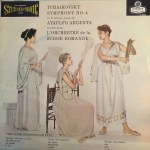
Once again, the right Decca reissue blows the doors off the original London we played. This has lately become a pattern, but keep in mind it’s a pattern that’s reliable less than half the time, if memory is any guide. Many of the Decca reissues we’ve played over the last few years have failed badly in a head to head with their earlier-mastered and -pressed counterparts.

But the ones that beat all comers are the ones that stick in our minds and show up on our site.


UPDATE 2025

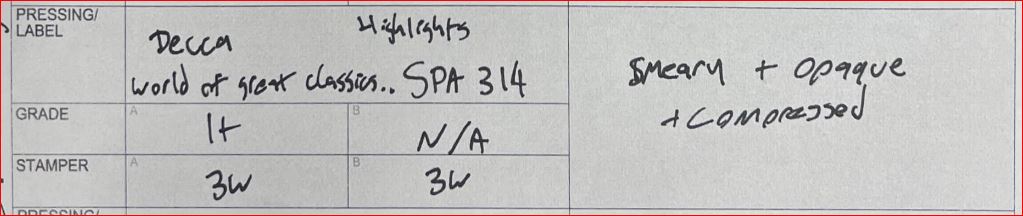
A copy of one of the SPA reissues we used to like shown above made it to our latest shootout and did not do nearly as well as a copy did years ago.

We don’t have those copies anymore and cannot say whether they actually did sound as good as we thought they did.

Our advice would be to assume that this is not the best way to buy this album. But neither is the original, as you will read below.


Clearly a case of confirmation bias, but at least we know something about our own biases, and that puts us well ahead of the audiophile pack.

Record collectors and record collecting audiophiles will tell you it shouldn’t happen, but fools like us, who refuse to accept the prognostications of those supposedly “in the know,” have done the work and come up with the experimental data that’s proven them wrong again and again.

Sort of. We had one, and only one, pressing of the original London (CS 6185), and boy was it a mess — crude as crude can be.

It sounded like an “old London record,” not the Decca engineered and mastered vintage collectible we know it to be.

We’ve played them by the hundreds, so we know that sound fairly well by now.

Are there copies that sound better? Surely there are, but how are you going to find them? Are you going to shell out the going rate of $25-50 on ebay for one (or more) clean copies, only to find that it/they sound every bit as bad as the one we auditioned? The question answers itself.

If, however, you are one of the lucky few who has a nice London or Decca original of this recording, please let us send you this copy so that you can do the shootout for yourself. You may be shocked at how good this music can sound on the right pressing. And if your copy sounds better than ours we will be very shocked indeed. [This offer was only good while we had the record, and it is long gone at this point. We still remember the sound though!]

Production and Engineering

James Walker was the producer, Roy Wallace the engineer for these sessions from April of 1959 in Geneva’s glorious Victoria Hall. It’s yet another remarkable disc from the Golden Age of Vacuum Tube Recording.

The hall the Suisse Romande recorded in was possibly the best recording venue of its day, possibly of all time. More amazing sounding recordings were made there than in any other hall we know of. There is a solidity and richness to the sound beyond all others, yet clarity and transparency are not sacrificed in the least.

It’s as wide, deep and three-dimensional as any, which is of course all to the good, but what makes the sound of these recordings so special is the weight and power of the brass, combined with unerring timbral accuracy of the instruments in every section of the orchestra.

(more…)

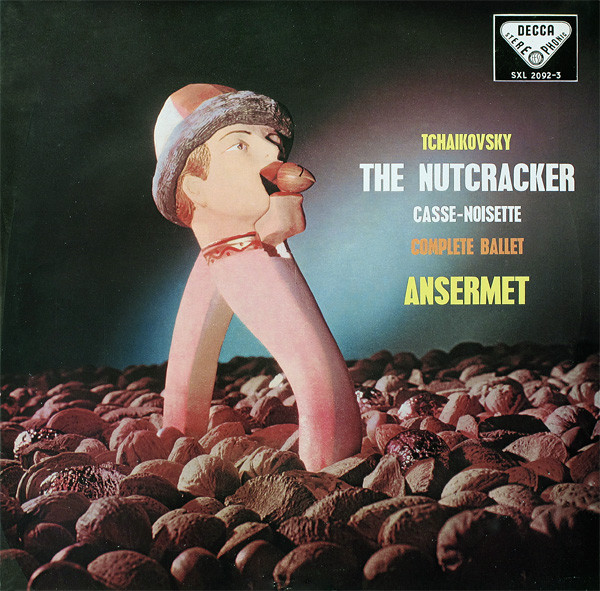
The Nutcracker on Speakers Corner

Hot Stamper Pressings of the Music of Tchaikovsky Available Now

Sonic Grade: B?

Not sure if we would still agree with what we wrote back in the ’90s when this record came out, but here it is anyway.

Superb! New records just don’t sound any better! This is the complete Nutcracker Ballet as conducted by Ansermet for Decca, a record that sets a standard of performance and sound that is unlikely ever to be equaled, and almost certainly not to be surpassed.

For those of you on a budget, if you can get your hands on one of these for a reasonable price, the Heavy Vinyl reissue would not be a bad way to go.

That’s assuming the copy you buy sounds at least good, similar to the one I played all those years ago, something that cannot be assumed.

But it would make for a good jumping off point.


A Must Own Classical Record (on Vintage Vinyl)

Ansermet breathes life into this ballet as only he can, and the Decca engineering team led by Kenneth Wilkinson do him proud.

It’s an Orchestral Spectacular that should have a place of honor in any audiophile’s collection.

Others that belong in that category can be found here.

Chabrier / Ansermet – The Best Espana on Record?

Hot Stamper Pressings of the Music of Chabrier Available Now

In 2021 we wrote:

Ansermet’s performance of Espana is still our favorite — nothing in our experience can touch it, musically or sonically.


UPDATE 2022

As of 2022 we slightly prefer the famous Argenta recording for Decca that’s on the TAS List, CS 6006.

Both are wonderful and both belong in any serious audiophile collection of orchestral music.


We created a special section for recordings of this quality. Classical and orchestral records that we’ve auditioned and found to have the best performances with the highest quality sound can be found here.

This has been a favorite recording of ours here at Better Records for a very long time, since at least the mid-’90s or thereabouts. We’ve mentioned how much we like the sound of Londons with catalog numbers ranging from about 6400 to 6500 or so (which are simply Decca recordings from the mid-’60s), and this one (CS 6438) is one of the best reasons to hold that view.

You get some of the Tubey Magic and golden age sound from Decca’s earlier days, coupled with the clarity and freedom from compression and tube smear of their later period. In other words, this record strikes the perfect sonic balance, retaining qualities from different periods that are normally at odds with each other. Here they work together wonderfully.


Further Reading

Carmen – Dry Strings on One Side, Rich on the Other

More of the music of Georges Bizet (1838-1875)

My notes for side two on a copy we recently auditioned read:

Could use more tubes.

Strings could be a bit smoother.

Needs a bit more weight down low.

My notes for side one:

Side one had all of this and more!

Some Common Issues with Londons and Deccas

Many London and Decca pressings lack weight down low, which thins out the overall sound and washes out the lower strings.

On some sides of some copies the strings are dry, lacking Tubey Magic. This is decidedly not our sound, although it can easily be heard on many London pressings, the kind we’ve played by the hundreds over the years.

If you have a rich sounding cartridge, perhaps with that little dip in the upper midrange that so many moving coils have these days, you will not notice this tonality issue nearly as much as we do.

Our 17Dx is ruler flat and quite unforgiving in this regard. It makes our shootouts much easier, but brings out the flaws in all but the best pressings, exactly the job we require it to do.

Here are some other records that are good for testing string tone and texture.

(more…)

Chabrier – Our Four Plus Shootout Winner

Hot Stamper Pressings of the Music of Chabrier Available Now

The Espana side earned our rare and coveted Four Plus A++++ grade, which is strictly limited to pressings (really, individual sides of pressings) that take a given recording to a level we’ve never experienced before and had no idea could even exist. We estimate that about one per cent of the Hot Stamper pressings we come across in our shootouts earn this grade. You can’t get much more rare than that.

Our lengthy commentary entitled Outliers & Out-of-This-World Sound talks about how rare these kinds of pressings are and how to go about finding them.

We no longer give Four Pluses out as a matter of policy, but that doesn’t mean we don’t come across records that deserve them from time to time.

Here you will find monstrous size and dynamic power, thanks to the brilliant Decca engineering of Roy Wallace. Without a doubt the most spectacular sound we’ve ever heard from CS 6438.

This Beyond White Hot Stamper London pressing has some of the loveliest orchestral music reproduction we know of. Man, this copy sure has it going on: it’s super clean and clear, tonally correct from top to bottom, with all of the weight of the orchestra down low on side one which is very, very hard to come by on this record!

And all that weight and energy down low is what really makes Espana magical. You won’t believe the sound!  (more…)

Albeniz / Iberia from 1960 – Amazing on the Original and the Right Reissues Too

xxx.jpg

More of the music of Isaac Albeniz (1860-1909)

Decca and London Hot Stamper Pressings Available Now

James Walker was the producer, Roy Wallace the engineer for these sessions from May of 1960 in Geneva’s glorious Victoria Hall.

It’s yet another remarkable Demo Disc from the Golden Age of Vacuum Tube Recording Technology, with the added benefit of mastering using the more modern cutting equipment of the ’70s. (We are of course here referring to the good modern mastering of 30+ years ago, not the bad modern mastering of today.)

The combination of old and new works wonders on this title as you will surely hear for yourself on both of these better than Super Hot sides.

The sound of this copy is so transparent, undistorted, three-dimensional and REAL, without any sacrifice in solidity, richness or Tubey Magic, that we knew we had a real winner on our hands as soon as the needle hit the groove.

We were impressed with the fact that it excelled in so many areas of reproduction. The illusion of disappearing speakers is one of the more attractive aspects of the sound here, pulling the listener into the space of the concert hall in an especially engrossing way.

Side One – Iberia (1-4)

A huge hall, correct string tone, spacious and open as practically any orchestral recording you can find! (more…)