Top Artists – Art Pepper

Thoughts on One of the Most Dynamic Contemporary Recordings

Hot Stamper Pressings of the Music of Art Pepper Available Now

This commentary was written in 2008.


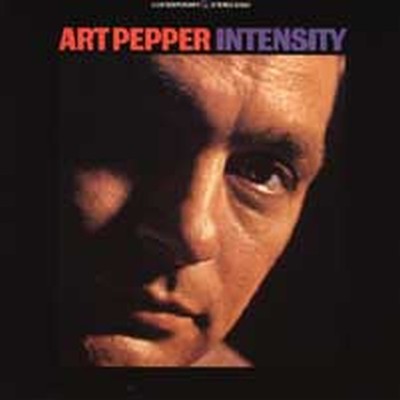
Intensity is right — this is some SERIOUSLY GOOD SOUNDING alto saxophone led quartet jazz. AMG was right to give this one 4 1/2 stars — the musicianship is top notch and Pepper’s playing is INSPIRED throughout. 

The real surprise was how well recorded this album from 1963 is. I can’t recall a more DYNAMIC Contemporary. Pepper’s sax gets seriously LOUD in some passages. This is very much a good thing. Not only is he totally committed to the music, but the engineers are getting that energy onto the record so that we at home can feel the moment to moment raw power of his playing.

(Pepper was famous for saying that his playing is best when he just plays whatever he feels in the moment, and this record is the best kind of evidence for the truth of that claim.)

Of course, since this is a Roy Dunann recording, all the tubey magical richness and sweetness are here as well, but what is surprising is how transparent, spacious and clear the sound is. Some of Roy’s recordings can sound a bit dead (recording in your stockroom is not always the best for spaciousness) and sometimes are a bit thick as well. Not so here. But it should be pointed out that we liked what we heard from a previous shootout too.

Last time around we wrote:

This record has superb sound: you can actually hear the keys clacking on the man’s alto. And that sort of detail does not come at the expense of phony brightness as it would with your typical audiophile recording. The tonality of the sax, drums, and bass are right on the money, exactly the way we expect Roy DuNann’s recording to be.

This time around we got more extension out of the cymbals. Either these copies are better, were cleaned better, or were helped quite a bit by our new Townshend SuperTweeters. (Probably the last two more than the first one.) (more…)

Art Pepper – Smack Up on Contemporary

More of the Music of Art Pepper

  • This is a classic from Pepper – all the songs were written by saxophonists and he tears into them with gusto and naked emotion, the hallmarks of his playing style
  • This is some seriously good-sounding saxophone-led jazz, thanks to Roy DuNann and Lester Koenig
  • 4 1/2 stars: “Pepper is very much on top of his game throughout, ably demonstrating a capacity for precision and intimidating passion. Nowhere is proof more readily available than on these sides, which project Pepper at the peak of his craft.”

The horns are really jumpin’ out of the speakers here, but they never get hard or squawky like they do on some pressings. This combination of clarity and fullness is not easy to come by, but it lets the music flow in glorious waves of All Tube 1960 analog. With the always wonderful Jack Sheldon on trumpet, this is a great date from the Golden Age of Jazz Recordings. (more…)

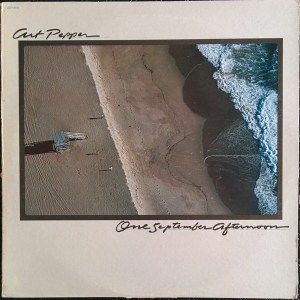
Art Pepper / One September Afternoon

More of the Music of Art Pepper

  • One September Afternoon returns to the site for the first time in years, here with STUNNING Shootout Winning Triple Plus (A+++) sonics throughout this original Galaxy pressing – fairly quiet vinyl too
  • Both of these sides are exceptionally full and spacious, with much more energy and dynamics than on all other copies we played
  • Pepper’s saxophone sound is right on the money – breathy and airy with clearly audible leading edge transients
  • “When Art Pepper died at the age of 56, he had attained his goal of becoming the world’s great altoist.” – AMG

This is an excellent recording from 1981, one of the best of the later Art Pepper period during which Art was signed with Galaxy and was devoting his remaining years to playing and recording as much as possible. The album is engineered by Baker Bigsby, as is Art Pepper Today (1978), my personal favorite Art Pepper album and amazing sounding if you can find the right pressing (we’re working on it!).

Like other Bigsby engineered titles, when you get a killer copy the bass is big, solid and it goes deep.

There are a lot of stinkers in the Art Pepper catalog from this era. (Acoustic Sounds released a few of them on 180 gram LPs as a matter of fact. What a waste of vinyl.)

But this album is actually quite good. Art plays in an energetic style, and Stanley Cowell on the piano is excellent as well.

(more…)

Art Pepper – Winter Moon

More of the Music of Art Pepper

  • A Winter Moon like you’ve never heard, with KILLER Shootout Winning Triple Plus (A+++) grades or close to them throughout this vintage Galaxy pressing
  • The sound here is rich and Tubey Magical, which is the only way this music makes any sense on record
  • You’d be hard-pressed to find a copy that’s this well balanced, big and lively, with wonderful clarity in the mids and highs and Pepper’s sax front and center
  • Rosiny string texture is key to the best pressings – the ones that have the highest-resolution strings with the most sheen tend to do the best in our shootouts
  • 4 1/2 stars: “Pepper sounds quite inspired performing seven strong compositions highlighted by Hoagy Carmichael’s ‘Winter Moon,’ ‘When the Sun Comes Out’ and a clarinet feature on ‘Blues in the Night.'”
  • If you’re a fan of Art’s, this is an excellent title from 1981 that belongs in your collection.

(more…)

Letter of the Week – “The whole house lights when up I turn this up all the way, emitting positive vibes into the universe…”

Hot Stamper Pressings of the Music of Art Pepper Available Now

Our good customer Michel wrote to us about his experience playing one of our records.

Hi Tom,

At 2 a.m. last night and again today, I simply cannot get over just how darn good the sound is on this 2.5 side 2
of the stereo Art Pepper Meets the Rhythm Section.

Truly, a magical experience indeed. The whole house lights up when I turn this copy up all the way, emitting positive vibes into the universe,
near and far.

All the other copies I had … no comparison at all.

One simply doesn’t know until one knows. That’s the crux of the biscuit as they say.

I sure do love my BR records!
Cheers,
Michel

Michel,

Thanks again for writing. I wish more audiophiles could have the kind of experience you apparently had with that killer copy of Art Pepper Meets the Rhythm Section you ordered.

As you say, your other copies could not hold a candle to the properly-cleaned, properly-mastered and properly-pressed copy we sent you.

And the Heavy Vinyl pressing that Chad and Bernie made is an insult to the record buying public.

(more…)

Letter of the Week – “The whole house lights up when I turn this copy up all the way, emitting positive vibes into the universe, near and far.”

Hot Stamper Pressings of the Music of Art Pepper Available Now

Our good customer Michel wrote to us about his experience playing one of our records.

Hi Tom,

At 2 a.m. last night and again today, I simply cannot get over just how darn good the sound is on this 2.5 side 2
of the stereo Art Pepper Meets the Rhythm Section.

Truly, a magical experience indeed. The whole house lights up when I turn this copy up all the way, emitting positive vibes into the universe,
near and far.

All the other copies I had … no comparison at all.

One simply doesn’t know until one knows. That’s the crux of the biscuit as they say.

I sure do love my BR records!

Cheers,
Michel

Michel,

Thanks again for writing. I wish more audiophiles could have the kind of experience you apparently had with that killer copy of Art Pepper Meets the Rhythm Section you ordered.

As you say, your other copies could not hold a candle to the properly-cleaned, properly-mastered and properly-pressed copy we sent you.

(more…)

Which Art Pepper Today Is Better: Phil DeLancie Digital or George Horn Analog?

Hot Stamper Pressings of the Music of Art Pepper Available Now

UPDATE 2024

This commentary was written in 2010 or thereabouts.

There is new information about the album as of 2024, which can be found here.


We’d wanted to do Art Pepper Today for more than a decade, but the original Galaxy pressings were just too thick and dark to earn anything approaching a top sonic grade. Thirty years ago on a very different system I had one and liked it a lot, but there was no way I could get past the opaque sound I was now hearing on the more than half-dozen originals piled in front of me.

So, almost in desperation we tried an OJC reissue from the ’90s. You know, the ones that all the audiophiles on the web will tell you to steer clear of because it has been mastered by Phil DeLancie and might be sourced from digital tapes.

Or digitally remastered, or somehow was infected with something digital somehow.

Well, immediately the sound opened up dramatically, with presence, space, clarity and top end extension we simply could not hear on the originals. Moreover, the good news was that the richness and solidity of the originals was every bit as good. Some of the originals were less murky and veiled than others, so we culled the worst of them for trade and put the rest into the shootout with all the OJCs we could get our hands on.

Now, it’s indisputable that Phil DeLancie is credited on the jacket, but I see George Horn‘s writing in the dead wax of the actual record, so I really have no way of knowing whether in fact Mr Delancie had anything to do with the copies I was auditioning. They don’t sound digital to me, they’re just like other good George Horn-mastered records I’ve heard from this period.

And of course we here at Better Records never put much stock in what record jackets say; in our experience, the commentary on the jackets rarely has much to do with the sound of the records inside them.

And, one more surprise awaited us as we were plowing through our pile of copies.

When we got to side two we found that the sound of the Galaxy originals was often competitive with the best of the OJCs. Which means that there’s a good probability that some of the original pressings I tossed for having bad sound on side one had very good, perhaps even shootout winning sound, on side two.

This is a lesson I hope to take to heart in the future. I know very well that the sound of side one is independent of side two, but somehow in this case I let my prejudice against the first side color my thinking about the second.

Of all the people who should know better…

(more…)

Don’t Skip the OJC, Put It in a Shootout

Of the three early OJC pressings of West Coast Sound we played recently, only one met our standards. At 2+/1.5+, the sound was good, not great.

One copy earned grades of 1+/1+, which means the sound was passable. The last copy had an NFG side two, which means it was just awful.

(Many of the Heavy Vinyl disasters we’ve been cataloging lately have earned that notorious grade. The unacceptably lo- to mid-fi sound even the better ones offer doesn’t seem to bother the audiophiles who rave about them, however.)

So does side two of the OJC pressing have fairly good sound, merely passable sound, or is the sound hopelessly bad?

In the case of this Shelly Manne album, all three, and the only way we were able to discover that is by cleaning up three of them and playing them head to head with real Contemporary pressings in a blinded experiment.

Obviously we were hoping for better results from our OJCs — only one of the copies we played will turn out to be saleable.

Why did we bother? That old bugaboo the profit motive was all that was needed to make us give the OJC pressings a try. We thought we could make money on them but it turns out that the opposite will happen. Oh well, nothing ventured, noting gained.

More importantly, we are not the least bit shy about coming clean and sharing the results with our readers and customers, especially the part about three identical looking copies with the same stamper numbers all sounding very diffferent from each other.

An added bonus is that side two was worse than side one most of the time. That happens often enough, but nobody but us ever seems to want to talk about it.

If we had had ten OJC pressings to play, we probably would have be able to find at least one or two with a grade of 2+/2+, meaning that George Horn probably did a creditable job mastering the album back in 1984 when he cut it for Fantasy, to sell for the very affordable price of $5.98. It’s most likely the pressing plant that let listeners down.

Needs Tubes

The problem here is that this title needs tubes, or, at the very least, the sound of tubes, and George apparently did not have them, or enough of them, in his mastering chain.

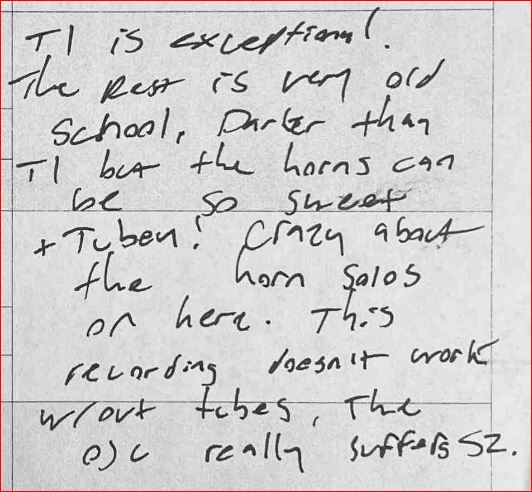
Our specific notes can be seen on the left. We mention that the first track has the best sound (1956 dates), the rest falling short for being darker and more crude (“old school,” some dating from 1953).

The West Coast horn players are the reason to buy this title, with horns that are “sweet and tubey,” but of course to hear that kind of sound you will need a real Contemporary pressing, not an OJC — or anything made in the modern era for that matter.

(more…)

Shorty Rogers – The Swingin’ Nutcracker

Hot Stamper Pressings of the Music of Tchaikovsky Available Now

UPDATE 2025

We wrote the commentary you see below about 15 years ago.

We liked the record back then just fine. However, we recently got another couple of copies in and they sounded OK, not great, but what really had aged badly was the music, which was corny and, worst of all, contra the album’s title, definitely did not swing.

Don’t waste your money on this one the way we did.


Our old commentary:

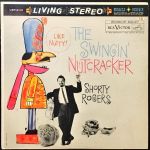
Insanely good Living Stereo sound throughout with both sides earning Shootout Winning Triple Plus (A+++) grades and playing reasonably quietly. Al Schmitt handled the engineering duties, brilliantly, with Shorty and dozens of his West Coast Pals contributing to the dates, the likes of Conte Candoli, Art Pepper, Bill Perkins, Bud Shank, Harold Land, Richie Kamuca and more.

“The most remarkable aspect about the score is how boldly it re-imagines the original. The Swingin’ Nutcracker is contemporary from an American perspective without patronizing the European original.” – Marc Meyers, Jazz Wax

(more…)

Shelly Manne & His Men – The West Coast Sound, Vol. 1

More Shelly Manne

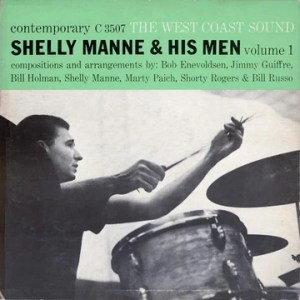
  • This early MONO pressing was doing practically everything right, with both sides earning INCREDIBLE Shootout Winning Triple Plus (A+++) grades or close to them
  • The first track here is by far the best sounding — it’s amazing and the perfect illustration of just how good 1956 mono sound can be if you know what you are doing
  • The sound may be a bit dated but the horns are enchantingly sweet and Tubey Magical, with solos that show off the jazz chops of “His Men” about as well as any Manne and His Men album ever has
  • Tube mastering is essential for this recording – without vintage tubes in the chain, you end up with the kind of modern sound that the average OJC pressing suffers from (this is especially noticeable on side two of the OJC pressings we played, which were mostly awful)
  • Contemporary in 1956 was making some awfully good jazz records, with room-filling, natural and realistic mono sound, the kind of sound that still holds up today and doesn’t need a lot of “mastering help” to do it
  • Good luck finding quieter early copies of this title — we sure couldn’t do it, not with top quality sound anyway
  • 5 stars: “The music has plenty of variety yet defines the era… Highly recommended and proof (if any is really needed) that West Coast jazz was far from bloodless.”
  • If you’re a fan of West Coast Jazz, this is a Top Title from 1956, and one that certainly belongs in any right-thinking audiophile’s collection.

(more…)