*Mastering Issues

How Good Are the Domestic Originals of City to City Cut by Artisan?

Hot Stamper Pressings of the Music of Gerry Rafferty Available Now

The original domestic pressings may be cut by Artisan, but they are brighter and dramatically more congested and distorted than the better UK imports, and should be avoided at any price.

They are clearly made from dubbed tapes, and there is no getting around what that does to the sound.

However, as good a cutting house as Artisan may be, it’s shocking how bad the sound is on most of the domestic copies of the album they mastered.

Atrocious, to be honest.

When it comes to stampers, labels, mastering credits, country of origin and the like, we make a point of rarely revealing any of this information on the site, for a number of good reasons we discuss in some depth here.

We will happily make an exception in this case. Stick with UK imports. Or buy a Hot Stamper pressing from us.

If you’re a Gerry Rafferty fan, or perhaps a fan of mid-70s British folk pop, this title, a personal favorite of mine since 1978, is surely a Must Own.

In our opinion, City to City is the man’s best sounding album, and probably the only Gerry Rafferty record you’ll ever need. Click on this link to see more titles we like to call one and done.

The sound, at least on some tracks, Baker Street amoung them, may be too heavily processed for some, making the album fairly difficult to reproduce, but the best sounding pressings — played at good, loud levels on big dynamic speakers in a large, heavily-treated room, as god intended — are a truly powerful listening experience.

1978 was a good year for music on vinyl — we have some excellent pressings of well-recorded albums available now for those who want the best and are willing to pay a premium price to get it.

(more…)

Tea for the Tillerman – This Is Your Idea of Analog?

Dear Record Loving Audiophiles of Earth,

I’m afraid we have some bad news. [This was written back in 2011 when the record came out so it’s hard to imagine that what I am about to say is news to anyone after all these years.]

Regrettably we must inform you that the 2011 edition of Tea for the Tillerman pressed by Analogue Productions on Heavy Vinyl doesn’t sound very good. We know you were all hoping for the best. We also know that you must be very disappointed to hear this unwelcome news.

But the record is what it is, and what it is is not very good. Its specific shortcomings are many and will be considered at length in our review below.

Yes, we know, the folks over at Acoustic Sounds, in consultation with the late George Marino at Sterling Sound, supposedly with the real master tape in hand, and supposedly with access to the best mastering equipment money can buy, labored mightily, doing their level best to master and press the Definitive Audiophile Tea for the Tillerman on Vinyl of All Time.

It just didn’t come out very good, no matter what the reviewers say. And what do they say? Allow me to quote one.

…superbly dynamic, spacious and detailed…The attack of the pick on the guitar strings is astonishingly clean and detailed.

Depth is pronounced…

…the resolution of low level detail reveals a host of details that are either buried or glossed over on the other versions I’ve heard…

Uh-oh, wait a minute, here’s a blindingly red flag:

If you have the edition, you’ll find this similar in one way: there’s nothing “mellow” about the overall production and when the music gets loud (and Marino lets it get so) it can get a bit hard, but better that than to soften it and lose the clarity, focus and detail of this superb recording, especially in the quieter passages where the resolution of low level detail is astonishing.

More about that later.

(more…)

Jimmy Page’s Houses of the Holy Needed Tubes and Didn’t Get Them

Hot Stamper Pressings of the Music of Led Zeppelin Available Now

We did not care for the newly remastered version of Houses of the Holy. It badly lacks the kind of mastering that Robert Ludwig brought to the sound, and by that we mean lots of lovely tubes in the mastering chain.

What tube equipment he used and how he used it is something we have been researching for years now, but rather than go down that rabbit hole for the moment, let’s just say the Tubey Magic that is all over the original cuttings of the album is hard to find on the new one, and that means it’s missing a quality that makes Houses of the Holy one of the most luscious audiophile listening experiences one can have, even for those of us who long ago gave up on tube equipment.

The notes for side one, track one (The Song Remains the Same) and track three (Over the Hills and Far Away), read:

  • Blary, but not as awful as I expected
  • Dry, top end is bright, big though

The notes for side two, tracks one (Dancing Days) and three (No Quarter), read:

  • A bit thick, tonally OK
  • Less space around the low end

Tubes are what the doctor ordered, precisely the medicine that was needed to cure many of this pressing’s problems, but tubes are not what Jimmy Page and his engineer, John Davis, brought to the project, and more’s the pity. Any good domestic original will show you exactly what is wrong with the sound of this version in under two minutes.

(more…)

Does Your Pressing of Death and Transfiguration Have These Shortcomings?

More of the Music of Richard Strauss

Many of the later pressings of CS 6211 were not competitive with the earlier pressings, something we had no idea was true until we actually did the shootout.

This is why we do our shootouts with every kind of pressing we can find that has any hope of sounding good to us.

(This is of course something that cannot be predicted with much certainty. What we are saying is simply that we do not expect the German, Dutch, Japanese and such like pressings from other countries outside the UK to do well because they have almost never done well in the past, not for Decca recordings anyway.)

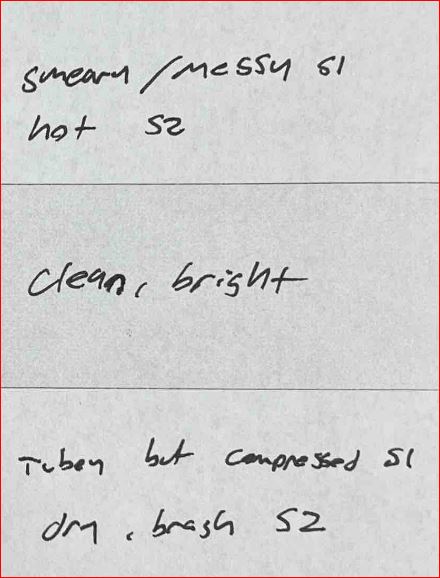
The notes on the left in the box are for the copies that did not do as well as our best copies.

If your copy of the album has any of the shortcomings we mention, and you would like a better pressing to play, rest assured we will have something for you down the road, as this is our favorite for both performance and sound.

Stamper Information

The stampers of the pressings that consistently came in last in our shootout had the mastering marking of L, which signifies the work of George Bettyes. He has done good work in the past, but odds are that any pressing of this title mastered by L is going to be inferior to those that are not.

Our advice: stick with E and G.

As is sometimes the case, there is one and only one set of stamper numbers that consistently wins our shootouts for CS 6211.  Here are some of the others we’ve discovered through the shootout process.

Our notes for an exceptionally good sounding copy from the last shootout can be seen below.

(more…)

Why Is It So Hard for Mobile Fidelity to Get the Midrange Right?

Hot Stamper Pressings of the Music of Joni Mitchell Available Now

We recently auditioned the Mobile Fidelity One-Step pressing of Blue and made the notes regarding the sound you see below.

We focussed on the quality of their pressing’s vocal reproduction, for the simple reason that a Joni Mitchell album that gets the vocals wrong is a Joni Mitchell album that no music lover and certainly no audiophile  would ever want to play.

The fact that some audiophiles do want to play this record speaks poorly of their ability to reproduce it properly. Accurate playback will reveal the problems with Joni’s voice described in detail below. The post-it for side one is on the left, for side two on the right.

We try to be very specific about the shortcomings of these records, which is why we reproduce our notes whenever they are available.

Side One

  • Tonally not far off, a bit too stringy and flat. Not awful. Congested vocals at peaks, harsh. 1+

Side Two

  • Vocal peaks like “traveling, traveling, traveling…” or “California” get squashed and harsh, lacking the real dynamics, presence and space of the vocals. No grade. (Awful in other words.)

(more…)

These Stampers Consistently Come in Last in Our Shootouts

Hot Stamper Pressings of the Music of The Eagles Available Now

All the original domestic pressings are cut by Ted Jensen at Sterling as far as we know.

You can find TJ and STERLING on every last one of them (with the notable exception of the SRC pressings, best avoided). What you can’t find is good sound on every last one of them.

The most common stampers can be found from pressing plants using the following label designations: MON, PRC, PRCW, AR and SP.

In our experience, two of the five labels listed above have the potential to win shootouts. Two of the others tend to end up somewhere in the middle of the grading curve. One consistently ends up at the bottom.

It’s important to keep in mind that in our shootouts, the person hearing the copy being played, the one who is carefully noting its strengths and weaknesses, has no idea what pressing plant actually produced the record, or what its specific stampers numbers might be.

That kind of  information is compiled after the grading has been done. That’s when these patterns emerge.

The domestic pressings with the stampers shown above have not done well in our shootouts for years now. If you own a copy with these stampers, or ones like them, the good news is that we can get you a much better sounding copy of The Long Run than you have ever heard. It won’t be cheap, but we guarantee that it will be very, very good.

Stamper numbers are not the be-all and end-all in the world of records, but after hearing too many copies with these stampers and less than stellar sound, from now on we are going to focus our attention on the stampers that do well and leave copies with these markings sitting in the bins.

Stampers

That the stampers are entirely responsible for the quality of any given record’s sound is a mistaken idea, and a rather convenient one when you stop to think about it. Audiophiles, like most everybody else on this planet, want answers, the simpler the better. Easier to memorize that way.

(more…)

Thriller Is Proof that Mobile Fidelity Is Cutting Some Real Crap These Days

Hot Stamper Pressings of the Music of Michael Jackson Available Now
Don’t blame the digital step for the bad sound of this pressing of Thriller. If it were all analog, you can be sure Mobile Fidelity would have screwed it up every bit as badly.

If this is the sound audiophiles are interested in, lord have mercy on their souls. They must be as lost as lost can be.

Side One:

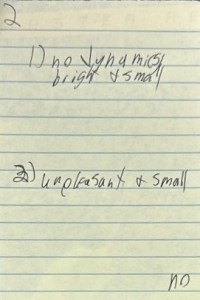
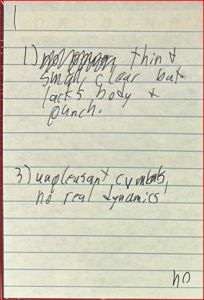
Track One: thin and small, clear but badly lacks body and punch.

Track Two: unpleasant cymbals, no real dynamics.

Side Two:

Track One: no dynamics, bright and small.

Track Three: unpleasant and small.

Two Questions

Is this the worst version of the album ever made?

Hard to imagine it would have much competition.

Are any of these Mofi One-Step pressings any good?

I seriously doubt it. Until one comes along that doesn’t sound awful, the jury is out. Those of you looking for miracles are likely to be disappointed.

Having said that, I’m sure there are audiophiles and audiophile reviewers who like the sound of this pressing and have said so online.

Based on what we heard, how on earth are these people qualified to judge the sound of records? I guess that’s three questions.

How bad does a record have to sound before they notice? Make that four, sorry.

Bernie Was The Man

Bernie Grundman cut the original pressings of Thriller. About the nicest thing we can say about him these days is that his work at one time was excellent.

Our evidence? When you hear a killer copy of Thriller — a recording with a lot going on and one that no doubt was difficult to master — the fact that nobody else has even come close to cutting the album as well as he did all those years ago stands as proof that he will always be considered one of the greats. (If he would only stop taking Chad’s calls, the record world would be in a much better place.)

Speaking of Chad (a man who thinks he is “saving the world from bad sound“), we have now auditioned the new Aja UHQR. You can read all about it here.

(more…)

Can Chris Bellman Cut Records As Well As Artisan Used to?

Robert Brook has a blog which he calls

A GUIDE FOR THE DEDICATED ANALOG AUDIOPHILE

Robert’s story begins:

Recently a friend and a frequent reader of my website suggested I review the 50th Anniversary Edition of David Crosby’s debut. He’d read my article from a while back in which I made comparisons between two different Hot Stamper copies of the record, and he knew I was a fan the album.

I’m sure he also knew, as any of my regular readers would, that I’m extremely skeptical of modern reissues. You can find many examples on this site of reissues I’ve written about that have failed miserably to impress me. But this friend was pretty insistent that this one, remastered by long time engineer Chris Bellman, was different. He also told me it was on par with original Monarch pressing of …My Name he also owned.

Bellman was responsible for cutting one of the few heavy vinyl reissues that my friend Tom Port has liked and recommended – a European pressing from 2020 of the Dire Straits record Brothers In Arms. Tom likes precious few “audiophile” reissues. He’s mentioned maybe 4 or 5 over the years as being worthy of any consideration. Given that, and the fact that my friend was so insistent, I figured why not give Bellman’s recut of . . .My Name a shot?

Click on the link to read the whole thing. I left some comments at the end you may enjoy reading. I hope to be able to address some of the other issues Robert brings up at a later date.

IF ONLY I COULD REMEMBER MY NAME: 50th Anniversary Edition

If you are interested in picking up an amazing Hot Stamper pressing of the album, we currently (as of 2/24) have some in stock. Click on this link to see what is available: If I Could Only Remember My Name.

On the website, we talk about just how much we love this album:

(more…)

“Tom, what about the argument that the engineers had to make the records sound good on the equipment of the day?”

More Letters from Customers and Critics Alike

OK, what about it?

Let’s dig in.

One of our good customers had some questions about a commentary we wrote entitled a kinder, gentler approach to record reviewing.

Tom, what about the argument that the engineers had to make the records sound good on the equipment of the day? Now that we have better gear, these guys can make the record sound the way it was originally intended. I think Chad said this about Rudy Van Gelder at some point in the video.

For the benefit of the reader, the video in question can be found on youtube under the title “Michael Fremer, Chad Kassem, Geoff Edgers: A Journey Back to Vinyl.”

Edgers was invited, apparently under pretext as it turns out, to talk about his article, but instead he was pressed into defending me most of the time. Kassem and Fremer — two individuals whose talents, such as they are, could not be more ill-suited to the work they have chosen for themselves — beat up on Edgers for about two hours.

As an aside, Geoff is a good guy and he certainly didn’t deserve this kind of mistreatment. Fremer and Kassem won’t apologize to him — that’s not something they are known to do — so please allow me to apologize to Geoff on their behalf.

I’m sure he has trouble understanding to this day why he was forced into acting as a spokesman for Better Records. Regardless of how he feels about it, we thank him for his service to the cause. (To be clear, he didn’t exactly take my side, which is the right thing for a reporter to do. He wanted to know why our disagreements upset them so much.)

For those of you who like to watch bickering and sniping from a couple of thin-skinned egomaniacs who can’t stand the fact that someone doesn’t think the records they like — or in the case of Chad, produce and sell — are any good, have I got a video for you. If you want to undertand how seriously you should take these two guys, both at the top of their respective mountains, watch the video and make your own judgments.

Our letter writer continues:

Suppose, that the RL cut of Zeppelin 2 had never existed, because Ludwig knew better than to cut it that way, knowing that most stereos couldn’t play it? And then Chad released something that sounded like that. Or, the argument that albums were engineered for listening to on the AM radio.

I think these guys believe they are improving on the mastering, and giving it the sound it should have had all along.

Dear ab_ba,

Yes, you are correct, this is indeed their position. They think these newly remastered pressings are a big improvement over earlier editions, and on quieter vinyl to boot!

Allow me to quote Michael Fremer, a man who apparently cannot get enough of the new records, even though his shelves are stuffed.

(more…)

Super Session – A Jack Hunt Mastered MoFi Winner

Hot Stamper Pressings of Music Produced or Performed by Al Kooper Available Now

Sonic Grade: B

Super Session is one of the best-sounding MoFi pressings. The midrange sounds wonderful — silky sweet and transparent. Not having been cut by Stan Ricker, the top end doesn’t have that SR/2 boost. Overall it’s a very nice sounding record, and the music just can’t be beat. 

In fact, it was actually mastered by Jack Hunt, a man we know to be responsible for some of the thickest, dullest, deadest MoFi recuts found in their shameful catalog.

But he did a pretty good job on this one, and for that he deserves some credit.

(more…)