Testing Ambience, Size and Space

These records are good for testing ambience, size and space.

What Is There To Say? – Our Previous Shootout Winner from 2019

Hot Stamper Pressings of Vintage Columbia Albums Available Now

UPDATE 2025

We have two new lists for those who would like to know which Columbia label pressings win shootouts — one for 6-Eye winners and one for 360 Label winners.

Recordings made at their 30th Street Studio are pretty hard to beat. There is no Heavy Vinyl reissue on the planet that can compete with the sound of one of our Hot Stamper pressings of any of the albums you see available, guaranteed or your money back.


This Six Eye stereo LP put every other copy we played to shame on side one with shootout winning Triple Plus (A+++) sound. Side two earned a Double Plus (A++) grade for its explosive dynamics and rich, full-bodied, Tubey Magical sax sound. Tubier, more transparent, more dynamic, with that “jumpin’ out of the speakers’ quality that only The Real Thing ever has. Hard to imagine any reissue, vintage or otherwise, can hold a candle to the sound of this amazing record. 

Recorded at Columbia’s 30th Street studios, here is a record that sounds like Kind of Blue, Ah Um and Time Out, for the simple reason that all were recorded in the same studio using the same equipment and perhaps even the same engineers.

(more…)

On Please Please Me, Which Is More 3-Dimensional, Mono or Twin Track?

Hot Stamper Pressings of the Music of The Beatles Available Now

With all due respect to George Martin, we’ve played a number of mono pressings of Please Please Me in the past twenty or so years and have never been particularly impressed with any of them. The monos jam all the voices and instruments together in the middle, stacking them one in front of the other, and lots of musical information gets mashed together and simply disappears in the congestion. 

But is twin track stereo any better?

Yes, when you do it the way Norman Smith did on Please Please Me.

Twin Track stereo (which is actually not very much like two-track stereo, I’m sure Wikipedia must have a listing for it if you’re interested) is like two mono tracks running simultaneously. It allows the completely separate voices to occupy one channel and the completely separate instruments to occupy another, with no leakage between them.

On some stereos it may seem as though the musicians and the singers are not playing together the way they would if one were hearing them in mono. They are in fact recorded on two separate mono tracks, the instruments appearing in the left channel and the singers in the right, separated as much as is physically possible.

Stuck in their individual stereo speakers, so far apart from one another, the members of the band don’t even seem to be playing together in the same room.

That’s on some stereos, and by some stereos I mean stereos that need improvement. Here’s why.

Three-Dimensional Mono?

In the final mixing stage, Norman Smith added separate reverb to each of the two channels, sending the reverb for the sound recorded in each channel to the opposite channel. This has the effect of making the studio, the physical space that The Beatles appear to be in, seem to stretch all the way from the right channel, where the Beatles’ voices are heard, to the back left corner of the studio, where the reverb eventually trails off.

(more…)

Port’s Rule and The Song of the Volga Boatman

More Records that Helped Me Make Progress in Audio

The track that started us down the road to our first Sauter-Finegan shootout is, to this very day, our Number One Test Track of All Time, a little ditty known as the Song of the Volga Boatman.

We first heard it back in the 90s on Bob and Ray Throw a Stereo Spectacular, which is still the version we test with, but this album of forward-looking big band contains that track  as well as 10 others, all with truly amazing sound.

Why is the Song of the Volga Boatman our ultimate test track?

The simplest way to understand it is that all the instruments are being played live in the studio, and all of them in the huge soundfield are real and acoustic — string bass, drums, horns of every size and type, woodwinds, percussion, tubular bells, etc.

In addition, the arrangements given to this roomful of players is so complex and lively that if anything sounds “funny,” to use the precise audiophile nomenclature, it really calls attention to itself.

Port’s Rule states: If it isn’t easy for your Test Discs to sound wrong, they are not very good Test Discs.

Wrong is the natural order of things.

Getting it right is where the work comes in to play.

And it should seem more like play than work or you are unlikely to get very far with it. (That’s another one of Port’s Rules, sometimes referred to as music does the driving.)

When the stereo is right from top to bottom, this song is right from top to bottom, and every other record we know the sound of will have the sound it’s supposed to have.

It seems simple and in some ways it is.

We’ve been getting the Song of the Volga Boatman to sound bigger and better now for years, through scores and scores of changes. At our current stage of audio evolution, at the very loud levels we play it at, it’s shocking how big, powerful and real it seems. It has more of the “live music” qualities we prize than almost any other studio recording I can think of.

(more…)

The Best Pressings of Brothers in Arms Are Not Hard to Recognize

We try to be upfront with our customers that the Hot Stamper pressings of Brothers in Arms on our site have many nice qualities, but some of the best qualities of analog recordings from the 50s, 60s and 70s are not among them.

It would be foolish to pretend otherwise. We want our customers to know what to expect when they buy a modern recording, and, having played copies of this album (as well as Love Over Gold) by the score, we are qualified to tell them what even the best pressings do not do as well as we might like. In a recent listing we introduced one of the best sounding pressings from our last shootout this way:

  • Tonally correct from start to finish, with a solid bottom and fairly natural vocals (for this particular recording of course), here is the sound they were going for in the studio
  • Drop the needle on “So Far Away” – it’s airy, open, and spacious, yet still rich and full-bodied
  • We admit that the sound may be too processed and lacking in Tubey Magic for some
  • When it comes to Tubey Magic, there simply is none — that’s not the sound Neil Dorfsman, the engineer who won the Grammy for this album, was going for
  • We find that the best properly-mastered, properly-pressed copies, when played at good loud levels on our system, give us sound that was wall to wall, floor to ceiling, glorious, powerful and exciting — just not Tubey Magical

The notes you see below catalog the qualities of our 2025 Shootout Winner.

Side One

Track One (So Far Away)

  • Meaty guitar and bass
  • Big, weighty and present

Track Two (Money for Nothing)

  • Wide, full and weighty
  • Lots of punch

Side Two

Track One (Ride Across the River)

  • Tight, deep and weighty [bass]
  • Vocals are sweet and present
  • Most space yet
  • Rich too

Note that the person doing the listening confined himself to what the record was doing right. In the case of this Shootout Winning Top Shelf 3/3 pressing, there really wasn’t any aspect of the sound to find fault with. As far as we were concerned, the record was doing what the record was trying to do, and doing it better than any of the other copies we played, hence the high grades.

If you have five or ten early domestic pressings of Brothers in Arms, you can judge them accurately by limiting yourself to the qualities the best of them have. For any copy you might play, you could ask:

  • How big is it?
  • How weighty is it?
  • How present is it?
  • How wide is the soundstage?
  • How full-bodied is the sound?
  • How punchy is it?
  • How tight, deep and weighty is the bass?
  • How sweet and present are the vocals?
  • How much space does the recording have?
  • How rich is the sound?

If your equipment, room, electricity, etc. are good enough, and your front end is properly set up, all these questions can be answered with relatively little effort. You could even create a checklist of them after playing a few copies and hearing what the best of them did well.

(more…)

Room Treatments Bring Out The Big Speaker Whomp Factor

Hot Stamper Pressings of the Music of Sergio Mendes Available Now

UPDATE 2025

The first Sergio Mendes and Brasil ’66 album is one of those records that helped us dramatically improve the quality of our playback.


Only the best copies are sufficiently transparent to grant the listener the privilege of hearing all the elements laid out clearly, each occupying a real three-dimensional space within the soundfield. 

With recent changes to some of our room treatments, we now have even more transparency in the mids and highs, while improving the whomp factor (the formula goes like this: deep bass + mid bass + speed + dynamics + energy = whomp) at the listening position.

There’s always tons of bass being produced when you have three 12′ woofers firing away, but getting the bass out of the corners and into the center of the room is one of the toughest tricks in audio.

For a while we were quite enamored with some later pressings of this album — they were cut super clean, with extended highs and amazing transparency, with virtually none of the congestion in the loud parts you hear on practically every copy.

But that clarity comes at a price, and it’s a steep one. The best early pressings have whomp down below only hinted at by the “cleaner” reissues. It’s the same way super transparent half-speeds fool most audiophiles. For some reason audiophiles rarely seem to notice the lack of weight and solidity down below that they’ve sacrificed for this improved clarity. (Probably because it’s the rare audiophile speaker that can really move enough air to produce the whomp we are talking about here.)

But hey, look who’s talking! I was fooled too. You have to get huge amounts of garbage out of your system (and your room) before the trade-offs become obvious.

When you find that special early pressing, one with all the magic in the midrange and top without any loss of power down below, then my friend you have one of those “I Can’t Believe It’s A Record” records. We call them Hot Stampers here at Better Records, and they’re guaranteed to blow your mind. (more…)

Listening for Energy and Rock and Roll Firepower on Bad Company’s Debut

Hot Stamper Pressings of Rock Classics Available Now

The drums on this album are so solid, punchy and present, they put to shame 99% of the rock records on the planet.

As well as having great drums, the overall sound of the best pressings is raw, real and wonderfully unprocessed.

Here you will find none of the glossy artificiality you might hear on many of the rock and pop records we sell.

There’s nothing wrong with that sound, mind you, but this recording captures much more of what the real instruments sound like in the studio.

And, if you’re playing this album good and loud, you’ll feel like you’re in the room with the boys as they kick out the jams. “Ready For Love” sounds great here — shocking clarity, tons of ambience, and silky sweet highs.

This album was one of Ron Nevison‘s early engineering jobs.

The year before (1973) he had been behind the board at Ronnie Lane’s Mobile Studio for Quadrophenia, one of the best sounding Who albums we know of, and a longtime member of our Top 100 (as is this album).

He also knocked it out of the park on Bad Company’s follow-up, 1975’s Straight Shooter.

He worked on the sprawling mess that turned into Physical Graffiti the same year.


Want to find your own killer copy?

Consider taking our moderately helpful advice concerning the pressings that tend to win our shootouts.

(more…)

The Strings on Elton John’s Second Album Are a Tough Test

Hot Stamper Pressings of the Music of Elton John Available Now

What’s especially remarkable about this album is the quality of Paul Buckmaster‘s string arrangements. I don’t know of another pop record that uses strings better or has better string tone and texture. Strings are all over this record, not only adding uniquely interesting qualities to the backgrounds of the arrangements but actually taking the foreground on some of the songs, most notably Sixty Years On.

When the strings give in to a lovely Spanish guitar in the left channel (which sounds like a harp!) just before Elton starts singing, the effect is positively glorious. It’s the nexus where amazing Tubey Magical sound meets the best in popular music suffused with brilliant orchestral instrumentation. Who did it better than The Beatles and Elton John? They stand alone.

Correct string tone and texture are key to the best-sounding copies. The arrangements are often subtle, so only the most transparent copies can provide a window into the backgrounds of the songs that reproduce the texture of the strings.

Without extension on the top, the strings can sound shrill and hard, a common problem with many pressings.

Without a good solid bottom end, the rockers (“Take Me to the Pilot”) don’t work either of course, but you can even hear problems in the lower strings when the bass is lightweight.

String tone on a pop record is a tough nut to crack, even more so on a record like this where the strings play such a prominent role. It’s the rare copy that allows you to forget the recording and let you just enjoy the music.

For that you really need a Hot Stamper.

These Are Some of the Qualities We’re Listening For on Elton’s Albums

There are probably closer to a dozen, but some of the more important ones would be these:


Extraordinary Engineering

There are three amazing-sounding Elton John records on our Top 100 list, one of them engineered by the estimable Robin Geoffrey Cable, Trident Studios’ house engineer in 1972. His work on this album and Tumbleweed Connection marks him as one of the All-Time Greats in my book. Madman Across the Water, the album to follow, seems to be a more difficult recording to master properly. That said, the best copies — we call them White Hot Stampers – are very nearly as good sounding as the two titles mentioned above.

(more…)

The Firebird on Mercury – Hard to Beat for Table Setup

Hot Stamper Pressings of the Music of Stravinsky Available Now

Dorati’s performance of The Firebird for Mercury is an excellent recording for adjusting tracking weight, VTA, azimuth and the like.

Classical music is really the ultimate test for proper turntable/arm/cartridge setup and evaluation.

A huge and powerful recording such as The Firebird quickly separates the men from the boys when it comes to higher fidelity orchestral reproduction.

Recordings of this quality are the reason $10,000+ front ends exist in the first place. Just ask Robert Brook.

You don’t need to spend that kind of money to play this record, but if you do, this might just be the record that will show you what you got for your hard-earned dough.

Ideally you would want to work your setup magic at home with this record, then take it to a friend’s house and see if you can achieve the same results on his system. I did this sort of thing for years.

Sadly, not so much anymore; nobody I know can play records like these the way we can. Playing and critically evaluating records all day, every day, year after year, you get pretty good at it. And the more you do it, the easier it gets.


UPDATE 2025

The above was written about ten years ago. By then I had learned enough to know that all the systems my audio friends owned were woefully inadequate to the reproducton of sonic blockbusters such as The Firebird. They simply hadn’t spent the money on their equipment or done the work that it takes to play a magnificent recording such as this.

It was about this time that I stopped visiting them. In my experience, mediocre sound is not simply a matter of being less enjoyable than good sound. In fact, I found it to be the opposite of enjoyable. It was frustrating, irritating and unpleasant, and I wanted no part of it. My friends couldn’t hear what was wrong — they had nothing better to compare the sound to. I knew how much better it could sound because I had the killer pressings and the highly-tweaked system that were able to work magic on orchestral spectaculars like The Firebird. More on that subject here.


Properly set VTA is especially critical on this record, as it is on most classical recordings. The smallest change will dramatically affect the timbre, texture and harmonic information of the strings, as well as the rest of instruments of the orchestra of course.

(more…)

Which Side of this Pressing Lacked Space, and How on Earth Did You Spot It?

Hot Stamper Pressings of the Music of Thelonious Monk Available Now

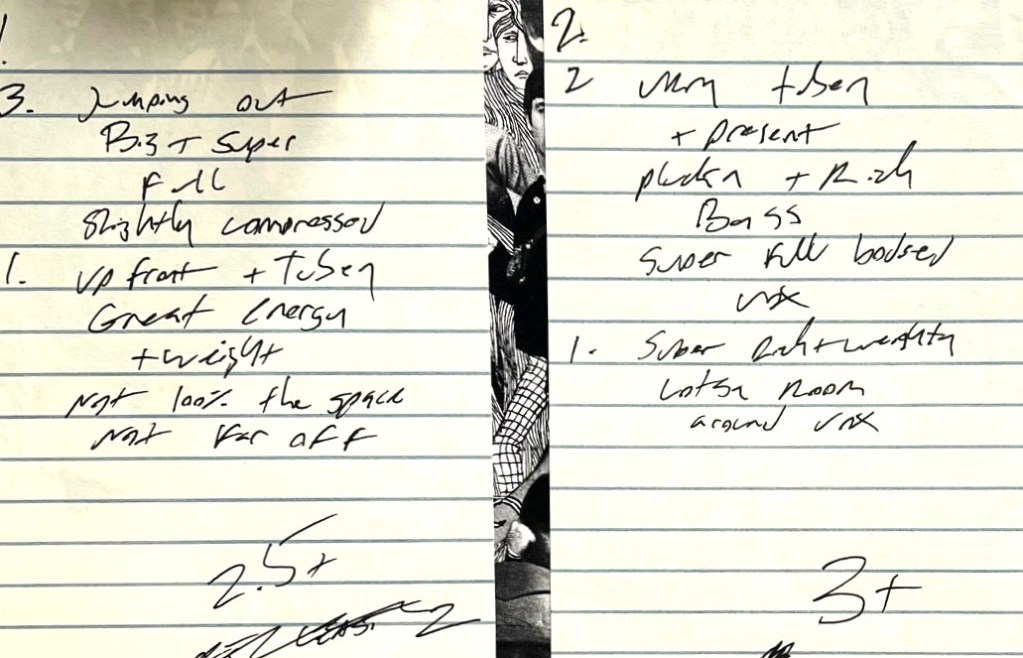
Our notes for a recent shootout winning copy read:

Monk’s Dream returns to the site for only the second time in over two years, here with INCREDIBLE Shootout Winning Triple Plus (A+++) grades or close to them throughout this black print Stereo 360 pressing.

These are just a few of the things we had to say about this killer copy in our notes: “big and weighty”…”great size and detail and very full”…”breathy sax jumping out of the speakers”…”very big and full piano”

In our notes you can see that side one fell short in one area, space, but how would anyone know that who hadn’t played a copy with even more space than this one? That’s why we do shootouts and you must do them too.

Both of these sides are rich, spacious, big and Tubey Magical, with less smear on the piano, a problem that holds many copies back. The sound found on these early Columbia 360 Label Stereo pressings is absolutely the right one for Monk’s music.

As you can see from the notes we took for this copy, we are not making any of this up!

This is why we do shootouts. If you really want to be able to recognize subtle (and sometimes not so subtle!) differences between pressings, you must learn to do them too.

And make sure to take notes about what you are hearing, good and bad.

One side falling short of the full Three Pluses happens all the time.

One out of five records that has one shootout winning side will have a matching shootout-winning other side.

(more…)

Testing for Life-Size Images and Living Presence

Hot Stamper Pressings of the Music of Paul McCartney Available Now

On the song Blackbird Paul moves the microphone, scraping it along the floor, which causes a huge wave of bass to spread through the room.

I was over at one of my customer’s houses a while twenty years ago, doing some testing with electronics and tweaks, and I remember distinctly that the microphone stand was shrunken and lean sounding in a way I had simply never heard before.

Now this customer, whose system was in the $100K range, had no idea what that microphone stand could really do. I did, because I’ve been hearing it do it for years.

Some speakers can’t move enough air down low to reproduce that sound properly.

And some speakers, usually those with woofers under 12 inches, shrink the size of images.

These are many things to test for for in a given system, dozens and dozens in fact, but two of the important ones are these: if it doesn’t have a solid foundation (read: a big bottom end), and it doesn’t have correctly-sized images for the instruments, that’s a system that is failing in fundamentally important ways. 

If you close your eyes, you’re not in the presence of full-size musicians. Ipso facto, the fidelity to the live event has been compromised.

That’s precisely what makes this a good test disc. The band is right there.

To the extent that you can make them sound live in your living room, you are getting the job done.

The last bit of resolution is not the point. Full-sized live musicians in your living room is the point. Either Paul and his band are in front of you, or they’re not.

When they’re not, it’s time to get to work and find out what part of the system is not doing its job.

Hint: you can be pretty sure it’s the speaker. Most audiophile speakers are not very good at moving enough air. You need multiple large dynamic drivers with plenty of piston area to do the job correctly. Speakers of that design are usually large and expensive. I recommend the original Legacy Focus (not the current model) as the best sounding, most affordable full-size speaker on the used market.

Make Me Better

The bulk of this commentary was written in 2006. Most of it is based on what we had learned from the shootout we’d just done, our first for the album.

I bought my first copy of Unplugged upon its release. I credit it with helping me advance in this hobby of ours. Back in those dark days of the 90s, although I was completely clueless at the time about pretty much everything having to do with vinyl and equipment, I can take some solace in the fact that everybody else appeared to be as clueless as I was.

This blog is dedicated to sharing some of what I’ve learned — with the unflagging help of my staff of course — about records and audio over the last fifty years.

Testing with Unplugged

This record is good for testing all of the following areas, and here are some links to other titles that will also make good test records for those of you looking to improve the quality of your analog playback:

(more…)