*Record Mysteries

How Can the Best Stampers Also Be Some of the Worst?

Hot Stamper Pressings of Vintage Columbia Albums Available Now

Recently we conducted a shootout for a favorite Columbia recording, one that we had auditioned a couple of times before and one for which we knew the music and the general quality of the sound well.

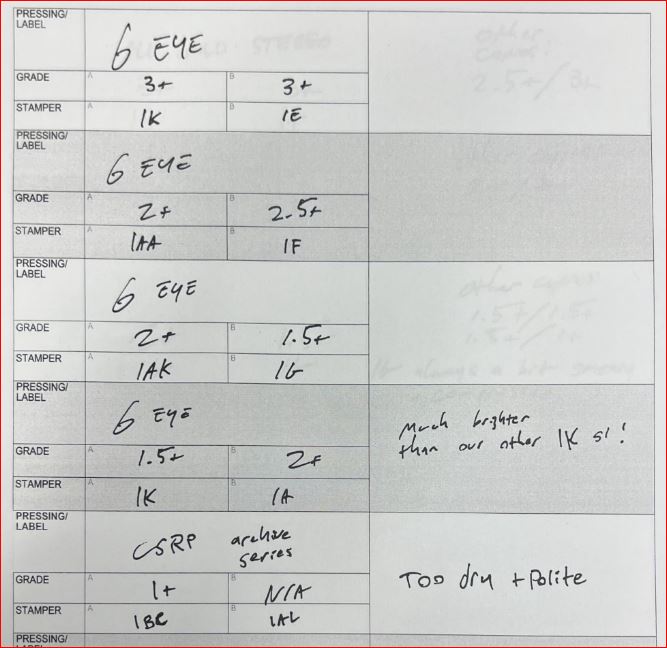
It’s not the record you see pictured. For now we’re keeping the title a mystery, consistent with the idea that we give out lots of bad stampers on this blog, but almost never do we give out the good ones. (When we do give out the best stampers, we keep the title under wraps. We are not the least bit interested in putting ourselves out of business.)

The discussion for today revolves around the idea held by a great many audiophiles that the 6-Eye pressings are going to be the best sounding of almost any album they might happen to run across.

And, to be fair, in the case of this mysterious album, they’re right.

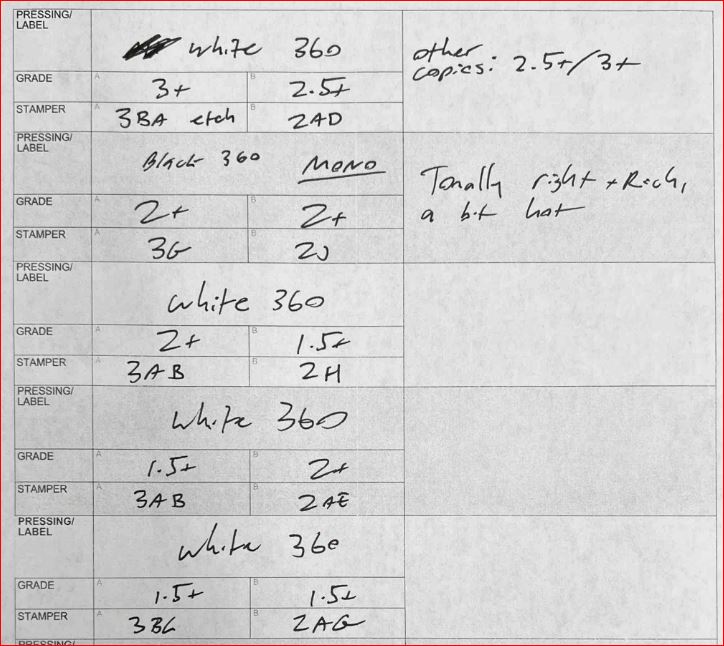
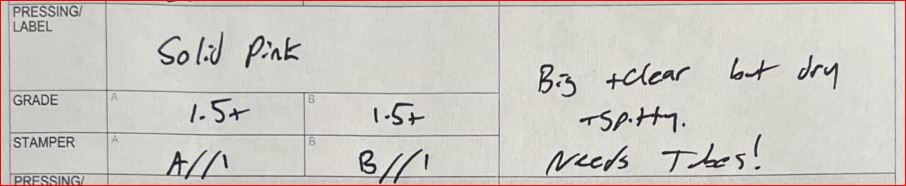
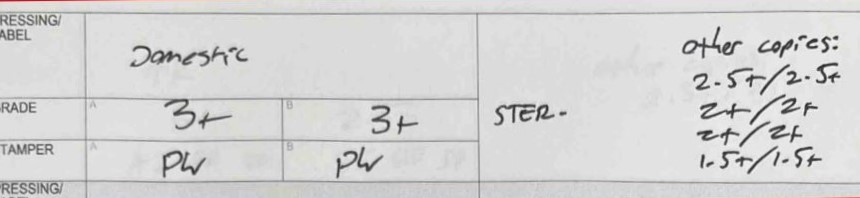
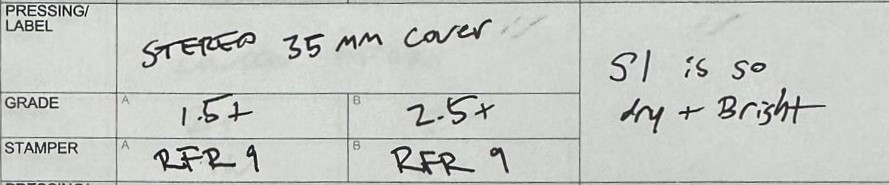
What interests me in these findings is that the stampers for a shootout winning copy, the top one, are almost identical to the one that came in close to last in the shootout outside of the Columbia Special Products reissue, with decent, respectable but far from shootout winning grades of 1.5+ and 2+.

One of the 1K side ones was the best we played, and one was very bright.

If an audiophile collector were to go to Discogs, find the IK pressings, he could either find himself with a top quality copy, or a not-nearly-as-good copy, depending on his luck.

Why one set of stampers sounds so much better than another set, or the same or similar set on a different pressing, is a mystery, and it’s one that we confidently predict will never be solved.

Does anyone have a practical way to get around the unfortunate reality that allows one set of stampers to sound great and the same or a similar set of stampers to sound no better than very good, if that?

Well, we can’t say there is a practical way, but we do know of an impractical one. We’ve been practicing and refining that one for more than twenty years.

We just play lots and lots of copies of the albums to find out how they sound.

(more…)

This Mystery Mercury May Have the Same Stampers on Both Sides, But the Sound Is Very, Very Different

Hot Stamper Pressings of Mercury Classical Recordings Available Now

For Mercury classical and orchestral recordings, the original FR pressings (when there are such pressings), in stereo, on the original plum label are the best way to go, right? 

In many cases, yes. We talk about how much better the FR pressings for The Firebird are compared to the much more common, and still quite good, M2 reissue pressings here. (Both beat the pants off the awful Classic Records pressing.

But sometimes the RFR pressings — which, as I am sure you know, can be the earliest stampers for some titles — are nothing special on one side or the other. That is exactly the case here.

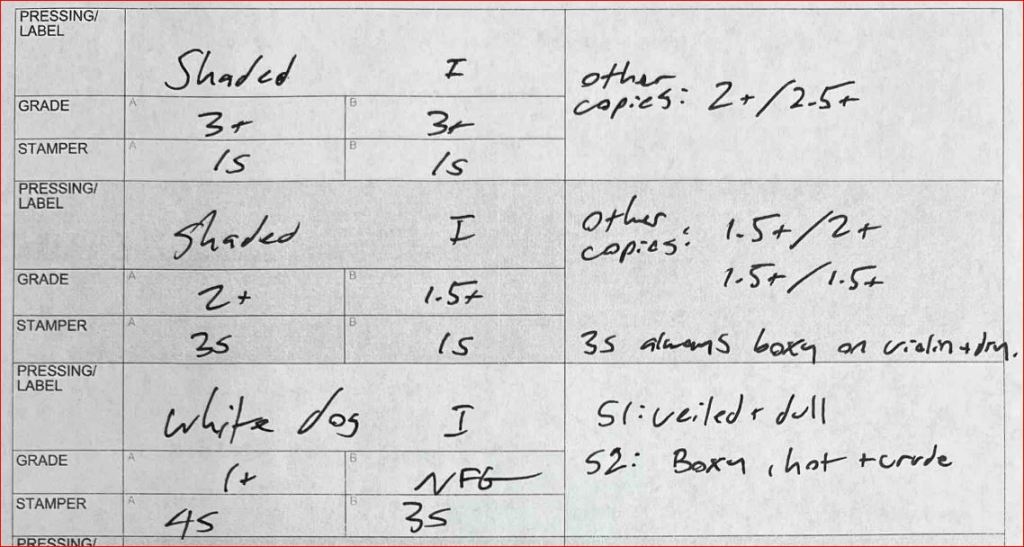
Keep in mind that the stamper numbers you see above belong to a different album.

We’ve lately been giving out much more stamper information than we used to, but for now we are keeping the identify of this title close to the vest.

We are not able to predict what stampers will win a shootout before we actually sit down to play all our copies.

It turns out that the FR pressings did not sound as good as some of other pressings. The RFR stampers came in somewhere in the middle of the pack, an average of 2+, but a hard record to sell with such very different sounding sides.

This is why we do shootouts, and why you must do them too, if owning the highest quality pressings is important to you.

Fortunately for readers of this blog, our methods are explained in detail, free of charge.

We’ve also written quite a few commentaries to help audiophiles improve the way they think about records.

I implore everyone who wants to make progress in this hobby to learn from the mistakes we’ve made. There are 146 “we were wrong” listings on the site as of this writing, and we learned something from every damn one of them, painful and costly as those experiences may have been.

(more…)

Yes, For Some Records There Is Only One Set of Magic Stampers

Hot Stamper Pressings of Music on Island Records Available Now

As is sometimes the case, there is one and only one set of stamper numbers that consistently wins our Catch Bull at Four shootouts.

We stumbled upon an out-of-this-world copy of the right pressing in 2016, a copy took the recording to a level we had no idea could even be possible. (We were going to give it Four Pluses, and probably should have, but cooler heads prevailed.)

Since then we have had many copies come in, but none that could compete with the Magic Stamper pressings.

And the best part of this story is that, no, the best stampers are not 1U, or 2U, or even 3U.

As a matter of fact, they are far from the stampers found on the earliest pressings. That’s one reason it took us so long to discover them, because they are much less commonly found than pressings with the earlier stampers. By the time these later pressings were mastered, pressed and released, the album’s biggest selling days were over.

For all we know this cutting may have been done just to keep the record in print, possibly undertaken many years after its initial release.

Who knows? Who cares? What difference does it make?

Well, it does serve to make a point near and dear to our hearts: that the idea (and operational premise of most record collectors) that the originals are always better is just a load of bunk. It might be and it might not be.

If you want better sounding records, you had better open your mind to the idea that some reissues have the potential to sound better than even the best original pressings.

These, for starters, and there are hundreds more you can read about here on the blog.

Of course this is nothing but bad news for the average audiophile collector, who simply does not have the time or money to go through the hassle of buying, cleaning and playing every pressing he can get his hands on.

But good news for us, because we do.

(more…)

Who Can Explain Why This Cheap Reissue Sounds So Good?

Hot Stamper Pressings of the Music of Claude Debussy Available Now

This Decca reissue is spacious, open, transparent, rich and sweet.

Roy Wallace was the engineer for these sessions from 1955 to 1962 in Geneva’s glorious sounding Victoria Hall. His work here is superb in all respects.

It’s yet another remarkable disc from the Golden Age of Vacuum Tube Recording, with the added benefit of mastering using more modern, but apparently still good, cutting equipment from the ’70s, 1972 to be exact.

We are of course here referring to the often amazing modern mastering of 40+ years ago, not the mediocre-at-best modern mastering of today.

The combination of old and new works wonders on this title as you will surely hear for yourself on both of these superb sides.

We were impressed with the fact that it excelled in so many areas of reproduction. The illusion of disappearing speakers is one of the more attractive aspects of the sound here, pulling the listener into the space of the concert hall in an especially engrossing way.

Thread It Up and Just Hit Play Already

What might be seen as odd — odd to some audiophiles but not to us — was how rich and Tubey Magical the reissue can be on the best copies.

This leads me to think that most of the natural, full-bodied, smooth, sweet sound of the album is on the tape, and that all one has to do to get that vintage sound on to a record is simply to thread up the master on a good machine and hit play.

The fact that nobody seems to be able to make an especially good sounding record these days makes clear that in fact I’m wrong to think that this approach would work. It seems to me that somebody should be able to figure out how to do it. In our experience that is simply not the case today, and has not been for many years.

Old Tapes, New Tapes

The master tapes were about fifteen years old when this record was mastered.

Compare that to a current cutting which would be made from approximately fifty year old tapes.

Perhaps that explains it.

Or maybe it doesn’t.

(more…)

Could This Be the Sound Audiophiles Complain About with RVG’s Mastering?

Hot Stamper Pressings of the Music of John Coltrane Available Now

A rare and expensive early mono pressing that we put into our most recent shootout was dreadful sounding.

Our main listening guy owns the record and made the note you see below, saying that his personal copy is every bit as bad.

The sound of the original was painfully midrangy and crude. It was not the worst of all the pressings we played, but it was nevertheless pretty bad, sounding nothing like our shootout winners.

We had a pressing on an early Prestige label in stereo, also mastered by Rudy Van Gelder, that was reasonably good sounding, earning grades of 1.5+ to 2+. It was sweet and relaxed, but relatively small and lacked the weight of the best.

For this music, we’ve found the best sound on the better Two-Fer pressings and the right OJC.

That Two-Fer budget reissue pressing, remastered by David Turner in 1972, can do very well in a shootout, but it can also fall far short of the mark on some sides, as you can see from the grades for these three other copies.

If you have the Two-Fer, how does yours sound compared to the four we auditioned (a shootout we were doing for the third or fourth time I might add), and how could you possibly know such a thing without a great many more copies at hand to clean and play?

(more…)

Some Pressings of Tchaikovsky’s Piano Concerto No. 1 Can Sure Be a Letdown

Hot Stamper Pressings of the Music of Tchaikovsky Available Now

I don’t know of another recording of the work that gets the sound of the piano better. On the properly-mastered, properly-pressed copies, the percussive quality of the instrument really comes through.

But that quality (along with lots of others) is only heard on the better copies.

The reissues (one with the later Tulips label, one with the earlier Large Tulips label) described below are at best passable, and some of them were just awful.

The note to the left makes clear that even some of the early Large Tulips label pressings had very bad sound. Watch out especially for 18A/15B stampers. They’re NFG: No F***ing Good.

As you can see from the notes above for this particular recording in the Black and White cover, one side was passable, earning our 1.5+ grade. That makes it a decent sounding record, I suppose, but it’s a long, long, long way from the best.

1.5+ is four grades down from the top copy. That’s a steep dropoff as far as we’re concerned. 1.5+ only hints at how good a recording this DG can be on the best pressings.

To see more records that earned the 1.5+ grade, please click here. (Incidentally, some of them are even on Heavy Vinyl. The better modern pressings have sometimes, if rarely, been known to earn Hot Stamper grades, and two recently shocked the hell out of us by actually winning a shootout. Wouldn’t you like to know which two!)

One Plus (1+) is a sub-Hot Stamper grade. We do not sell records that do not earn a grade of at least 1.5+ on both sides.

For those who might be interested, there’s more on our grading scale here.

Our Favorite Performance with Sound to Match

A recent listing for the album can be found here.

Without question this is a phenomenal piano recording in every way.

On the best copies the rich texture of the strings is out of this world — you will have a very hard time finding a DG with better string tone. This record does not have the shortcomings of the average DG: it’s not hard, shrill, or sour.

DG made plenty of good records in the 50s and 60s, then proceeded to fall apart, like most labels did. This is one of their finest. It proves conclusively that at one time — 1962 to be exact — they clearly knew exactly what they were doing.

It’s amazing how many piano recordings have poorly-miked pianos. The badly recorded pianos are either too distant, lack proper reproduction of the lower registers, or somehow smear the pounding of the keys into a blurry mess.

Are they badly recorded?

Or is it a mastering issue?

Perhaps a pressing issue?

(more…)

Are All the Masterdisk Pressings of 2112 Good Sounding?

Hot Stamper Pressings of the Music of Rush Available Now

Even though many of the original pressings are mastered at Masterdisk (by HW, BK and GK), some of the reissues from 1979 on the “skyscraper” label are too.

But none of the later pressings we played sounded very good. Audiophiles looking for top quality sound should stick to the domestic originals.

What We’re Listening For On 2112

  • Energy for starters. What could be more important than the life of the music?
  • Then: presence and immediacy. The vocals aren’t “back there” somewhere, lost in the mix. They’re front and center where any recording engineer worth his salt would put them.
  • The Big Sound comes next — wall to wall, lots of depth, huge space, three-dimensionality, all that sort of thing.
  • Then transient information — fast, clear, sharp attacks, not the smear and thickness so common to these LPs.
  • Tight punchy bass — which ties in with good transient information, also the issue of frequency extension further down.
  • Next: transparency — the quality that allows you to hear deep into the soundfield, showing you the space and air around all the instruments.
  • Extend the top and bottom and voila, you have The Real Thing — an honest to goodness Hot Stamper.

(more…)

Are White Label Promos the Way to Go on this Mystery Columbia Jazz Album?

Hot Stamper Pressings of Vintage Columbia Albums Available Now

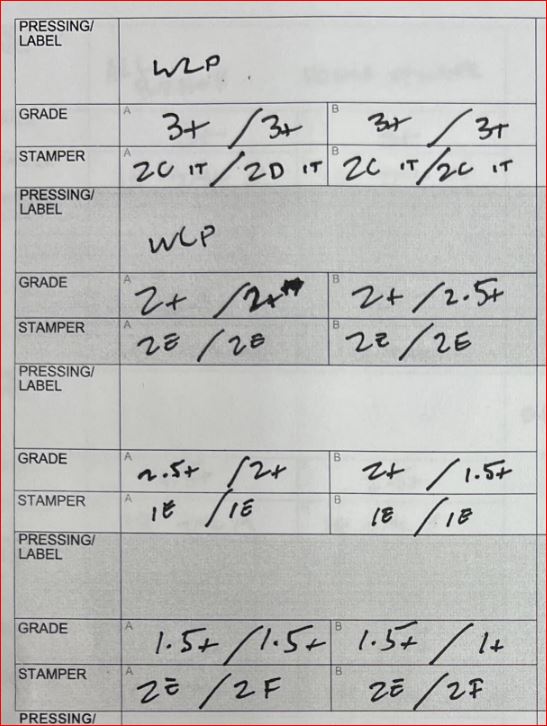
Recently we conducted a shootout for a Columbia recording, one that we had auditioned a couple of times before and one for which we knew the music and the general quality of the sound well.

It’s not the record you see pictured. For now we’re keeping the title a mystery, consistent with the idea that we give out lots of bad stampers on this blog, but almost never do we give out the good ones. (When we do give out the best stampers, we keep the title a mystery. We are not the least bit interested in putting ourselves out of business.)

The discussion for today revolves around the idea held by a great many audiophiles that the White Label Promo copies are going to be the best sounding pressings of almost any album they might happen to run across.

And, to be fair, in the case of this mysterious double album, they’re right.

Our two best sounding copies were White Label Promos.

What interests me in these findings is that the stampers for a White Label Promo copy, the second one, the one with mostly Super Hot grades, are almost identical to the one that came in last in the shootout, with barely passable grades.

If an audiophile collector were to go to Discogs, find the WLP pressings, write down their stampers, and then check them against the copies he owned or might want to buy, he could either find himself with a top quality copy, or a not-nearly-as-good copy, depending on his luck. (And side four of the worst pressing earned a sub-Hot Stamper grade of 1+.)

Why one set of stampers sounds so much better than another set, or the same or similar set on a different pressing, is a mystery.

Does anyone have a practical way to get around the unfortunate reality that allows one set of stampers to sound great and the same or a similar set of stampers to sound not much better than decent?

Well, we can’t say there is a practical way, but we do know of an impractical one. We’ve been practicing and refining that one for more than twenty years.

(more…)

Sidewinder on the Liberty Label Might Sound Dubby and Weird

Hot Stamper Pressings of Blue Note Recordings Available Now

The top copy from our most recent shootout went for $1500 and, in our opinion, was worth every penny of that amount, being one of the best sounding jazz records we have ever played

It probably took us ten years to get this latest shootout going, but the best copies we played were so impressive that they made all the time and money it took to pull it off worth the effort — what a record!

The copies that do not have VAN GELDER in the dead wax are very unlikely to be any good. The Liberty label pressing that we played in our shootout was minty and cost us a pretty penny, but the sound was No F***ing Good.

It’s yet another reason we don’t judge records by their labels.

Of course, as all our customers know, we judge records by one thing and one thing only: their sound.

Our shootout winner may have been a reissue, but it sure wasn’t one of those copies you can find on the Liberty label without VAN GELDER in the dead wax.

(more…)

The Wrong Stampers on Some Albums Are Shockingly Bad

Hot Stamper Pressings of the Music of Carly Simon Available Now

Below you will see the bottom part of the stamper sheet for a shootout we did recently.

Please note that the album you see pictured is not the record we are discussing here. It very well could have been been a Carly Simon album, or something from some other artist, but all we can say for sure is that it was definitely an album from the 70s on Elektra.

We are not revealing what record had these stampers and earned these grades for the simple reason that avoiding these bad labels for the record in question would make it fairly easy to figure out what the better pressings of the album might be.

As I’m sure you can understand, we want you to buy the copy with the Hottest Stampers from us, not find one on your own.

We’re happy to be moderately helpful, but naturally we find it necessary to draw the line somewhere, and giving out the kind of information that makes it is easy to find the best pressings is where we have chosen to draw it. The top copies are the ones that pay the bills around here, and with a staff of ten, in California no less, the bills are sizable.

We appreciate your understanding.

(more…)