MFSL (Newer)

Labels With Shortcomings – Mobile Fidelity (Newer)

Elvis Costello Likes Mobile Fidelity Records About as Much as I Do

Hot Stamper Pressings of the Music of Elvis Costello Available Now

And he doesn’t even know how bad they sound!


Excerpted from an interview in Variety.

People do seem to have caught on to “Painted” as a classic, though, even well outside the realm of your hardcore fans. I saw it on web forums where there were so many people thirsting over the two different editions of the album that Mobile Fidelity put out prior to this, calling it one of the great albums of the ’90s and clamoring to get the best available vinyl versions.

Well, I don’t have any opinion about that. I don’t hold with that company putting their name above the artist. I don’t like the way their records look. I’ve never listened to any of ’em because of that. I think there’s a huge arrogance. Because I’ve worked with the greatest, Bob Ludwig, who mastered the original record, remastered this (new Universal edition), mastered everything else. He’s the end of the story about that. So Mobile Fidelity can fuck themselves. If you put your name above the artist and above the title, what gives you the temerity to do that? You didn’t make the record.

But you must be proud of the fact that this body of work is so well-regarded…

Yeah. Apart from those copies. I’m kidding. They can do what they want with it. I mean, people are listening to it on a memory stick or whatever, you know? I guess it’s better that it exists than it doesn’t exist. It’s like when people say, are you worried about your birthday coming up? I go, you know what’s worse than having a birthday? Not having a birthday. (more…)
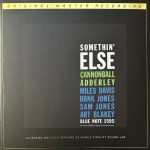
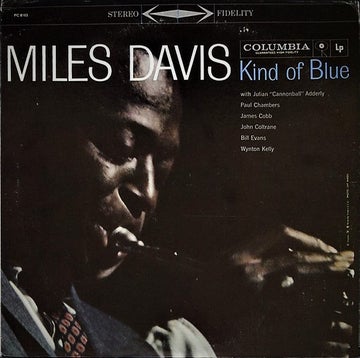
Somethin’ Else on MoFi – How Is This Company Still in Business?

Hot Stamper Pressings of Recordings by Rudy Van Gelder Available Now

For our 2023 White Hot Stamper shootout winning pressing we wrote:

A triumph for Rudy Van Gelder, a top Blue Note title, and as much a showcase for Miles Davis as it is for Cannonball Adderley.

The best sides of this album have as much energy, presence, dynamics and three-dimensional studio space as any jazz recording we’ve ever played.

When you hear it on a copy like this, it’s hard to imagine it could get much better.

We’ve heard more than our fair share of tubby, groove-damaged originals and smeary, lifeless reissues over the years, but this White Hot Stamper blew them all away.

This is a record we could play every week and never tire of. 


But this expensive ($125) MoFi pressing had us wondering what the hell we were on about, because almost nothing about it is right except for something we were not expecting: it’s actually tonally correct.

What are the chances?

With Mobile Fidelity, slim and none, but in this case they managed to pull off slim. So let’s give credit where credit is due.

But the sound is still a mess no matter how tonally correct it is.

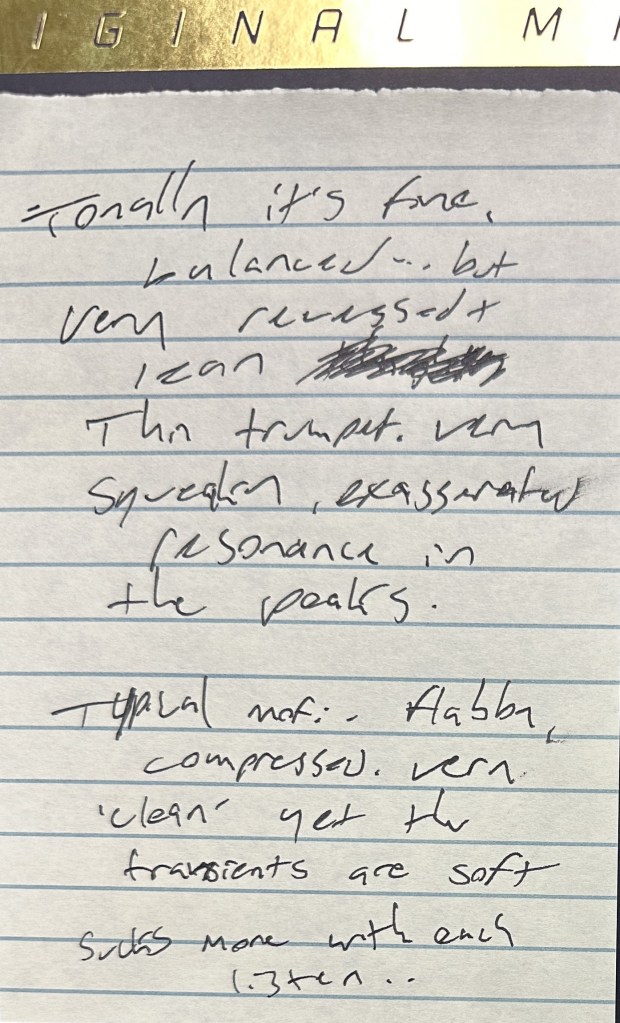
Allow me to list its faults based on the notes we took as the record was playing. The last line sums up the experience nicely.

1) It’s very recessed and lean.

2) The trumpet is thin and very squawky.

3) There is an exaggerated resonance in the peaks.

We summed it up this way:

Typical MoFi.

Flabby and compressed.

“Clean” yet the transients are soft.

Our final judgment:

Sucks more with each listen…

Man, that’s gotta hurt.

We made some other notes about how the MoFi compared to the originals and reissues we had on hand, but I did not reproduce them here for the simple reason that they gave away too much information about the pressings that tend to win shootouts.

Those pressings are hard enough to find as it is — we don’t want anybody finding them on his own and robbing our good customers of the chance to hear this amazing album sound the way it should: amazing.

Two to Four Questions

Is this the worst version of the album ever made?

Hard to imagine it would have much competition.

Are any of these Mofi One-Step pressings any good?

I seriously doubt it. Until one comes along that doesn’t sound awful, the jury is out. Those of you looking for miracles are likely to be disappointed.

Having said that, I’m sure there are audiophiles and audiophile reviewers who like the sound of this pressing and have said so online.

Based on what we heard, how on earth are these people qualified to judge the sound of records? I guess that’s three questions.

How bad does a record have to sound before they notice? Make that four, sorry.

(more…)

So Long So Wrong – Still So Wrong in the Vocal Department

Hot Stamper Pressings of Jazz and Pop Vocals Available Now

Most audiophiles have a soft spot for female vocals. It’s a sound that a high end stereo — practically any high end stereo — reproduces well.

But why do some audiophiles listen to the artificial-sounding junk that Patricia Barber and Diana Krall put out on album after album?

Their recordings are drenched in digital reverb. Who is his right mind likes the sound of digital reverb?

Rickie Lee Jones may not be my favorite female vocal of all time, but at least you can make the case for it as a Well Recorded Album. It’s worlds better than anything either of the above-mentioned artists have ever done.

The MoFi pressing of Alison Krauss (5276) is a disaster in the vocal department too.

Audiophiles for some reason never seem to notice how bad she sounds on that record. Can’t make sense of it. Any of the good Sergio Mendes records will show you female vocals that are hard to beat. Our best Hot Stampers bring the exquisite vocal harmonies of Lani Hall (aka Mrs. Herb Alpert) and Janis Hansen (and others) right into your living room.

Why bother with trash like this Mobile Fidelity?

(more…)

Our Take on the MoFi 45 Brothers In Arms

Hot Stamper Pressings of the Music of Dire Straits Available Now

We have never bothered to play their remaster, along with some other Heavy Vinyl reissues we think have very little chance of actually sounding good to us.

I found out recently that the MoFi is now on the TAS Super Disc list. You can find it along with the domestic — yes, you read that right — domestic pressing of the first album.

Now just how hard of hearing do you have to be to think that the domestic pressing of Dire Straits’ first album is a Super Disc? A nice record, sure, but nice records aren’t really Super Discs, are they?

Not when there are UK pressings that trounce it. We should know, we’ve played them by the dozens. How the writers for The Absolute Sound can be this far off the mark is a question we cannot begin to answer.

The most obvious answer — and therefore the most likely one — is reviewer malpractice.

What else could it be?

What We Think We Know

We have written quite a number of reviews and commentaries for the first album and we encourage you to read some of them.

Speaking of Super Discs, the good British pressings are so good we put them on our Top Ten Most Tubey Magical Rock and Pop Recordings List. No domestic pressing we have ever played would qualify as anything other than a minimally-acceptable Hot Stamper.

We would never bother to put such a pressing in a shootout, when even the average run-of-the-mill UK copy is better.


We Get Letters

A few years ago we received this email from a customer.

“How would you compare the Brothers in Arms SHS to the Mobile Fidelity 45 rpm copy?”

Dear Sir,

We have never bothered to play their remaster, and why would we? Every MoFi pressing made by the current regime has had major sound problems when compared head to head with the “real” records we sell, and it’s simply not worth our time to find out exactly what is wrong with the sound of any of these new reissues, theirs included.

[I will be reviewing their unbelievably awful Dire Straits first album on 45 one of these days. Rarely have I heard such a good recording, a brilliant recording, turned into such a piece of crap. Robert Brook didn’t like it either.]

However, we have been known to make an exception to that rule from time to time. Recently we did so in the case of the Tea for the Tillerman George Marino cut at 45 RPM for Analogue Productions.

(more…)

Imagine on MoFi Heavy Vinyl from 2003

Hot Stamper Pressings of the Music of John Lennon Available Now

Sonic Grade: B

The last time I played this record was probably in the mid-2000s. Not sure what I would think of it now. Probably not much. Back in those days we thought it was a reasonably good sounding pressing, but it’s doubtful we had ever heard an exceptionally good version of the album, as it would be years before we managed to do our first shootout for it. To see what we have to say about the record now, please click here.

Our review from many years ago:

I played this when it came out, and I have to hand it to the new MOFI, they did a great job with this one. It sounds better than I’ve ever heard it, and KILLS the old MoFi vinyl, which is the version we did the shootout with.

It was a short comparison, as in, no comparison. The earlier MoFi Half Speed (a different master tape, but still…) has that classic MoFi midrange suckout this awful label is famous for, so that Lennon and his piano on the first track sound like they are coming from another room. 

(more…)

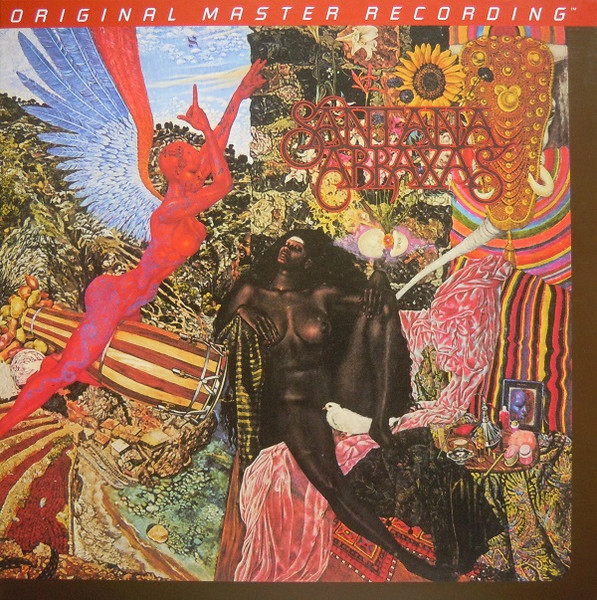
With Abraxas, MoFi Manages to Disgrace Itself Even Further

Hot Stamper Pressings of the Music of Santana Available Now

The remastered Abraxas never got past the first elimination round; it had to have been one of the worst half-speeds I have ever heard. Dead dead dead as a doornail.

Is it the worst version of the album ever made? Hard to imagine it would have much competition.

Santana’s first album on MoFi is a record we admit to having liked a bit when it first came out. Since then we have changed our minds. It’s just too damn compressed and lifeless. The Whomp Factor on this pressing is Zero. Since whomp is critical to the sound of Santana’s music, it’s Game Over for us. The review below is exactly what we wrote at the time the record came in. We tried to like it, but it’s clear to us now that we tried to like it too hard. Please accept our apologies.

I noted in my old blog: “But now I would have to say that the MoFi LP is far too lifeless to be acceptable to anyone, even those with the worst kinds of audiophile BS systems.”

We also mentioned a while back (4/29/08) on our blog how bad the latest crop of MoFi vinyl was, with the heading: “Mobile Fidelity, Ouch.

On another note, we played some godawful sounding MOFI pressings over the last few weeks: Linda Ronstadt (which appears to be out of phase, more on that down the road); Metallica (with blobby bass at 45 RPM no less; only half-speed mastering can guarantee muddy bass under any and all circumstances!); and Rush (nothing even resembling a top end. How do these things happen?).

These three albums have to be some of the worst sounding vinyl I have ever heard in my life. I won’t waste any more of your time or mine talking about them. Buy them if you feel the need, and if you like what you hear, drop us a line. Maybe the copy we cracked open was a “bad” one, unrepresentative of the general pressing run in the same way that the latest Crisis half-speed was.

Well, maybe so, but we are going to have to leave that conundrum unsolved for the time being. To crack open more copies to see if they are all as bad as the first one we played is not something we are particularly inclined to do. We call that throwing good money after bad around here at Better Records.

This is a label making some seriously bad records these days.

But why single them out? They all are.


Further Reading

Why Is It So Hard for Mobile Fidelity to Get the Midrange Right?

Hot Stamper Pressings of the Music of Joni Mitchell Available Now

We recently auditioned the Mobile Fidelity One-Step pressing of Blue and made the notes regarding the sound you see below.

We focussed on the quality of their pressing’s vocal reproduction, for the simple reason that a Joni Mitchell album that gets the vocals wrong is a Joni Mitchell album that no music lover and certainly no audiophile  would ever want to play.

The fact that some audiophiles do want to play this record speaks poorly of their ability to reproduce it properly. Accurate playback will reveal the problems with Joni’s voice described in detail below. The post-it for side one is on the left, for side two on the right.

We try to be very specific about the shortcomings of these records, which is why we reproduce our notes whenever they are available.

Side One

  • Tonally not far off, a bit too stringy and flat. Not awful. Congested vocals at peaks, harsh. 1+

Side Two

  • Vocal peaks like “traveling, traveling, traveling…” or “California” get squashed and harsh, lacking the real dynamics, presence and space of the vocals. No grade. (Awful in other words.)

Notice that only the vocals are mentioned in the notes — not how deep the bass goes, not how high the highs are, not the tone of the piano, not the pluck of the lap dulcimer, not the black background, not the soundstaging — none of those things that audiophiles — including us! — like to talk about endlessly in our reviews so that everyone will know how attuned we were to every aspect of the recording.

For this album that kind of listening is unnecessary.

When the voice is wrong, the sound is wrong. What more do you need to know?

And when the voice is wrong on a Joni Mitchell record, you have a worthless piece of vinyl no matter how much you may have paid for it.

(Other titles that get the voice wrong and therefore should be avoided by audiophiles of all stripes can be found here.)

We noted in our first ever Hot Stamper listing for Blue what the best pressings of the album are able to offer the discriminating audiophile:

(more…)

There’s Something Not Quite Right about MoFi’s Blue

Robert Brook has a blog which he calls

A GUIDE FOR THE DEDICATED ANALOG AUDIOPHILE

Below is a link to a review Robert Brook wrote recently for the MoFi One-Step pressing of one of our favorite albums of all time, Joni Mitchell’s Blue, originally released in 1971.

BLUE: What’s the RIGHT SOUND For Joni Mitchell’s CLASSIC?

Blue Sounds Funny Now

Based on everything I am reading these days from Robert Brook, he has a good stereo, two working ears, and knows plenty about records and what they are supposed to sound like.

This was not always the case as he himself would tell you. His stereo used to be much better at hiding the faults of a record like the MoFi One-Step of Blue than the stereo he has now. He got rid of most of his audiophile electronics, got a better phono stage, cartridge and arm, improved the quality of his electricity, found some sophisticated vibration controlling platforms for his vintage gear and did lots of other things to make his playback more accurate and — we cannot stress this too strongly — more fun, more exciting and more involving.

When your stereo is doing a better job of reproducing what’s in the grooves of your records, the first thing you notice when playing a Mobile Fidelity or other Heavy Vinyl pressing is that the sound is funny and wrong. (Please excuse the technical jargon; those of you who have been audiophiles as long as we have will understand what I mean, the rest of you can just play along. All of this will make sense eventually.)

When you use colored-sounding audiophile equipment — but I repeat myself — then your colored-sounding audiophile records don’t sound nearly as colored as they would under other conditions.

For example, other conditions obtain if you have — again, sorry about the jargon — revealing, accurate, tonally correct, natural-sounding equipment, free from the colorations — euphonic and otherwise — that allow one piece of audiophile equipment to sound so different from another.

(more…)

Thriller Is Proof that Mobile Fidelity Is Cutting Some Real Crap These Days

Hot Stamper Pressings of the Music of Michael Jackson Available Now
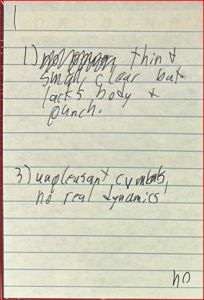
Don’t blame the digital step for the bad sound of this pressing of Thriller. If it were all analog, you can be sure Mobile Fidelity would have screwed it up every bit as badly.

If this is the sound audiophiles are interested in, lord have mercy on their souls. They must be as lost as lost can be.

Side One:

Track One: thin and small, clear but badly lacks body and punch.

Track Two: unpleasant cymbals, no real dynamics.

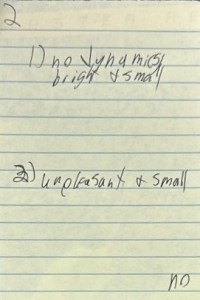
Side Two:

Track One: no dynamics, bright and small.

Track Three: unpleasant and small.

Two Questions

Is this the worst version of the album ever made?

Hard to imagine it would have much competition.

Are any of these Mofi One-Step pressings any good?

I seriously doubt it. Until one comes along that doesn’t sound awful, the jury is out. Those of you looking for miracles are likely to be disappointed.

Having said that, I’m sure there are audiophiles and audiophile reviewers who like the sound of this pressing and have said so online.

Based on what we heard, how on earth are these people qualified to judge the sound of records? I guess that’s three questions.

How bad does a record have to sound before they notice? Make that four, sorry.

Bernie Was The Man

Bernie Grundman cut the original pressings of Thriller. About the nicest thing we can say about him these days is that his work at one time was excellent.

Our evidence? When you hear a killer copy of Thriller — a recording with a lot going on and one that no doubt was difficult to master — the fact that nobody else has even come close to cutting the album as well as he did all those years ago stands as proof that he will always be considered one of the greats. (If he would only stop taking Chad’s calls, the record world would be in a much better place.)

Speaking of Chad (a man who thinks he is “saving the world from bad sound“), we have now auditioned the new Aja UHQR. You can read all about it here.

(more…)

Our Filmed Tapestry Shootout Was a Real Shocker

The Washington Post article that Geoff Edgers wrote includes a video of a little shootout we did for Tapestry, using, without my knowledge, the MoFi One-Step, a Hot Stamper pressing, and a current, modern, standard reissue of the album. Could I spot the Hot Stamper without knowing what record was playing?

First up (and of course unbeknownst to me), the MoFi. My impressions from the video:

That’s probably tonally correct for this record. It’s just missing everything that’s good about this record, which is a meaty, rich piano. And the vocal sounds very dry. There’s no Tubey Magic. It’s tonally correct. If you were playing me a CD right now, I wouldn’t be able to tell you weren’t. 

Next up, the cheap ($20?), current reissue:

Piano’s better.

Voice is better!

Richer and smoother.

That’s what this is supposed to sound like.

Her voice sounds mostly correct.

This might not be a particularly good record. If I played a real one for you, you might just say, oh, my God, there’s so much more.

But this is not a wrong record. It’s not awful. It’s doing something… I don’t know if I would say most things right. I’ll just say something right.

At least the person understands what she’s supposed to sound like.

Then the Hot Stamper (a Super Hot copy as it turns out):

She sounds pretty right on this copy.

I think there’s more space.

You hear more space, more three-dimensional space.

The piano: there’s more richness to the tone of the various notes that she’s playing.

I would probably pick this one.

Jeff sums it all up as follows:

So we have a winner, and I couldn’t fool the Hot Stamper king.

Without knowing what he was listening to, he chose the hot stamper of Tapestry.

If he still had it, that copy would be sold for about $400 on the Better Records website.

When we went back and played each of the pressings again, the differences were much more pronounced. The MoFi still sounded like a CD, the current Columbia reissue was still no better than passable, and the Hot Stamper became even better sounding than it had been earlier, with sound the other two could not begin to offer.

Our grades for the three pressings would have been F, C and A, in that order.

In the video, you can see that it took me a few minutes to get deep into the sound, but once I was there, it turned out to be no contest. The Hot Stamper was the only pressing capable of showing us just how good Tapestry can sound.

Colorations Are Bad Now?

The MoFi was by far the worst sounding of the three. As I said, it sounded to me like a CD.

(more…)