_Composers – Mussorgsky

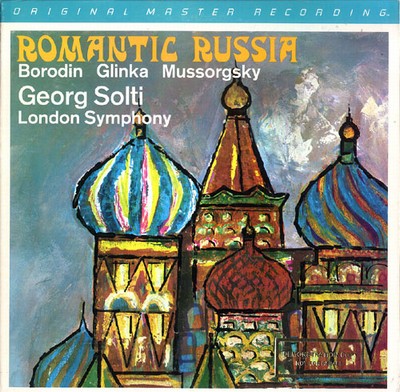
Ballet Music From The Opera – Yet Another Reissue that Trounces the Original

More of the Music of Saint-Saens

More of the Music of Mussorgsky

  • You will find superb sound throughout this vintage Victrola 60s reissue, one of the best in the entire series
  • Both of these sides are big, lively, and dynamic, with the lovely bells and other percussive elements benefitting immensely from the wonderfully extended top
  • The sonics here have the power to transport you completely, with solid imaging and a real sense of space, qualities that allow us to forget we are in our listening rooms and not in the concert hall

Pay attention to the brass — yes, it may have some tubey smear, but listen to how huge and powerful it is.

Drop the needle and watch (or listen) as the sound comes jumping out of your speakers.

Modern remastered records never do that.

These Decca-derived recordings are highly sought after, and with good reason. It’s hard to imagine a more wonderful audiophile disc, both in terms of the program and the quality of the sound.

This is the precisely the kind of big, bold, lifelike sound Decca engineers were able to capture on tape, and RCA mastering engineers were able to master from that analog tape, 60+ years ago.

The original RCA (LSC 2400) sells for many, many hundreds of dollars in clean condition and may not have especially good sound, if our experience is any guide. Some of the ones we’ve played have been quite shrill. In other words, you could easily spend a ton of money on one and end up with a bad sounding collector piece destined to sit on your shelf for years between playings.

Or you could buy the Classic 180g reissue and end up with one of the biggest disasters in the history of remastering. More about that later.
(more…)

Who on Earth Could Possibly Take the Sound of this Ridiculous Remaster Seriously?

Hot Stamper Pressings on Decca and London Available Now

There actually is such a person who does exactly that, can you imagine?

Only an Audiophile True Believer could be fooled by sound so ridiculously unnatural.

But the world is full of such people. They bought into the audiophile BS of Mobile Fidelity in the 80s and apparently haven’t learned much since.

Now they think Heavy Vinyl is the answer to the world’s problems. The more things change…

If your stereo is any good at all, you should have no trouble hearing the sonic qualities of this album we describe below. If you are on this blog, and you have tried some of our Hot Stamper pressings, there is a good chance you’re hearing pretty much what we’re hearing. Why else why would you pay our prices?

One thing I can tell you: we would never charge money for a record that sounds as weird and wrong as this MoFi.

A well-known reviewer has many kind things to say about this pressing, but we think it sounds like a hi-fi-ish version of a 70s London, which means it’s opaque and the strings are badly lacking in Tubey Magical sheen and richness.

The bass is like jello on the MoFi, unlike the real London, which has fairly decent bass.

If an audiophile reviewer cannot hear the obvious faults of this pressing, I would say there’s a good chance one or both of the following is true:

  1. His equipment is not telling him what the record is really doing, and/or,
  2. His listening skills are not sufficiently developed to notice the shortcomings in the sound.

The result is the worst kind of reviewer malpractice.

But is it really the worst kind? It seems to be the only kind!

MoFi had a bad habit of making bright classical records. I suppose you could say they had a bad habit of making bright records in general. A few are dull, some are just right, but most of them are bright in one way or another.

Dull playback equipment? An attempt to confuse detail with resolution? Whatever the reasons, the better and more accurate your equipment becomes, the more obvious this shortcoming will be. My tolerance for their phony EQ is at an all time low. But hey, that’s me.

(more…)

Mussorgsky / Danse Infernale – Our Favorite Night On Bald Mountain

More of the Music of Modest Mussorgsky (1839-1881)

  • The best pressings of this 70s DG are some of the best sounding orchestral showpieces we know of
  • After a three year hiatus, our favorite performance of Night on Bald Mountain is back, and it’s guaranteed to blow your mind (and maybe a woofer or two), thanks at least in part to the conducting skills of Arthur Fiedler
  • Side one also boasts an excellent Danse Macabre, with a powerful finish that may remind you of the thrill of live orchestral music
  • Clear and transparent, with huge hall space extending wall to wall and floor to ceiling, this is a sound that the modern Heavy Vinyl reissue fails to reproduce utterly
  • There are about 150 orchestral recordings we think offer the best performances with the highest quality sound. This record is certainly deserving of a place on that list.
  • Watch your levels – this pressing is dramatically more dynamic than most Golden Age recordings
  • Click on the link to see more classical “sleeper” recordings we’ve discovered with demo disc sound

This pressing clearly has Demo Disc quality sound — not in every way, but in some important ways. The energy of both the sound and the performances of these barnburning showpieces is truly awesome. Fiedler brings this music to life like no other conductor we have heard.

This pressing boasts relatively rich, sweet strings, especially for a Deutsche Grammophon LP. Both sides really get quiet in places, a sure sign that all the dynamics of the master tape were protected in the mastering of this copy (and the reason it is so hard to find a copy that plays better than Mint Minus Minus.)

(more…)

Various Artists / Witches’ Brew

More of the Music of Modest Mussorgsky

  • This original Shaded Dog pressing of the New Symphony Orchestra of London’s performance of these classical warhorses boasts seriously good Double Plus (A++) Living Stereo sound from first first note to last
  • If the price seems high, keep in mind that the top copy from our most recent shootout went for almost $3000(!)
  • A quick look at the cost of used copies on eBay or Discogs should tell you all you need to know about how impossibly tough it is to get this shootout going these days – we may not do it again for a very long time!
  • These TAS-approved sides are doing just about everything right – they’re rich, clear, undistorted, open, spacious, and have depth and transparency to rival the best recordings you may have heard
  • The rich, textured sheen of the strings that Living Stereo made possible in the 50s and early 60s is clearly evident throughout these pieces, something that the Heavy Vinyl crowd will never experience, because that sound just does not exist on modern records
  • We have written extensively about this recording and went into some depth about the Classic Records repress of it, which you can find linked here and here.

Demonstration Quality Sound, of a sort. As I’ve said elsewhere on the site, this is not my idea of natural tonality. It’s not trying to be a realistic recreation of music performed in the concert hall. It’s a blockbuster to be impressive when played on an audio system in your home. On that level is succeeds.

The excerpt on side 1 from Pictures at an Exhibition and the complete A Night on Bare Mountain are both played with a kind of energy and attention to detail that allows these pieces to come alive right in your living room.

The entire side 2 is outstanding from start to finish.

Only the Arnold piece on this record is not particularly inspiring, although it does have excellent sound.

All in all, an amazing group of warhorses given a fresh reading by Alexander Gibson and the New Symphony Orchestra of London.

(more…)

On Ballet Music From The Opera, How Much Tubey Magic Is Too Much?

Hot Stamper Pressings of Living Stereo Recordings Available Now

UPDATE 2023

We have stopped buying the original LSC 2400 for the simple reason that it is not competitive with the budget VICS 1206 reissue from 1960 that replaced it in the RCA catalog.

The review we wrote for the Shaded Dog is probably close to twenty years old. There was a time when the shortcomings of the original RCA were not nearly as easy for us to recognize, but that time has long since past.

If any copy of the original, or any remastered version from the modern era sounds good to you, we can almost guarantee that you are mistaken about the quality of the sound, and, even better, we can offer you the pressing that makes our case better than any review can.


Our Old Review

The hall is HUGE — so transparent, spacious and three-dimensional it’s almost shocking, especially if you’ve been playing the kind of dry, multi-miked modern recordings that the 70s ushered in for London and RCA. (Many of Solti’s recordings from the decade are not to our liking, for reasons we lay out here.)

EMI recordings may be super spacious but much of that space is weird, coming from out-of-phase back channels folded in to the stereo mix. And often so mid-hall and distant. Not our sound, sorry.

We strongly believe that there will never be a modern reissue of this record that even remotely captures the richness of the sound found on the best of these Living Stereo original pressings.

Here are some of the strengths and weaknesses we noted on a copy we played way back when.

Side One

Big and lively. The Tubey Magical colorations are a bit much for us, with too much tube smear on the strings and brass to earn more than a single plus. 

Side Two

Even bigger and more spacious, with some smear caused by the serious amounts of tube compression being used, of course, but the quiet passages are magical. [Which is precisely what heavy tube compression is designed to accomplish.]

The Victrola Reissue

We much prefer the sound of the Victrola reissue, VICS 1206, which came out in 1966.

As for the Victrola pressing, we’re guessing — how could we possibly know for sure? — that less tube compression was used in the mastering.

It’s still plenty tubey, but more to our taste for not being overly tubey.

(more…)

Our Favorite Night on Bald Mountain

Hot Stamper Pressings of the Music of Mussorgsky Available Now

If you like Orchestral Spectaculars, have we got the record for you!

What you want this record for is the best performance of Night On Bald Mountain ever recorded.

Fiedler plays it with a kind of pull-out-all-the-stops abandonment that no other conductor has on a modern recording, not to my knowledge anyway. It’s supposed to be a wild witches’ frenzy, and this is the only performance I know of that allows you to experience the full measure of diabolic revelry playing in your mind’s eye.

This is one of those “sleeper” albums that, as record collectors, you might stumble across from time to time, especially if you’re the kind of person who does nothing but play records all day. You will simply be amazed at the performance and the sound on this copy.

The Sound

Lively, set in a huge hall, with big orchestral sound, and more energy than you will find on 99 out of 100 classical LPs. So present, with an extended top end and transparency that allows you to “see” to the back of the hall.

Huge low brass, the kind you hear on Ansermet’s recording from the Victoria Hall. What a sound!

It gets loud and it stays clean doing it. Not many records can make that claim.

This pressing clearly has DEMONSTRATION QUALITY SOUND — not in every way, but in some important ways. The ENERGY of both the sound and the performances of these barnburning showpieces is truly awesome. Fiedler brings this music to LIFE like no other conductor we have heard.

This pressing boasts relatively rich, sweet strings, especially for a Deutsche Grammophon LP. Both sides really get quiet in places, a sure sign that all the dynamics of the master tape were protected in the mastering of this copy, and the reason it is so hard to find a copy that plays better than Mint Minus Minus. (more…)

Mussorgsky & Ravel – Pictures at an Exhibition

More of the Music of Modest Mussorgsky

  • With two seriously good Double Plus (A++) sides, this British EMI import pressing is doing just about everything right – exceptionally quiet vinyl too
  • Our favorite performance by far, with big, bold and powerful sonics like no other recording we know
  • The brass clarity, the dynamics, the deep bass and the sheer power of the orchestra are almost hard to believe
  • No vintage recording of these works compares with Muti’s – and Stravinsky’s Firebird Suite is an extra special added bonus on side two
  • There are about 150 orchestral recordings we’ve awarded the honor of offering the best performances with the highest quality sound, and this record certainly deserve a place on that list.
  • If you like orchestral spectaculars, have we got amazing sounding records for you

This EMI import pressing gives you the complete Pictures at an Exhibition with a top performance and superb sonics.

As this is my All Time Favorite performance of Pictures, this record naturally comes very highly recommended. Pictures is a piece of music that has been recorded countless times, and I’ve played scores of different recordings, but the only one that truly satisfies is this one, Muti’s 1979 recording with the Philadelphia Orchestra. Much like Previn and the LSO’s performance of The Planets, he finds the music in the work that no one else seems to.

A Must Own Classical Record

This orchestral spectacular should be part of any serious Classical Collection. Other Must Own classical recordings can be found here.

For his 1979 review of the Mussorgsky, Robert Layton in the GRAMOPHONE writes of Muti and The Philadelphia Orchestra :

…what orchestral playing they offer us. The lower strings in ‘Samuel Goldenberg and Schmuyle’ have an extraordinary richness, body and presence, and “Baba Yaga”, which opens the second side, has an unsurpassed virtuosity and attack as well as being of demonstration standard as a recording. The glorious body of tone, the richly glowing colours, the sheer homogeneity of the strings and perfection of the ensemble is a constant source of pleasure.

Of the performance of Stravinsky’s Firebird, Layton writes:

…Muti’s reading is second to none and the orchestral playing is altogether breathtaking. The recording is amazingly lifelike and truthful.

(more…)

Music of Old Russia – We Give Up (on Noisy Angel Vinyl)

Hot Stamper Pressings Featuring the Violin Available Now

White Hot Stamper sound on side one – the Tubey Magic is off the scale. Milstein is brilliant on these shorter violin works, 7 in all.

This rare, hard to find original Blue Angel stereo pressing has exquisite sound. As we noted in our listing for Milstein’s Saint-Saens Third, it is the rare Heifetz album on Shaded Dog (or any other label) that could hope to compete with it.

We would rank this Angel pressing with the best of Rabin and Milstein on Capitol, as well as the wonderful Ricci and Campoli discs on London/Decca.

The transparency of both sides lets you “see” the orchestra clearly, without sacrificing richness or weight.

What a record! What a performance from the incomparable Nathan Milstein. 


UPDATE 2024

This is an album we can no longer find enough clean, early stereo pressings with which to do a proper shootout.

Consequently it has been tagged as a never again record. It’s possible we could do it again, but unlikely.

We love both the music and sound and encourage you to find a nice copy for yourself.

For best results, stick to the Blue Label stereo pressings. There are two, but only one of them sounds good.

See how hard all this record stuff is!

(more…)

A Killer Copy of Pictures at an Exhibition

Hot Stamper Pressings of the Music of Mussorgsky Available Now

We describe the better copies of Muti’s Pictures for EMI this way in our listings:

Our favorite performance by far, with big, bold and powerful sonics like no other recording we know.

The brass clarity, the dynamics, the deep bass and the sheer power of the orchestra are almost hard to believe. No vintage recording of these works compares with Muti’s – and Stravinsky’s Firebird Suite is an extra special added bonus on side two.

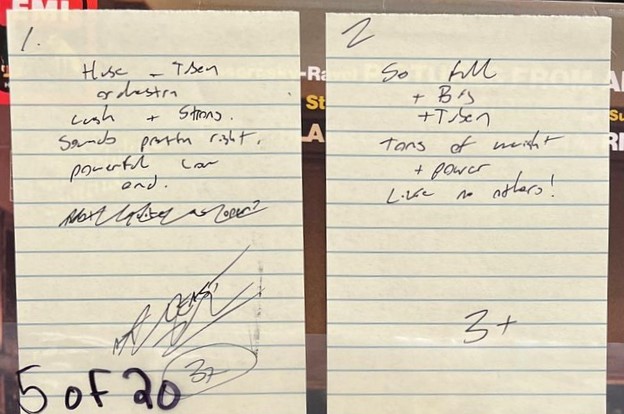
Here are the notes for our most recent Shootout Winning pressing to back up everything we say.

Side One

  • Huge and tubey orchestra
  • Lush and strong
  • Sounds pretty right
  • Powerful low end

Side Two

  • So full and big and tubey
  • Tons of weight and power
  • Like no others!

No doubt the enthusiastic nature of these notes is in response to the big finish for Pictures.

It is a very special piece of music, one that has thrilled me as an music-loving audiophile since I first heard it on record sometime in my twenties, and this was a very special pressing of the recording. In the old days a side two like this might have been given a grade of Four Pluses, but we don’t do that anymore, for reasons explained elsewhere on the blog.

Regardless of what grade we chose to give it, this side two was superior to either side of every other copy we played. It set a standard that no other side could meet. Yes, exceptional vintage pressings with sound that good are out there sitting in the record bins.

More from Our Listing

There is a slightly multi-miked quality to this recording. If you’ve been playing true Golden Age records all day you will notice that the instruments are more naturally and correctly spaced and sized on those recordings.

But, this is still a KNOCKOUT record which is guaranteed to bring any stereo to its knees. The dynamics, the deep bass and the sheer power of the orchestra have to be heard to be believed.

What does the typical EMI pressing of this album sound like? Not good. Sour brass, smeary or shrill strings, lacking in bass — mid-hall dead-as-a-doornail sound is fairly typical. Almost all the copies I’ve played are spacious, but so what? The sound of the instruments is often wrong and in my book that trumps any benefits concerning soundstaging or depth.

But the Hot Stampers give you the presence and immediacy you need to get involved in the work. The strings on the better copies have rosiny texture. The brass has weight — not the full measure of an RCA or London recording, but at least you get the impression that those instruments are trying to sound correct. And the bass drum really goes deep, unlike the Golden Age recordings I’ve heard.

(more…)

Pictures at an Exhibition – An Overview

Hot Stamper Pressings of the Music of Mussorgsky Available Now
There is a slightly multi-miked quality to this recording. If you’ve been playing true Golden Age records all day you will notice that the instruments are more naturally and correctly spaced and sized on those recordings.

But, this is still a KNOCKOUT record which is guaranteed to bring any stereo to its knees. The dynamics, the deep bass and the sheer power of the orchestra have to be heard to be believed.

What does the typical EMI pressing of this album sound like?

Not good. Sour brass, smeary or shrill strings, lacking in bass — mid-hall dead-as-a-doornail sound is fairly typical.

Almost all the copies I’ve played are spacious, but so what?

The sound of the instruments is often wrong and in my book that trumps any benefits concerning soundstaging or depth.

But the best Hot Stamper pressings give you the presence and immediacy you need to get involved in the work.

The strings on the better copies have rosiny texture.

The brass has weight — not the full measure of an RCA or London recording, but at least you get the impression that those instruments are trying to sound correct.

And the bass drum really goes deep, unlike many of the Golden Age recordings I’ve heard.

Other Pressings and Performances

The natural question for most audiophiles is how does these pressings compare to the the Mobile Fidelity?

It’s a joke next to a properly mastered British EMI. All that phony boosted top end that makes the strings sound so funny and causes mischief in virtually every part of the orchestra is missing from the real EMIs.

While I’m in this bashing mode, let me take a shot at Classic Records, since their mastering approach is — gulp — even worse. I can play the MoFi of Pictures and enjoy it. I can’t play the Classic of Pictures at all.

The shrillness, the hardness, the sourness, the loss of texture to the strings, the phony boosted deep bass — this is the kind of sound that makes my skin crawl. After a minute or two I’ve had it.

And I don’t much care for Reiner’s performance either. I don’t think the classical critics ever had much respect for his Pictures, but audiophiles and TAS heads for some reason put up with his awkward, disjointed, unmusical approach. I’ll never understand it. And insult is only added to injury by Classic’s bad mastering.

Another performance I don’t care for is Ansermet’s with the Suisse Romande. It’s slow and ponderous.

But my God, the sound of the brass on that record is to die for. It’s without a doubt one of the most powerful classical recordings I have ever heard.

There is a blast of brass at the end of The Catacombs that is so big and real, it makes you forget you’re listening to a recording. You hear every brass instrument, full size, full weight. I still remember the night I was playing that album, good and loud of course, and that section of the work played through. It was truly startling in its power.

Some of Ansermet’s recordings with the Suisse Romande are absolutely the best I’ve ever heard. It was a magical combination of the right hall, the right engineers, the right orchestra and the right technology — the long lost, outdated but still glorious recording technology of the 50s and 60s.

(more…)