Advice-WTLF, Vocals

Records with advice on what to listen for in order to separate the best pressings from the also-rans.

The Concert Sinatra – What to Listen For

sinatconce_1011_1310577590

[Originally posted 2/2015]

There may be a touch of smear (you can most easily hear it in the strings) but the sound is so RICH and Tubey Magical that you will barely be aware of it. Your attention should be focused on the superb feel the man has for this music.

One thing to pay special attention to, especially if you have other copies of the album, is that Sinatra’s voice on both sides of this pressing always sounds natural even at its loudest. There is no strain or hardness.

That, among many other things, is what separates the best copies from the also-rans (and, of course, all the reissues, which tend to have gritty, harsh vocals which quickly get unbearably edgy in the louder parts).

For audiophiles, the amount of effort that went into the recording, effort that actually paid off, is what will impress the most about The Concert Sinatra. The 73 musicians you see stretched out across the soundstage at Samuel Goldwyn Studios behind Sinatra will give you some idea of the size and scope of the sound. With 24 mics feeding 8 tracks of 35MM recording film, this was the sonic equivalent of Gone With the Wind. No expense or effort was spared.

Fortunately for those of us who are still playing records forty-odd years on, this special project took place before the advent of the transistor, which means that all the Tubey Magic of the singer and his all-encompassing orchestra was captured on the “tape”.

Ah, but how much of that sound made it to the record itself? That’s always the rub with records isn’t it?

In this case, plenty.

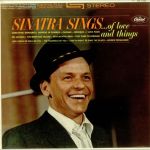
Sinatra Sings… of Love and Things – Key Tracks to Play

The music is excellent as one can see from the track listing. It’s hard to go wrong with these later Capitol Sinatra records. They’re almost always a fun listen.

This album comprises the last group of singles Capitol released of Sinatra’s music. Reprise had started in 1960 and the rest of Sinatra’s music would come out on his own label. Somehow he managed to record and release six studio albums in 1962, with this compilation making a total of seven for the year. Even more remarkable, all seven of them made the Top Ten of the pop charts.

Side One

The first track is especially good sounding – note how full-bodied the lower registers of Sinatra’s voice are rendered.

Side Two

Some of the better sounding tracks are the fourth (big, rich and breathy vocals) and fifth (it really swings!).

Side One

The Nearness of You
Hidden Persuasion
The Moon Was Yellow
I Love Paris
Monique (song from “Kings Go Forth”)
Chicago

Side Two

Love Looks So Well on You
Sentimental Baby
Mr. Success
They Came to Cordura
I Gotta Right to Sing the Blues
Something Wonderful Happens in Summer

Frank Sinatra

Frank Sinatra was arguably the most important popular music figure of the 20th century, his only real rivals for the title being Bing Crosby, Elvis Presley, and the Beatles. In a professional career that lasted 60 years, he demonstrated a remarkable ability to maintain his appeal and pursue his musical goals despite often countervailing trends. – AMG Biography

Ella Fitzgerald Sings the Harold Arlen Song Book #2 – Brash Sound? Not this Copy!

Hot Stamper Pressings of Ella Fitzgerald’s Albums Available Now

The first Harold Arlen Song Book to hit the site, and with sound like this it’s going to be very hard to beat. White Hot on side two, Super Hot on side one, Ella is especially rich, Tubey Magical and breathy throughout.

The space is HUGE and the sound so rich. The vocals have dramatically less hardness and the orchestra — especially on side two — is not brash for once.

Huge amounts of Tubey Magic as well, which is key to the best sounding copies. The sound needs weight, warmth and tubes or you might as well be playing a CD.

Hardness and Brashness

Want to know what we are on about with all this talk of hardness and brashness? Easy, just play the average copy. Unless you have been exceptionally fortunate to have chanced upon a properly mastered and pressed and cared for copy, you will hear plenty of both.

It’s one of the main reasons we have such a hard time doing shootouts for Ella’s Songbook albums. The other of course is the poor condition most copies are in. Few pressings do not have marks that play or damaged grooves. The players of the ’50s and ’60s, not to mention their owners, were ruinous on the records of the day.

Which is simply another reason not to expect another top copy of this album to come to the site any time soon. Give us three to five years or so and we might be able to find another batch with which to do a shootout. In that time we might look at fifty copies, buy ten, and end up with five that are worth playing. We obviously wouldn’t bother if the music and sound were so good. (Click on The Legendary Songbooks tab above to read more about the historical value of the music. The sound we can judge for ourselves.)

Stereo Vs. Mono

It is our opinion that the mono takes all the fun out of the Billy May’s deliberately wide, spacious orchestral presentation surrounding Ella. Which is too bad: the mono pressings are five times as common as the stereo ones.

(more…)

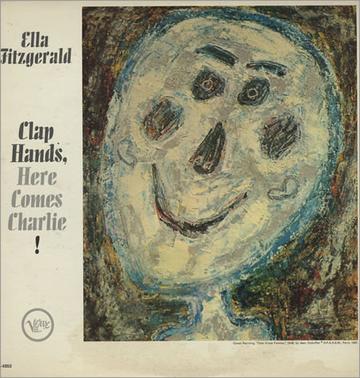
Clap Hands Here Comes Charlie – We Found the Missing Bass Player in 2009

Hot Stamper Pressings of Ella Fitzgerald’s Albums Available Now

This commentary is fairly old and some of it is a bit out of date. Check our newest listings for our current understanding of the album. We still love the mono but we prefer the stereo pressings now.

Folks, this record came as a SHOCK — the first and ONLY mono pressing we have ever played that not only was competitive with the best stereo copies, but actually bettered them in some ways. Some IMPORTANT ways I might add. We’ve only played a handful of mono pressings of Clap Hands over the years, and for good reason — they’re exceedingly mediocre. On almost every one Ella was distant, dull and lifeless. Feh! Who wants to play a record the sounds like that?

(Side two is pretty much what you would expect from a good mono, A to A+, better than average but hardly competitive with the best, or with this side one for that matter.)

What’s So Special About This Mono Side One Anyway?

Well I’m more than happy to tell you. It’s simply this: the mono lets you know that there was a bass player at the session in a way that the stereo copies — none of them — do not. The bass player is front and center (in mono where else would he be?) in the mix and he DRIVES the rhythmic elements of the songs so strongly that the songs actually seem to pick up pace compared to the way they sound on the stereo LPs. For the first time you really get the feeling that this is a tightly-knit, swinging jazz combo that Ella is fronting. Everybody is playing together, right there in the center, with the drums and the bass as a unit laying down a super-solid rhythm line behind Ella.

What was surprising, even shocking in a way, was how much better Ella got as a singer. She swings more. She’s more energetic. She’s picked up the tempo, how I don’t know, but that’s the feeling you get when you hear her in mono on this copy.

And every bit as surprising was the fact that the slow songs got better too! Round Midnight and Signing Off aren’t faster, but she seems to somehow be feeling the lyric more, finding more emotion in it. Again, I have no idea how. I just know I heard it and felt it. It’s real.

(more…)

Sinatra at the Sands – What to Listen For

There is some edge on Sinatra’s voice on every side of every copy; it’s so common it’s got to be on the tape. Those copies with less edge and grit on the vocals which are not overly smooth or dull tend to do very well in our shootouts.

Also, richness is very important. We look for a combination of rich, Tubey Magical sound that still maintains a fair amount of space, clarity, transparency and freedom from smear.

The original label pressings (always in stereo; the monos are really a joke) are richer and thicker as a rule.

The pressings with the orange two-tone labels tend to be thinner and clearer. A high percentage of them are much too modern sounding, bright and gritty, and when they are we throw them right in the trade-in pile.

Finding the copy with “best of both worlds” sound is the trick. Pressings on both labels have won shootouts in the past. With this album we do what we always do. We play the record without looking at the label and simply grade the quality of the sound coming out of the speakers. Any other approach is liable to fall prey to unconscious biases. As we like to say, record shootouts may not be rocket science, but they’re a science of a kind, one with strict protocols developed over the course of many years to insure that the results we arrive at are as accurate as we can possibly make them.

(more…)

Julie Is Her Name – What a Record!

More of the Music of Julie London

Reviews and Commentaries for the Music of Julie London

We awarded this copy’s side one our very special Four Plus A++++ grade, which is strictly limited to pressings (really, individual sides of pressings) that take a given recording to a level we’ve never experienced before and had no idea could even exist. We estimate that about one per cent of the Hot Stamper pressings we come across in our shootouts earn this grade. You can’t get much more rare than that.

  • Our lengthy commentary entitled Outliers & Out-of-This-World Sound talks about how rare these kinds of pressings are and how to go about finding them.
  • We no longer give out Four Pluses as a matter of policy, but that doesn’t mean we don’t come across records that deserve them from time to time.

Mono Versus Stereo

This is the kind of record that the mono cartridge owners of the world worship, with good reason: the sound is amazing. But you don’t need a mono cartridge to hear how good, in fact how much better, this copy sounds than the stereo pressing.

The recording is mono, which means that the stereo pressings are actually reprocessed into stereo. Not too surprisingly the sound is terrible.

Consider taking our moderately helpful advice concerning the pressings that tend to win shootouts. In our experience, this record sounds best this way:

Our Review from Circa 2010

Beyond White Hot stamper sound on side one of this Turquoise Liberty Mono pressing – the sound is guaranteed to blow your mind. Julie is in the room with you – intimate, breathy and Tubey Magical like practically nothing you’ve ever heard. For late night listening this may be the best Sultry Female Vocal recording ever made.

Side One

This side had breathy resolution that was hard to believe, along with size and immediacy that no other side of any copy could touch. Phenomenal. (more…)