*Table and Cartridge Setup

Advice for tuning and tweaking your table, arm and cartridge.

Letter of the Week – John Wesley Harding Has Playback Issues

Hot Stamper Pressings of the Music of Bob Dylan Available Now

One of our good customers had this to say about a Hot Stamper pressing of John Wesley Harding he purchased a while back:

Hey Tom,   

So many great records in this batch, but some solid misses too — details coming. John Wesley Harding for example sounds great but has some serious distortion through much of side two; a bit ’too vintage’, in spite of the sound it seems once to have had.

Dear Sir,

Definitely check your front end setup on this one, there is no actual distortion on the record, just sound that may be hard to reproduce.

My advice would be to make sure you have replaced your cartridge recently.

Carts that get old have a problem with records like these. We know, we replace our cartridge every three months when hard-to-play records start to sound strained or congested and gritty.

The sheen of massed strings, a sound critical to the orchestral recordings we play, are impossible to reproduce correctly with an older-than-it-should-be unit. A fresh cartridge can make all the difference in the sound of  difficult to reproduce records.

Keeping a cartridge installed for too long is a mistake made by 100% of the audiophiles I have ever known.

The other explanation could be that our microfine tip is playing deeper in the groove and missing whatever damage is encoded above it, damage which may have been caused by the older cartridges of the day that were used to play the record by the previous owner or owners. We can’t say it doesn’t happen.

We can say that if you bring this record back, the next person to buy it has a roughly 98% chance of keeping it. Maybe one out of five hundred or so ever come back a second time. At least that’s how it has worked out over the last twenty-five years.

(more…)

With the Right VTF the Record Comes to Life

Robert Brook runs a blog called The Broken Record, with a subtitle explaining that the aim of his blog is to serve as:


A GUIDE FOR THE DEDICATED ANALOG AUDIOPHILE

We know of none better, outside of our own humble attempt to enlighten that portion of the audiophile community who love hearing music reproduced with the highest fidelity and are willing to go the extra mile to make that happen.

Here is Robert’s latest posting.

With the RIGHT VTF the Record COMES to LIFE

Robert writes:

The other day I checked the VTF, yet again, and my scale showed it was set at 1.807. I adjusted it to 1.800 and went back to playing records. Was it now actually at 1.800? Impossible to really know for sure.

But it did seem, if 1.800 is the indeed the magic number, that I’d finally hit it.

I was playing Miles Davis Friday Night At The Blackhawk, an extremely well recorded live album. My copy had generally sounded excellent. On this occasion, the record sounded . . . imagine this, exactly like a live performance.

Of course there was some occasional surface noise and, of course, I wasn’t actually listening to a live performance. It was a record after all.

But never before that moment had a record convinced me so completely I was hearing something I wasn’t. Somehow one tiny little change had managed to strip away just enough of the remaining artifice to lift the experience of hearing a record from very live sounding to uncannily real.

(more…)

When Did You First Hear that 10k Boost on Sittin’ In?

Hot Stamper Pressings of the Music of Loggins and Messina Available Now

UPDATE 2026

It took us a long time to recognize it, I can tell you that. 30 years? Maybe even more.

And how about the boost to the low end?

This commentary is from many years ago, perhaps as far back as 2010.

Of course it could not have been written until the stereo had reached the level where these anomalies and others like them could be easily recognized, the clearest kind of evidence of progress in audio.

If you’re not noticing these kinds of things on the vintage vinyl you play, then it’s probably time for a serious upgrade or two.

The anomalies are there, of that there can be no doubt. They’re everywhere. You just need a more accurate and revealing system and room to show them to you.

In that respect, you my find our shootout notes are helpful at pointing you in the right direction as to what you should be listening for. They are especially helpful in recognizing when one side or another falls short in some specific area.

(more…)

VTA – A Few Moments of Experimentation Can Really Pay Off

Basic Audio Advice — These Are the Fundamentals of Good Sound

Here we discuss what to listen for as you critically adjust your VTA.

While experimenting with the VTA for this record, we found a precise point where it all came together, far beyond whatever expectations we might have had for the sound at the time.

Practically out of nowhere we heard a solid, full-bodied, palpable violin that appeared to be floating between the speakers, an effect that, speaking for myself as a lifelong, obsessive audiophile — I fully appreciated for the magic trick that it is.

The sound of the wood of the instrument became so clear, the harmonic textures so natural, it was quite a shock to hear a good record somehow become an amazing one.

And all it took was a few moments of experimentation.

With the right VTA setting we immediately heard more harmonic detail, achieved, as is often not the case, with no sacrifice in richness.

That’s the clearest sign that your setup is right, or very close to it.

By the way, Robert Brook can get your front end tuned up and working right. We highly recommend his new service. It might just put you on the path to achieving the next level in audio. (You will definitely struggle to get there with a table, arm and cartridge that aren’t set up with a high degree of precision by a person who knows what they are doing, and Robert has been doing this work for years now.)
(more…)

Get the Phono Finish!

Robert Brook runs a blog called The Broken Record, with a subtitle explaining that his blog is:

A GUIDE FOR THE DEDICATED ANALOG AUDIOPHILE

We know of none better, outside of our own humble attempt to enlighten that portion of the audiophile community who love hearing music reproduced with the highest fidelity and are willing to go the extra mile to make that happen.

Get the PHONO FINISH!

Robert’s Approach

Robert has methodically and carefully — one might even say scientifically — approached the various problems he’s encountered in this hobby by doing the following:

(more…)

The Fascinating Lifecycle of Our Stereo Cartridge

Robert Brook runs a blog called The Broken Record, with a subtitle explaining what the aim of his blog is:

A GUIDE FOR THE DEDICATED ANALOG AUDIOPHILE

We know of none better, outside of our own humble attempt to enlighten that portion of the audiophile community who love hearing music reproduced with the highest fidelity and are willing to go the extra mile to make that happen.

The FASCINATING LIFECYCLE of Our Stereo CARTRIDGE

An excerpt:

Whatever the number of hours our cartridge will last, and however long we can expect it to perform well, I’d say most of us who do avoid breaking it will run it too long. Which is completely understandable and not totally without its merits. Great cartridges are expensive and the degradation of their sound is often gradual and not necessarily universal across every record in our collection. Plus it’s really not all that easy to know exactly when our cartridge is starting to sound audibly worse.

So how do we know when it’s time to replace our cartridge? Before I answer that question I need to point out that audiophiles are too focused on stylus wear and not enough on degradation of the cantilever assembly, which plays a sizable role in the quality of sound our cartridge delivers.

As Robert makes clear in his piece, a properly setup, fresh-sounding cartridge is fundamental to achieving high quality playback.

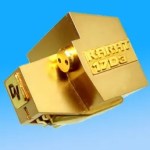
In both his system and mine, it starts with this little fellow right here.

If you are interested in acquiring what we consider to be the best sounding cartridge on the market, please contact us. We are dealers for Dynavector and can get you a 17dx at a good price, and typically in short order.

(more…)

Amazing Grace – A Bit of VTA Experimentation Can Really Pay Off

More Setup Advice for Turntables and Cartridges

UPDATE 2026

Although we liked it well enough, this title unfortunately did not get much love from our customers.

Years ago it was tagged here as a never again title, which simply means we would stop doing shootouts for it because they were no longer profitable. (It’s possible we could do it again, expecially if we were to get hold of an amazing sounding pressing or two, but at this point that does not seem to be in the cards, if for no other reason than we have stopped buying them altogether. Cheap records are a thing of the past and have been for quite a while now.)

We encourage you to find a nice copy for yourself. Stick with the early label. If you don’t hear the sound we describe below, you might consider buying more copies until you do, assuming you like the music.


Amazing Grace is a handy record for VTA setup, a subject we discuss below.

On the better copies Aretha’s vocals are as dynamic as any you will ever hear, and unlike all the records she did with Tom Dowd, her voice never breaks up on this record. If you have big speakers that can play at loud levels, with the right volume level you can really get Aretha to belt it out like nothing you have ever heard on record. 

Like most modern churches, the kind that have upholstered pews and lots of carpeting, the natural reverberation of the sound isn’t as pronounced as it would be were the recording taking place in a 16th century cathedral.

Note also that the recording is from 1972, not 1962, so the Tubey Magic that would have been on a recording such as this ten years earlier is not going to be as great either.

When we play a big stack of copies of a record like this, the limitations of the recording have to be taken into account.

The best copies will do what the best copies do; we can’t ask them to sound like something they were never designed to sound like.

The best copies of the album clearly sound quite a bit better than the average copy we played, but they still sound like the same recording, just bigger, richer, clearer and more alive.

To set your VTA right, don’t try to make Aretha too smooth — she should sound a bit “hot” when the spirit fills her and she shouts her loudest. If you get her to sound correct you lose a lot of space and ambience. What space and ambience there is on the tape need to be there for the recording to sound “real.”

(more…)

Robert Brook Knows a Better Way to Do Analog – Part Two

Robert Brook runs a blog called The Broken Record, with a subtitle explaining that his blog is:

A GUIDE FOR THE DEDICATED ANALOG AUDIOPHILE

We know of none better, outside of our own humble attempt to enlighten that portion of the audiophile community who love hearing music reproduced with the highest fidelity and are willing to go the extra mile to make that happen.

There’s a BETTER WAY to do ANALOG – Part 2


(more…)

Is That a Good Record, Or Just One Your Cartridge Really Likes?

More Turntable Setup Advice

An anonymous person commented as follows about the 17dx he bought recently:

I think it’s worth mentioning here that when it comes to cartridges, not only are we rarely in a position to demo a cartridge that we don’t necessarily have to keep, but even if could remove a cartridge we’ve tried and return it, the installation process can be a significant deterrent to doing that.

Plus, as ab_ba points out, that cartridge is likely to like some of our records. So what do we do? We just end up playing those records more often and buying more records like them so we have more records that our catridge likes. IOW, we adapt to the circumstances.

When one day we put on a record that we used to love and discover we don’t love it so much, and we realize it’s the cartridge that doesn’t love it, some of us will do what I did and buy a Dynavector 17dx from Better Records because we can then rest assured that anything that’s on that record that’s lovable, or not so lovable, the 17dx is going to show it to us either way.

I repied:

Dear Sir (if I may assume your gender),

Well said. The reason we have an entire section devoted to test records is so that audiophiles can find out what the strengths and weaknesses of their equipment might be. Whether the relatively few audiophiles who choose to test themselves with these recordings will go on to fix the problems they find is something we can only speculate about.

Most of the audiophiles whose systems I critiqued didn’t seem to appreciate what I had to say and none as I recall acted on my ideas for improvement.

I am glad you like what your 17dx does for your system. Its output is ruler flat, and that is its biggest benefit for those of us who want to hear our records sounding they way they actually do sound, “lovable” or “unlovable,” as the case may be.

It has been my experience that many audiophiles are not in favor of removing mostly-euphonic colorations from their systems. This is especially true when it results in the imperfections and shortcomings they have failed to address, or even acknowledge, are exposed and become irritating.

The modern Heavy Vinyl pressing tends to be overly smooth. This, judging from the sales and overall customer satisfaction of such records, must be helping to solve some of the problems in the systems of those who have found these pressings and their artificially adjusted tonal balance to their liking.

Accurate playback is not the be-all and end-all for everyone in our hobby. Some people just want to play a record for enjoyment, and if the colorations or limitations of their system helps them to do that, I say more power to them.

It’s not what you want and it’s not what I want, but clearly the audiophile community has outvoted us and proceeded down that road.

For those who want to make progress in the quality of our playback and the specific pressings of the recordings we choose play, you and I both know that road leads to a dead end.

(more…)

Can the Brightness Problem on the UHQR of Tea for the Tillerman Be Fixed?

Hot Stamper Pressings of the Music of Cat Stevens Available Now

Can adjusting the VTA for the heavier weight vinyl of the UHQR fix its tonality problems?

[This subject also came up in a discussion of the remastered pressings of Scheherzade.]

Probably not. VTA is all about balance.

Adjusting for all the elements in a recording involve tradeoffs. When all the elements sound close to their best, and none of them are “wrong,” the VTA is mostly right.

Try as you might, you cannot fix bad mastering by changing your VTA.

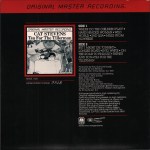
Tea for the Tillerman on UHQR

When I first got into the audiophile record business back in the 80s, I had a customer tell me how much he liked the UHQR of Tea for the Tillerman.

This was a record I was selling sealed for $25. And you could buy as many as you liked at that price!

I was paying $9 for them and could order them by the hundreds if I’d wanted to. Yes, I admit I had no shame.

I replied to this fellow that “the MoFi is awfully bright, don’t you think?” (My old Fulton system may have been darker than ideal, but no serious audio system can play a UHQR as bright as this one without someone noticing the paint has started to peel.)

His reply: “Oh no, you just adjust your VTA until the sound is tonally correct.”

(more…)