Month: December 2024

Don’t Waste Your Money on these Mozart Symphonies

More of the Music of Wolfgang Amadeus Mozart

Neither the sound nor the performance of this 1958 Mercury are impressive.

1959 just happens to be one of the all time great years for recording in analog.

If you have any doubt, check out this amazing group of albums, all recorded or released that year.

This Mercury might be passable on an old school system, but it was too unpleasant to be played on the high quality modern equipment we use.

There are quite a number of others that we’ve run into over the years with similar shortcomings. Here they are, broken down by label.

  • London/Decca records with weak sound or performances
  • Mercury records with weak sound or performances
  • RCA records with weak sound or performances

Have You Noticed…

If you’re a fan of Mercury Living Presence records — and what right-thinking audiophile wouldn’t be? — have you noticed that many of them, this one for example, don’t sound very good?

If you’re an audiophile with good equipment, you should have.

But did you? Or did you buy into the hype surrounding these rare pressings and just ignore the problems with the sound?

(more…)

Letter of the Week – “Un******believable that any record could sound that good.”

Hot Stamper Pressings of the Music of America Available Now

One of our good customers had this to say about some Hot Stampers he purchased not long ago:

Hey Tom, 

I want to tell you I bought America’s 1st LP from you some couple of years back. White Hot designation at that time. I don’t know if you have found one better since then.

Paid big dollars and I still cannot believe the sound. Worth every penny. 

When I play that LP, I cannot avoid getting goose bumps or getting totally enveloped with the music. The guitars and vocals are flat out surreal.

It is just as amazing as the Eagles 1st LP Hot Stamper. Un******believable that any record could sound that good.

Bill 

Bill,

Thanks for your letter. I know exactly what you mean. In 1971 or 1972 I got my first copy of America and it quickly became a record I could not get enough of.

I didn’t discover how hot the first Eagles album could sound until about 2000. That’s how long it took me to stumble upon the original white label Asylum pressing.

Before then all I had heard were the blue label reissues, and most of those are unimpressive to say the least.

Since then we have written in some depth about the album, which you can read all about here if so inclined.

(more…)

Simply Red – Men and Women

More Simply Red

More Rock and Pop

  • Simply Red’s sophomore LP makes its Hot Stamper debut with INCREDIBLE Shootout Winning Triple Plus (A+++) sound throughout this original import pressing – remarkably quiet vinyl too
  • Both sides are amazing clear and transparent, with present and breathy vocals throughout
  • Analog at its Tubey Magical finest – you’ll never play a CD (or any other digitally sourced material) that sounds as good as this record as long as you live
  • “…the album holds up as a solid and assured work, and the musicianship is as stellar as you’d expect.”

(more…)

Music From Peer Gynt – Another Cisco Disaster

Hot Stamper Pressings of the Music of Edvard Grieg Available Now

An audiophile hall of shame pressing from Cisco / Impex /  Boxstar / Whatever.

Pretty bad, on a par with the transistory, shrill crap Classic Records had been dishing out for years, but in the opposite direction tonally: it’s dull and dead as a doornail.

I often mention on this blog that Cisco’s releases (as well as DCC’s) had to fight their way through Kevin Gray’s transistory, opaque, airless, low-resolution cutting system. We discuss that subject in more depth here.

Our favorite recording of Peer Gynt is the one by Otto Gruner-hegge and the Oslo Philharmonic from 1959.

(more…)

Al Di Meola – Electric Rendezvous

More Al Di Meola

More Jazz Fusion

  • Electric Rendezvous debuts on the site with killer Nearly Triple Plus (A++ to A+++) grades throughout this vintage Columbia pressing, just shy of our Shootout Winner – exceptionally quiet vinyl too
  • Both sides are incredibly lively, full-bodied, open and present – the sound is huge and weighty and it rocks
  • “Al di Meola’s fifth of seven fusion albums as a leader for Columbia is a typically fiery effort…[and] is easily recommended to fans of rock-ish jazz guitar.”

(more…)

Our Take on the MoFi 45 Brothers In Arms

Hot Stamper Pressings of the Music of Dire Straits Available Now

We have never bothered to play their remaster, along with some other Heavy Vinyl reissues we think have very little chance of actually sounding good to us.

I found out recently that the MoFi is now on the TAS Super Disc list. You can find it along with the domestic — yes, you read that right — domestic pressing of the first album.

Now just how hard of hearing do you have to be to think that the domestic pressing of Dire Straits’ first album is a Super Disc? A nice record, sure, but nice records aren’t really Super Discs, are they?

Not when there are UK pressings that trounce it. We should know, we’ve played them by the dozens. How the writers for The Absolute Sound can be this far off the mark is a question we cannot begin to answer.

The most obvious answer — and therefore the most likely one — is reviewer malpractice.

What else could it be?

What We Think We Know

We have written quite a number of reviews and commentaries for the first album and we encourage you to read some of them.

Speaking of Super Discs, the good British pressings are so good we put them on our Top Ten Most Tubey Magical Rock and Pop Recordings List. No domestic pressing we have ever played would qualify as anything other than a minimally-acceptable Hot Stamper.

We would never bother to put such a pressing in a shootout, when even the average run-of-the-mill UK copy is better.


We Get Letters

A few years ago we received this email from a customer.

“How would you compare the Brothers in Arms SHS to the Mobile Fidelity 45 rpm copy?”

Dear Sir,

We have never bothered to play their remaster, and why would we? Every MoFi pressing made by the current regime has had major sound problems when compared head to head with the “real” records we sell, and it’s simply not worth our time to find out exactly what is wrong with the sound of any of these new reissues, theirs included.

[I will be reviewing their unbelievably awful Dire Straits first album on 45 one of these days. Rarely have I heard such a good recording, a brilliant recording, turned into such a piece of crap. Robert Brook didn’t like it either.]

However, we have been known to make an exception to that rule from time to time. Recently we did so in the case of the Tea for the Tillerman George Marino cut at 45 RPM for Analogue Productions.

(more…)

Making Mistakes Is Key to Finding Better Sounding Records

New to the Blog? Start Here

Wise men and women throughout the ages have commented on the value of making mistakes.

Here is one of our favorite quotes on the subject.

“A man should never be ashamed to own he has been in the wrong, which is but saying… that he is wiser today than he was yesterday.”   Alexander Pope, in Swift, Miscellanies

When I think of the 20 odd years (early ’70s to early ’90s) I wasted trying to figure out how audio works before I had much in the way of critical listening skills, it brings to mind that old Faces’ song, “I wish that I knew what I know now, when I was younger.”

Learning how to do shootouts for your favorite albums is without a doubt the fastest and easiest way to hone your listening skills, a subject we discuss often on the site and most cogently in this commentary from way back in 2005.

We believe that the only way to really learn about records is to gather a big pile of them together, clean them up and listen to them one by one as carefully and critically as possible.

We do not recommend devoting much time to reading about them in magazines or on forums.

We also would dissuade the serious record collector from paying much attention to what the most sought after or most expensive pressings are. Records have market prices based on a host of factors that mostly have nothing to do with sound quality.

And don’t think you can “logically” predict which pressings should sound the best and then just go about acquiring them.

None of these methods are likely to produce good results.

Making mistakes will though. And the more you make, the more you learn. The more you learn, the easier it is to recognize and pursue good records. It also makes it easy to part with your bad ones. The latter group we hope will include the majority of your holdings of Heavy Vinyl and Half-Speed Mastered Recordings. At best those should be seen as placeholders. They’ll do until something better comes along. And considering how mediocre so many newly remastered records are, “something better’ should not be hard to find.

And the better developed your critical listening skills become, the less likely “they’ll do” at all. They’ll just get put on a shelf. It has been our experience that good records get played and bad records don’t.

(more…)

Bud Shank And the Sax Section – An Undiscovered Gem

More Bud Shank

More Jazz Recordings Featuring the Saxophone

  • This stellar copy of Bud Shank’s 1966 release boasts Shootout Winning Triple Plus (A+++) sound or close to it on both sides – open, lively and dynamic throughout
  • Full, rich, and spacious with tons of Tubey Magic and, better yet, never dry, hard or transistory — true DEMO DISC QUALITY sound 
  • An absolutely amazing recording engineered by none other than Bruce Botnick – the sound of multiple saxes playing these lively arrangements is music to our ears
  • “… the album works, largely because of Bob Florence’s arrangements and the shrewd doubling of the baritone and bass sax parts, which give the charts heft at the bottom… The overall sound remains wonderfully reedy and flighty.”

Bruce Botnick sure knew what he was doing on this session. He succeeded brilliantly in capturing the unique sound of each of the saxes. The album is really more of a West Coast pop jazz record than it is a “real” jazz record. The arrangements are very tight, the songs are quite short — none exceed three and a half minutes — so there is not a lot of classic jazz saxophone improvisational blowing going on.

Spacious and transparent with plenty of analog Tubey Magic to go around, this is a really wonderful way to hear the music. The sax sound is excellent — rich and full, with none of the hard, edgy quality we heard on the less than stellar pressings. For richness and Tubey Magic — with no sacrifice in clarity or dynamics — these sides just could not be beat.

(more…)

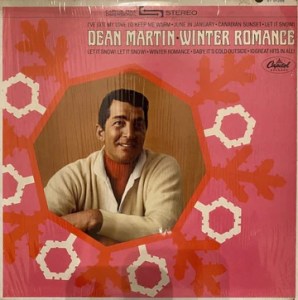
Dean Martin – Winter Romance

More Dean Martin

More Pop and Jazz Vocal Recordings

  • Stunning sound throughout this vintage 60s Stereo LP, with both sides earning Nearly Triple Plus (A++ to A+++) grades, just shy of our Shootout Winner – fairly quiet vinyl too
  • With a voice that is relaxed, smooth and warm, Dino is the perfect guy to sing these songs
  • The sound of this reissue is far better than any of the originals we played, which just goes to prove that the idea that the original is going to be the best sounding version of any given title is a canard
  • More titles like this one that potentially sound their best on the right reissue pressing
  • Rich, sweet, full of ambience, dead on correct tonality, and exceptionally breathy vocals – everything that we listen for in a great record is here
  • “…with its lush strings, well-scrubbed vocal choruses, and buoyant mood, this collection has an appropriately festive feel.”
  • 1959 was a phenomenal year for audiophile quality recordings – we’ve auditioned and reviewed more than one hundred and seventy titles as of 2024, and there are undoubtedly a great many more that we’ve yet to discover

Having done this for so long, we understand and appreciate that rich, full, solid, Tubey Magical sound is key to the presentation of this primarily vocal music. We rate these qualities higher than others we might be listening for (e.g., bass definition, soundstage, depth, etc.). The music is not so much about the details in the recording, but rather in trying to recreate a solid, palpable, real Dean Martin singing live in your listening room. The better copies have an uncanny way of doing just that.

(more…)

Simon & Garfunkel / Bookends

More Simon and Garfunkel

  • With two solid Double Plus (A++) or BETTER sides, this early Stereo 360 pressing will be very hard to beat
  • Side one was sonically very close to our Shootout Winner – you will be amazed at how big and rich the sound is
  • This copy has lovely Midrange Magic on the guitars and voices, as well as plenty of studio ambience on most tracks, especially the simpler, more folky ones
  • An album that has become much tougher to come by, especially copies with sides that play as well as these do, although marks in the vinyl are sometimes the nature of the beast with these vintage LPs – there simply is no way around them if the superior sound of vintage analog is important to you
  • A high percentage of pressings had condition problems this time around, including our Shootout Winner, so those of you looking for the best sound might have to wait until late-2025 or even 2026 it seems
  • Top 100Five Stars – side two alone has four classics: “Fakin’ It,” “Mrs. Robinson,” “A Hazy Shade of Winter” and “At the Zoo”
  • If you’re a fan of this phenomenal folk duo, this early domestic pressing of their 1968 classic belongs in your collection.

The better copies of Bookends and Parsley, Sage, Rosemary and Thyme are a sonic step up in class from anything else these two guys ever released. If you’re looking for the Ultimate Audiophile Simon & Garfunkel record, you just can’t do better than a killer Hot Stamper pressing of either title.

Do you know how hard it is to find a clean copy of this record? I’ll bet we look at 50 every year and probably buy no more than a few, which, after cleaning and going into a shootout may or may not sound good or have audiophile quality surfaces.

What We’re Listening For On Bookends

The bigger production songs on this album have a tendency to get congested on even the best pressings, which is not uncommon for Four Track recordings from the 60s. Those of you with properly set up high-dollar front ends should have less of a problem than some. $3000 cartridges can usually deal with this kind of complex information better than $300 ones.

But not always. Expensive does not always mean better since painstaking and exacting set up is so essential to proper playback.

The supremely talented Roy Halee handled the engineering duties. Not the most “natural” sounding record he ever made, but that’s clearly not what he or the duo were going for. The three of them would obviously take their sound much farther in that direction with the Grammy-winning Bridge Over Troubled Water from 1970.

The Wrecking Crew provided top quality backup, with Hal Blaine on drums and percussion, Joe Osborn on bass and Larry Knechtel on piano and keyboards.

(more…)