vin-misc-w

We judged these vintage records to have unacceptable sound based solely on the specific pressings we played.

We can’t say that other pressings don’t sound better. We just don’t plan on playing any more copies to find out.

Avoid M Stampers and Imports If You Want the Best Sound on Tapestry

More of the Music of Carole King

The domestic pressings with the stampers shown below, and others similar to them, have not done well in our shootouts for years now. If you own a copy with these stampers, or ones like them, the good news is that we can get you a much better sounding copy of Tapestry than you have ever heard. It won’t be cheap, but we can guarantee that it will be very, very good.

Stamper numbers are not the be-all and end-all in the world of records, a subject we discuss below, but after hearing too many copies with these stampers and decidedly mediocre sound, from now on we are going to focus our attention on the stampers that do well and leave copies with these markings sitting in the bins.

Note that the last listing is for an early UK import. I have no idea how that record got into the shootout. The chances of an import doing well up against Bernie Grundman’s brilliant mastering — from back in the good old days of the 60s, 70s and 80s when he was actually doing brilliant mastering work — is so close to zero it can’t be calculated.

Sometimes we take long shots, hoping to learn something new. In this case, we learned what we already know. Yes, there are still some audiophiles who buy imports of a record like this hoping to find better sound. I can’t imagine what kind of system it would take to hide the bright, dubby sound of the UK pressing we played, but judging from some of the foolishness I read on the Hoffman forum and others of its ilk, I know there must be plenty of them out there.
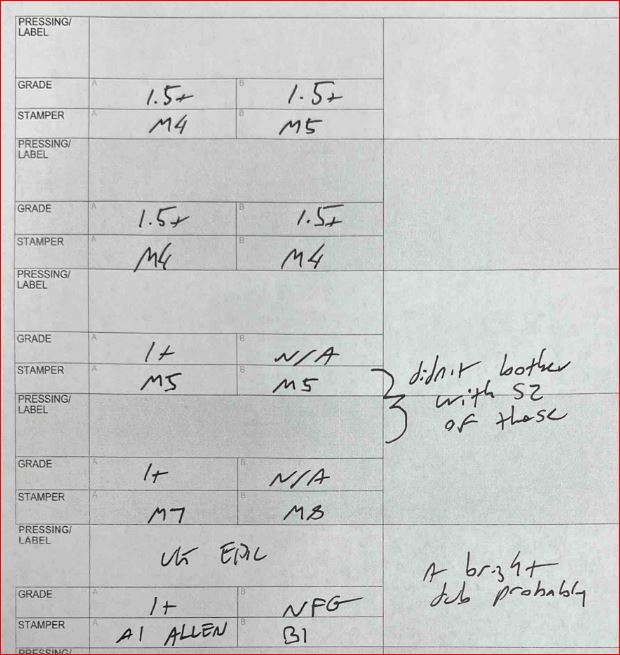
Monarch is responsible for the mediocre-at-best sound of the pressings with the stampers you see above. We tend to like Monarch pressings as a rule, but sometimes they mess up, and they messed up Tapestry compared to others who pressed the record.

We liked all the other copies with other stampers better than than these, which just goes to show you can never know how good it can get until it gets that good. That is what shootouts allow us to do.

Playing close to twenty copies of Tapestry in a shootout allows us to grade Tapestry on a scale, with the M stampers filling out most of the bottom and the other stampers — wouldn’t you like to know which ones! — occupying the middle and the top of the distribution. 

This is what the forum posters fail to understand. They think they have a Hot Stamper when what they actually have (maybe!) is a good sounding record. They don’t know how amazing the record can sound — so much more amazing than the one they own, probably — so they assume they have something good, maybe even the best.

They probably do not, but who really knows? The shootout would supply the data they need to support their conclusions, and since they could not be bothered to conduct one, they have no data to back up their opinions.

The “probably” you see in the above two sentences is there for a good reason. We make a point of being clear about what we can know and we cannot know, and we cannot know what a record sounds like until we play it.

This is obviously true for those of us who try to listen as critically as possible, but we also know that it is just as important to think about records the right way.


(more…)

These Are Just Some of the Stampers to Avoid on Catch Bull at Four

More of the Music of Cat Stevens

The domestic pressings of Catch Bull at Four with the stampers shown below, and others similar to them, have not done well in our shootouts for years now. If you own a copy with these stampers, or ones like them, the good news is that we can get you a much better sounding copy of Catch Bull at Four than you have ever heard.

Stamper numbers are not the be-all and end-all in the world of records, a subject we discuss below, but after hearing too many copies with these stampers and decidedly mediocre sound, from now on we are going to focus our attention on the stampers that do well and leave copies with these markings sitting in the bins.

When it comes to stampers, labels, mastering credits, country of origin and the like, we make a point of revealing very little of this information on the site, for a number of good reasons we discuss here.

The idea that the stampers are entirely responsible for the quality of any given record’s sound is a mistaken idea, and a rather convenient one when you stop to think about it. Audiophiles, like most everybody else on this planet, want answers.

(more…)

Columbia Released Mariah Carey’s Bad Sounding Debut in 1990

Digital Recordings with Honest to Goodness Audiophile Quality Sound

Very digital sounding, with way too much sizzle on the top end. Best to give this one a pass if you are looking for audiophile sound. If you are looking for audiophile sound quality, this site is full of the best sounding records ever made.

We play mediocre-to-bad sounding pressings so that you don’t have to, a public service from your record loving friends at Better Records.

You can find this one in our hall of shame, along with more than 350 others that — in our opinion — qualify as some of the worst sounding records ever made. (On some records in the Hall of Shame the sound is passable but the music is bad.  These are also records you can safely avoid.)

Note that most of the entries are audiophile remasterings of one kind or another. The reason for this is simple: we’ve gone through the all-too-often unpleasant experience of comparing them head to head with our best Hot Stamper pressings.

When you can hear them that way, up against an exceptionally good record, their flaws become that much more obvious and, frankly, that much more inexcusable.


Further Reading

A Very Bad Porky/Pecko Cutting of My Aim Is True

Hot Stamper Pressings of Elvis’s Albums Available Now

My notes for the one and only UK pressing I’ve played in many years, the one with Porky is the dead wax, note its many weaknesses:

Really loud and full.

Too loud and hot vocal.

Strains a lot.

You know what the sound of this record reminds me of?

An old 45 RPM 7″ single. Remember those?

It’s not unusual for 45 RPM singles from back in the day to be very loud, very compressed, and they often have much-too-hot vocals designed to jump right into your lap.

Mono mixes sometimes have some of that same lowest-common-denominator sound.

This mix is stereo but it sounds like it’s coming right out of a jukebox.

No doubt Mr. Peckham was told to make the record sound that way, and he did his job very well.

But audiophiles looking for good sound should heed this warning and avoid the UK LPs of the album. It’s a joke next to the domestic pressings with the right stampers. (The right stampers are hard to find but you will never hear a good sounding early pressing unless you have a copy with the stampers that sound right, a tautology to be sure but one worth noting.)

(more…)

These Two Recordings of Antonio Carlos Jobim Didn’t Make the Grade

Hot Stamper Pressings of Bossa Nova Albums Available Now

Pictured to the left are a couple of the Antonio Carlos Jobim albums we’ve auditioned over the years.

Without going into specifics, we’ll just say these albums suffer from weak music, weak sound, or both. They may have some appeal to fans of Mr. Jobim, but audiophiles looking for top quality sound and music — our stock in trade — are best advised to look elsewhere.

(more…)

Where Can I Find Your Hot Stamper Beatles Pressings in Mono?

Hot Stamper Pressings of Rubber Soul Available Now

One of our good customers had a question about our Hot Stampers recently:

I notice you don’t mention whether the Beatles recordings are stereo or mono. The Rubber Soul that just arrived is stereo. I’m guessing that the one I reordered is also stereo.

Do you guys stock the mono versions? Do you say on the site when something is mono. Let me know, as I like mono versions too.

I was close with Geoff Emerick and he always stressed to me that they spent tons of time on the mono mixes and not much on the stereos (up through Revolver). So let me know if/when you have mono for Rubber Soul and Revolver and perhaps I can snatch them up.

Brian

Brian,

All our records are stereo unless we specifically mention otherwise, as are our Beatles records.

We never sell Beatles records in mono, ever.

Here is a little something I wrote about it: Revolver in disgraceful mono

They spent time on the mono mixes because getting the levels right for all the elements in a recording is ten times harder than deciding whether an instrument or voice should be placed in the left, middle or right of the soundstage.

And they didn’t even do the stereo mixes right some of the time, IMHO.

But in my book, wall to wall beats all stacked up in the middle any day of the week.

(more…)

Barabajagal – Never Played a Good One

My notes: Murky sound.

We’ve played pressings from every era and have yet to hear one sound any good.

A PUBLIC SERVICE

We play mediocre-to-bad sounding pressings so that you don’t have to, a public service from your record loving friends at Better Records.

You can find this one in our Hall of Shame, along with more than 350 others that — in our opinion — qualify as some of the worst sounding records ever made. (On some Hall of Shame records the sound is passable but the music is bad.  These are also records you can safely avoid.)

Note that most of the entries are audiophile remasterings of one kind or another. The reason for this is simple: we’ve gone through the all-too-often unpleasant experience of comparing them head to head with our best Hot Stamper pressings.

When you can hear them that way, up against an exceptionally good pressing, their flaws become that much more obvious and, frankly, that much less excusable.

(more…)

The Original Pressings of The Beatles Albums Are the Best Sounding, Right?

beatles help labelHot Stamper Pressings of the Music of The Beatles Available Now

No they are not. At least the ones on the label you see pictured are not (with the exceptions noted below).

We think it’s just another example of mistaken audiophile thinking.

Back in 2005 we compared the MFSL pressing of Help to a British Parlophone LP and were — mistakenly, as you may have already surmised — impressed by the MoFi. We wrote:

Mobile Fidelity did a GREAT JOB with Help!. Help! is a famously dull sounding record. I don’t know of a single original pressing that has the top end mastered properly. Mobile Fidelity restored the highs that are missing from most copies.

The source of the error in our commentary above is in this sentence, see if you can spot it:

I don’t know of a single original pressing that has the top end mastered properly.

Did you figure it out? If you’ve spent much time on our site of course you did.

Original pressing?

Is that the standard?

Why? Who said so? Where is it written?

(more…)

Did Gary Puckett and the Union Gap Ever Make a Good Sounding Record?

Their recordings may be amazing, but the pressings made from them sure leave a lot to be desired.

In fact, their music sounds better on the radio than it does on the half dozen pressings we’ve played, of the one pictured above and other titles as well. If we hear a good sounding pressing down the road, we would certainly be open to the possibility of doing a shootout for it.

We play mediocre-to-bad sounding pressings so that you don’t have to, a public service from your record loving friends at Better Records.

You can find this one in our Hall of Shame, along with more than 350 others that — in our opinion — qualify as some of the worst sounding records ever made. (On some records in the Hall of Shame the sound is passable but the music is bad.  These are also records you can safely avoid.)

Note that most of the entries are audiophile remasterings of one kind or another. The reason for this is simple: we’ve gone through the all-too-often unpleasant experience of comparing them head to head with our best Hot Stamper pressings.

When you can hear them that way, up against an exceptionally good pressing, their flaws become that much more obvious and, frankly, that much less excusable.

Skip the Mono on Big Band and Quartet

Hot Stamper Pressings of the Music of Thelonious Monk Available Now

Stick with stereo on this title; the mono we played was a disaster and not worth anybody’s time (scratch that: any audiophile’s time).

If you see one for a buck at a garage sale, pick it up for the music, and then be on the lookout for a nice stereo original to enjoy for the sound.

Skip This One Too

The Thelonious Monk Orchestra at Town Hall on Riverside (1959). Never heard a good one. Same arranger, Hal Overton, but much poorer sound.

Notes from a Long Ago Shootout

An amazingly well-recorded Big Band Concert from 1963, and these White Hot sides make the case like nothing you have ever heard. Our early pressing here is so rich, Tubey Magical, spacious and lively we simply could not fault the sound. Monk alternates between a 10 piece Big Band and his standard quartet, with magical results. 

Normally our notes for the sound of the records we are comparing in our shootout fall into two categories: what the record is doing right and what the record is doing wrong. In this case there was nothing wrong about the sound to write about.

I could have tried to pick some nits, but when a record is so clearly superior to its competition, what’s the point?

Side One

The right sound — HUGE, rich, tubey and clear. No need to pick nits. This side is so HTF – Hard To Fault – that we simply have to call it MTS – Master Tape Sound.

Side Two

Transparent. Rich, smooth, balanced. Spacious and open and yet so Tubey Magical.

Tubes

On this record, more than most, the tubes potentially make all the difference.

(more…)