thin-sound

Stick with Porky on East Side Story

More Hot Stamper Pressings We Only Offer on Import Vinyl Available Now

Porky cut the original British pressings of this Squeeze album, one of countless personal favorites of yours truly. They are records (and cassettes and CDs) I have played hundreds of times and still listen to regularly to this very day, in this case more than forty years after I purchased my first copy. (Good albums age well.)

I would have picked the record out of the bin at my local Tower Records, probably based on the radio play Tempted was getting.

That copy undoubtedly would have been domestic and made from a sub-generation tape, although I’m quite sure I could not have recognized what constituted dubby sound back then. In 1981, what I understood about the importance of different record pressings would have fit comfortably in a thimble.

I had my MoFi’s, and although I hate to admit it, that’s about as far as I had gotten in my quest for superior sounding pressings. You could add Nautilus and a few other Half-Speeds to the list of what pressing I thought were impressive, leaving plenty of room in that thimble unfilled.

Thankfully those bad old days are gone, and the music can now, finally, live and breath on the best of these imports from the UK. Of course they are the only ones we buy these days for our shootouts. The others are what are known around these parts as “mistakes.”

Sometimes the imported pressings are mastered by Porky and sometimes they are not. The ones that are not tend to have a lot of problems, as you can see from our stamper sheet below.

When Porky is not on side one, that side will tend to be hard, lean and bright. Side two of that copy had decent sound, earning a minimal Hot Stamper grade of 1.5+.

(more…)

Coltrane’s Sound – Forget the 70s Reissues

Hot Stamper Pressings of the Music of John Coltrane Available Now

This is yet another superb Tom Dowd recording of Coltrane in his prime, with support from the brilliant McCoy Tyner and Elvin Jones.

Just don’t bother with the later Red and Green Atlantic pressings.

Every one we’ve ever played was flat, dry, and thin. They sound like most of the cheap reissues that Atlantic churned out in the ’70s.

Don’t get me wrong; there are some good sounding records on the Red and Green label, but you really have to know what you are doing — or be really lucky — to find them.

We’ve played them by the score, and found relatively few winners among a slough of losers. If you want to take your chances on some, knock yourself out, more power to you, but expect to come up with nothing to show for your time and money almost every time. That’s been our experience anyway.

And be very thankful if you happen to run into one of these early Atlantic stereo pressings, especially if it plays quietly. Few Classic Coltrane albums survived the jazz lovers of the day and their awful turntables.

(more…)

Black Byrd on Heavy Vinyl – Yes, You COULD Do Worse!

Hot Stamper Pressings of Blue Note Recordings Available Now

We did a shootout for Black Byrd in 2025. We were fortunate to be able to include the Heavy Vinyl pressing that came out in 2002 along with the vintage pressings we had on hand.

The reissue was made back in the days when Rainbo Records was pressing records. (Scorpio carried a lot of Rainbo Records when I was still selling regular vinyl, and their pressings were often warped and defective, causing me to stop buying their releases.) Rainbo Records went under in 2011 (according to Discogs), not a moment too soon. They pressed mostly cheap junk vinyl aimed squarely at the lo-fi crowd.

But let’s get back to Black Byrd. Here is the way we described a Hot Stamper we put up on the site recently:

We played a bunch of these recently and only a few had the kind of sound we were looking for. This one was one of the best we heard — big, bold and lively with excellent presence. The bottom end is meaty and punchy, the highs are sweet and extended, and the mids sound right.

Most copies didn’t jump out of the speakers the way this one does. You’ll have a hard time finding such rich, smooth sound for this wonderful jazz album.

Some of these later pressings are just plain weak, but every now and then you find one like this that clearly benefits from the use of modern cutting equipment. The bass is tighter, the drums have more snap, and the soundfield has real depth. There’s excellent energy and good presence throughout, and the top end sounds just right.


Admittedly the above is fairly generic, but good records tend to do what good records always do, so why get specific? If you want to see in-depth notes for records that we’ve played in shootouts, we have a section full of them on the blog and you can be sure there are a great many more on their way if I have anything to say about it. (You can’t fire me — technically I still own the company.)

At around $30, all this Heavy Vinyl pressing would have to be is decent sounding. With a grade of 1+, it’s close, but just short of a cigar. Heavy Vinyl reissues of mediocre quality have their own section, mostly populated by the better releases on Speakers Corner, Cisco, Classic Records and others starting in the 90s.

We use the 1+ grade for vintage records that are passable, not good enough to qualify as a Hot Stamper but not really a bad pressing either.

A mediocre grade puts it well ahead of the pack when you consider just how dreadful many of the releases we’ve played recently turned out to be.

(The Heavy Vinyl disasters section you see below has more than two hundred entries at this point, with many more on the way. As long as they keep making bad sounding remastered vinyl, we’ll keep publishing our notes, hopefully to help music lovers and audiophiles more easily recognize their shortcomings. Perhaps someday both groups will recognize what a waste of money these pressings are.)

We only played side two of this copy for some reason. It’s possible side one is better, but it may be worse, we honestly can’t say since we didn’t play it. Considering it was pressed by Rainbo Records, side one is unlikely to be any better.

(more…)

With The Beatles on Mobile Fidelity

Sonic Grade: C+

The MoFi pressing of With the Beatles has so many problems it would take an hour to describe them all. Suffice it to say, it’s thinner and brighter, with voices that are grittier and grainier. The overall effect is the sinking feeling that you are listening to a cheap reissue and not the real thing. Don’t the Beatles sound better than this? To be fair, some tracks are okay, others a disaster.

If you own the MoFi, play it. Listen to it carefully. Make notes of which songs sound better than others and why. That’s how we spend our days, evaluating the relative merits of various pressings, and it’s that and that alone that has given us the critical listening skills necessary to recognize and appreciate the differences among the records we play.

One of the biggest problems with the average Parlophone copy is just the reverse of the MOFI. They tend to have rolled off highs, which emphasizes the harshness in the upper midrange and causes a loss of transparency. (The best Hot Stamper copies are of course as smooth, sweet, and transparent as they come.) Even with those shortcomings though, I would still rather listen to a typical Parlophone pressing. I wouldn’t be frustrated by the sound of somebody fooling with the EQ and screwing it up.  (more…)

Could This Be More of the Sound Audiophiles Complain About with RVG’s Mastering?

Hot Stamper Pressings of the Music of John Coltrane Available Now

Some of the Rudy Van Gelder cuttings of this album were decent, but had you bought a copy with these stampers, you could be forgiven for using the man’s name in vain.

VAN GELDER in the dead wax is no guarantee of high quality sound, on any record. Records don’t work like that.

The 1+ grade found on side one of both discs means the sound for those two sides may be passable, but the NFG sound on side two of record one means you have at best only half an album with decent sound, and what good is that?

As you can see from our notes, the sound is way too hot and messy and thin.

Note that side two of the second record wasn’t played at all. Why waste more time on a record that clearly did not come off the press properly, whether from bad mastering or bad vinyl? Or bad something else, who can say?

We do not sell records with 1+ grades. You should have no trouble finding those on your own. The world is full of them.

Poor Rudy

Rudy Van Gelder comes in for a lot of criticism from the audiophile community, especially from audiophiles who tend to prefer the remastered Heavy Vinyl pressings made from his recordings.

Unsurprisingly, much of the criticism comes from some of the very same engineers responsible for the remastering those records.

Those who produce reissues of his recordings are notable critics as well.

(more…)

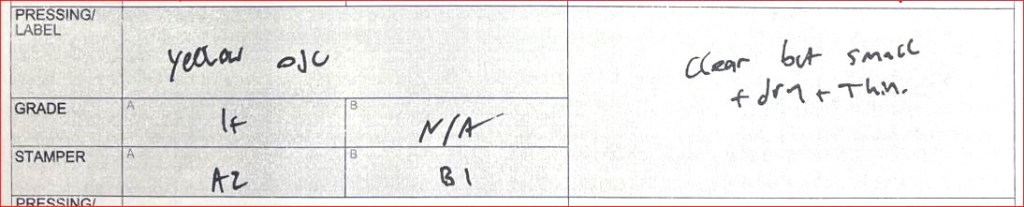
Soultrane Sucks on the Early OJC

Hot Stamper Pressings of the Music of John Coltrane Available Now

The early OJC reissues from 1982 of this title are awful.

And whatever Heavy Vinyl they’re churning out these days is probably every bit as bad, but — I’m guessing, never played one so don’t hold me to it — in the opposite way.

The OJC is thin and bright, and the modern reissue (I’m assuming, based on playing scores of them) is probably thick, veiled, overly smooth, lacking in space and boosted in the bass — because that’s the sound that audiophiles record buyers seem to like these days.

Without the excellent sounding 60s and 70s reissues that we are still able to find in audiophile playing condition, all that we would have available to buy for our shootouts would be the originals. 

At the big bucks those records go for nowadays, shootouts would be impossibly expensive.

So our thanks go to Rudy for doing a good job on these later pressings!


UPDATE 2025

We were surprised to find that the right stampers on the new OJC pressings can have very good sound. Click on the link below to that Soultrane has joined the group of good sounding modern OJC pressings.

(more…)

The Original Jazz Classics Series Put Out a Passable Relaxin’ in ’85

Hot Stamper Pressings of the Music of Miles Davis Available Now

We much prefer the 70s Two-Fer reissue (PR 24001) to the OJCs of both Cookin’ and Relaxin’. Previously we had written:

These 70s reissue pressings are practically as good as any we have ever heard. Full-bodied, warm and natural, with plenty of space around all of the players, this is the sound of vintage analog.

It had been a while since we last played the OJC pressing of either album, so we picked up a copy of Relaxin’ and threw it into the shootout, where it did about as badly as expected.

The first side earned our 1+ grade, which means that, like a lot of reissues it’s passable, but really not good enough for a serious audiophile (hopefully meaning you) to bother with, which is why we didn’t even play side two (the N/A you see noted where the grade should be).

The OJC is clearly better suited to the old school audio systems of the 60s and 70s rather than the modern systems in use today. These kinds of reissues used to sound good on those older systems, and I should know, I used to have an old school stereo, and some of the records I used to think sounded good back in the day don’t sound too good to me anymore (although this one never did).

(more…)

These Kelly Blue Reissues from the 70s Are a Real Mess

Hot Stamper Pressings of the Music of Wynton Kelly Available Now

Sometimes the 70s reissues of vintage jazz recordings that were made in the fifties, sometimes released with different covers similar to the one you see pictured, have excellent sound.

We know that for a fact because we’ve played some very good ones.

In the case of Kelly Blue, we felt we were obligated to play a few to make sure we were hearing as wide a range of different pressings as possible. We wanted to be sure we were hearing the best sounding pressings regardless of what era they were pressed in. (We’re very open minded that way.)

Here are our notes for the Black Label Riverside Stereo pressing with “1971” stampers:

  • Thin,
  • Dry,
  • Honky,
  • Veiled.
  • Severe stereo spread. (Hard left and right, unmusical this way, players are disconnected.)
  • Grade: 1+ on both sides

The other copy we had was even worse:

  • NFG on side one, side two never played.

The Riverside originals we’ve played in the past, like a lot of other Riverside originals from the 50s, such as those by Thelonious Monk, were uniformly terrible.

And trying to find one in audiophile playing condition is as easy as it sounds.


We’ve auditioned countless pressings like this one in the 38 years we’ve been in business — buying, cleaning and playing them by the thousands. This is how we find the best sounding vinyl pressings ever made.

Not the ones that should sound the best. The ones that actually do sound the best.

If you’re an audiophile looking for top quality sound on vintage vinyl, we’d be happy to send you the Hot Stamper pressing guaranteed to beat anything and everything you’ve heard, especially if you have any pressing marketed as suitable for an audiophile. Those, with very few exceptions, are rarely better than mediocre, and some of them are just awful, with many of the newest releases being the most awful of them all!

(more…)

When Fisher Took Over from Goodall, He Really Let the Side Down

Hot Stamper Pressings of Recordings by Decca Available Now

Please keep in mind that, as per our usual, the record you see pictured is not the record we are discussing in this posting.

The stamper numbers you see below belong to a different album.

The quick takeaway: Stan Goodall (“E”) cut the Shootout Winning early pressings.

Then, for reasons known only to the folks at Decca, Harry Fisher (“W”) took the reins and managed to cut some side twos that were very good. Not as good, but still very good: 2+ most of the time, some slightly worse. They were not as weighty or rich, and we take a lot of points off for records that are not as weighty or rich as they should be.

By the time Decca had changed its label to the Decca in a Box design, Mr. Fisher was cutting all the pressings, and, in our experience, not doing an especially good job. We do not even offer records with grades that low.

The sound might be passable, and would probably still be better than whatever Heavy Vinyl pressings might have been made from the tapes in the last twenty years, but that’s not good enough for us here at Better Records, not at the prices we charge anyway.

We described Fisher’s sound as dry and hot on side one, and thin and very small on side two of the 5W-stamped pressing we played. We only had the one, and the reason we had even one after having heard other Boxed Decca pressings do poorly, is that it’s a good way to stay honest and to have a better baseline to work with.

If we played nothing but 3E/1E originals, most of those 1E side twos would have earned a 2+ grade, but they would have sounded much better than the 2W-graded copies, and that seriously screws up the grading scale, especially when clean originals cost us a hundred bucks or more these days.

(more…)

Waiting For Columbus Gets the Bernie Treatment Care of Rhino Records

Hot Stamper Pressings of the Music of Little Feat Available Now
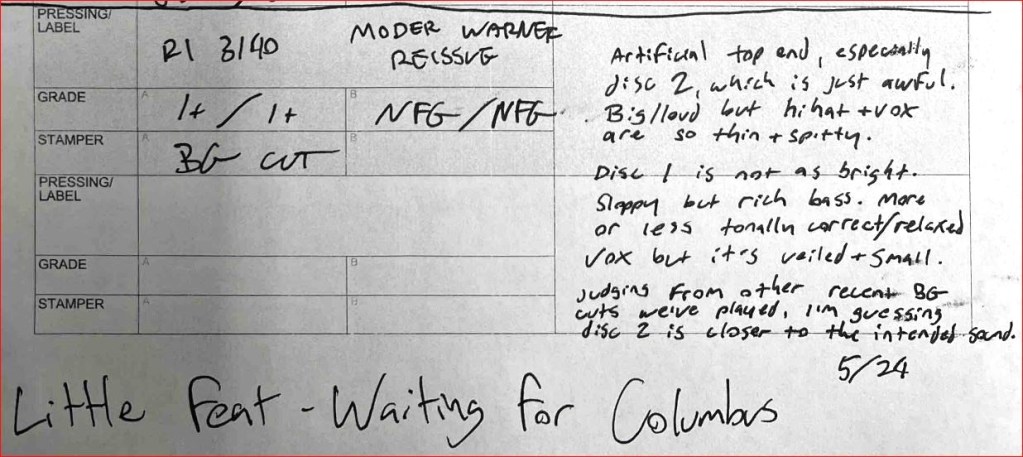
A Hot Stamper pressing of this amazing sounding album, a title we regret to say we have in stock only rarely, might be described this way:

Some of the best sounding live rock and roll sound you will ever hear outside of a concert venue. If you want to understand the unique appeal of the band, there’s no better place to start than right here.

It’s one of our all-time favorite live recordings and their single best release – a true Masterpiece.

I have lately been listening to this album in its entirety at the gym (playing the standard cassette over headphones) and enjoying the hell out of it. As good as their best studio albums are, and I count myself as big a fan of the band as there is, Waiting for Columbus is surely the pinnacle of their recorded output. It is as close to perfect as any live album I know.

(The Last Record Album is my personal favorite of their studio albums, but since nobody seems to want to buy it at the prices we charge, I regret to say we had to stop doing shootouts for it years ago. We were losing too much money that way.)

But Bernie Grundman’s version is just another one in a very long line of disastrous recuts, the kind of crap he has been churning out for the last thirty years. It’s all but unplayable on modern high quality equipment. (If it’s not on your system, you might consideer the idea that you still have plenty of work left to do, audio-wise.)

As you can see from the notes below, record one may be passable, but record two is NFG. How is it possible to turn such a wonderful recording into such a ridiculously bad sounding pressing? Even Mobile Fidelity did a better job with the album, and they’re one of the most incompetent remastering outfits that the audiophile world has even known.

We’re frankly at a loss to understand any of it.Bernie Grundman used to make good sounding records. We know that for a fact, having played them by the hundreds. Apparently those days are gone, and, based on this album and plenty of others, there is very little chance of them returning.

Notes on the Sound

(more…)