smeary-strings

Haydn / Symphonies 100 & 101 – Reviewed in 2010

More of the Music of Joseph Haydn
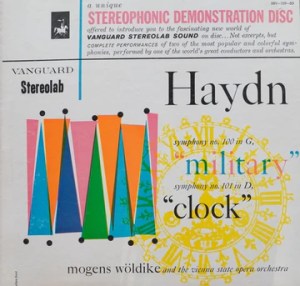
The New York Times review for these performances called them “matchless” and we see no reason to disagree! With Super Hot Stamper sound for No. 100, “Military”, we’re confident you will have a very hard time finding better sound and music from Haydn than is found on this original Black Label Vanguard Stereophonic Demonstration Disc.

Side one, containing Symphony No. 100, “Military,” is smooth and rich and full of tubey magic, the kind of analog sound that has not been recorded for more than thirty years. Because the top end is not boosted and phony like most audiophile pressings, you can play a record like this at much more realistic levels without fatigue or harshness.

Try that with the average Reference or Telarc.

The sound is a bit distant, mid-hall we would call it, but wide and full of depth the way these vintage recordings often are.

Side two has Symphony No. 101, “Clock”, another famous work from the master of the form and well-played by Mogens Woldike and the Vienna State Opera Orchestra.

This side suffers from a problem endemic to vintage pressings from all eras: smear. There is a notable loss of texture to the strings on side two compared to side one. 

(more…)

Clair de Lune – Compare and Contrast Sides One and Two

More of the Music of Claude Debussy

This Shaded Dog LP has DEMONSTRATION QUALITY SOUND, if what you’re demonstrating is not a Hi-Fi spectacular, but rather a sublime presentation of an exceptionally sweet and natural string section in an orchestra, presented here on analog disc pressed more than sixty years ago.  

I can’t imagine a more beautiful record, both in terms of the program and the sound. This record is a wonderful example of what the Decca recording engineers were able to capture on tape, and the RCA mastering engineers were able to master from that tape.

Even though the album was recorded by Decca, it’s a superb example of Living Stereo Tubey Magic at its best. There will never be a reissue of this record that even remotely captures the space, transparency, sweetness and richness of the sound here.

Side Two

A++ to A+++ or better! Without more copies in hand it’s hard to know how good the sound can get, but we found it Hard To Fault (HTF).

This side has more extension up top and down low and more texture to the strings.

Side One

A++, although it starts out a bit weaker than that and only really gets good a few minutes into the side. (We hear this effect fairly often on the records we play. Noticing things like this is what we do for a living.)

There is some smear and it is slightly opaque as well.

You will hear what we mean when you flip it over and those two problems disappear.

(more…)

Gaite Parisienne Is Just More Smeary Dreck from Classic Records

More of the Music of Jacques Offenbach (1819-1880)

Sonic Grade: F

The last time I played the Classic I thought it was nothing but a smeary mess, as awful as their awful Scheherazade. If I were to play it today, I’m guessing it would join the other Classic Records entries in our audiophile hall of shame.

Here are some other records we played and found had smeary strings. They did not last long on our turntable.

I love Arthur Fiedler‘s performance with the Boston Pops and the 1954 two track RCA Living Stereo sound, but finding an original Shaded Dog pressing in clean condition under $500 with the right stampers is all but impossible nowadays.

If you want to go that way, more power to you. 

This 1954 2-track recording is RCA’s first stereo recording of the work. 1954. Can you believe it? A few mics and two channels and it blows away most of the classical recordings ever done! Some old record collectors and tube lovers say classical recording quality ain’t what it used to be. This record proves it.

Click on this link to read more reviews and commentaries for Gaite Parisienne.

(more…)

The Concert Sinatra – What to Listen For

sinatconce_1011_1310577590

[Originally posted 2/2015]

There may be a touch of smear (you can most easily hear it in the strings) but the sound is so RICH and Tubey Magical that you will barely be aware of it. Your attention should be focused on the superb feel the man has for this music.

One thing to pay special attention to, especially if you have other copies of the album, is that Sinatra’s voice on both sides of this pressing always sounds natural even at its loudest. There is no strain or hardness.

That, among many other things, is what separates the best copies from the also-rans (and, of course, all the reissues, which tend to have gritty, harsh vocals which quickly get unbearably edgy in the louder parts).

For audiophiles, the amount of effort that went into the recording, effort that actually paid off, is what will impress the most about The Concert Sinatra. The 73 musicians you see stretched out across the soundstage at Samuel Goldwyn Studios behind Sinatra will give you some idea of the size and scope of the sound. With 24 mics feeding 8 tracks of 35MM recording film, this was the sonic equivalent of Gone With the Wind. No expense or effort was spared.

Fortunately for those of us who are still playing records forty-odd years on, this special project took place before the advent of the transistor, which means that all the Tubey Magic of the singer and his all-encompassing orchestra was captured on the “tape”.

Ah, but how much of that sound made it to the record itself? That’s always the rub with records isn’t it?

In this case, plenty.

LSC 2603 on Classic Records Is Airless, Smeary and Low-Rez

Hot Stamper Pressings with Jascha Heifetz Performing Available Now

It should go without saying that a good original pressing kills the Classic reissue, and the Classic version is one of the better Classics.

It might earn a grade of D or C, simply because it might sound about as good as the typical Red Seal reissue from the 70s.

Still, it’s no match for the real thing, not even close.

The Classic is low-rez, with smeary strings, which means that all the subtleties of the music — and the performance — will be much more difficult to appreciate. 

(more…)

Tchaikovsky / Serenade for Strings – Our Shootout Winner from 2012

The Music of Tchaikovsky Available Now

This original Shaded Dog pressing has WONDERFUL sound and exceptionally quiet vinyl for a record made in 1958.

Like most recordings from the era, it has the strengths and weaknesses of simply-miked analog tapes recorded and mastered during The Golden Age.

It’s every bit as RICH and Tubey Magical as one could ever want, but evidences some congestion in the loudest passages and a touch of tube smear even when quiet. With All Tube Mastering, this is of course to be expected.

The soundstage is especially wide on both sides but not quite as deep as one might expect. With more copies we could have done a better job of investigating the sound of the recording, but where does one find minty Shaded Dogs these days at affordable prices? Most of what we see is scratched and overplayed.

Be that as it may, the PERFORMANCE IS KING HERE — one of the greatest ever recorded, more powerful and more emotional than any with which we are familiar.

This orchestra is on fire with this stirring music. If you haven’t heard Munch’s definitive performance, you haven’t really heard the Serenade for Strings.

This is your chance to hear string playing that will have you sitting up in your chair, transfixed by the energy and enthusiasm of the Boston Symphony strings. (more…)