Jimmy Page’s Houses of the Holy Needed Tubes and Didn’t Get Them

Hot Stamper Pressings of the Music of Led Zeppelin Available Now

We did not care for the newly remastered version of Houses of the Holy. It badly lacks the kind of mastering that Robert Ludwig brought to the sound, and by that we mean lots of lovely tubes in the mastering chain.

What tube equipment he used and how he used it is something we have been researching for years now, but rather than go down that rabbit hole for the moment, let’s just say the Tubey Magic that is all over the original cuttings of the album is hard to find on the new one, and that means it’s missing a quality that makes Houses of the Holy one of the most luscious audiophile listening experiences one can have, even for those of us who long ago gave up on tube equipment.

The notes for side one, track one (The Song Remains the Same) and track three (Over the Hills and Far Away), read:

  • Blary, but not as awful as I expected
  • Dry, top end is bright, big though

The notes for side two, tracks one (Dancing Days) and three (No Quarter), read:

  • A bit thick, tonally OK
  • Less space around the low end

Tubes are what the doctor ordered, precisely the medicine that was needed to cure many of this pressing’s problems, but tubes are not what Jimmy Page and his engineer, John Davis, brought to the project, and more’s the pity. Any good domestic original will show you exactly what is wrong with the sound of this version in under two minutes.

(more…)

U2 – The Unforgettable Fire


  • “Pride (In the Name of Love)” is the big hit on this one, and the sound is appropriately glorious on this Double Plus side one
  • A tough album to find with that elusive combination of good sonics, quiet sides, and no marks that play – if you’re a fan, grab this one while you can
  • True, side two earned a minimal Hot Stamper grade of 1.5+, but we still guarantee that it will beat the pants off any Heavy Vinyl reissue because every one of those that we played was opaque, muddy and thick enough to have us crying “uncle” after five minutes
  • 4 stars: “U2 took their fondness for sonic bombast as far as it could go on War, so it isn’t a complete surprise that they chose to explore the intricacies of the Edge’s layered, effects-laden guitar on the follow-up. Working with producers Brian Eno and Daniel Lanois, U2 created a dark, near-hallucinatory series of interlocking soundscapes … ranking among U2’s very best music…”

(more…)

Electric Light Orchestra – Out Of The Blue

More Electric Light Orchestra

More of our favorite Art Rock Records

  • These early Jet pressings of ELO’s seventh studio album boast solid Double Plus (A++) grades or BETTER from start to finish
  • Side three was sonically very close to our Shootout Winner – you will be shocked at how big and powerful the sound is
  • All four sides are notably smoother and richer than most of what we played, with much less of the grit and congestion that plagues the average copy
  • “Out of the Blue was of a piece with its predecessor, A New World Record, as the most lavishly produced album in the group’s history… [It] was massively popular and did become the centerpiece of a huge worldwide tour for the group which earned them status as a major live attraction for a time.”
  • If you’re an ELO fan, this classic double album from 1977 is surely a Must Own
  • If you are new to the music of ELO and want to learn more about our pick for their best album, click here

SR Over 2

The record is actually mastered by none other than Mr. MoFi himself, Stan Ricker, at Half-Speed if you can imagine that.

Yes, the bass isn’t as tight as it would have been using real time mastering, and there is the kind of “fake richness” to the low end that you hear on many audiophile records (and practically nowhere else), but Jeff Lynne likes some artificiality in the sound of his albums, so whatever Stan Ricker brought to the table it seems Mr. Lynne was fine with it, otherwise we assume he would have had it mastered by somebody else.

Does the album need the deeper, more articulate bass it would have if someone else had mastered it using a real-time cutter? It doesn’t seem so to us. Note-like bass with its fundamental frequencies intact is always a nice thing to have on a recording, but can anyone say this music would be noticeably better for it with better bass? Again, Mr. Lynne must not have found the bass wanting enough to have the album recut by some other mastering house. Could it be a matter of trade-offs? No matter which side you are on, it’s all just speculation. You always have the option of listening to the album on CD and seeing if the bass is better there. That would be the only practical test that I can imagine having any value. And to do that test you have to play the CD, something nobody really wants to do, right?

(more…)

Stravinsky / Petrushka / Dorati

More of the Music of Igor Stravinsky

  • Excellent sound for this superb recording of Stravinsky’s ballet, with Double Plus (A++) grades on both sides of this vintage pressing (only the second copy to hit the site in nearly three years)
  • It’s also remarkably quiet at the high end of Mint Minus Minus, a grade that even our most well-cared-for vintage classical titles have trouble playing at
  • This spectacular Demo Disc recording is big, clear, rich, dynamic, transparent and energetic – here is the Mercury sound we love, and that is so hard to find
  • “Petrushka brings music, dance, and design together in a unified whole. It is one of the most popular of the Ballets Russes productions.”
  • 1960 was a great year for classical recordings – other Must Own orchestral releases can be found here.

This vintage Mercury pressing has the kind of Tubey Magical Midrange that modern records can barely BEGIN to reproduce. Folks, that sound is gone and it sure isn’t showing signs of coming back. If you love hearing INTO a recording, actually being able to “see” the performers, and feeling as if you are sitting in the studio with the band, this is the record for you. It’s what vintage all analog recordings are known for — this sound. (more…)

It’s 2007 and We’ve Just Discovered a New Wave Record to Beat Them All

Hot Stamper Pressings of New Wave Recordings

This review/commentary was written in 2007.

As far as we know, this is the only New Wave rock record with DEMO DISC sound ever made. We’re talking huge amounts of dynamic energy, tons of bass, a luscious midrange, all topped with a sweetly extended high end. I always knew there were superb sounding copies of this album, but I honestly had no idea they any could sound like this. There is only one copy that earned our coveted Triple Plus designation for both sides, and this is it. As Good As It Gets.

One other copy received a Triple Plus on side one, but this copy was still a step up from it. We hold the line at three pluses but three doesn’t begin to tell the whole story. This record is really just plain off the charts.

On our two day journey through this shootout we discovered that Candy-O only offers two things on its menu*:

1) Open Top Sandwich – extended and open top end with not enough bass 
2) Topless Tacos – driving solid punchy bass with not enough top end extension

But here’s Today’s Special:

Delicious Combo Platter – a sampling of the highest highs, the deepest punchiest bass, and the most open transparent mids, all beautifully laid out on a slab of vinyl, a veritable feast for the ears. Ahem.

(*all items come with free side of shipping when ordered from our mailer.)

What other New Wave band ever recorded an album with this kind of DEMONSTRATION QUALITY sound? It positively JUMPS out of the speakers.

No album by Blondie, Television, The Talking Heads or ANY of their contemporaries can begin to compete with this kind of sound.

[UPDATE: Not true, this one does.]

The Cars very own first album is excellent, but it doesn’t have this kind of LIFE and ENERGY. No way, no how.

If you have big dynamic speakers and like to rock, you can’t go wrong here. Neil Young albums have the Big Rock sound, and if you’re more of a Classic Rock kind of listener, that’s a good way to go. We’re behind you all the way, just check out the commentary for Zuma.

For a band with thin ties, leather jackets, jangly guitars, synths and monstrously huge floor toms that fly back and forth across the soundstage, Candy-O is the girl for you, no doubt about it.

2007 was a long time ago. It was the year we made many breakthroughs.

In fact, we made more breakthroughs in that year than in any other in the history of the company, including this singularly important break with the past.

(more…)

Art Pepper – Art Lives

More Art Pepper

More Jazz Recordings Featuring the Saxophone

  • An original Galaxy pressing with INCREDIBLE Shootout Winning Triple Plus (A+++) sound or close to it on both sides
  • You’d be hard-pressed to find a copy that’s this well balanced, big and lively, with wonderful clarity in the mids and highs
  • This live album features music from Pepper’s 1981 engagement at the Maiden Voyage club in Los Angeles
  • 4 stars: “Pepper, pianist George Cables, bassist David Williams, and drummer Carl Burnett are heard at their best on ‘Allen’s Alley’ and ‘Samba Mom Mom.'”
  • Here are some other reviews for the better live jazz club recordings we’ve auditioned over the years

(more…)

Porgy and Bess – “This is a serious step up! Crazy good.”

More of the Music of Harry Belafonte

A Living Stereo knockout. We often forget to spend time with records like this when there are Zeppelin and Floyd records to play. We’ve always enjoyed Belafonte At Carnegie Hall, but when we’ve dug further into the man’s catalog we’ve been left cold more often than not.

However, when we finally got around to dropping the needle on a few of these we were very impressed by the music and completely blown away by the sound on the best pressings.

Our Shootout Winner showed us everything we could ever want in this kind of recording and more. More, in this case, was a side two that was a step up over our best side one. We used to give records with a side two like this one a grade of A++++, but we stopped doing that years ago. (We discuss the subject of outliers down below.)

The notes for side one read:

Track One

Big, dynamic and rich vocals. Very full and rich.

Track Four

Good bass, rich and note-like.

Vocals are silky and present and hi-rez.

The notes for side two read:

Track Two

Dynamic, three-deimensional vocals.

Frequencies extend high and low.

Sweet and breathy flutes and vocals. Tubey.

Track One

So sweet and rich, can’t complain.

This is a serious step up! Crazy good.


If you want to hear a record with sound like that, focus your attention on the pressings made in 1959 – that’s where that sound can be found, and you will have a hard time finding it on any record made in the last 50 years, no matter what anybody may tell you.

If someone disagrees with that assessment, have them play you the record that beats this one, something they will have a devil of a time managing to do.

1959 Tubes?

You just can’t beat ’em.

(more…)

Can You Believe I Actually Used to Like this CBS Half-Speed?

More of the Music of Boston

Reviews and Commentaries for the Music of Boston

Sonic Grade: D

Lack of weight down low — or as we like to call it, lack of whomp factor [1] — is the main reason Half-Speed mastered records so often come up short when played against their real-time-mastered competition. The highs can be good, the mids can be good, but the bottom end is almost always lacking, which is exactly the problem here.

You can be sure that Boston would not have wanted, nor would they have ever been willing to accept, the kind of anemic sound that the CBS Half-Speed delivers.

The CBS is cut clean from a good tape, so it easily beats the bad domestic pressings, of which there are many.

But it doesn’t rock.

What good is a Boston record that doesn’t rock? It’s a contradiction in terms; they’re a rock band.

The band, as well as their amazingly well recorded debut album, have no other reason to exist.

Transparency is a nice quality, but when it comes at the expense of the energy and power of the music, especially down low, then it comes at too high a price, especially for those of us who have full-range systems and like to play them loud.

We talk about the shortcomings of transparent audiophile records here:

(more…)

Lincoln Mayorga and Distinguished Colleagues – Volume 1 (S9)

More Lincoln Mayorga and Distinguished Colleagues

Reviews and Commentaries for Lincoln Mayorga and Distinguished Colleagues

  • An original pressing of this rare and sought-after direct to disc recording (the first to hit the site in twelve months) with two INSANELY GOOD Shootout Winning Triple Plus (A+++) sides
  • Here are just a few of the things we had to say about this amazing copy in our notes: “deep, rich bass”…huge extension top to bottom”…”very detailed and transparent, just jumping out and huge bass and weight”…”more realistic all around” (side one)…”top detail” (side two)…”silky and spacious”….”great weight and dynamics”
  • This copy could not be beat for sound – get your VTA right and the bottom end on this LP will turn into a Bass Demo Disc like nothing you’ve heard
  • It’s very difficult to find this album in clean condition, and even more difficult to find one that sounds as good as this one does, but marks in the vinyl are sometimes the nature of the beast with these vintage LPs – there simply is no way around them if the superior sound of vintage analog is important to you
  • One of the rarest Hot Stamper records bar none – only a handful have ever made it to the site
  • If you’re a fan of Mr. Mayorga and His Distinguished Colleagues, this is a top title from 1971.

This is a stunning copy of The Big One — Lincoln Mayorga and Distinguished Colleagues’ first Sheffield Direct-to-Disc LP aka S9. We’ve been comparing and contrasting pressings of this album for more than twenty years and this is one of the better copies we’ve stumbled upon. The sound is BIG, RICH and FULL OF ENERGY.

Both sides have prodigious amounts of bottom end. It is a thrill to hear the power of the bass on this recording. The kick drum is HUGE.

Both sides have about as much Tubey Magic as can be found on the album, although Tubey Magic is clearly not what the engineers were going for with this recording. It’s a sound that many copies reproduce less than ideally, being somewhat dry. (more…)

Does Your Pressing of Death and Transfiguration Have These Shortcomings?

More of the Music of Richard Strauss

Many of the later pressings of CS 6211 were not competitive with the earlier pressings, something we had no idea was true until we actually did the shootout.

This is why we do our shootouts with every kind of pressing we can find that has any hope of sounding good to us.

(This is of course something that cannot be predicted with much certainty. What we are saying is simply that we do not expect the German, Dutch, Japanese and such like pressings from other countries outside the UK to do well because they have almost never done well in the past, not for Decca recordings anyway.)

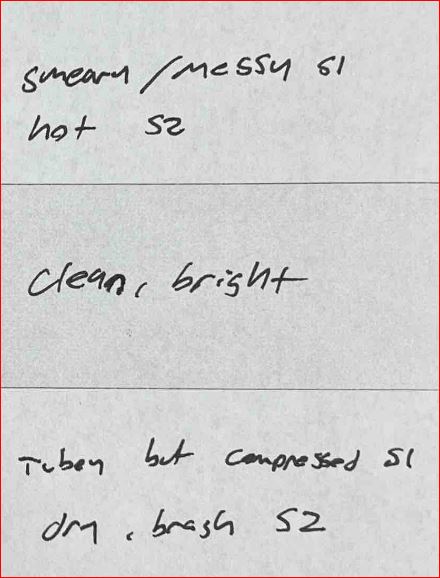
The notes on the left in the box are for the copies that did not do as well as our best copies.

If your copy of the album has any of the shortcomings we mention, and you would like a better pressing to play, rest assured we will have something for you down the road, as this is our favorite for both performance and sound.

Stamper Information

The stampers of the pressings that consistently came in last in our shootout had the mastering marking of L, which signifies the work of George Bettyes. He has done good work in the past, but odds are that any pressing of this title mastered by L is going to be inferior to those that are not.

Our advice: stick with E and G.

As is sometimes the case, there is one and only one set of stamper numbers that consistently wins our shootouts for CS 6211.  Here are some of the others we’ve discovered through the shootout process.

Our notes for an exceptionally good sounding copy from the last shootout can be seen below.

(more…)