Victoria Hall – Reviews and Commentaries

Petrushka on Speakers Corner

Hot Stamper Pressings of the Music of Stravinsky Available Now

UPDATE 2026

This review was written in the 90s when we were still selling Heavy Vinyl records like this Decca reissue from Speakers Corner, which was one of the better releases.

Our current favorite recording of Petrushka for both performance and sound is the one Dorati recorded for Mercury in 1960.


Sonic Grade: B (I’m guessing)

We haven’t played a copy of this record in years, but back in the day we liked it, so let’s call it a “B” with the caveat that the older the review, the more likely we are to have changed our minds.

(more…)

Yes, Sometimes There Is Only One Set of Magic Stampers

Hot Stamper Pressings of the Music of Rimsky-Korsakov Available Now

Way back in 2015 we wrote:

There are certain stampers that seem to have a consistently brighter top end. They are tolerable most of the time, but the real magic can only be found on the copies that have a correct or even slightly duller top. Live classical music is never “bright” the way recordings of it so often are.

On the other hand, it’s rarely “rich” and “romantic” the way many vintage recordings are — even those we rave about — but that’s another story for another day.

We recently did the shootout again, and now with a much more resolving, clear, accurate upper midrange and an even more extended top end, the stampers that we used to find “brighter than ideal” are almost always just too damn bright, period.

We will never buy another copy with those stampers except by accident or misfortune.

We was wrong and we don’t mind admitting it. We must be learning something in our shootouts, right?. We ran an experiment, we discovered something new about this album, and that should be seen as a good thing.

If you have been making improvements to your system, room, electricity, etc., then you too own records which don’t sound as good as you remember them. You just don’t know which ones they are, assuming you haven’t played them in a while.

One Stamper to Rule Them All

Which leaves one and only one stamper that can win a shootout. There is another stamper we like well enough to offer to our discriminating customers, but after that it is all downhill, and steeply.

Here are some of the other albums we’ve discovered for which one set of stampers has been consistently winning shootouts for years now.

Wouldn’t you know it — the right stampers are the hardest ones to find.

Which of course pretty much explains why you will rarely see a copy of the album for sale on our site.

(more…)

The Greatest Beethoven Ninth on Vinyl – Ansermet in 1960

Hot Stamper Pressings of the Music of Beethoven Available Now

The legendary Ansermet recording from 1960 you see to the left is the best sounding Beethoven 9th we have ever had the pleasure to play here at Better Records.

Ansermet’s performance is clearly definitive to my ear as well. The gorgeous hall the Suisse Romande recorded in was possibly the best recording venue of its day, possibly of all time. More amazing sounding recordings were made there than in any other hall we know of.

Both sides are big, rich and clear, and both were showing us pretty much everything that’s good about a vintage symphonic recording.

There is a solidity and richness to the sound beyond all others, yet clarity and transparency are not sacrificed in the least.

It’s as wide, deep and three-dimensional as any, which is of course all to the good, but what makes the sound of these recordings so special is the weight and power of the brass, combined with unerring timbral accuracy of the instruments in every section of the orchestra.

The Chorus — Always a Tough Test

To get the chorus to play cleanly right to the very end is difficult for any pressing and this one is no exception. The chorus should play mostly without distortion or congestion even in the loudest parts, but we can’t say there won’t be a trace of one or both.

A good test of your turntable setup!

Production and Engineering

James Walker was the producer, Roy Wallace the engineer for these sessions from April of 1959 in Geneva’s glorious Victoria Hall.

The album came out in 1960, along with a great many other exceptional titles from the Golden Age of vacuum tube recording.

(more…)

Who Can Explain Why This Cheap Reissue Sounds So Good?

Hot Stamper Pressings of the Music of Claude Debussy Available Now

This Decca reissue is spacious, open, transparent, rich and sweet.

Roy Wallace was the engineer for these sessions from 1955 to 1962 in Geneva’s glorious sounding Victoria Hall. His work here is superb in all respects.

It’s yet another remarkable disc from the Golden Age of Vacuum Tube Recording, with the added benefit of mastering using more modern, but apparently still good, cutting equipment from the ’70s, 1972 to be exact.

We are of course here referring to the often amazing modern mastering of 40+ years ago, not the mediocre-at-best modern mastering of today.

The combination of old and new works wonders on this title as you will surely hear for yourself on both of these superb sides.

We were impressed with the fact that it excelled in so many areas of reproduction. The illusion of disappearing speakers is one of the more attractive aspects of the sound here, pulling the listener into the space of the concert hall in an especially engrossing way.

Thread It Up and Just Hit Play Already

What might be seen as odd — odd to some audiophiles but not to us — was how rich and Tubey Magical the reissue can be on the best copies.

This leads me to think that most of the natural, full-bodied, smooth, sweet sound of the album is on the tape, and that all one has to do to get that vintage sound on to a record is simply to thread up the master on a good machine and hit play.

The fact that nobody seems to be able to make an especially good sounding record these days makes clear that in fact I’m wrong to think that this approach would work. It seems to me that somebody should be able to figure out how to do it. In our experience that is simply not the case today, and has not been for many years.

Old Tapes, New Tapes

The master tapes were about fifteen years old when this record was mastered.

Compare that to a current cutting which would be made from approximately fifty year old tapes.

Perhaps that explains it.

Or maybe it doesn’t.

(more…)

This Tchaikovsky 4th with Argenta Didn’t Make the Grade

Hot Stamper Pressings of the Music of Tchaikovsky Available Now
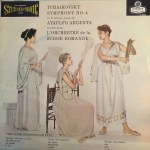
This vintage London Blueback pressing of CS 6048 was released in 1958.

(1958 just happens to be one of the best years for analog recording, as evidenced by this amazing group of albums, all recorded or released in that year.)

CS 6048 seemed to have a lot going for it so we thought we would get one in and give it a spin.

For starters, just take a look at that cover!

Roy Wallace was the engineer and many of his recordings are superb. (As of this posting there are fifteen available on our site.)

Recorded in Geneva’s world-renowned Victoria Hall with L’Orchestre De La Suisse Romande performing, many of of the best sounding records we’ve ever played boast these three elements.

Unfortunately, this London has a case of the “old record” sound we find on far too many vintage pressings, even those with credentials as promising as this one.

All the right people worked on it. How did it all go so wrong?

Who the hell knows?

The world is full of old records that just sound like old records. We’ve suffered through them by the tens of thousands in the 38 years we’ve been in the business of selling premium vinyl to audiophiles.

Our website, as well as this blog, are devoted to helping audiophiles find pressings that don’t sound anything like the millions of run-of-the-mill — and sometimes just awful, as was the case here — LPs that were stamped out over the last seven decades or so.

Even a million dollar stereo can’t make the average record sound good, and the more accurate and revealing the system, the more limited and lifeless the average record will show itself to be.

(more…)

Compression Works Its Magic on The Christmas Eve Suite

Hot Stamper Pressings of the Music of Rimsky-Korsakov Available Now

Some notes about the compression effects we heard on side two of a Blueback pressing of The Christmas Eve Suite album back in 2012. We wrote:

Side two is even more transparent and high-rez than side one. The texture on the strings and the breathy quality of the woodwinds make this a very special pressing indeed.

The horns are somewhat smeary and do get a bit congested when loud.

There is more compression on this side two than there was on the best copy we played, and that means low level detail is superb, but louder parts, such as when the more powerful brass instruments come in, can present problems.

Note how good The Flight of the Bumble Bee sounds here.

Compression is helping bring out all the ambience and detail in the recording, and there’s no downside because the orchestra is playing softly, unlike the piece that precedes it.

A classic case of compression having sonic tradeoffs.

(more…)

Mendelssohn / Symphony No. 4 – Don’t Be Fooled by the Cover

More of the Music of Felix Mendelssohn

Demo disc quality. This record has the same kind of amazing sound as the Chabrier disc on London, but it’s much more rare, perhaps because the cover does not to sell the album.

I don’t think I’ve ever heard a better Mendelssohn 4th. 

We admit we foolishly did not expect much from a mid-60s London with a cover this plain.

It’s hard to get excited about an album with such a generic cover, but hearing the recording we were forced to confront our silly prejudices and recognize the greatness of James Lock‘s work for Decca in 1965.

It even beats the famous Solti on Blueback, which has a cover to die for. However, like many of the Londons and Deccas we’ve played over the years, the sound of that pressing is awful.


This is an older classical/orchestral review

Most of the older reviews you see are for records that did not go through the shootout process, the revolutionary approach to finding better sounding pressings we started developing in the early 2000s and have since turned into a veritable science.

We found the records you see in these older listings by cleaning and playing a pressing or two of the album, which we then described and priced based on how good the sound and surfaces were. (For out Hot Stamper listings, the sonic grades and vinyl playgrades are listed separately.)

We were often wrong back in those days, something we have no reason to hide. Audio equipment and record cleaning technologies have come a long way since those darker days, a subject we discuss here.

(more…)

What We Think We Know about Beethoven’s Symphony No. 6

More of the Music of Ludwig van Beethoven

In our opinion this is the best sounding Beethoven 6th Symphony ever recorded. It is the most beautiful of them all, and has long been my personal favorite of the nine Beethoven composed.

Ansermet’s performance is clearly definitive to my ear as well. The gorgeous hall the Suisse Romande recorded in was possibly the best recording venue of its day, possibly of all time; more amazing sounding recordings were made there than any other hall we know of.

There is a richness to the sound that exceeds all others, yet clarity and transparency are not sacrificed in the least.

It’s as wide, deep and three-dimensional as any, which is of course all to the good, but what makes the sound of these recordings so special is the weight and power of the brass and the timbral accuracy of the instruments in every section.

We have a section of classical recordings that we nominate for the best performances with top quality sound, and this record is of course one of its founding members.

The best pressings from the Readers Digest set with Leibowitz conducting were very good but no match for Ansermet and the legendary Orchestre De La Suisse Romande.

We’ve liked Monteux on RCA for the 6th in the past. We do not believe that even the best pressings of that album are competitive with this London.

The 1960 Decca/London cycle with Schmidt-Isserstedt and the Vienna Phil has always sounded flat and modern to us, and that was on every pressing we’ve played, so we stopped buying anything from the series.

Production and Engineering

James Walker was the producer, Roy Wallace the engineer for these sessions from October of 1959 in Geneva’s glorious Victoria Hall.

Released in 1960, it’s yet another remarkable disc from the Golden Age of Vacuum Tube Recording.

(more…)

El Amor Brujo – Brilliant Decca Remastering from 1967

Hot Stamper Pressings of Orchestral Spectaculars Available Now

UPDATE 2022

In 2012 we were knocked out by this Stereo Treasury Budget Reissue pressing.

We had the temerity to charge $175 for our Hot Stamper copy, a record we’d probably picked up locally for five or ten bucks. Nowadays of course it would go for even more than that, and still be worth every penny, assuming the buyer was looking for wonderful music with top quality sound regardless of the vinyl’s trade-in value, which in this case would probably be a dollar.

It is our strongly held belief that records are for playing and enjoying, not trading-in. Some records (like this one) are perfect for collectors, but their appeal is lost on us and has been since I soured on Mobile Fidelity records back in the 80s. It would take us another twenty years before we were done with other pressings that promised so much and delivered so little.

Decca released this title on their London label as a budget reissue, but that didn’t keep them from mastering it properly and pressing it on high quality vinyl.  The same cannot be said for RCA, which kept many of their golden age recordings in print on the RCA red label as well as others, but with sound that was most of the time clearly inferior to those earlier releases.


Our 2012 Review

Our current favorite El Amor Brujo for sound and performance is this Decca recording from 1967 with De Burgos conducting the New Philharmonia.

The best sound on this album is on side two, where El Retablo de Maese Pedro can be found.

(more…)

Borodin / Symphonies 2 & 3 – Side Two Had Some Common Sonic Problems

More of the music of Alexander Borodin (1833-1887)

This shootout, conducted back in 2012, was our first for the album.

This White Hot Stamper pressing has DEMO QUALITY sound of the HIGHEST ORDER on fairly quiet vinyl no less. We’ve long considered the album one of the greatest of all the Decca / London recordings, but this pressing takes the sound beyond even our high expectations.

There is simply nothing in the sound to fault. Where is the slightly dry and midrangy quality in the upper strings that so many Londons from this era suffer from? It’s nowhere to be found on this side one. (If you have a rich sounding cartridge, perhaps with that little dip in the upper midrange that so many moving coils have these days, you will not notice this tonality issue nearly as much as we do.)

And it’s not as though our stereo was hiding that quality, because some of it creeps into the sound on this very side two (which is why it earned a slightly lower grade of A++).

Big, rich and dynamic, this is the sound of LIVE MUSIC, and it can be yours, to enjoy for years to come — if you’ve got the stereo to play it and the time to listen to it.

The powerful lower strings and brass are gorgeous. Ansermet and the Suisse Romande get that sound better than any performers I know. You will see my raves on record after record of theirs produced during this era. No doubt the world renowned Victoria Hall they recorded in is key. One can assume Decca engineers use similar techniques for their recordings regardless of the artists involved. The only real variable should be the hall.

Ansermet’s recordings with the Suisse Romande exhibit a richness in the lower registers that is unique in my experience. His Pictures At Exhibition has phenomenally powerful brass, the best I’ve ever heard. The same is true for his Night On Bald Mountain. Neither performance does much for me — they’re both too slow — but the sound is out of this world. Like it is here.

Side One

A+++, big, rich and lively, yet clear, transparent and spacious. The brass is shockingly dynamic and powerful. I defy you to find better brass on a record than can be found on this side one. I can’t recall hearing it, and we play the best sounding Golden Age classical recordings by the score week after week.

Side Two

A++, a bit wider, with lovely sheen to the strings, but tonally a bit thinner and drier than it should be. Still, awfully good in comparison to the better classical records we put up every week, just not competitive with this amazing side one.

If you’re looking for Demonstration Quality Sound, look no further. This side one has it in spades.

Heavy Vinyl

Speakers Corner did a heavy vinyl reissue of this title, which we auditioned and used to sell. It’s reasonably good, but like all reissues it lacks the weight found on this original. I remember it being a little flat and bright. I haven’t played it in years so I could easily be wrong.

(more…)