Doug Sax, Engineer – Reviews and Commentaries

We love his work in the 70s. However, his audiophile records from the 90s leave much to be desired and should be avoided by anyone looking for good sound.

Analogue Productions Fails Spectacularly Right Out of the Gate with Jazz Giant

Hot Stamper Pressings of Contemporary Albums Available Now

You may remember what a disaster the Analogue Productions version of Jazz Giant from the 90s was.

Or maybe you agree with a certain writer that they were god’s gift to the record lovers of the world in need of higher quality pressings. We thought they were crap right from the get-go and were not the least bit shy about saying so,

I haven’t heard the new 45 RPM version and don’t intend to play one, but I seriously doubt that it sounds like our good Hot Stamper pressings. We have yet to hear a single Heavy Vinyl 45 that sounds any good to us, judged by the standards we set in our shootouts.

Actually, to run the risk of sounding even more pedantic than usual, the records themselves set the standards.

We simply grade them on the curve they establish for themselves.

We guarantee that none of their LPs can hold a candle to our vintage records or your money back. If you have one of the new pressings and don’t know what’s wrong with it, or don’t think that anything is wrong with it, try one of ours.

It will show you just how much better a real record can sound, with more space, more transparency, more energy, more presence, more drive, more ambience — more of everything that’s good about the sound of music on vinyl.

It is our contention that no one alive today makes records that sound as good as the vintage LPs we sell. Once you hear one of our Hot Stamper pressings, those Heavy Vinyl records you bought might not ever sound right to you again.

They sure don’t sound right to us, but we have the good fortune of being able to play the best older pressings (vintage reissues included) side by side with the new ones, where the faults of the current reissues become much more audible — in fact, exceedingly obvious. When you can hear them that way, head to head, there really is no comparison. 

What to Listen For

As a general rule, this Heavy Vinyl pressing will fall short in some or all of the following areas:

(more…)

Acoustic Sounds Hired Doug Sax to Ruin a Classic Chet Baker Album

Hot Stamper Pressings of Jazz Recordings Featuring the Trumpet

The less said about this awful mid-90s Doug Sax remastering for Analogue Productions the better. What a murky piece of crap it was.

Audiophile reviewers may have been impressed, but even way back then we knew a bad sounding record when we played one, and that pressing was very bad indeed.

One further note: the Heavy Vinyl pressings being made today, twenty-five thirty-one years later, have a similar suite of shortcomings, sounding every bit as bad if not worse, and fooling the same audiophile reviewers and their followers to this very day.

Nothing has changed, other than we have come along to offer the discriminating audiophile an alternative to the muddy messes these labels have been churning out for decades.

(more…)

How Do the The Mastering Lab Pressings of Sticky Fingers Sound?

Hot Stamper Pressing of the Music of The Rolling Stones Available Now

A listing for an early domestic Hot Stamper pressing for Sticky Fingers will typically be introduced like this:

If you have never heard one of our Hot Stamper pressings of the album, you (probably) cannot begin to appreciate just how amazing the sound is.

A landmark Glyn Johns / Andy Johns recording, our favorite by the Stones, a Top 100 Title (of course) and 5 stars on Allmusic (ditto).

After hearing so much buzz about it, we finally broke down and ordered a German TML pressing about a year ago. Having played scores of phenomenally good sounding copies of the album over the past fifteen or so years, we were very skeptical that anyone could cut the record better than the mastering engineers who inscribed Rolling Stones Records into the dead wax on the early pressings. (I could find no mastering engineers credited.)

Well, the results were not good. As we suspected would be the case, we were not impressed in the least with what The Mastering Lab — one of the greatest independent cutting houses of all time, mind you — had wrought.

Their version is not really even good enough to charge money for. It might have earned a grade of One Plus, just under the threshold for a Hot Stamper that we would put on the site these days. Decent, but not much more than that.

Wait, There’s More

We subsequently learned that it is the British TML pressings that are supposed to be the best.

So we got one of those in, an A3/B4 copy.

Better, but good enough? Barely.

Here are the notes for the copy we played. For those who have trouble reading our writing, I have transcribed the notes as follows:

Side One

Track one:

Weighty, a bit veiled or smeary. Backing vox kinda lost.

Track three:

Very full, rockin’ but not the sparkle/space.

Kinda compressed.

Not as huge.

Side Two

Track two:

Not as rich, clear.

A bit pushy/dry vox.

No real space.

Thick drums

Track one:

This works better.

A bit hard, but full and lively.

This Sound?

Is this the sound audiophiles are raving about?

(more…)

The Who By Numbers – How Did We Know Side Two Was Slightly Veiled?

Hot Stamper Pressings of the Music of The Who Available Now

Here is how we might typically describe one of our Shootout Winning copies:

Who By Numbers returns to the site for only the second time in over three years, here with KILLER Shootout Winning Triple Plus (A+++) sound or close to it on both sides of this vintage Polydor import pressing – fairly quiet vinyl too.

Glyn Johns‘s magic is on display here, with open mics in a big studio space creating the 3D soundscapes we love.

Features two of their most iconic songs, “Slip Kid” and “Squeezebox,” and both sound incredible on this copy.

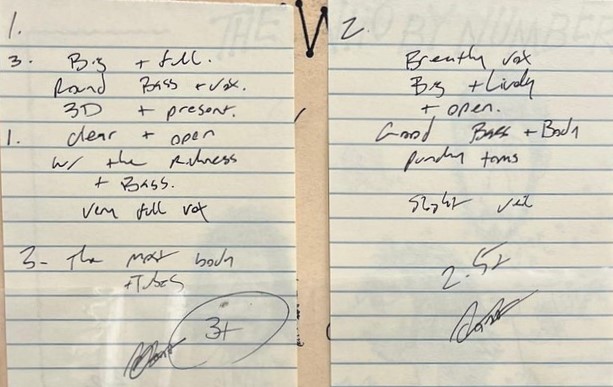
To back it all up, here are the notes for that very copy.

We started playing track three on side one, Squeeze Box, and returned to that track when we had two top copies to play against each other in the final round. Which one won? The one with “the most body and tubes.”

Note that side two of this copy was slightly veiled compared to the side two of the best copy we played, the one that would go on to earn 3+.

We don’t like veiled records — records where there is a curtain, no matter how transparent, in front of the musicians. Heavy Vinyl pressings are typically quite veiled and recessed in the midrange compared to their vintage vinyl counterparts, and that sound is simply not going to cut it with us. (Other folks may prefer a different sound it seems.)

Midrange presence is one of the most important qualities of any rock or pop recording we evaluate. You want Roger Daltry to be front and center, neither recessed nor behind a veil.

(more…)

The Dreadful Sound of the Heavy Vinyl Reissues Doug Sax Mastered in the 90s

Hot Stamper Pressings of the Music of Sonny Rollins Available Now

Longstanding customers know that we have been relentlessly critical of so-called “audiophile” LPs for years, especially in the case of these Analogue Productions releases from back in the early-90s. A well-known reviewer loved them, I hated them, and he and I haven’t seen eye to eye on much since.


(Old) Newflash!

Just dug up part of my old commentary discussing the faults with the original series that Doug Sax cut for Acoustic Sounds. Check it out.

In the listing for the OJC pressing of Way Out West we wrote:

Guaranteed better than any 33 rpm 180 gram version ever made, or your money back! (Of course I’m referring to a certain pressing from the early 90s mastered by Doug Sax, which is a textbook example of murky, tubby, flabby sound. Too many bad tubes in the chain? Who knows?

This OJC version also has its problems, but at least the shortcomings of the OJC are tolerable. Who can sit through a pressing that’s so thick and lifeless it communicates none of the player’s love for the music they’re making?

If you have midrangy transistor equipment, go with the 180 gram version (at twice the price).

If you have good equipment, go with this one.


UPDATE 2015

We are no longer fans of the OJC of Way Out West, and would never sell a record that sounds the way even the best copies do as a Hot Stamper. It’s not hopeless the way the Heavy Vinyl pressing is, but it’s not very good either. It’s yet another example of a record we was wrong about.

Live and learn, right?


(more…)

Carnival of the Animals on Klavier Is Another Doug Sax-Mastered Disaster

Hot Stamper Pressings of the Music of Saint-Saens Available Now

Yet another murky, smeary audiophile piece of vinyl trash from the mastering lathe of the formerly brilliant Doug Sax. He used to cut the best sounding records in the world. (Exhibit A: this one.)

Then he started working for perhaps the worst record label of all time and to my knowledge never cut a good sounding record again.

This record may be on the TAS Super Disc list, but we don’t think it belongs there. Instead, it belongs on the bad TAS list that we created specifically for these far-from-super records.

To be fair, the real EMI is on there as well, ASD 2753. However, including the Klavier on the list brings into doubt the compentence of whoever is curating it these days.

This Klavier pressing, along with all the Classic Records titles, as well as other modern reissues, renders the advice found there all but useless. Is anyone calling attention to all the bad sounding records that have lately been recommended by The Absolute Sound? I think we might just be the only ones. If you know of any others, please email me at tom@better-records.com.

Doug Sax

For those of us who remember the consistently superb work Doug Sax was doing in the 70s, we sadly note that he passed away in 2015. I was honored to have met him a few years before then at a Chopin concert with Lincoln Mayorga performing on the piano. (Impressively performing, I might add. He played the complete Chopin Preludes from memory, all 24 of them.)

Both he and Lincoln were gentlemen and artists of the highest caliber. Needless to say, I hope this awful sounding Klavier is not the kind of record that he would want to be remembered by.

On this record, in Doug’s defense it should be noted that he had only second generation tapes to work with, which is neither here nor there as these pressings are not worth the dime’s worth of vinyl used to make them and should never have seen the light of day.

Can this dubbysmeary sound possibly be what EMI engineer Stuart Eltham was after?

Hard to believe. We’ve played plenty of his recordings and we cannot ever remember any of the non-audiophile pressings having this kind of sound.

But isn’t that just the way? The mainstream labels mass produce the good sounding pressings and the audiophile labels produce the limited edition junk.

Now there’s a rule of thumb you might want to keep in mind, especially if you’ve made the mistake of buying any of the Heavy Vinyl pressings we reviewed in 2024 and 2025, a parade of horribles that defy understanding.

Actually, if we understand that there is a need for vinyl product for the lo- to mid-fi record collector market, it makes perfect sense. That’s what Klavier was in the business of producing, and now everybody wants in on the action, hence the proliferation of crap Heavy Vinyl pressings coming to market, practically every one even worse sounding than the last.

(more…)

On Discovered Again, Does It Sound Like the Snare Is Wrapped in a Towel on Your Copy?

Hot Stamper Pressings of Direct-to-Disc Recordings Available Now

The bulk of this commentary was written in 2008 and is based on the shootout we had just done, our first for the album. It has been amended a number of times since.

I bought my first copy of Discovered Again in 1976 upon its release. I was a big fan of the label at the time. The Missing Linc had been a revelation to me years before in terms of how good music could sound in the home (or apartment as the case may be). I wrote a bit about it here.

I credit that amazing record as well as Discovered Again as fundamentally important in helping me advance in this devilishly difficult hobby of ours. Back in those dark days of the 70s, although I was completely clueless at the time about pretty much everything having to do with vinyl and equipment, I can take some solace in the fact that everybody else was every bit as clueless as I was too.

This blog is dedicated to sharing some of what I’ve learned — with the unflagging help of my staff of course — about records and audio over the last fifty years.


The sound quality of the typical pressing of Discovered Again leaves much to be desired.

Two areas are especially lacking as a rule: the top end tends to be rolled off, and there is a noticeable lack of presence, which can easily be heard in the drum sound.

The snare sounds like it’s covered with a towel on most copies of this album.

How does that even happen?

Who knows? Even though the mastering is fixed at the live event, there are many other variables which no doubt affect the sound. The album is cut on two different lathes — M (Master) and S (Slave), and pressed in two different countries: Japan and Germany. Many mothers were pulled from the acetates and many, many stampers made from those mothers. (I saw one stamper marked number 15!)

Bottom line? You got to play ’em to know how they sound, just like any other pressing. If no two records sound the same, it follows that no two audiophile records sound the same, a fact that became clear early on in the listening.

Of course not many audiophiles are in a position to shootout six copies of Discovered Again, and I’m not sure most people would have the patience to do it. Here at Better Records we have a whole system set up to do that, so we waited until we had a pile of them, got them all cleaned up, and off to the races we went.

What Else to Listen For

Listen to the harmonics around the cymbals and bells on Git Along Little Dogies — on the best copies you can really hear the transients of the cymbals and percussion, so important to the actual sound of those instruments. (More records that are good for testing percussion can be found here.)

The stand-up acoustic bass is amazingly well recorded on this album; it’s so rich and full-bodied. You will have a hard time finding a string bass that sounds better.

Track after track, the sound is surprisingly open and airy. Dave’s keyboards throughout have wonderful presence; on the best copies they really jump out of the speakers. (A good test for midrange presence.)

(more…)

Judging the Sound of Heavy Vinyl We’ve Never Played

Hot Stamper Pressings of Pablo Recordings Available Now

We freely admit that we have never played the Heavy Vinyl pressing of The Alternate Blues on the Analogue Productions label. It started life in 1996 as APR 3010, part of the Analog Revival Series on 150 gram vinyl (average price on Discogs these days: $99), and now it seems to be in print on 180 gram vinyl, made from the same metalwork by the looks of it.

The mastering of the Analog Revival Series pressing may have been credited to Bruce Leek and Stan Ricker, but the stamper information is TML, The Mastering Lab all the way.

In case you, unlike us, are tempted to try one or both of the AP pressings, or perhaps already own one or both, here is our advice on how to recognize the fairly predictable shortcomings of Chad’s pressing, or any pressing mastered by Doug Sax in the 90s for that matter. Every one we’ve ever played has suffered from the same suite of sins.

The Best Part

And we expect that the AP pressing’s failures in some areas will be so obvious that you really don’t need any other copy of the album to be able to hear them.

Just focus on the two qualities that Analogue Productions’ records have always failed to deliver: transparency and freedom from smear.

In our 2011 shootout notes we drew the reader’s attention to both:

What to Listen For – Transparency

What typically separates the killer copies from the merely good ones are two qualities that we often look for in the records we play: transparency and lack of smear. Transparency allows you to hear into the recording, reproducing the ambience and subtle musical cues and details that high-resolution analog is known for.

Note that most Heavy Vinyl pressings being produced these days seem to be quite transparency challenged.

Lots of important musical information — the kind we hear on even second-rate regular pressings — is simply nowhere to be found. That audiophiles as a whole — including those that pass themselves off as the champions of analog in the audio press — do not notice these failings does not speak well for either their equipment or their critical listening skills.

What to Listen For – Lack of Smear

Lack of smear is also important, especially on a recording with this many horns, where the leading edge transients are so critical to their sound. If the horns smear together into an amorphous blob, as if the sound were being fed through ’50s vintage tube amps (for those of you who know that sound), half the fun goes right out of the music.

Richness is important — horns need to be full-bodied if they are to sound like the real thing — but so are speed and clarity, two qualities that insure that all the horns have the proper bite and timbre.

More on Smeary Sound

Smear, a blurring of the sharpness of the notes, refers to the loss of transient information which is most often associated with tube gear.

However, smear occurs with every kind of gear, especially high-powered amps, the kind typically required to power the inefficient speakers audiophiles often favor. We caution against the use of both.

When we finally got rid of our tube equipment and high-powered amps, a lot of smear in the playback of our records disappeared with them.

Once that happened, the smear that is commonly heard on most modern Heavy Vinyl repressings became much more noticeable and, over time, even more annoying.

Nobody else seems too bothered by smear, and one of our many theories about the stereo shortcomings of reviewers and audiophiles in general is that their systems are fairly smeary, so a extra smear — a little or a lot — becomes virtually inaudible to them.

(more…)

Venerable or Execrable? If It’s Athena the Chances Are Good It’s the Latter

Hot Stamper Pressings of the Music of Rachmaninoff Available Now

I spied an interesting quote on the Acoustic Sounds site many years ago:

“…Analogue Productions’ 45rpm remastering improves upon the venerable Athena LP release from the late 80s, with better dynamics and a fuller ‘middle’ to the orchestral sonority.” – Andrew Quint, The Absolute Sound, October 2010

For some reason Andrew uses the word “venerable” when a better, certainly more accurate term would have been “execrable.” Having played the record in question this strikes us as the kind of mistake that would not be easy to make.

Athena was a godawful audiophile label that managed to put out all of five records before going under, only one of which was any good, and it’s definitely not this one.

It was in fact the Debussy piano recording with Moravec, mastered by the venerable Robert Ludwig himself, a man who knows his classical music, having cut scores if not hundreds of records for Nonesuch and other labels in the 60s and 70s.

From the jacket:

Analogue Master Recording™

Unlike other remastering companies, Athena Records always uses the ORIGINAL ANALOG MASTER SESSION TAPES. In this case, The Master Lacquers were cut directly by Doug Sax at The Mastering Lab so you know it will sound superb.

Our Hot Stamper listing for the Vox pressing:

This famously good sounding Vox pressing os Symphonic Dances has been remastered a number of times, but you can be sure that the Hot Stamper we are offering here will beat any of those modern pressings by a wide margin in any area that has to do with sound (surfaces being another matter and one we won’t go into here).

The sound of this recording on the best pressings is dynamic, lively and BIG. The music just jumps out of the speakers, bringing the power and vibrant colors of a symphony orchestra right into your listening room. Guaranteed to put to shame 95% or more of all the classical records you own, even if you own lots of our Hot Stampers. [Can’t say I would agree with that in 2023.]

The bass is phenomenal on this recording, assuming you have a copy that has the bass cut and pressed right. This one sure does! Few Golden Age classical recordings from the 50s will have the kind of bass that’s found on this record.

(more…)

Letter of the Week – “Why can’t all records sound this good…?”

Hot Stamper Pressings of the Music of Ambrosia Available Now

One of our good customers wrote to tell us about a very Hot Stamper pressing he purchased recently:

Hey Tom,   

Question:

Does Tom Port have any clue as to what the hell he’s doing or selling to the public?

That is my question.

Hello Tom,

I’m the idiot who spent $399 on your White Hot Stamper of Ambrosia’s first album a few weeks ago. I did an A/B listening test with an A++/A++ copy I bought from you a few years ago. Your website waxes lyrical about the exceptional qualities of this recording; I always thought it was very, very good but not quite the recording you make it out to be!

To perform my listing test, I listened to my A++/A++ side one first. Then listened to the newly purchased A+++/A+++ next. The results? I almost had to call 911 because my jaw hit the floor! THIS was the recording you had written about in the records descriptive comments. This pressing is so holographic I swear I could have stepped into the recording.

Dare I say this is a better recording than Dark Side of the Moon; and yes, I can make such a claim, I purchased an A++/A+++ – A++/A+++ copy from you guys a few years ago. This is what I refer to as Master Tape sound quality. A Holy Grail for audiophiles.

It’s pressings like this that pose the questions: Why can’t all records sound this good and why can’t all recording engineers be as great as Alan Parsons?

So, back to my original question. Does Tom Port know what the hell he is doing or selling to the public?

Yes Tom, I’d say absolutely, 100% you know what you are doing and I’m the happiest idiot on this Earth. Keep up the great work, Tom, and thank you and your staff for the incredible service you provide.

Todd N.

Dear Todd,

Thanks for your letter. I’m positively blushing!

Seriously, the right vintage pressing — on the right stereo — can take the enjoyment of music to a level far beyond that of anything being experienced by the audiophile of today, at least those who are stuck in a rut due to their misguided devotion to the modern Heavy Vinyl reissue. (more…)