Top Artists – Lee Ritenour

On Discovered Again, Does It Sound Like the Snare Is Wrapped in a Towel on Your Copy?

Hot Stamper Pressings of Direct-to-Disc Recordings Available Now

The bulk of this commentary was written in 2008 and is based on the shootout we had just done, our first for the album. It has been amended a number of times since.

I bought my first copy of Discovered Again in 1976 upon its release. I was a big fan of the label at the time. The Missing Linc had been a revelation to me years before in terms of how good music could sound in the home (or apartment as the case may be). I wrote a bit about it here.

I credit that amazing record as well as Discovered Again as fundamentally important in helping me advance in this devilishly difficult hobby of ours. Back in those dark days of the 70s, although I was completely clueless at the time about pretty much everything having to do with vinyl and equipment, I can take some solace in the fact that everybody else was every bit as clueless as I was too.

This blog is dedicated to sharing some of what I’ve learned — with the unflagging help of my staff of course — about records and audio over the last fifty years.


The sound quality of the typical pressing of Discovered Again leaves much to be desired.

Two areas are especially lacking as a rule: the top end tends to be rolled off, and there is a noticeable lack of presence, which can easily be heard in the drum sound.

The snare sounds like it’s covered with a towel on most copies of this album.

How does that even happen?

Who knows? Even though the mastering is fixed at the live event, there are many other variables which no doubt affect the sound. The album is cut on two different lathes — M (Master) and S (Slave), and pressed in two different countries: Japan and Germany. Many mothers were pulled from the acetates and many, many stampers made from those mothers. (I saw one stamper marked number 15!)

Bottom line? You got to play ’em to know how they sound, just like any other pressing. If no two records sound the same, it follows that no two audiophile records sound the same, a fact that became clear early on in the listening.

Of course not many audiophiles are in a position to shootout six copies of Discovered Again, and I’m not sure most people would have the patience to do it. Here at Better Records we have a whole system set up to do that, so we waited until we had a pile of them, got them all cleaned up, and off to the races we went.

What Else to Listen For

Listen to the harmonics around the cymbals and bells on Git Along Little Dogies — on the best copies you can really hear the transients of the cymbals and percussion, so important to the actual sound of those instruments. (More records that are good for testing percussion can be found here.)

The stand-up acoustic bass is amazingly well recorded on this album; it’s so rich and full-bodied. You will have a hard time finding a string bass that sounds better.

Track after track, the sound is surprisingly open and airy. Dave’s keyboards throughout have wonderful presence; on the best copies they really jump out of the speakers. (A good test for midrange presence.)
(more…)

Side One Is Actually In Phase (Usually) and You Read It Here First (Probably)

Hot Stamper Pressings of Direct-to-Disc Recordings Available Now

This is a well recorded jazz album that should be able to find a home in any audiophile’s jazz collection.

It is also one of the pressings we’ve discovered with reversed polarity

According to the liner notes, this Dave Grusin album has reversed absolute phase. They tell you to switch the positive and negative at the speaker for the best transient response and spatial clarity. But get this: most side ones are NOT in reversed phase.

That out of phase quality is as plain as the nose on your face when you know what to listen for.

There’s an unpleasant hardness and hollowness to the midrange, a lack of depth, and an off-putting opaque quality to the overall sound.

With our EAR 324p phono stage, the click of a button reverses phase, also known as polarity. I can’t tell you how handy it is to have such a tool at your disposal. Checking the phase for Discovered Again couldn’t have been easier.

An Amazing Discovery

But get this: most side ones are NOT reversed phase. (All the side twos we played were however.) How about them apples! We could not have been more shocked. Here is the most famous out of phase audiophile recording in the history of the world, and it turns out most copies are not out of phase at all!

(more…)

Dave Grusin – Discovered Again!

  • Grusin’s jazz masterpiece from 1976 returns to the site for only the second time in sixteen months, here with INCREDIBLE Shootout Winning Triple Plus (A+++) grades or close to them throughout this original import copy – fairly quiet vinyl too
  • Here are just a few of things we had to say about this killer copy in our notes: “weighty, deep bass and kick”…”3D, rich, and silky”…”excellent detail and size”
  • After critically listening to this record good and loud, and hearing it sound the way this copy sounds, we have to call it One of the All Time Great Direct to Disc Recordings
  • The songs, the players, the arrangements, the sound – this is a record that will reward hundreds of plays for decades to come
  • Side one of this copy is out of polarity and not a copy you should buy if you can’t switch
  • “…makes for the kind of demo material audiophiles are so fond of using to impress friends and neighbors.”

We are on record as being big fans of this album. Unlike most Direct to Disc recordings, Discovered Again actually contains real music worth listening to. During our all-day shootout, the more we played the record, the more we appreciated it. These are top quality players totally in the groove on this material. When it’s played well, and the sound is as good as it is here, there’s nothing dated about this kind of jazz. Hey, what can we say — it works.

(more…)

Relax, Stare into the Middle Distance and Listen to the Players as a Group

Hot Stamper Direct-to-Discs Available Now

Reviews and Commentaries for More Direct to Disc Recordings

Many years ago we had discussed the polarity issues associated with this record:

According to the liner notes, this album has its polarity reversed. They tell you straight out to reverse the positive and negative at the speaker terminals for the best “transient response and spatial clarity.”

That out of phase quality is as plain as the nose on your face when you know what to listen for. There’s an unpleasant hardness and hollowness to the midrange, a lack of depth, and an off-putting opaque quality to the sound. The top gets dull and the bass gets weird and wonky.

With our EAR 324p phono stage, the click of a button reverses the polarity. I can’t tell you how handy it is to have such a tool at your disposal. Checking the polarity for Discovered Again couldn’t have been easier.

But get this: most side ones are NOT out of polarity. How about them apples! We could not have been more shocked. Here is the most famous reversed polarity audiophile recording in the history of the world — or maybe just the history of our world — and it turns out most copies are not reversed on side one at all.

Findings from a Few Years Back

I did not do the shootout for the album, but I wanted to check on the polarity just to hear it for myself. I must admit I had to go back and forth a number of times, using my favorite song on the album and an old Demo track from back in my earliest days in audio, the mid- to late-70s: Keep Your Eye On The Sparrow.

Harvey Mason’s super-punchy drum playing catches your attention right off the back. A tambourine comes along in the left channel at some point. Lots of bass. Rit’s guitar in the right channel and Grusin’s keyboards in the center fill out the soundstage. The ensemble is on fire.

Evaluating the sonic differences of the individual instruments in and out of polarity had me confused. A typical conundrum: Should the tambourine be smoother with more body, or brighter with more harmonic overtones? Which is right? Who can say definitively?

Experiments Provide Answers

It was only after about fifteen minutes of switching the polarity back and forth that the penny dropped.

Focussed on an individual instrument, I could hear it just fine both ways. But then I noticed that with the polarity reversed the group got vague.

The images seemed blurrier, less defined. If I relaxed and just stared into the middle distance and let the music flow, the band seemed to be more jumbled up and messy.

That was the key. The obvious change when the polarity was wrong was a loss of image specificity. Flipping the record over to side two and using my new “lens” to hear the difference with the polarity changed, it was obvious when the polarity was right or wrong.

I have experimented with polarity on scores of records.

Certain effects on certain records are unmistakable. But these effects seem to vary a great deal from title to title.

Grusin’s brilliant direct to disc recording initially had me at a loss. With a little experimentation, the improvement in the sound with the correct polarity became evident over time, as it always seems to do. Thank god I didn’t have to change speaker leads the way I used to in the old days. (more…)

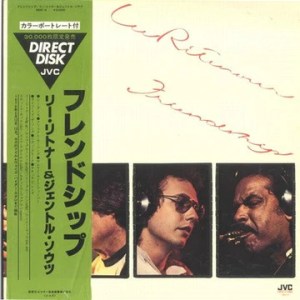
Lee Ritenour – Friendship

More Lee Ritenour

More Audiophile Recordings

  • Superb sound throughout this original Direct-to-Disc Japanese import pressing, with both sides earning Double Plus (A++) grades – fairly quiet vinyl too
  • Full-bodied and warm, exactly the way you want your vintage analog to sound – the guitar is surprisingly real here
  • Both of these sides are Tubey Magical, lively and funky, with the kind of rich, solid sound that will fill your listening room from wall to wall
  • “The third of three Lee Ritenour sets originally cut for Japanese JVC matches the studio guitarist with … Ernie Watts (on tenor and soprano), both Dave and Don Grusin on keyboards, electric bassist Abraham Laboriel, drummer Steve Gadd and percussionist Steve Forman.”
  • Friendship is without a doubt this group’s best sounding album, and, to our way of thinking, their only essential one

This is one of my all time favorite audiophile discs. It’s actually real music.

The song “Woody Creek” is wonderful and reason enough to own this excellent album. The guitar of Lee Ritenour and the saxophone of Ernie Watts double up during a substantial portion of this song and the effect is just amazing.

Special kudos should go to Ernie Watts on sax, who blows some mean lines. But everybody is good on this album, especially the leader, Lee Ritenour. I saw these guys live and they put on a great show.

By the way, looking in the dead wax I see this record was cut by none other than Stan Ricker of Mobile Fidelity fame himself!

(more…)

Rit – The Nautilus Half-Speed Is Not Bad

More of the Music of Lee Ritenour

Hot Stamper Pressings of Jazz Fusion Albums in Stock

This review was written in 2010 or so, before we had done much work with the album. Even though the best Elektra pressings are sure to be much better than this half-speed, we haven’t been impressed enough with any of the copies we’ve played to get a shootout going.

This very nice Nautilus Half-Speed Mastered LP has SURPRISINGLY GOOD SOUND.

We played this pressing against the 180g Discovery reissue that Doug Sax remastered and it SMOKED it.

What a piece of muddy trash that Discovery pressing is. 

Members of both Toto and Chicago play on this album, so fans of either might get a kick out of this music. 

AMG Review

Lee Ritenour has long been the perfect studio musician, one who can melt into the background without making any impact. While he possesses impressive technique, Ritenour has mostly played instrumental pop throughout his career, sometimes with a Brazilian flavor. His few jazz efforts have found him essentially imitating Wes Montgomery, but despite that he has been consistently popular since the mid-’70s. After touring with Sergio Mendes’ Brasil ’77 in 1973, Ritenour became a very busy studio guitarist in Los Angeles, taking time off for occasional tours with his groups and in the mid-’90s with Bob James in Fourplay. He also recorded many albums as a leader.