Favorites – Rock-Pop – rev/com

Listening in Depth to Pretzel Logic

Hot Stamper Pressings of the Music of Steely Dan Available Now

It’s positively criminal how mediocre this amazingly well-recorded album sounds on the average pressing of it. How can you possibly be expected to appreciate the music of Pretzel Logic when it sounds like that?

The reason we audiophiles go through the trouble of owning and tweaking our temperamental equipment is that we know how hard it is to enjoy good music when it doesn’t sound right.

Bad sound is a barrier to deeper understanding and a more intense listening experience, which is why I spent 50 years building a stereo that could play a record like Pretzel Logic right, or at least as right as I could get it to sound. (Speaking of sound, acquiring this preamp only a few years after discovering the music of Steely Dan changed everything for me.)

I also credit Pretzel Logic, probably more than any other album of theirs, with helping me dramatically improve the quality of my playback.

Side One

Rikki Don’t Lose That Number

By far the biggest hit on this album and one of the biggest for the band, it’s also one of the clearest indicators of Hot Stamper Sound. The Horace Silver inspired intro is at its best when you can easily hear the acoustic guitar in the left channel doubling the piano. On most copies it’s blurry and dull, which causes it to get lost in the mix. Transparent copies pull it out in the open where it belongs.

That’s the first test, but the real test for this track is how well the (surprisingly) DYNAMIC chorus is handled. On a properly mastered and pressed copy, Fagen’s singing in the chorus is powerful and very present. He is RIGHT THERE, full of energy and drive, challenging the rest of the band to keep up with him. And they do! The best copies demonstrate what a lively group of musicians he has backing him on this track. (If you know anything about Steely Dan’s recordings, you know the guys in these sessions are the best of the best.)

Check out the big floor tom that gets smacked right before the first chorus. On the best copies the whomp factor is off the scale.

Shocking as it may seem, most copies of this album are DOA on this track. They’re severely compressed — they never come to life, they never get LOUD. The result? Fagen and the band sound bored. And that feeling is contagious.

Of course few audiophiles have any idea how dynamic this recording can be because they’ve never heard an especially good pressing played back on a big speaker system in a big room.

Only a handful of the copies we played had the truly powerful dynamics heard on the best copies. These are Pretzel Logics with far more life than I ever dreamed possible. Who knew?
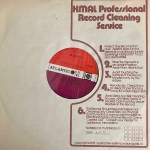
As an aside, back in 1976 I had my fifty favorite albums professionally cleaned on a KMAL record cleaning machine at the stereo store I worked at. They would give you a custom record sleeve along with the cleaning, and sure enough I found my original Pretzel Logic with its KMAL sleeve. My copy was pretty good but no Hot Stamper. So, yes, it really did take us thirty years to find the best copy!

(I took the picture of the KMAL sleeve you see to the left partly because it provides a piece of factual evidence that I really didn’t have a clue about records in 1976. I was proud to be the owner of an original British pressing of Led Zeppelin II — which is absolutely the wrong pressing of the album if you are interested in good sound — but of course I had no way to know that back then.  (more…)

The Glorious Big Speaker Sound of Wind of Change

Hot Stamper Pressings of the Music of Peter Frampton Available Now

A while back we discussed the kind of sound that Glyn Johns managed to get for the likes of Humble Pie and The Who:

But oh what a glorious sound it is when it’s working. There’s not a trace of anything phony up top, down low or anywhere in-between. This means it has a quality sorely at odds with the vast majority of audiophile pressings, new and old, as well as practically anything recorded in the last twenty years, and it is simply this: The louder you play it, the better it sounds.

Chris Kimsey knew how to get the Big Rock Sound onto tape about as well as anybody who ever lived. His work on this album set me on a path I would would follow for the next fifty years.

Wind of Change is the very definition of a big speaker record, one that requires the highest-resolution, lowest-distortion components to bring out its best qualities. If you have a system like that, you should find much to like here.

I bought my first copy in 1972 while still in high school and it quickly became one of my favorite records.

All these years later it still is.

It’s records like this that shaped my audio purchases and pursuits. It takes a monster system to even begin to play this record right, and that’s the kind of stereo I’ve always been drawn to.

A stereo that can’t play this record, or The Beatles, or Ambrosia, or Yes, or the hundreds of other amazing recordings we put up on the site every year, is not one I would want to own.

This is Peter Frampton’s Masterpiece as well as a personal favorite of yours truly.

(more…)

Emerson, Lake & Palmer – Out of This World Sound at Loud Levels

More of the Music of Emerson, Lake and Palmer

  • This UK Island Pink Rim pressing makes the case that ELP’s debut is clearly one of the most powerful rock records ever made, here with incredible Nearly Triple Plus (A++ to A+++) grades from top to bottom – just shy of our Shootout Winner
  • Spacious, rich and dynamic, with big bass and tremendous energy – these are just some of the things we love about Eddie Offord‘s engineering work on this band’s albums
  • Analog at its Tubey Magical finest – you’ll never play a CD (or any other digitally sourced material) that sounds as good as this record as long as you live
  • “Lucky Man” and “Take A Pebble” on this copy have Demo Disc quality sound like you won’t believe
  • If you are looking for a shootout winning copy, let us know – with such good music and sound, we hope to get another shootout going again soon
  • Our White Hot pressing had a one half plus better grade on one side and sold for $849, making this copy a “relative bargain,” if there could ever be such a thing on this site – but what an amazing sounding record!
  • 4 1/2 stars: “Lively, ambitious, almost entirely successful debut album… [which] showcased the group at its least pretentious and most musicianly …there isn’t much excess, and there is a lot of impressive musicianship here.”

If you’ve got the system to play this one loud enough, with the low-end weight and energy it requires, you are in for a treat. The organ that opens side two will rattle the foundation of your house if you’re not careful. This music really needs that kind of megawatt reproduction to make sense. This is bombastic prog that wants desperately to rock your world. At moderate levels, it just sounds overblown and silly. At loud levels, it actually will rock your world.

Near The Top Of The List

Without a doubt this record belongs in the Top Rock section. I’d even say it belongs in the Top Ten. It is one of the most dynamic and powerful rock recordings ever made. The organ on this album is wall to wall and floor to ceiling. The quiet interlude during “Take A Pebble” is about as quiet as any popular recording can ever be — the guitar is right at the noise floor. It’s amazing! (Which explains why so many domestic copies have groove damage. The record is just too hard to play for the average turntable. Hell, it’s hard to play with an audiophile turntable.)

Credit engineer Eddie Offord, who would later go on to enormous and entirely justifiable fame with Yes.

The Power Of Analog

Folks, this is analog at its Tubey Magical finest. You ain’t never gonna play a CD that sounds like this as long as you live. I don’t want to rain on your parade but digital media are seemingly incapable of reproducing this kind of sound. There are nice sounding CDs in the world but there aren’t any that sound like this, not in my experience anyway. If you are thinking that someday a better digital system is going to come along to save you the trouble and expense of having to find and acquire these expensive original pressings, think again. Ain’t gonna happen. This is the kind of record that shows you what’s wrong with your best sounding CDs. (Let’s not even talk about the average one in your or my collection. The less said the better.)

(more…)

I Don’t Care What Anybody Says, One Eighty Is a Great Album

Hot Stamper Pressings of the Music of Ambrosia Available Now

This is smooth, rich ANALOG at its best.

Easy on the ears as we like to say.

One Eighty is clearly the poppier side of Ambrosia, containing as it does two of their highest-charting mainstream hits, Biggest Part of Me (#3) and You’re the Only Woman (#13). 

I myself of course prefer the proggy first two albums, which fallinto the broad category of Art Rock, where my favorite albums by Bowie, Peter Gabriel, Roxy Music, Supertramp, 10cc, later-period Beatles, Jethro Tull, Pink Floyd, Traffic and so many others from the last forty-plus years can be found.

These artists’ recordings tend to be big, powerful and exceedingly hard to reproduce, which, probably more than anything else, accounts for my becoming a serious stereo enthusiast right out of my teens.

(My mother had to co-sign the loan I needed to purchase the currently-state-of-the-art ARC SP3A-1 preamp I coveted. I remember it being $600+ at a time, back when I was earning roughly $2 an hour. That had to hurt, but I did it. Bought a D-75 amp after I paid it off too.)

The Music

One Eighty (recorded on 1/80, get it?) kicks off with a real rocker: Ready, which is a great name for an opening track and really gets the album off to a high-energy start. Side two opens with my favorite track on the album, Livin’ On My Own. I actually used to demonstrate my system with it: the bass is huge, way up in the mix and really punchy. Additionally there are powerful multi-tracked vocal harmonies in the chorus that are wall-to-wall, surprisingly dynamic, yet sweet (all things considered; this is a modern recording after all).

One Eighty has an excellent mix of rock and softer pop ballads. The last track, Biggest Part Of Me, no matter how many times you’ve heard it, on the radio or elsewhere, is an exceptionally well-produced (designed?) piece of songcraft that will tug at anyone’s heartstrings, anyone who has a heart that is (if I may quote the title of the best song Burt Bacharach ever wrote). On a big audiophile system it should be both powerful and emotional. (more…)

One of The Most Tubey Magical Rock Recordings of All Time

Hot Stamper Pressings of Psychedelic Rock Recordings Available Now

This is some of the best High-Production-Value rock music of the 70s. The amount of effort that went into the recording of this album is comparable to that expended by the engineers and producers of bands like Supertramp, Yes, Jethro Tull, Ambrosia, Pink Floyd and too many others to list.

It seems that no effort or cost was spared in making the home listening experience as compelling as the recording technology of the day permitted. (Of course, as it turns out, recording technology only got worse as the decade wore on, and during the 80s the sound of most recordings went off the proverbial cliff.)

Big Production British Rock just doesn’t get much better than A Space in Time.

Just listen to the guitar solo on Let The Sky Fall. It comes complete with layer upon layer of guitars, acoustic and electric, with some backwards guitar thrown in for good measure. And that’s just the guitar parts. This kind of dense aural soundscape, presented with so many carefully placed elements from side to side and front to back, makes repeated listenings especially rewarding.

No matter how many times you play the album, you are likely to hear (and hopefully appreciate) something new in the mix. I’ve been playing ASIT for forty fifty years (bought my copy when I was still in high school) and I heard lots of things this time around I never knew were there. This is why we keep improving our systems, right? There is never going to be a time when these nearly forty more than fifty year old recordings have nothing new to offer.

Their Only Essential Album

By the way, this was the first Ten Years After record I bought, and I liked it so much I went out and bought many of their other albums, only to find that none of those albums are anything like this one. None of them sound particularly good; none of them are particularly well produced; and, worst of all, most of the music is fairly forgettable British Blues Rock.


Want to find your own killer copy?

Consider taking our moderately helpful advice concerning the pressings that tend to win our shootouts.

As of 2025, shootouts for this album should be carried out:

How else can you expect to hear this record at its best?

Based on our experience, Bad Company sounds its best:

(more…)

Listening in Depth to James Taylor’s Forgotten Classic

Hot Stamper Pressings of the Music of James Taylor Available Now

Mud Slide Slim is one of those albums that we think should be more popular with audiophiles, at least the ones looking for timeless music with top quality sound.

It has some of the man’s strongest material:

  • You’ve Got a Friend;
  • You Can Close Your Eyes;
  • Hey Mister, That’s Me up on the Jukebox;

and one of his best and most underrated,

  • Love Has Brought Me Around.

If you’ve got a top copy of the album, this song, the leadoff on side one, can really rock. It’s yet another in the long list of recordings that really comes alive when you Turn Up Your Volume.

Side One

Love Has Brought Me Around

One of my all-time favorite James Taylor tracks. When you get a good copy, this music comes ALIVE! This is not your typical sad sack, touchy feely James Taylor song. This song ROCKS!

You’ve Got a Friend

Listen to Carole King’s piano. On the best copies the transparency allows her playing to be heard clearly. Her style is unmistakable.

Places in My Past
Riding on a Railroad
Soldiers
Mud Slide Slim

Side Two

Hey Mister, That’s Me up on the Jukebox

As good as any James Taylor song ever written.

(more…)

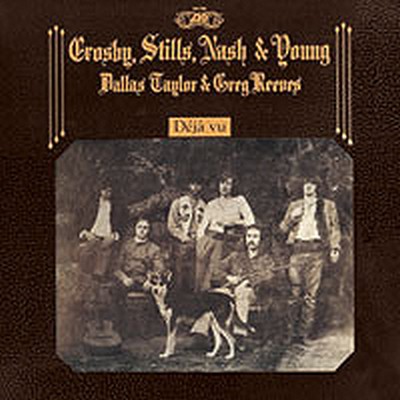
Before 2016 We Were Completely Wrong About Deja Vu

More Crosby / More Stills / More Nash / More Young

There are two areas in which we would like to amend some of the previous comments we’ve made about Deja Vu.

The first has to do with early pressings. Many years ago we wrote the following:

As we noted in previous commentary, the originals are uniformly awful. 

Although that’s mostly still true — Deja Vu is a very difficult album to find with good sound no matter what stampers you have. However, we now know that there are very good sounding copies — Shootout Winning copies in fact — with early stampers.

Deja Vu is in fact a title in which one stamper always wins, and that stamper can only be found on the early pressings.

Amazingly enough, there are more than 90 others (as of 2025) that we’ve discovered with one killer set of stampers that beat all comers as well. (There are surely many more hundreds that do, we just haven’t found them all yet. Please be patient; we are working on it.)

That’s area number one. Area number two is part of this old piece of advice:

If you bought the Classic Records pressing and you can’t tell what’s wrong with it, this may not be the right hobby for you. I highly recommend you buy the Joe Gastwirt mastered CD and either play it on your system or take it to a hi-fi store in your area. It’s tonally correct and undistorted. The Classic version is neither. Now when a stupid $15 CD is correct in a way that a $40 LP is not, something is very very wrong.

The part where we said this may not be the right hobby for you if you like Classic’s godawful remastering of Deja Vu is still true, depending on what exactly you’re trying to accomplish in the hobby.

If you’re not too picky about sound quality and just want to play new records, perhaps because old records are hard to find and often noisy, then fine, the Classic should get that job done for you.

We of course want nothing to do with it because we want exceptionally good sounding vinyl, and the Classic is definitely not very good sounding no matter how many nice things audiophile reviewers may have said about it.

No, the problem we see above is that we were recommending the currently available CD.

Yes, it’s mostly tonally correct and not distorted, but it has a bad a case of dead-as-a-doornail sound.

It’s as awful sounding as any remastered CD I have ever heard.

There is no top, there is no space, there is no life, there is no immediacy, there is no Tubey Magic — in short there is almost nothing left of what makes the best copies of Deja Vu so good.

We’ve known this for about five ten years, apologies for not getting around to correcting the record.

(more…)

The Domestic Stampers of 10cc’s Masterpiece Had Us Fooled for Years

Hot Stamper Pressings of the Music of 10cc Available Now

I haven’t run into many audiophiles who own a copy of The Original Soundtrack, or any other 10cc album for that matter.

It’s the rare person who has the the kind of system that can play a recording with such explosive dynamics.

As I have an uncontrollable habit of saying, this is the kind of record that is guaranteed to bring any audiophile stereo to its knees. 

Since that is the case, and audiophiles who build the kind of big systems in heavily-treated custom rooms to meet the challenge such recordings present are thin on the ground — very thin it seems, as I am the only one I have ever known — it stands to reason that practically no audiophiles have ever experienced the size and power of the recording as it was meant to be heard.

I thought I was doing a very good job reproducing the sound of the album, but recent research has proved that, once again, I was mistaken. Previously I had written:

The recording itself is a tour de force, the main reason I’ve been demonstrating my stereo with it for more than thirty years. The extended suite that opens side one, One Night in Paris, has ambience, three-dimensional sound effects, and incredibly dynamic multi-tracked vocals at the climax that will leave you with your jaw on the floor.

All true. But I had been playing both domestic pressings and British pressings over the course of those thirty years, and I don’t remember clearly preferring one to the other.

With our latest shootout the British pulled away from the pack in a big way, with no British pressing being beaten by any domestic competitor.

The domestic pressings ranged from very good — 2+ on both sides — to passable at best — 1+ on both sides.

I honestly used to think they were close, that they would be hard to tell apart. Those days are gone. We are operating at a whole ‘nother level, and I am glad that we are. We want to give out only the most accurate information and sell only the best sounding records.  What I had thought was true ten years ago turns out to have been off the mark.

When reality turns out to be dramatically different from what you thought it was, and you can prove it — you actually have the physical records to back up your newer, more correct understanding — that’s audio progress.

You might try proving yourself wrong more often.

Most audiophiles I have run into like having their biases confirmed, but look where that has gotten some of them — stuck in a rut. Break out of that way of thinking and you may very well find that you have broken through to another level.

Because if you don’t go out of your way to prove yourself wrong, who will?

(more…)

Gorilla – A Soft Rock Favorite from 1975

Hot Stamper Pressings of the Music of James Taylor Available Now

This is soft rock at its best, primarily made up of love songs, and helped immensely by the harmonically-gifted backing vocals of Graham Nash and David Crosby.

Rolling Stone notes that “With Gorilla, Taylor is well on his way to staking out new ground. What he’s hit upon is the unlikely mating of his familiar low-keyed, acoustic guitar-dominated style with L.A. harmony rock and the sweet, sexy school of rhythm and blues.”

If you are not a fan of the mellow James Taylor, this is not the album for you.

I happen to be just such a fan. Taylor’s sixth album contains consistently engaging, well-produced, well-written, memorable, singable (or hummable) songs that hold up to this day.

After enjoying it for more than 45 years I can honestly say now it actually sounds good. The recording finally makes sense, now that I have the stereo that can play it and the cleaning system that could get the record truly clean. And it only took 35 years — nice!

At Better Records that’s what we’re talking about when we talk about progress. Make no mistake, it is very REAL. When we take a recording that, on copy after copy, never sounded much better than passable, and actually get it to sound musical and involving, that’s not an illusion. It’s the result of the countless revolutions in audio that we’ve participated in. Without the hundreds of changes we’ve made to our stereo, room and cleaning systems, old records would just sound like old records.

The average copy is so flat, lifeless and hard sounding that you might just wonder if there isn’t something wrong with your stereo when the needle hits the Gorilla groove. Most copies are awful, and the same goes for the albums that came before it and after it, Walking Man and In the Pocket, respectively.

This record does not sound like just any old record, not the best copies anyway.

(more…)

Neil Young’s Guitar Masterpiece – Danger Bird

Hot Stamper Pressings of the Music of Neil Young Available Now

Listen to the way Danger Bird (the second track on side one of  Zuma opens. Each instrument, one by one, slowly, deliberately, one could almost say haltingly, feeds into the mix, until the churning guitars give way to Neil’s spare vocal — fatalistic, doomed, already resigned to some fate he barely understands. 

Even though the song has just begun, you sense that Neil feels a weight and a darkness bearing down on him, that it’s ongoing, that it’s already started, that somehow you’re coming into it in the middle, well after the weight of it has begun to crush and perhaps even kill him. He knows the story of Danger Bird all too well.

It’s as powerful and intense a piece of music as any I have ever experienced; sublime in its simplicity, transcendental in effect. You feel yourself swept along, an out of body experience that you can’t control. When Neil launches into the first of many guitar solos the sense of journeying or exploring with him the imaginary musical world he is creating is palpable. He doesn’t seem to know where it will lead and neither do you. There is no structure to reassure you, no end in sight, only the succession of notes that play from moment to moment, first tensing, then relaxing; cresting, then falling away.

Music has the power to take you out of the world you know and place you in a world of its own making. How it can do that nobody knows. Whatever Neil tapped into to make that happen on Danger Bird, he succeeded completely.

If you’re in the right frame of mind, in the right environment, with everything working audio-wise, a minute into this song you will no longer be sitting in your comfy audio chair. You won’t know where you are, which is exactly where you should be.

(more…)