Masterpieces of Orchestral Music

Classical and Orchestra Masterpieces

Beethoven / Symphony No. 9 / Ansermet

More of the music of Ludwig van Beethoven (1770-1827)

Decca and London Hot Stamper Pressings Available Now

  • An early London pressing of this definitive performance by Ansermet and the Suisse Romande that was doing just about everything right
  • It’s also fairly quiet at Mint Minus Minus, a grade that even our most well-cared-for vintage classical titles have trouble playing at
  • The sound here is rich, lively and musical yet still clear and spacious (particularly on side two)
  • True, side one earned a minimal Hot Stamper grade of 1.5+, but we still guarantee that it will beat the pants off any Heavy Vinyl reissue, because every one of those that we played was opaque, muddy and thick enough to have us crying “uncle” after five minutes
  • “…the Orchestre de la Suisse Romande play very well, facing every challenge with musical integrity that reveals to the listener that emotional engagement with the score is far more meaningful than virtuosity for its own sake.”
  • There are about 150 orchestral recordings we think offer the best performances with the highest quality sound. This record is certainly deserving of a place on that list.
  • More entries in our core collection of well recorded classical albums.

(more…)

Rodrigo / Concierto Andaluz & Concierto de Aranjuez

More TAS Super Disc Recordings

  • An original Mercury pressing of this wonderful TAS-approved recording (the first to hit the site in years) with incredible Nearly Triple Plus (A++ to A+++) grades from top to bottom – just shy of our Shootout Winner
  • Our last shootout was in 2010 — we really dropped the ball on this one!
  • This is a TAS list title that deserves its place on a list of Super Discs, as long as you are talking about one that sounds the way this one does
  • The vinyl was a problem with many of our better copies — those of you who are fans of later Mercs, perhaps the Starker titles, just to take one example, know what I am talking about with the less-than-audiophile-quality surfaces so common to these pressings
  • These sides are exceptionally transparent and full of energy, with the lush strings of the guitars more textured and real than on practically all other copies we played
  • The orchestra sounds rich and sweet, yet the guitars are clear, present and appropriately placed relative to the surrounding ensemble

These Nearly White Hot Stamper pressings have top-quality sound that’s often surprisingly close to our White Hots, but they sell at substantial discounts to our Shootout Winners, making them a relative bargain in the world of Hot Stampers (“relative” meaning relative considering the prices we charge). We feel you get what you pay for here at Better Records, and if ever you don’t agree, please feel free to return the record for a full refund, no questions asked.


This is a wonderful record and fully deserving of its place on Harry’s TAS list. The performance here by the first family of guitar is legendary. More importantly, the music is delightful and belongs in any serious classical collection. (Others that belong that category can be found here.)

(more…)

Beethoven / Symphony No. 6 (Pastoral) – Ansermet

More of the music of Ludwig van Beethoven (1770-1827)

More Classical Recordings

  • A vintage London pressing of Beethoven’s Sixth with superb grades from top to bottom
  • These sides are doing practically everything right – they’re rich, clear, undistorted, open, spacious, and have depth and transparency to rival the best recordings you may have heard
  • The texture on the strings is captured perfectly – this is an area in which modern pressings fail almost completely
  • Recorded in Geneva’s exquisite Victoria Hall in 1959, this is a top performance from Ansermet and the Suisse Romande, the best we know of
  • There are about 150 orchestral recordings we think offer the best performances with the highest quality sound. This record is certainly deserving of a place on that list.
  • If you love the symphonic music of Beethoven — and what audiophile doesn’t? — this London from 1959 is surely a Must Own as well as our pick for the best recording of any of the nine Beethoven symphonies

In our opinion, this is the best sounding Beethoven 6th Symphony ever recorded. It is the most beautiful of them all, and has long been my personal favorite of the nine Beethoven composed.

Ansermet’s performance is clearly definitive to my ear as well. The gorgeous hall the Suisse Romande recorded in was possibly the best recording venue of its day, possibly of all time; more amazing sounding recordings were made there than any other hall we know of. There is a richness to the sound that exceeds all others, yet clarity and transparency are not sacrificed in the least. It’s as wide, deep and three-dimensional as any, which is of course all to the good, but what makes the sound of these recordings so special is the weight and power of the brass and the timbral accuracy of the instruments in every section.
Everything sounds so right on this record, so much like live music, there is practically nothing to say about the sound other than You Are There.

This is the kind of record that will make you want to take all your heavy vinyl classical pressings and put them in storage. None of them, I repeat none of them, will ever begin to sound the way this record sounds. Quality record production is a lost art, and it’s been lost for a very long time.

The texture on the strings is captured perfectly; this is, by the way, an area in which modern pressings fail almost completely. We have discussed this subject extensively on the site. The “rosin on the horsehair” is a sound that is apparently impossible to encode on modern vinyl.

(more…)

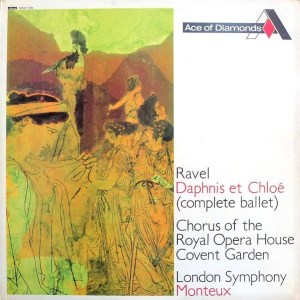
Ravel / Daphnis et Chloé / Monteux

More of the Music of Maurice Ravel

  • Boasting excellent Double Plus (A++) grades or close to them throughout, this vintage Decca Ace of Diamonds pressing was giving us the sound we were looking for on Ravel’s complete Masterpiece
  • The sound is big and rich, lively and open, with tons of depth and huge climaxes that hold together (particularly on side one)
  • The voices in the chorus are clear, natural, separate and full-bodied — this is the hallmark of a vintage Golden Age recording: naturalness
  • We know of no other recording of the work that does as good a job of capturing such a large orchestra and chorus
  • Of course, Monteux is a master of the French idiom – his performance of the complete ballet is definitive in our opinion
  • Even though properly-cleaned, properly-pressed, properly-mastered original Decca pressings are the ones that win our shootouts, we guarantee this 60s reissue will easily beat any copy of the album you can find, at any price
  • There are about 150 orchestral recordings we have found to offer the best performances with the highest quality sound. As card-carrying audiophiles, we naturally insist on both. This record is certainly deserving of a place on that list.

Both sides here are BIG, with the space and depth of the wonderful Kingsway Hall that the LSO perform in. John Culshaw produced the album, which surely accounts for the huge size and space, not to mention quality, of the recording. The sound is dynamic and tonally correct throughout.

(more…)

Mozart / Eine Kleine Nachtmusik / Munchinger

More of the music of Wolfgang Amadeus Mozart (1756-1791)

Hot Stamper Classical and Orchestral Imports on Decca & London

  • Stunning sound throughout this vintage London pressing, with both sides earning Nearly Triple Plus (A++ to A+++) grades – just shy of our Shootout Winner
  • This copy has the clarity, space and transparency that recreates the live event and really lets you hear into the music
  • Karl Munchinger is of course an expert on Mozart and here he does not disappoint – it’s a top performance with sound to match
  • You will have a very hard time finding a better Eine Kleine Nachtmusik on record, sonically or musically
  • Need we even bother saying it’s guaranteed to beat the pants off of the Speakers Corner pressing of the Decca of the same performance from 1994? No? Okay, we won’t
  • If you’re a Mozart fan — and what audiophile wouldn’t be? — this London from 1961 is surely a Must Own

What to Listen For

On most copies the strings are slightly drier and more steely than one would want, occasionally turning strident in the louder passages. As always, proper VTA adjustment — by ear — is critical to getting the strings to sound their best.

An extended top end helps the harmonics of the stringed instruments immensely.

The more resolving copies will show you more of the hall which adds to the sense that you are listening to live music, not a record.

Is It Live?

(more…)

Liszt / Smetana / Mussorgsky – Les Préludes / The Moldau / Night On Bald Mountain / Dorati

More of the music of Franz Liszt (1811-1886)

More Recordings on Mercury

  • Boasting superb Double Plus (A++) sound throughout, this original copy will show you just how good the Mercury engineers were back in those days
  • Dorati breathes life into these concert hall favorites as only he can, and the Mercury engineers (Fine and Eberenz) capture the excitement on tape as only they can
  • We have a preference for Dorati’s recordings with the London Symphony Orchestra, and a record like this will show you exactly why we do
  • The exciting sound of Mercury lives on through the vintage disc they made all those years ago – you can forget the idea that anybody will come along and produce sound of this quality
  • If you’re a fan of orchestral showpieces such as these, this LP from 1960 belongs in your collection

(more…)

Paganini – Violin Concertos Nos. 1 & 2 / Menuhin

The Music of Paganini Available Now

Album Reviews of the Music of Paganini

  • Two of the truly great virtuoso/romantic violin concertos in seriously good Double Plus (A++) sound can be found on this vintage EMI pressing
  • It’s simply bigger, more transparent, less distorted, more three-dimensional and more real than much of what we played
  • The best balance of orchestra and soloist we know of for both works, with sound to rival the greatest violin concerto recordings we’ve played

Another remarkable demo disc from the Golden Age of Vacuum Tube Recording Technology, in this case 1961, with the added benefit of mastering using the more modern cutting equipment of the ’70s. (We are of course here referring to the good modern mastering of 40 years ago, not the bad modern mastering of today.)

This combination of old and new works wonders on this title as you will surely hear for yourself on this wonderful copy.

The sound of the best copies is transparent, undistorted, three-dimensional and REAL, without any sacrifice in solidity, richness or Tubey Magic. The illusion of disappearing speakers is one of the more attractive aspects of the sound here, pulling the listener into the space of the concert hall in an especially engrossing way. (more…)

Respighi / Pines of Rome – Our Favorite for Performance and Sound

More Music Conducted by Fritz Reiner

  • This Shaded Dog pressing of Reiners’s excellent 1960 recording had the glorious Living Stereo sound we were looking for
  • It’s also fairly quiet at Mint Minus Minus, a grade that even our most well-cared-for vintage classical titles have trouble playing at
  • There were only three performances with audiophile quality sound in our shootout, and the Shaded Dog pressings not only had the best performances, but the sound that the team of Mohr/Layton managed to achieve was second to none
  • In other words, Harry was right to put this on his TAS Super Disc list – it really is a super disc
  • If you know anything about these works, you know that have tons of top and bottom end, and it is the rare pressing that can capture both
  • The texture and harmonic overtones of the Living Stereo strings are near perfection – as we listened we became completely immersed in the music on the record, transfixed by the remarkable virtuosity Reiner and the CSO brought to these difficult and demanding works so many years ago
  • There are roughly 150 orchestral recordings that we think offer the discriminating audiophile the best combination of superior performances with top quality soundThis record has moer than earned a place on that list.

This shootout has been at least five years in the making, and the case could be made that something like fifteen is closer to the truth. Around 2016 we surveyed the recordings of the work we had on hand — close to a dozen different performances, I think — and found them all wanting, save three: this one (which is still on the TAS list), a Reader’s Digest pressing with Kempe (our second favorite), and a London with Kertesz.

If a particular performance had any distortion or limitation problems in the higher frequencies, it was quickly rejected out of hand. Same with low end whomp and weight. On these works both are crucial.

No other pieces of music of which we are aware have so much going on up high and down low. This narrowed the field of potential Hot Stampers considerably. Great performances by top conductors could not get over these hurdles — high and low — time and time again.

For these reasons, it took us years to find the right recordings. We knew the Reiner would be hard to beat, but we kept trying record after record hoping that we could find one to wrest the crown away from what is widely considered the greatest recording of the works ever made.

We never did find something better. Our best Shaded Dog ended up winning the shootout. The best RCA pressings were doing everything right. There was plenty of top end, with virtually no harmonic distortion, and when I say plenty, I mean the right amount. Not many engineers managed to get all the highs correctly onto the tape, but Lewis Layton nailed it — in 1960!

So many recordings had screechy strings and horns. When the music would get loud — and both the Pines and the Fountains get very loud indeed, assuming the recording will let it — the sound would become unbearably harsh and unpleasant. This is the opposite of what should happen, and it was obvious that those recordings would not make it past the first round.

All three of the finalists could claim enthusiastic performances with powerful energy and top quality orchestral playing. Still, with the best copies going head to head with each other, Reiner had more of all the qualities we were looking for.

How did the famous 1S/1S pressing fare? No idea. I haven’t seen one in twenty years. It may be better than the White Hot copy we are offering here. I certainly would not make the mistake of saying what it sounds like without having played it. If someone has one and wants to send it to me to audition, I would love to give it a spin.

Some recordings we played lacked transparency, as well as the relaxed sense of involvement that eases one’s ability to be tricked into thinking “you (really) are there.”

The famous 1977 Maazel recording for Decca, which was on the TAS List for a long time, suffered from a bad case of multi-miking and the transparency issue mentioned above. What do you expect from 1977?

This is, of course, the knock on the Modern Heavy Vinyl Pressing — where is the transparency? The space? The three-dimensional depth? If your stereo can reproduce these qualities — a big if, since even as recently as twenty years ago mine could not — you should have given up on these opaque and airless frauds years ago.

(more…)

Ravel / Dukas et al. – Works by Ravel, Honegger and Dukas / Ansermet

More Classical and Orchestral Recordings

  • An incredible London pressingof this superb release with Nearly Triple Plus (A++ to A+++) grades on both sides – just shy of our Shootout Winner
  • It’s also fairly quiet at Mint Minus Minus, a grade that even our most well-cared-for vintage classical titles have trouble playing at
  • This spectacular Demo Disc recording is big, clear, rich, dynamic, transparent and energetic – here you will find some of the best orchestral Hot Stamper sound we offer
  • The sound of the orchestra is dramatically richer and sweeter than you will hear on practically all other pressings – what else would you expect from Decca’s engineers and the Suisse Romande?
  • 1963 was a great year for classical recordings – other Must Own Orchestral releases can be found here.

The sound is clear, with wonderful depth to the stage. As a rule, the classic ’50s and ’60s recordings of Ansermet and the Suisse Romande in Victoria Hall are as big and rich as any you may have ever heard. These recordings may just be the ideal blend of clarity and richness, with depth and spaciousness that will put to shame 98% of the classical recordings ever made.

Side One

Bolero (Ravel)

Tubey and clear, with both the snare and the flute coming from so far back in the hall. OUTSTANDING energy and dynamic power.

Turn it up and it really comes to life like LIVE MUSIC. It’s big, wide and believable. We loved it.

Side Two

The Sorcerer’s Apprentice (Dukas)

ZERO compression. ZERO distortion when loud. Which means it has ZERO compressor distortion, something not five out of a hundred Golden Age recordings can claim. Nice extended top too.

There is depth and richness to beat the band, as well as clarity and tonal correctness that let you forget the recording and just enjoy the music. This piece is not quite as transparent as the Ravel, but still has earned every one of its Three Pluses.

The timbre of the brass is right on the money. As we have noted before, the brass of the Suisse Romande is some of the best to have ever been committed to analog tape.

Again, this side had OUTSTANDING energy and dynamic power the likes of which we think you may never have heard.

La Valse (Ravel)

Again, with that wondrously huge hall adding a sense of space that will allow your speakers to disappear. The performers are not too close, which is very much in keeping with live music.

In his tribute to Ravel after the composer’s death in 1937, Paul Landormy described the work as follows:

“….the most unexpected of the compositions of Ravel, revealing to us heretofore unexpected depths of Romanticism, power, vigor, and rapture in this musician whose expression is usually limited to the manifestations of an essentially classical genius.”

(more…)

Tchaikovsky / The Nutcracker Ballet in Two Acts (Complete) / Ansermet

More of the music of Peter Ilyich Tchaikovsky (1840-1893)

More Orchestral Music Conducted by Ernest Ansermet

  • Tchaikovsky’s complete classical masterpiece returns to the site for the first time in nearly two-years with INSANELY GOOD Shootout Winning Triple Plus (A+++) sound on all FOUR sides of these original London pressings
  • It’s also fairly quiet at Mint Minus Minus, a grade that even our most well-cared-for vintage classical titles have trouble playing at
  • If you have never experienced a vintage top quality pressing of a Wilkinson-engineered Decca Tree recording from Victoria Hall, this is your chance to hear sound that puts practically anything else to shame
  • A record like this lets you get lost in the world of its music, and what could be more important in a recording than that?
  • This is our favorite performance of The Nutcracker, perhaps the most famous ballet ever written, and one that belongs in every right-thinking audiophile’s collection
  • Enchanting music and sound combine on this copy to make one seriously good Demo Disc, if what you are trying to demonstrate is how relaxed and involved vintage analog can make you feel
  • If you’re a fan of brilliant orchestral showpieces, this London Box Set from 1959 belongs in your collection.

There is certainly no shortage of Audio Spectaculars available on the site. A record such as this, so rich, natural and effortless, has distinctly different qualities that we feel are every bit as vital to the critical audiophile’s enjoyment of Tchaikovsky’s music.

Ansermet breathes life into this ballet as only he can and the Decca engineering team led by Kenneth Wilkinson do him proud. (more…)