More TAS Super Disc Recordings

- An original Mercury pressing of this wonderful TAS-approved recording (the first to hit the site in years) with incredible Nearly Triple Plus (A++ to A+++) grades from top to bottom – just shy of our Shootout Winner
- Our last shootout was in 2010 — we really dropped the ball on this one!
- This is a TAS list title that deserves its place on a list of Super Discs, as long as you are talking about one that sounds the way this one does
- The vinyl was a problem with many of our better copies — those of you who are fans of later Mercs, perhaps the Starker titles, just to take one example, know what I am talking about with the less-than-audiophile-quality surfaces so common to these pressings
- These sides are exceptionally transparent and full of energy, with the lush strings of the guitars more textured and real than on practically all other copies we played
- The orchestra sounds rich and sweet, yet the guitars are clear, present and appropriately placed relative to the surrounding ensemble
These Nearly White Hot Stamper pressings have top-quality sound that’s often surprisingly close to our White Hots, but they sell at substantial discounts to our Shootout Winners, making them a relative bargain in the world of Hot Stampers (“relative” meaning relative considering the prices we charge). We feel you get what you pay for here at Better Records, and if ever you don’t agree, please feel free to return the record for a full refund, no questions asked.
This is a wonderful record and fully deserving of its place on Harry’s TAS list. The performance here by the first family of guitar is legendary. More importantly, the music is delightful and belongs in any serious classical collection. (Others that belong that category can be found here.)
This vintage Mercury pressing has the kind of Tubey Magical Midrange that modern records can barely BEGIN to reproduce. Folks, that sound is gone and it sure isn’t showing signs of coming back. If you love hearing INTO a recording, actually being able to “see” the performers, and feeling as if you are sitting in the studio with the band, this is the record for you. It’s what vintage all analog recordings are known for — this sound.
If you exclusively play modern repressings of vintage recordings, I can say without fear of contradiction that you have never heard this kind of sound on vinyl. Old records have it — not often, and certainly not always — but maybe one out of a hundred new records do, and those are some pretty long odds.
What the Best Sides of Concierto Andaluz & Concierto de Aranjuez Have to Offer Is Not Hard to Hear
- The biggest, most immediate staging in the largest acoustic space
- The most Tubey Magic, without which you have almost nothing. CDs give you clean and clear. Only the best vintage vinyl pressings offer the kind of Tubey Magic that was on the tapes in 1968
- Tight, note-like, rich, full-bodied bass, with the correct amount of weight down low
- Natural tonality in the midrange — with all the instruments having the correct timbre
- Transparency and resolution, critical to hearing into the three-dimensional studio space
No doubt there’s more but we hope that should do for now. Playing the record is the only way to hear all of the qualities we discuss above, and playing the best pressings against a pile of other copies under rigorously controlled conditions is the only way to find a pressing that sounds as good as this one does.
Copies with rich lower mids and nice extension up top did the best in our shootout, assuming they weren’t veiled or smeary of course. So many things can go wrong on a record! We know, we’ve heard them all.
Top end extension is critical to the sound of the best copies. Lots of old records (and new ones) have no real top end; consequently, the studio or stage will be missing much of its natural air and space, and instruments will lack their full complement of harmonic information.
Tube smear is common to most vintage pressings. The copies that tend to do the best in a shootout will have the least (or none), yet are full-bodied, tubey and rich.
What We’re Listening For On Concierto Andaluz & Concierto de Aranjuez
- Energy for starters. What could be more important than the life of the music?
- The Big Sound comes next — wall to wall, lots of depth, huge space, three-dimensionality, all that sort of thing.
- Then transient information — fast, clear, sharp attacks, not the smear and thickness so common to these LPs.
- Next: transparency — the quality that allows you to hear deep into the soundfield, showing you the space and air around all the instruments.
- Extend the top and bottom and voila, you have The Real Thing — an honest to goodness Hot Stamper.
Side One
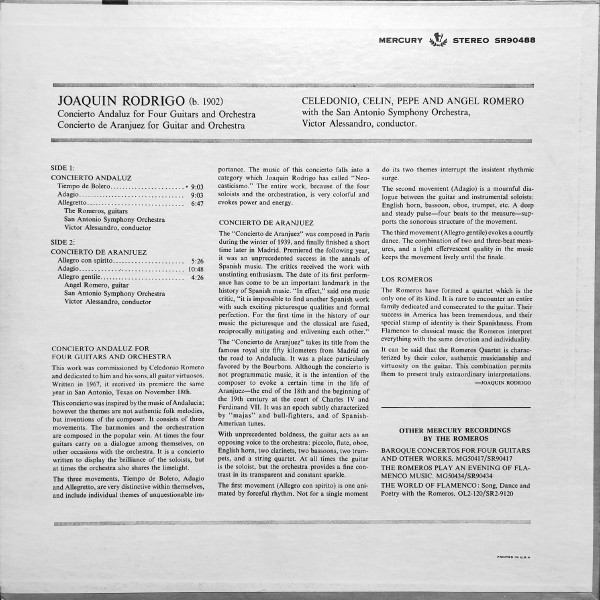
Concierto Andaluz
Side Two
Concierto de Aranjuez
Concierto de Aranjuez
The Concierto de Aranjuez is a concerto for classical guitar by the Spanish composer Joaquín Rodrigo. Written in 1939, it is by far Rodrigo’s best-known work, and its success established his reputation as one of the most significant Spanish composers of the 20th century.
The Concierto de Aranjuez was inspired by the gardens at the Royal Palace of Aranjuez, the spring resort palace and gardens built by Philip II in the last half of the 16th century and rebuilt in the middle of the 18th century by Ferdinand VI. The work attempts to transport the listener to another place and time through the evocation of the sounds of nature.
According to the composer, the first movement is “animated by a rhythmic spirit and vigour without either of the two themes… interrupting its relentless pace”; the second movement “represents a dialogue between classical guitar and solo instruments (cor anglais, bassoon, oboe, horn etc.)”; and the last movement “recalls a courtly dance in which the combination of double and triple time maintains a taut tempo right to the closing bar.” He described the concerto itself as capturing “the fragrance of magnolias, the singing of birds, and the gushing of fountains” in the gardens of Aranjuez.
Rodrigo and his wife Victoria stayed silent for many years about the inspiration for the second movement, and thus the popular belief grew that it was inspired by the bombing of Guernica in 1937. In her autobiography, Victoria eventually declared that it was both an evocation of the happy days of their honeymoon and a response to Rodrigo’s devastation at the miscarriage of their first pregnancy. It was composed in 1939 in Paris.
Rodrigo, nearly blind since age three, was a pianist. He did not play the guitar, yet he still managed to capture and project the role of the guitar in Spanish music.
The concerto is in three movements, Allegro con spirito, Adagio and Allegro gentile. The first and last movements are in D major, while the famous middle movement is in B minor. Along with the solo guitar, it is scored for an orchestra consisting of two flutes (one doubling on piccolo), two oboes (one doubling on cor anglais), two clarinets in B♭, two bassoons, two horns in F, two trumpets in C, and strings.
The first movement’s 40-measure introduction begins with the solo guitar strumming a three-measure theme in 6/8. The theme is made of tonic, supertonic, and dominant chords and features a flamenco-like hemiola rhythm. As it repeats several times, the tonic chord’s uppermost note gets higher, starting with the third, then using the fifth, the tonic, and the fifth again.
The second movement in B minor, the best-known of the three, is marked by its slow pace and quiet melody, introduced by the cor anglais, with a soft accompaniment by the guitar and strings. A feeling of quiet regret permeates the piece. Ornamentation is added gradually to the melody in the beginning. An off-tonic trill in the guitar creates the first seeds of tension in the piece; they grow and take hold, but relax back to the melody periodically. Eventually, a climactic build-up starts. This breaks back into the main melody, molto appassionato, voiced by the strings with accompaniment from the woodwinds. The piece finally resolves to a calm arpeggio from the guitar, though it is the strings in the background rather than the guitar’s final note that resolve the piece.
The third movement is in mixed metre, alternating between 2/4 and 3/4. At the beginning of the movement, four-measure phrases containing 9 beats in total are formed from one 3/4 measure followed by three 2/4 measures. As the movement progresses, the metre becomes more irregular. It begins with the guitar starting the theme in the “wrong” key of B major, but the orchestra restates it in the home key of D major.
-Wikipedia